MRL 3D Simulation Team Description
Mahmood Rahmani, S.Vahid Hosseini, Siavash Aslani, S.Mohammad H.S. Javadi, S.Mohammad S.Kazemzadeh, Nima Shafiee, Saeed Chitgar
Mechatronics Research Laboratory, Qazvin Islamic Azad University
Abstract This paper introduces our first effort of developing a new team for RoboCup Simulation 3D Competition. The major goal in this project is to accomplish control architecture for intelligent, reactive agents. The architecture is reusable because of its minimum dependency on low level structure. We have made the agent's low-level skills from scratch. To provide coordination, we have used concept of strategic positioning of players. Our previous experiences in 2D soccer domain facilitated the development of 3D version of agents.
Introduction
MRL 3D team is strongly based on MRL 2D simulation team. High-level structure has imported to 3D environment with several changes. New high-level structure has minimum dependency to low-level skills, world-model, and execution system. Low-level skills have been completely rewritten. The current status of our team is relatively good at the moment. Team selects defensive or offensive formation depending on ball position and ball owner. It also uses a basic mechanism for passing ball to teammate.
The reminder of this paper is organized as follows. Section 2 briefly describes our agent skills. Section 3 illustrates the Control Architecture. Section 4 is the conclusion and future work.
Basic Skills
MRL 3D soccer agents have basic skills such as on-ball (intercept, stop, pass, shoot) and off-ball (positioning, get-open, mark opponent) actions. Both perception and prediction processes provide required information for skill execution. Perception contains calculating agent's current position in the field, and then estimating other objects positions. Determining the fastest teammate/opponent to ball, or calculating ball intercept point is the result of prediction process.
To provide coordination, we have used concept of strategic positioning of players. Our former experiences in 2D soccer domain facilitated the development of 3D version of agents.
The Control Architecture
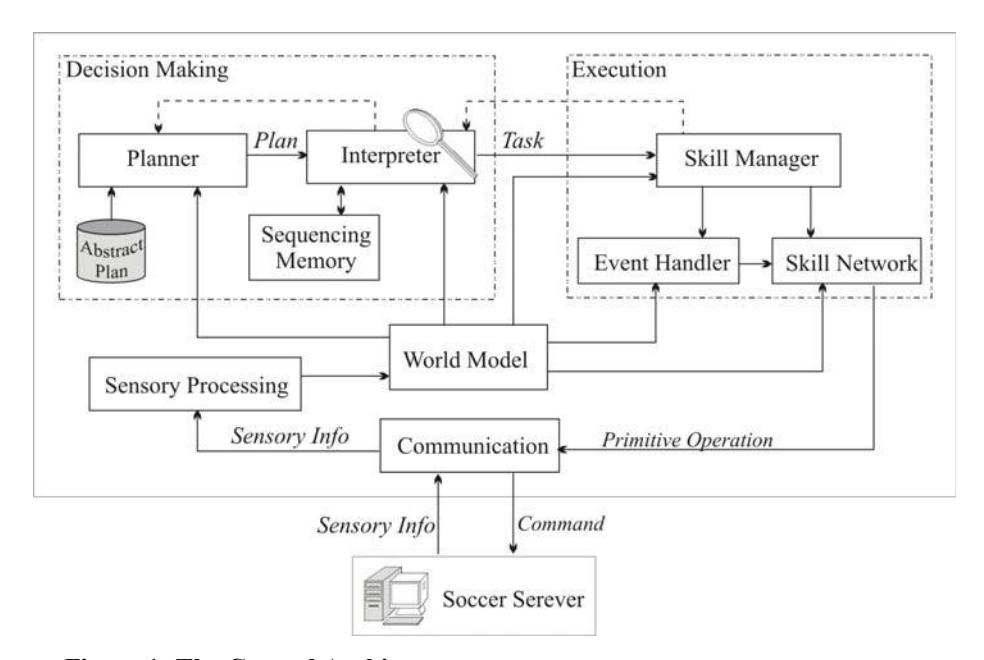
The architecture has three tier, Planning, Sequencing, and Execution [1, 2]. Decision making takes place during two upper tiers. Planner uses a repository of abstract plans to generate a new plan according to current state, strategy of team, and success or failure of former plans. A plan contains a few parallel individual tasks and also equivalent roles. Interpreter decomposes the new plan and finds the best role dynamically for the agent in this plan, and then starts the task. Each task is composition of agent's skills. Interpreter asks Skill Manager to execute skills. Skill Manager runs skills and feedback the status of skill execution to Interpreter. According to the feedback Interpreter decides to continue the current task or ask for a new plan from Planner.
Occasionally, it is needed to react very fast and no need to think about the action, e.g. when agent has ball and can easily score, definite action would be "shout on opponent's goal". Event Handler component handles these situations. On the other hand tasks might have conditions exactly same as events. To avoid collision between Event Handler and task execution an extra feature considered in action selection mechanism. The feature is capability of making events disable/enable. Consequently if a task needs to handle a situation itself, it should disable relevant events. Event Handler ignores disabled events.
Sensory Processing unit is responsible for processing the information received from the server. The outcome of the data processing would be stored into the World Model.
Conclusion and future work
The first results achieved by MRL 3D team are very hopeful. We believe that the architecture provides several benefits. It allows one to add functionality incrementally to the robot. We have also presented the architecture to MRL Middle-Size soccer team, and it is applied successfully. Having this framework we have begun to investigate of other AI disciplines.
Debugging a distributed and real-time system like 3D soccer agents is very difficult. To simplify debugging process we intend to develop a visualization tool that has facilities to play standard and specific log-files [3].
Acknowledgements
This work is completely supported by Mechatronics Research Lab., Qazvin Azad University. Project: "Scalable, Portable and Distributed Control Architecture".
References
- Mahmood Rahmani, Bahman Radjabalipour, and Eslam Nazemi: 3T Architecture for the SBCe Simulator Team: A. Birk, S. Coradeschi, S. Tadokoro (Eds.): RoboCup 2001: Robot Soccer World Cup V, Springer, 2002.
- Peter Bonnaso, David Korten Kamp, David P.Miller and Marc Slack, Experiences with an Architecture for Intelligent, Reactive Agents. Intelligent Agents II, Springer: 187-202, 1995.
- David Kortenkamp, Designing visualization tools for a distributed control architecture. Intelligent Agents II, Springer: 187-202, 1995.