Nexus 2005 - 3D Team Description
Vahid Salmani, Farid Seifi, Hossein Moienzadeh, Amin Milani Fard, Mahmoud Naghibzadeh
Software Simulation and Modeling Lab., Computer Dept., Ferdowsi University of Mashhad, Iran
Abstract This paper intends to give an overview of our Soccer Simulation Team work done on 3D version. The main development we made was using a two-phase selection mechanism to determine the best action among all possible ones carried out by the ball controller agent for a given situation. Our aim is to construct stable and flexible agent architecture for our further development and research.
1 AGENT SKILLS
As the primitive commands are rather difficult for the decision-making component to use directly, we develop some high level skills which are easy and convenient to use. These skills include "dash to some position", "kick the ball to some position with a specified 3D velocity", "shoot the goal to a specified point", "dribble to some target position with a specified velocity" and so forth. And the decision-making component should decide to take some action to gain the highest profit according to the world model.
The Skills are an abstraction to low level server commands and should provide the decision layer with high-level commands, like 'go to a certain position' or 'kick the ball with a certain speed'. The intercept skill (either of the ball or a position) will be implemented in a kind of greedy fashion, i.e. drive in the direction of the target and slow down soon enough.
2 EVALUATION
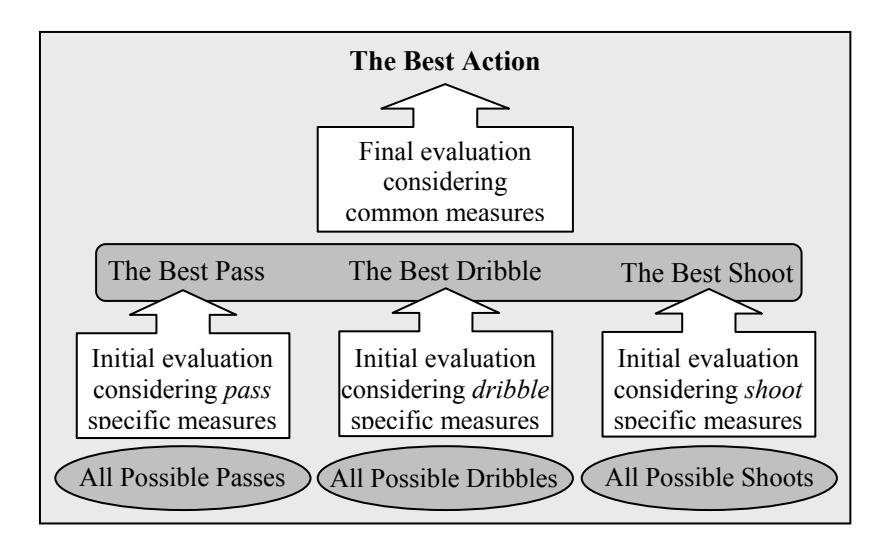
To determine the best action among all possible ones carried out by the ball controller agent for a given situation, we first recognize the best of each action, i.e., the best shoot, the best dribble, and the best pass, independently. It is clear that, when the best possible shoot is sought the parameters that affect the shooting action are considered, only. For dribble and pass actions the same kind of process is followed. In the next phase, we select the best of bests, i.e., the system chooses the best action among three best actions shoot, dribble, and pass. In this phase, common measures are used in order to evaluate the actions. Fig. 1 shows the two-step evaluation method in which in the first phase it finds the best possible shoot, pass and dribble using specific measures. In the second phase, it selects the actual action to take, using common measures. To determine the priority in the second step, the calculated priorities in the first step is not considered.
3 TEAM STRATEGY
We use very simple team strategy, that is when the agent is the fastest player to get the football, and then it tries to intercept the ball; when the agent is not the fastest, it drives to its strategic position; when the agent can kick the ball, it kicks the ball directly to the opponent's goal, passes the ball to one of its teammates or performs a long dribble.
4 FUTURE WORKS
Our future work would mainly based on developing a fuzzy decision making system which tells an agent what to do. Considering the noise and uncertainties in the agent actions, fuzzy decision making seemes suitable to be used in the soccer simulation environment. This approach is much less time consuming and very simple to follow, in contrast with the other analytical implementations with complex conditions in the codes.
As the number of input variables may increase, filling in all the possible rules is a time consuming task. Therefore rules that only include a few of the input variables and cover greater subspaces in the control space are used. As the second reason to use fuzzy systems, they are not sensitive to the completeness of the rule base as long as the boundary rules are preserved in the fuzzy associative memory. Having completed the bank of fuzzy if-then rules, center of maximum defuzzification method would be used which is continuous and computationally efficient.
References
- RoboCup Soccer Server 3D Maintenance Group (2003). The RoboCup 3D Soccer Simulator. Available at http://sserver.sourceforge.net/
- V. Salmani, M. Naghibzadeh, F. Seifi, A. Taherinia, A two-phase mechanism for agent's action selection in soccer simulation, International Conference on Artificial Intelligence and Data Mining, ALDM – (2005, February 25-27), Istanbul Turkey