Team Description of OPU hana 3D
Tomoharu Nakashima, Masahiro Takatani, Naoki Namikawa, Satoshi Yokoyama, Masayo Udo, Hisao Ishibuchi
Department of Industrial Engineering, Osaka Prefecture University Gakuen-cho 1-1, Sakai, Osaka, 599-8531
http://rc-oz.sourceforge.jp/pukiwiki/index?3D%2Fagenttest · http://staff.science.uva.nl/~jellekok/robocup/index_en.html
Abstract The main stream of the RoboCup simulation league has shifted from the 2D competition to the 3D competition. The first 3D competition was held in Lisbon, Portugal in 2004. OPU hana 3D participates in the 3D competition for the first time this year. This paper presents the description of team OPU hana 3D. First, we introduce a base team from which OPU hana 3D is developed. Then, we show the extension to the base team for developing OPU hana 3D. Finally, possible future works are presented.
1 Introduction
The main stream of the RoboCup simulation league has shifted from the 2D competition to the 3D competition. The first 3D competition was held in Lisbon, Portugal in 2004. OPU hana 3D participates in the 3D competition for the first time this year.
This paper presents the description of team OPU hana 3D. First, we introduce a base team from which OPU hana 3D is developed. Then, we show the extension to the base team for developing OPU hana 3D. Finally, possible future works are presented.
2 Tsubamegaeshi
Tsubamegaeshi, which is a Japanese word for a swordmans' technique, is used as a base team of OPU hana 3D. The source codes of Tsubamegaishi are available from the web page http://rc-oz.sourceforge.jp/pukiwiki/index?3D%2Fagenttest (Japanese language only). Tsubamegaeshi participated in the competition in Lisbon, Portugal in 2004. It was ranked in the 11th place in the competition.
Tsubamegaeshi is developed from 'agenttest' which is a sample agent in the 3D soccer server software. Since the behavior of the sample agent is just to follow the ball and kick it towards the opponent's goal, the team strategy is what is called kiddy soccer. That is, all players gather around the ball and no cooperation among teammate is possible. The behavior of players are implemented with the developer's know-how for 2D soccer teams.
3 OPU hana 3D
We modified Tsubamegaeshi to develop OPU hana 3D. The following are key modification points:
- Precise calculation of the coodinates of objects,
- Introduction of home positions,
- Introduction of action rules.
3.1 Precise Calculation of Coodinates
High ability to precisely calculate the cooodinates of objects is important part in the development of mobile agents. We improved the accuracy of the location of objects in the soccer field by revising the calculation part of coodinates in the source codes.
3.2 Home position
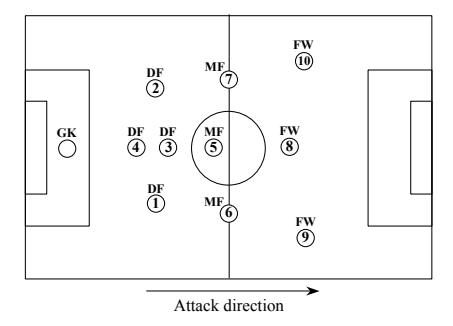
We are planning to introcude home positions for all players so that all players do not gather around a ball. In Fig. 1, we show a sample home positions for players. The introduction of home position allows us to establish a formation system. For example, the home positions in Fig. 1 correspond to a 4-3-3 formation system where four players are defenders, three mid-fielders, and three forwards.
3.3 Action rules
The behavior of players are determined by action rules. We use if-then rules of the following type as the action rules:
$R_j$ : If Agent is in Area $A_j$ and the nearest opponent is $B_j$ then the action is $C_j$ , $j = 1, 2, ..., N$ , (1)
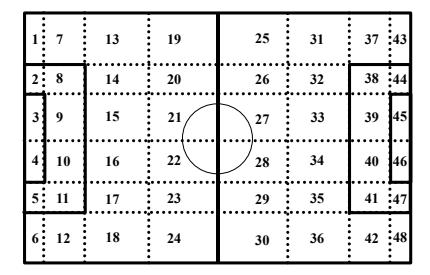
where $R_j$ is the rule index, $A_j$ is the antecedent integer value, $B_j$ is the antecedent linguistic value, $C_j$ is the consequent action, and N is the number of action rules. We divide the soccer field into subfields. We show an example of the field division in Fig. 2. In Fig. 2, the soccer field is divided into 48 subfields. The antecedent integer value $A_j$ will represent one of the 48 subfields. As $B_j$ , we consider the distance between a player and its nearest opponent player. The possible linguistic values for $B_j$ are near and not near. That is, if the nearest opponent player is near to a player, the player has to do a different action than one if the nearest one is not near. The introduction of action rules allows us to use any machine learning techniques to automatically determine optimal action rules.
4 Future works
The possible ways of further extensions to the current version of OPU_hana_3D are:
- Development of low-level skills
- Dribble
- Pass
- Shoot
- On-line learning of those skills
- Development of higher-level behaviors
- Implementation of simple action behavior as UvA Trilearn Base [2]
- Evolutionary computation for determining optimal action rules
- Explicit implementation of team cooperation (either manually or automatically)
Acknowledgement
We would like to thank the development team of Tsubamegaeshi for kindly releasing the source codes.
References
- Takenori Kubo, "Tsubame-Gaeshi 3D Team Descirption," Robocup 2004 Team description paper, CD-ROM (two pages), Lisbon, Portugal, 2004.
- UvA Trilearn, URL at http://staff.science.uva.nl/~jellekok/robocup/index_en.html