Apadana3D 2006 Team Description
Saeed Danesh
Computer Engineering Department, Sheikhbahaee Institute of Higher Education, 81797 Baharestan, Isfahan, Iran
http://www.shbu.ac.ir/apadana3d · http://www.saeeddanesh.netfirms.com/robocup
Abstract This paper aims to describe the Apadana3D team that is based on SPADES (The System for Parallel Agent Discrete Event Simulation ) and the 3D soccer simulation environment ,the 3D Soccer Server.
1 Introduction
Apadana3D's goal is to create simulation agents based on thinking and acting rationally. This project was conceived as an effort to create intelligent players, capable of thinking like real soccer players and behave like a real soccer team. Therefore was quickened by designing a simple binary which had some simple but effective advancement. It has the most simplest but the most useful decision trees. Having the best methods of "Move" ,"Dribble" and "Kick" and "Intercept" ,has made Apadana3D a powerful team.
The final goal of Apadana3D is to test nearly all AI methods implemented on the base codes of the team and issuing the statistical results as a good reference for other researchers.This paper is supposed to be ready for RC2007 symposium.
2 Team Architecture
Apadana3D Soccer Simulation Team is an eleven autonomous software agent team in the purpose of consecutive research on Multi-Agent Systems and Artificial Intelligence. It operates in simulation system called rcssserver3D (3D soccer server) which enables two teams of agents to play a soccer game against each other. The 3D soccer server provides a fully distributed and real-time multiagent environment where all teammates need to cooperate to achieve the common goal of winning the game*.*
The term Artificial Intelligence, refers to the applied AI methods on Apadana3D, including the Intelligent Strategy Chooser that enables the team to change the formation and strategic positions according to the game situation and the rival's formation and strategy. Also the basic actions such as move are implemented via the AI methods so that an agent can learn the way to have an optimized move.
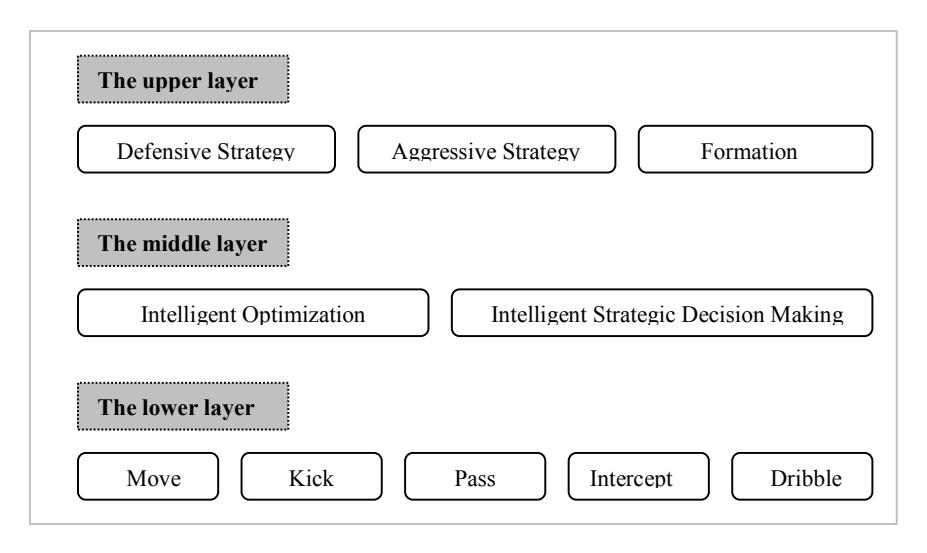
The team uses a layered architecture that makes it work in the best form it can.
- 1 The lower layer gives the agent the primary abilities such as move ,kick ,dribble ,pass ,Intercept in the best form it can .
- 2 The middle layer, lets the agents use their learning capabilities such as optimizing the primary abilities according to the game situation and making strategic decisions intelligently.
- 3 The upper layer is the result of the decisions in lower layers that makes the agent decide on which way to play, for example defensive strategy or aggressive one , which formation and which policy.
3 Team Strategy
Tactics, formations and primary abilities such as Move, Kick and etc are common concepts in soccer and a good RoboCup team must use them in order to be able to play simulated robot oriented soccer.
Apadana3D uses a dynamic intelligent strategic position pattern in response to the game situation. Formations are used for different game situations like defense, attack, transition from defense to attack ,etc, assigning each player a base strategic position and a player type.
4 Dynamic Low-Level Skills
Most of Apadana3D's work is focused on low-level skills and as there is not still a good source code for low-level skills for a 3D simulation team available on the Internet. So we implemented different Low-Level skills and tested them. We also decided to let the agents themselves choose the appropriate Low-Level Skills by learning from the environment to have their primary skills optimized. This is implemented in agents Move and as the results are extraordinarily good, also these efforts will be applied in other primary skills such as Intercept, Kick, Pass and Dribble.
5 SPADES
The simulation server is implemented above a platform called SPADES (System for Parallel Agent Discrete Agent Simulation). SPADES is a middleware system for agent based distributed simulation (Riley 2003) [1]. It aims to provide a generic platform to run in multi-computer systems. It implements the basic structure to allow the interaction between agents and a simulated world in such a way that the users do not have to worry about sockets, addresses, etc. SPADES main features are: notify that returns an empty sensation (time notify) and after receiving it the agent is able to respond with actions.
6 Communication
As the basic simulation engine is based on SPADES, we use the SPADES agent library from P. Riley [4] to handle the communication with the server. The agent waits for a message from the server and updates its world model according to it. Then the player selects an action based on the new information, sends it to the server, and starts waiting for a new message from the simulator. This could be changed to a multi threaded model to decide upon arrival of a new message whether to finish the current decision process or to start a new one based on the new information.
7 World Model
The world model's function is to maintain an approximately precise mirror of the real world and provides the agent with all information he needs to know, e.g. positions or velocities of all objects on the field. It Parses the message received from the server, and updates the world model.
8 Conclusion and Future Work
The Apadana3D soccer simulation team was born to work on artificial intelligence (AI) and implementation of algorithms and AI methods . We want to approach the agents which can think like real soccer players. A lot of efforts have been done to make our team stable.
The final goal of Apadana3D is to test nearly all AI methods implemented in the base codes of the team and issuing the statistical results as a good reference for other researchers . This paper is supposed to be ready for RC2007.
References
- Riley, P.: SPADES System for Parallel Agent Discrete Event Simulation, User's Guide and Reference Manual for Version 0.91
- Koegler, M.: Simulation and Visualization of Agents in 3D Environments.
- S.J.Russel –Peter Norvig , Artificial Intelligence: A Modern Approach (2nd Edition) , Prentice-Hall, 1995
- Riley, P., Riley, G.: SPADES A Distributed Agent Simulation Environment with Software-inthe-Loop Execution. In: Winter Simulation Conference Proceedings (2003) 817–825