Team Description of CZU2006(3D)
Diao Jiandong, Shen Liang, Gao bin
School of Computer Information & Engineering Changzhou Institute of Technology, Changzhou 213002, Jiangsu Province, P.R.China
Abstract This paper describes the main features of the CZU soccer simulation team (3D). CZU2006 is a RoboCup team developed by Changzhou Institute of Technology, who tries to develop some new approach to build the 3D agent. Our aim is to construct stable and flexible agent architecture for our further development and research.
Introduction
In the Robocup Simulation League Soccer Competition, 3D Simulation has a lot of differences from 2D simulation in both the appearance of platform and the substrate. It operates in a physical soccer simulation system called rcssserver3D (3D soccer server) which enables two teams of agents to play a soccer game against each other. The 3D soccer server provides a fully distributed and real-time multi-agent environment where all teammates need to cooperate to achieve the common goal for winning the game.
CZU2006 3D Soccer Simulation Team tries to build a smart 3D simulation team different from last year based on the CZU2005. It provides a clear interface with flexible extending ability for future development. In the next section, we explain the agent architecture of CZU2006. Section 3 presents the communication server. Section 4 presents the CZU2006 agent world model. Section 5 presents the CZU2006 agent skills. Section 6 describes the CZU2006 decision component. Section 7 is the conclusion and future directions.
Agent
The soccer team provides a number of an agent with equal capabilities. The agent of CZU2006 consists of communication component, world model, low level action, high-level action and decision component.
The agent usually has a 360°view. The 3D Server delivers lists of seen objects, where objects are either other robots, the ball, or markers on the field. So the agent can make use of 8 markers on the field (one at each corner point of the field and one at each goal post) to compute the global position for every seen objects.
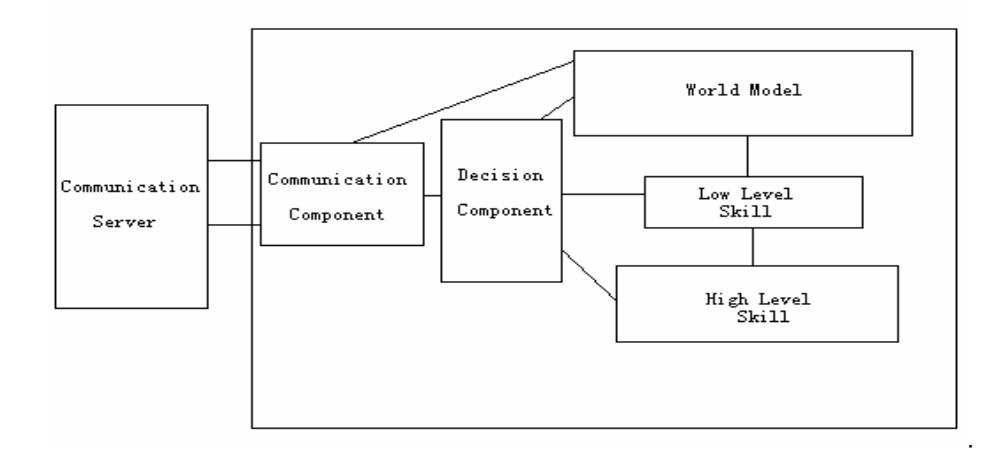
Communication
The communication component receives the vision information from the 3D Server and sends command to the 3D server. Something like: Initialize Agent, Time Notify Message, error message also is processed here.
World Model
The world model component parses the message received from the server, and then updates the whole world model. We add some foundation in world model to make our agents more useful.
There is four parts of the world model: strategy, team, information, formation. The Strategy Model help the decision component for some prediction, information collection. It makes our players think looking like a real human. In some bad conditions, the agents will take an uncommon action. Such as: if there is a teammate who has a good position for intercepting ball, though I am the nearest player from the stop position of ball, let the teammate intercept the ball, and I can defend some specific offensive opponent.
The Team Model describes the main information for both sides. It provides every players position, velocity, acceleration. In addition, our agents can obtain the sequence number of whole team sorted by many situations.
Every football team needs an availability formation. CZU2005 3D team uses the Formation Model to get the tactic position. The Formation Model will change the different formation depending on the Strategy Model and Information Model.
The last part is Info Model,' memorize' the constant for the competition, just like the Field parameter and the score.
Agent Skills
In CZU2006 3D Soccer Simulation Team, every agent uses the actions like a man. It's depending on the primitive commands, but more complex.
If we can take the agent as a real person, and he has many football skills, for example: 'pass', 'intercept', 'shoot'. These skills can achieve the target that he wants, and a high level action will take more than one simulation time, but it can bring more advantage, for example, the forward can send the high level action command 'shoot' which will help the player advance rapid on its way with the ball when he is in the opponent's forbidden area, and he will shoot at the goal promptly once he and ball all are in position suitable for shooting at the goal.
Decision Component
A skillful player is not all, and privatism is disadvantageous to football game. Everyone all should be hard at work towards a common goal. So we have improved the decision-making of CZU2005 3D soccer simulation team. We adopt different tactics for different circumstances, and then the agent will take the suitable action for each condition. This also profits from the strategy model. We divide the football field into some regions, so the agent (player) can make decision promptly based on these regions.
Conclusion
The CZU2006 3D tries to build a team like a real football team. We use a trainer for developing our low level skill and measure the physical laws. It is helpful.
And we also have lots of things to do, make the skills more powerful, optimize the decision component. For future directions, we are interested in developing the new agent in the new 3D simulator in its 0.4 version. We think this will be an exciting platform.
References
[1] Guan Jun, Jiang Hao, Tan Qifeng:Team Description of ZJUBase 2004 (3D) [2] Yao Jinyi, Lao Ni, Yang Fan, Cai Yunpeng, and Sun Zengqi: Technical solutions of TsinghuAeolus for Robotic Soccer. [3] Cheng Jiang: Thesis Submitted to TsinghuAeolus for Bachelor Degree [4] Huo Yinhui, Zhang Lianming: A method of local path programming in mobile robot. [5] Peter Stone: Layered Learning in Multi-Agent Systems. [6] Simon Haykin: Theory of Artificial Neural Network. [7] Haix Zhang Quan Li Changchun Zhu Chunguang Li: A Method of Tackle Model Design Based on BP-ANN [8] RoboCup Server Manual.