Team Description of Kshitij3D
nitish g, karteek bj, ravi s, kamal
Center for Data Engineering International Institute of Information Technology, Hyderabad India
Abstract Kshitij3D continues to participate in the 3D Robocup Soccer with the sole purpose of implementing the latest collaboration and coordination models in the Multi-agent System and improve them if possible in the view of research. This paper we brief our Team Structure, Strategies some Low - level and High level Skills developed (or still in development by us).
1 Introduction
This Team Description paper outlines our current developments of Kshitij3D, a Robocup 3D-Soccer-Simulation League team from International Institute of Information Technology, which participated in the Robocup 2005. This year the improvements in the team, are in line with goal to pursue the reasearch. A prediction component has been added to our system which is integrated with the worldmodel component of our system. This prediction module accurately determines the most probabilistic opponents' next moves from a wide search space. This gives us the upperhand in every time-frame of the simulation.
Another major improvement that significantly changes the team is the improved high level skills such as pass and dribble. The passive agents currently follow SBSP[3].One - to - One opponent marking is used in the defense to decrease the opponents chance to score the goal.
2 Team Structure
The Team mainly consists of 4 major layers :
- Communication Layer
- World Model Layer
- Decision Making Layer
- Action Layer
The Communication Layer, as the name suggests, mainly communicates with the server for passing and recieving messages. The World Model takes the recieved messages from the server and prepares and updates the Model of the world with every action taken. The Decision Making Layer Consists of all High-Level skill such as pass and dribble and all the decision making is done for where to go, when to pass, where to pass, etc.It also contains formation specific information. The Action Layer consists of the Low-level skill such as kick , dash , drive, etc.
Localization Positions of all the objects in the environment are obtained relative to the agent (similar to 2D) Global positioning of the agent is calculated by using the nearest flag relative to the agent in the simulation environment.
3 Team Strategy
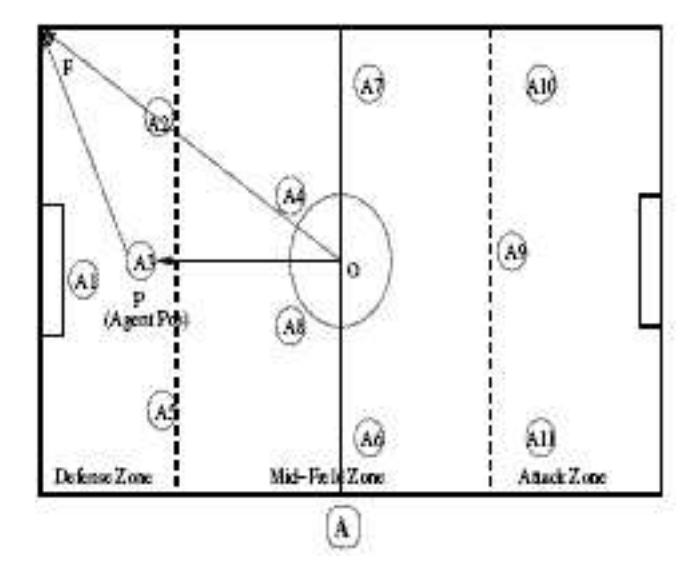
The team uses zonal based approach, where the total field is divided to 3 zones as shown in Figure 1(A) - Defense zone, Mid field, Attack Zone.
4 Low Level Skills
The existing low level skills are modified in view of the improvement of functionalities of pass and dribble, and some new low level skill were introduced.
DribbleKick This function takes the point or line to which the dribbling can be done as an argument. Then the ball is dribbled to the desired location.This is done by determining the path through which dribbling is done and divide that into smaller paths and use KickToPoint consequetively.
RandomKick This function determines the best direction and power required for a kick when there are a lot of opponents in the vicinity and no team members. This acts as a function to clear the ball when the ball is in Defensive zone and pass the ball to Attack Zone once it is in the Mid - Zone.
5 Goalie Behavior
Goalie Behavior is updated with use of the prediction module, and the setup of the field the most probable hit targets are calculated. This is done by checking whether there is a player trying to check the player with the ball possession. And other opponent team members are covered or not. If one of the team members is not covered then a pass is predicted to the uncovered player and the probable entry point to the goal is calculated.More prediction algorithm have been implemented to assist Goalie to resist the goal of the opponent players.
6 High Level Skills
Dribble When there is no teammate available to receive the ball, we use this skill to maintain ball possession. We use a 2-phase algorithm for finding the optimal dribble direction. In the first phase, we consider all the opponents within a certain area and enumerate all the possible directions in which our agent can dribble. In the second phase, we select the best direction by considering our teammates within a limited region. Dribble length is based on the two nearest opponents in the dribble direction.
Offside rule Check As the new server is in the run which has a offside rule implemented, an offside rule check is added to the system which checks if offside rule is not violated.
Interception Using the predictions for the ball and the agent, we determine an optimal interception point in order to reach the ball before an opponent does.
7 Conclusion
As new features are introduced in the new server, we mainly concentrated on a basic team with strong low-level skills.In future we will concentrate on improving prediction algorithms, high-level skill and introducing re-inforcement learning for deteriming the pass and dribble priorities.
References
- Remco de Boer and Jelle R. Kok. The incremental development of a synthetic multi-agent system: The uva trilearn 2001 robotic soccer simulation team. Master's thesis, University of Amsterdam, The Netherlands, feb 2002.
- 3D-Server development team. Text instead of manual. Padova, Italy, 2003.
- Nuno Lau Luis Paulo Reis and Eugenio Oliveria. Situation based strategic positioning for coordinating a simulated robosoccer team. In MAS Springer, LNAI, Berlin, volume 2103, page 175.
- Patrick Riley and George Riley. SPADES?a distributed agent simulation environment with software-in-the-loop execution. In S. Chick, P. J. Sanchez, D. Ferrin, and D. J. Morrice, editors, Winter Simulation Conference Proceedings, volume 1, pages 817?825, 2003.