SBCE SmartSpheres 2006 Team Description
Eslam Nazemi, Bahador Nooraei B., Amin Habibi Shahri, Ahmad Hosseingholizadeh, Vahid Kazemi
Electrical and Computer Engineering Faculty Shahid Beheshti University, Tehran, IRAN
Abstract SBCE SmartSpheres 2005 was the result of our first year of adopting RoboCup 3D Soccer Simulator as our research test bed. This year using our developed agent architecture and low-level utilities, we are going to fully implement our Situation Based Action Selection design. Besides, the RoboCup 3D Soccer Simulator is going to take a big step towards a more realistic humanoid model. The new legged sphere model brings the competitions to a whole new level. Generating a walking pattern is the first step for developing an agent with the newly introduced model. This paper describes our studies about achieving a stable walking pattern for biped robots as well as our works with regards to the old sphere-shaped model.
1 Introduction
After many discussions within the community, it is now generally accepted that the soccer simulator must evolve directly towards a humanoid robot model (instead of adopting other intermediated robot model such as the middle-size league's robots). But the roadmap towards such a realistic humanoid soccer simulator is still a subject of considerable debate.
This year, we divided our efforts between working on legged agents and improving on last year's code base and architecture.
The work on legged agents consists of implementing a new biped robot model for the 3D Development Competitions (which is now abandoned; but will be described briefly here), and doing some studies about stable walking patterns of biped and quadruped robots.
2 Biped Walking Patterns
Trajectory planning is perhaps the single most important aspect of stable motion of biped robots.
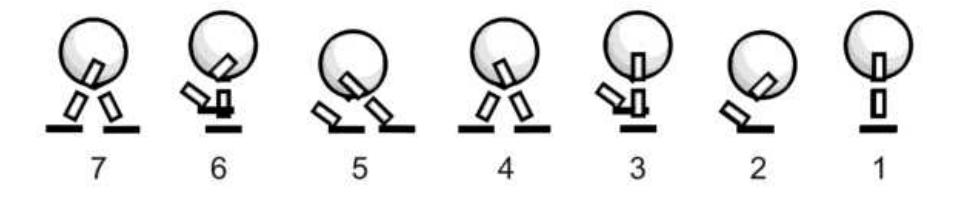
First, some basic constraints must be satisfied throughout the entire gait cycle: existence of the solution for inverse kinematics of the legs, limitations of joint angle ranges, limitation of joint angle velocities, etc. A tool has been developed to validate different planned motions of agents, against the agent model. This tool was very helpful for experimenting with the new legged spheres.
Second, some criteria must be followed in order to ensure a stable gait generation. In case of a static walking pattern, the center of gravity (COG) must be maintained inside of the support area. Static walking is easy to implement but usually unacceptably slow [1]. It seems that the agent is unable to use static walking with its current body structure; only 3 degrees-of-freedom in each leg and no means to produce torque in the upper part of the body has made the agent somehow inflexible.
But in dynamic walking, we take into account dynamic effects of the robot; thus the COG may lie outside of the support region during a gait cycle, without the agent losing its balance. A popular concept called Zero Moment Point has been used for a criterion of walking stability [2, 3]. The ZMP is defined as the point with respect to which dynamic reaction force at the contact of the foot with the ground does not produce any moment.
Currently all the calculations are done offline; and the agent needs the set of completely specified joint trajectories at runtime. But dealing with many difficulties (especially ball handling problems) needs real-time walking pattern generations. There have been many studies about real-time walking pattern generations [4, 5, 6, and 7]. We have plans to implement the Enhanced Inverted Pendulum Model [7]. But as mentioned above, implementing it with the current agent model, seems to be quite a challenging task.
3 Proposed Biped Robot Model
Achieving a stable motion in a biped robot is quite an elaborate work. It requires some serious research background and is still the research focus of many studies (for example, participants of the RoboCup Humanoid League). Therefore it will be a huge climate shift in the Soccer Simulation competitions and it will not be easy for the participants to cope with it. In the old model, the stability of the robot was not a problem at all; the agent's means to handle the ball (i.e. kickeffector) were really simple, etc. With legged spheres there are a whole lot of low-level problems to be solved and it will really impact the quality of competitions.
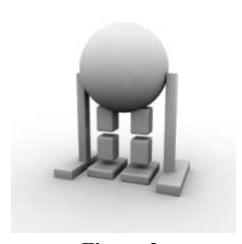
It is important to insure a smooth transition between the old simple sphere-shaped agent model and the new legged model. To achieve such goal, we propose a transient agent model: a biped robot with 7 degrees-of-freedom with two stabilizers attached to the sides of its body to maintain its stability. The goal is to postpone encountering the stable walking problem; and at first step, only deal with the ball handling issues.
The work on the above-mentioned simulator abandoned after the technical committee's announcement of the new legged sphere agent model; and the proposal for the competition roadmap will be put on discussion in RoboCup event later this year.
4 Agent Localization and Physical World Model
RoboCup 2005 (Osaka, Japan) was our first experience with the new 3D soccer simulator. Our agents suffered from lack of accurate world information and a good physical model of the simulated environment.
Because of the above mentioned problems, the agents were actually incapable of performing their high-level decisions effectively. The problems impacted our RL trainings as well.
Hence we put considerable effort to improve these aspects of the agents:
- Kalman Filtering is now used for agent'sself-localization.
- Some statistical analysis were performed and an accurate physical model of the simulated world is now used as the agent's internal estimation algorithms.
5 Situation-based Action Selection
The implemented action selection architecture of our last year team will be used this year. It contains many improvements over its predecessor, but the basic definition is the same:
"In every situation, we define a set of task s. The trick is how to assign the most important tasks to the most appropriate agents. Fulfilling each task may contain some risks and/or benefits. We have tried to formalize the risks and benefits of every possible task from different aspect s. A fuzzy number is assigned to each aspect of a given task, Reflecting the risks and benefits of the task from that aspect.
The situations are classified into different situation classes and each Class specifies how to take into account different aspects of a given Task, when evaluating it. Armed with this knowledge, the agents choose the most appropriate Tasks to fulfill in the situation at hand."
6 Conclusion and Future Works
The open architecture of our agents, allows us to put many ideas in to test easily. There are 4 with-ball tasks and 2 without-ball tasks in our current implementation and tweaking their related aspect values enables us to fine-tune the agent's behavior.
Defining control parameters (and setting intuitive values for some) for our current algorithms of generating walking patterns, becomes tedious and time-consuming, and may not result in an optimum trajectory planning, especially when different gait speeds or highly accurate manipulation of legs are needed (e.g. driving legs for kicking the ball in any desired angle with any desired power). One possible solution is to obtain the optimal design through parameter search. It is possible to formulate the design of the biped controller and gait as a parameter search algorithm.
Another problem is the instability caused by the violent transitions between the different dynamic walking phases. There are many algorithms and designs [8, 9] that can be applied to ensure a smooth transition between subsequent phases.
References
[1] Cheng, M.-Y. and Lin, C.-S. (1995). Genetic algorithm for control design of biped locomotion, Proc. of the IEEE International Conference on Robotics and Automation, pp. 1315–1320. [2] M. Vukobratovic, D. Juricic, Contributions to the synthesis of biped locomotion, IEEE Trans. On Bio&Eng, Vol. BME-16, No. 1, Jan 1969, pp.1-6. [3] M. Vukobratovic and B. Borovac, D. Surla, D. Stokic, Biped Locomotion: Dynamics, Stability, Control and Application, Springer-Verlag, Berlin- Heidelberg, 1990. [4] Nishiwaki, K., Nagasaka, K., Inaba, M. and Inoue, H., Generation of reactive stepping motion for a humanoid by dynamically stable mixture of pre-designed motions, Proc. IEEE Int. Conf. on Systems, Man, and Cybernetics, No. VI, pp. 702–707, 1999. [5] Shuji Kajita. A realtime pattern generator for biped walking, Proceedings of International Conference on Robotics and Automation, 2002. [6] Kajita,S., Matsumoto,O. and Saigo, M., Real-time 3D walking pattern generation for a biped robot with telescopic legs, Proc. IEEE Int. Conf. Robotics and Automations, pp. 2299–2308, 2001. [7] S. Kudoh, and T. Komura, C2 Continuous Gait Pattern Generation for Biped Robots, IROS 2003. [8] Q. Huang , K. Yokoi, S. Kajita, K. Kaneko, H. Arai, N. Koyachi and K. Tanie, Planning walking patterns for a biped robot, IEEE Trans. Rob. Aut., vol.17,no. 6 (1998). [9] Tang, Z., Zhou, C., Sun, Z.: Trajectory planning for smooth transition of a biped robot, 2003 IEEE International Conference on Robotics and Automation (ICRA2003), Taibei, Taiwan, September 2003, pp.2455-2460