IUST 3D Research proposal 2006
Kamran Tirdad, Majid Sadeghi, Mostafa Rokooie, Naser Mozayani
IUST Robotic Association Labs, Computer Engineering Department Iran University of Science and Technology, Tehran, Iran
Abstract In this paper we introduced our physical approaches for balanced movements, main ideas and mathematical fundamentals used to model simple movement of humanoid robots. We also try to categorize our agent motions, and obtaining some physical rules to keep the agent balanced.
Introduction
Simulated environments are a commonly used method for researching artificial intelligence methods in physical multi-agent systems. Simulations are specially useful for too different types of problems: (1) to experiment with different sensors, actuators or morphologies of agents and (2) to study team behavior with the set of given agents. Additionally the connection between both types of problems is an interesting research problem [1]. Because of the changes to the 3D simulator, we have to start our agent development from the scratch and try to find the basic equations to implement our lowlevel skills. So we explain the fundamental principles to model the joints motions. Next we have categorized the motion types of our robot, at last we concentrated on the physical issues to keep our motions balanced and stable.
Joint rate analysis
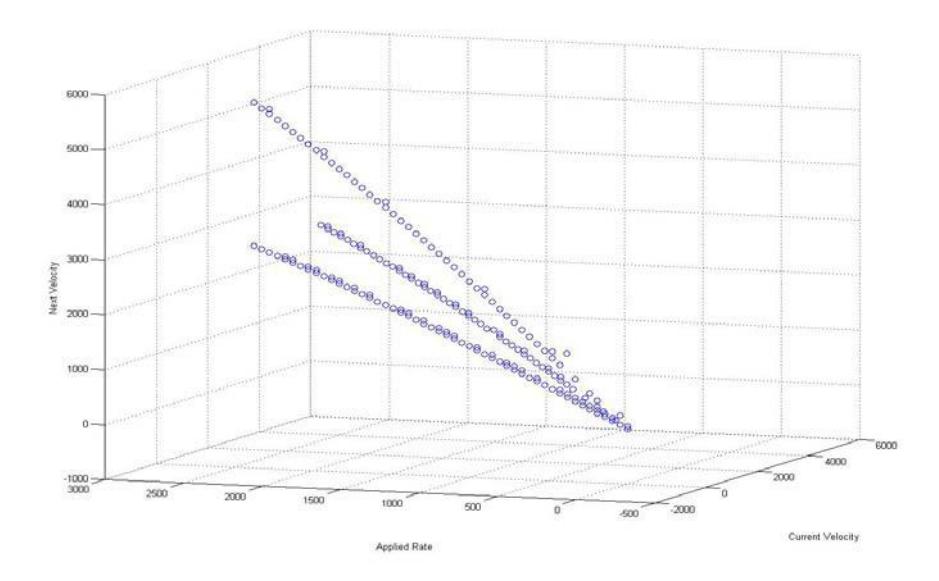
The most primitive part of our agent development is to determine how the rate of rotation of specific joint changes according to the power that applied to that joint. First we have to determine the range of rate of a joint that does not have an effective influence to other joints of the agent. In the specified range we try to formulate the changes of the rate according to the power which is applied to the joint. The fig.1 illustrates the next rate of a sample joint according to the current rate of the joint and the rate which is applied to a specific joint. Here we could see how the noises of rate application of the specified joint affect the rate of changes of the velocity of the joint.
Motion control analysis
The movement of the robot is divided in two ways: real-time trajectory computation with inverse kinematics and predefined motion pattern.
Real-time trajectory computation
When the goal position changes, the robot must normally stop walking and then start to walk to the new goal. However, this method wastes the time when the robot stops and walks again. In order to decrease the time, the robot computes it own walking trajectory real-time and computes the trajectory again when the new goal position is given. In this kind of motions in all the real time actions we have to keep the robot balanced or at least predict the next balanced position to avoid from collapsing. We are going to talk about it in the physical analysis part.
Predefined motion pattern
These patterns are the methods to make motions such as shooting the ball and waving hands. These methods change a specific state of robot to another state i.e. from the state of standing to the state of walking or vice versa.
We could develop these methods by simulating human actions and use fuzzy techniques for improvement; we still need some algorithms to keep the robot balanced that going to introduce in the next part.
Physical analyses of balanced motions
The main interest has focused on getting the robot to remain stable as it walks in a straight line. Two methods are usually used for this purpose. The first and most widely used method aims to maintain the projection of the center of masses (COM) of the robot inside the area inscribed by the feet that are in contact with the ground. The COM represents the unique point in an object or system which can be used to describe the system's response to external forces and torques. The concept of COM is an average of the masses factored by the distances from a reference point. This is known as static balance. The second method, also referred to as dynamic balance, uses the zero moment point (ZMP), which is defined as the point on the ground around which the sum of all the moments of the active forces equal zero [2]. If the ZMP is within the convex hull of all contact points between the feet and the ground, the biped robot is stable and will not fall over [3, 4].Nevertheless, linear walking is not the only type of movement the biped robot will need in order to explore the real world. It also needs to turn around, lift one foot, move sideways, step backwards, etc., and the problems involved in these movements could be quite different from those of linear walking.
Future Works
To reach adaptive solutions in dynamic environments which conditions varied time to time, we need adaptive methods that can be combined with our current solutions and improve them as more as possible. Using reinforcement learning and genetic algorithms in our solution frameworks are our main goals in the future.
References
- Oliver Obst and Markus Rollmann. SPARK -- A Generic Simulator for Physical Multiagent Simulations. In Gabriela Lindemann, Jörg Denzinger, Ingo J. Timm, and Rainer Unland,editors, Multiagent System Technologies -- Proceedings of the MATES 2004 , pp. 243–257,Lecture Notes in Artificial Intelligence 3187, Springer, September 2004
- Vukobratovic M., Brovac, B., Surla, D., Sotkic, D. (1990) Biped Locomotion. Springer-Verlag, Berlin
- Huang, Q. Yokoi, K., Kajita, S., Kaneko, K., Arai, H., yachi,N.,Tanie,K.(2001)Planningwalking patterns for a biped robot. IEEE Trans. on Robotics and Automation, 17(3), 280-289
- Furuta, T., Tawara, T., Okumura, Y., Shimizu M., Tomiyama, K. (2001) Design and construction of a series of compact humanoid robots and development of biped walk control strategies. Robotics and Autonomous Systems, 37(2-3), 81-100