Resear h Proposal
Soroosh Radpoor, Zahra Khakpour, Mahsa Mokhtarzadeh, Parto Maghdoori, Deniz Aghdam Shayan
Farzanegan High-S hool of Tehran, National Organization for Development of Ex eptional Talents(Nodet), Iran
Abstract Our main interest in robo up so er domain is to develop these eorts and design a robust and reliable ontroller for humanoids in dynami There are problems that don't allow robots to be useful for real-world problems, without help from human. Autonomous robots la k the ability to re ognize and adapt to their damaged parts, stand up after falling, and dete ting instabilities aused by external disturban e. Humanoid robots are unstable be ause their enter of mass is high and when the robot is in single-support phase of walking small external impa ts an ause instability in robot movement and if the robot doesn't rea t it will fall. Falling robot an ause damage to itself and other ob je ts in their environment. So dete ting instabilities and res ue behaviors are essential for robots in less ontrolled environment[1℄.
But it's not always possible to avoid robot to fall. Re exive behavior an avoid damage to riti al parts of the robot, and robot an stand up faster if it has a better posture. If the robot fell down and some parts get damaged it should ontinue it's operation. Animals sustain the ability to operate after injuries by reating qualitatively dierent ompensatory behaviors[2℄.
Although Spark simulator doesn't simulate damages aused by impa ts, it's ne essary in real world appli ation, spe ially where the robot is out of rea h to be repla ed or repaired. A reliable standing up method an also improve biped lo omotion[7℄.
Our goal is to design a ontroller for humanoid robots with a defensive and reliable design. Be ause evolutionary omputation requires evaluation of many potential solutions it is not possible to use real robots. With the re ent advent of omputer software known as physi al simulation, it has be ome possible to simulate, instead of a tually build, embodied robots whi h will redu e the ost and time required to use evolutionary methods[12℄.
Reliability is one of the most important problems that avoid using humanoids in real-world problems. There has been a lot of eort to make robots more exible and adaptable in dynami environments. In order to operate reliable there are several steps.
Robots must avoid falling as mu h as possible be ause it has bad ee ts on robot and the ob je ts around it. Humans use re exes after dete ting instability. A ommon used riterion to dete t instability is based on ZMP[4℄. But humans violate this riterion while walking[3℄. There is also a method based on pattern re ognition. After instability is dete ted re exes an be emergen y stopping[5℄ or de reasing speed[1℄.
But sometimes when robot is not in a good position a small external for e an ause the robot to fall. So, It is important to minimize damage in situations where a fall is unavoidable[6℄.Another step to in rease reliability is ability to stand up after falling. Re ognizing a fall is not diÆ ult. But getting ba k on ts is not straightforward. Robot needs to use hands and knees as additional support points. Robot an re over by two stati motions, for prone and supine positions[7℄.
The remainder of this paper is organized as follows: The next se tion des ribes dierent approa hes used to design a robot to survive falling. In Se tion 2.2, we des ribe methods used to stand up, it's diÆ ulties and robots whi h are able to stand up after falling.
Instability Dete tion, Fall Avoidan e and Damage Minimization
Most ommer ial robots available today (like ASIMO[9℄ and QRIO[8℄) use Zero Moment Point (ZMP) for gait stabilization and instability dete tion. Baltes et al. used gyros ope sensors in humanoids, to sense instability and stabilize walking gaits[10℄. There is also an approa h that uses translational and rotational velo ity and information from robot sensors as input for pattern re ognition. The pattern re ognition lassies urrent state into dierent stability and instability lasses and was trained on a simulator[11℄.
We will use this method of lassi ation to dete t instabilities, and initiate a stabilizing reex depending on the type of dete ted instability. Also SPARK simulator does not simulate damages, it is important for real-world robot to prote t its important parts. So, when the instability is dete ted as an unavoidable fall re exive behavior an be initiated for two reasons. To minimize the damage of falling and to be in a better position so that robot an stand up faster. Humans, for example, use re ex behaviors to fall in prone position be ause it's harder to get up from a supine position and it's more dangerous.
Standing up
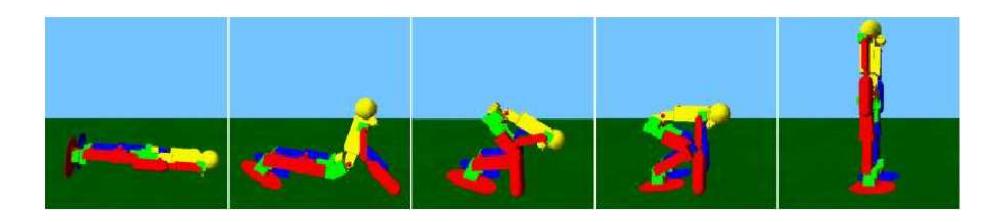
Only few humanoid robots an operate after a fall. Advan ed robots like Asimo have not been demonstrated to be able to get ba k into an upright posture. Most of re overy methods use a stati movement to stand up. Standing up from a supine posture requires strong arms, wide ranges of motion in key joints. But humanoids an stand up from a supine posture like humans. Humans usually stand up from this posture by rolling to prone posture. Standing from prone posture is relatively easier as it is possible to use knees as extra support points. Fig. 1 shows four steps required to stand up by a simulated version of Jupp robot[7℄.
References
- Renner, R., Behnke, S., [2006℄. Instability Dete tion and Fall Avoidan e for a Humanoid using Attitude Sensors and Reexes. In Intelligent Robots and Systems, 2006 IEEE/RSJ International Conferen e 2006, 2967-2973.
- Bongard. J.,Zykov, V., Lipson, H., [2006℄. Resilient Ma hines Through Continuous Self-Modeling, S ien e, November 2006, Vol. 314, 1118-1120.
- Pratt, J. E., Tedrake, R., [2005℄. Velo ity Based Stability Margins for Fast Bipedal Walking, First Ruperto Carola Symposium in the International S ien e Forum, 2005.
- Vukobratovi , M., Borova , B., [2004℄. Zero-Moment Point thirty ve years of its
- Morisawa, M., Ka jita, S., Harada, K., Fujiwara, K., Fumio Kanehiro, K. K., Hirukawa, H., [2005℄. Emergen y Stop Algorithm for Walking Robots, IEEE/RSJ
- Fujiwara, K., Kanehiro, F., Ka jita, S., Kaneko, K., Yokoi, K., Hirukawa, H., [2002℄. UKEMI: Falling Motion Control to Minimize Damage to Biped Humanoid Robot, IEEE/RSJ Int. Conf. on Intelligent Robots and Systems, 2002, 25212526.
- St kler, J.,S hwenk, J., Behnke, S., [2003℄. Getting Ba k on Two Feet:Reliable Standing-up Routines for a Humanoid Robot.
- Tanaka, F., Noda, K., Sawada, T., Fujita, M., [2004℄. Asso iated emotion and its expression in an entertainment robot QRIO in Entertainment Computing - ICEC,
- Yokoi, K., Kanehiro, F., Kaneko, K., Fujiwara, K., Ka jita, S., Hirukawa, H., [2004℄. A Honda Humanoid Robot Controlled by AIST Software, in IEEE/RAS Int. Conf. on Humanoid Robots, Tokyo, Japan, 2001, 259264.
- Baltes, J., M Grath, S., Anderson, J., [2005℄. The Use of Gyros ope Feedba k in the Control of the Walking Gaits for a Small Humanoid Robot, in RoboCup 2004: Robot So er World Cup VIII, ser. LNCS, no. 3276, 2005, 628635.
- Hohn, O., Ga nik, J., Gerth, W., [2005℄. Dete tion and Classi ation of Posture Instabilities of Bipedal Robots, 8th Int. Conf. on Climbing and Walking Robots and the Support Te hnologies for Mobile Ma hines - CLAWAR, 2005
- Obst, .O, Rollmann, M., [2004℄. SPARK A Generi Simulator for Physi al Multiagent Simulations. In Gabriela Lindemann, Jorg Denzinger, Ingo J. Timm, and Rainer Unland, editors, Multiagent System Te hnologies Pro eedings of the MATES 2004, volume 3187 of Le ture Notes in Arti ial Intelligen e, Springer, September