Reseach proposal NAITO-StrikerS
Yoichi Setoguchi, Nobuhiro Ito
Department of Information engineering, Nagoya Institute of Technology Gokiso-cho, Showa-ku, Nagoya City, Aichi Prefecture 466-8555, JAPAN; Software Science Course, Department of Applied Information Science, Faculty of Management and Information Science, Aichi Institute of Technology 1247 Yachigusa, Yakusa-Cho, Toyota City, Aichi Prefecture 470-0392, JAPAN
Abstract We propose a new game of RoboCupSoccer Simulation League which encourages cooperation between agents from different teams. To provide real simulation, RoboCupSoccer Simulation should be done as a large scale dispersed development. Accordingly the large scale distributed development of RoboCupSoccer Simulation suggests the development of agents of RoboCupSoccer Simulation League will also be large scale. In the traditional design method, researchers in the same group often discuss and agree theier agents' strategy among themselves before development. We propose to permit agents developed in isolation to participate in RoboCupSoccer Simulation League.
1 Introduction
RoboCupSoccer Simulation needs more real simulation and we propose that one agent acts for one person. In the past, a reaearcher or study group has discussed the strategy of their Agent Team among themselves and decided how the simulation will proceed. However, it is difficult for one researcher or study group to develp such a large simulation system, so the system should allow large scale distributed development. In practice RoboCupSoccer Simulation League will be developed both with and without discussion among the team members and so there will be a combination of independently-developed and group-developed agents in the game. This will be cause problems in the future so we propose to combine agents in RoboCupSoccer Simulation League.
2 Proposal
The game that we propose includes specific design considerations for agent cooperation and team combination.
2.1 Realization method of combination
We considered two methods of realizing the combining the agents:
Develop a protocol
To let agents cooperate in the shortest possible time by preparing a framework for the realization of the cooperative behavior in advance.
Develop interaction by considering other agents
To let agents cooperate based on their autonomy and proactive behavior.
We consider the autonomy and pro-activity of agents in this paper. It depends on the following reasons.
- We consider a game which increases the autonomy and pro-activity of agents.
- It is important to consider agents more because now we measure their social ability, autonomy and pro-activity.
Then, the following three points are promoted by proposing a game using this approach and pro-activity.
- Research about the design and implementation of agents that understands the intention of other agents.
- Research about the combination of agents.
- Research about an evaluation method of agents' combination.
The results of these investigations will enable the large scale distributed development.
2.2 Competition design
The game that we propose this time is the following.
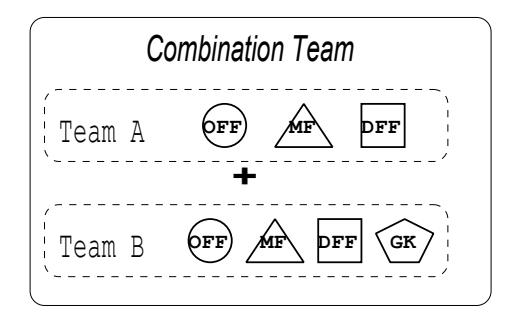
Put agents of a certain fixed team and agents of a participation team together, and form one team. The participating team then competes for a degree of cooperation with the fixed agent team.
For example, if we set up team of agents(one DFF, two MF, one OFF) in Team A, and a participating Team B joins with other agents(one GK, rest of the DFF, MF, OFF). Then, the participating Team play a game by a combination team(refer Fig.1).
We set up a team approach because we think that is an easier way to vie for mastery. A bariety of the other scenarios are suggested. Several examples follow.
- Compete for the degree of cooperation for fixed single-species agents(e.g. all the DFF agents of a team ).
- put an agent of plural participation teams together and make one team, and compete for the degree of cooperation.
These are the current suggestions for the game which we think are reasonable and are good examples for the new game. After more discussion about our study it is likely more scenaios may be adopted.
3 Conclusion
In this article, we pointed out problems of current RoboCupSoccer Simulation League, and propose a new game of RoboCup Simulation League which encourages cooperation between agents from different teams. It will help the large scale distributed development of RoboCupSoccer Simulation.