RoboLog 3D - Research Proposal 2007
Yuichi Matsumoto, Heni Ben Amor
Department of Information and Physical Sciences, Osaka University, Japan; VR and Multimedia Group, Technical University Bergakademie Freiberg, Germany
Abstract RoboCup Soccer Simulator is a well known experiment platform for such as multi-agent systems, behavior learning, decision-making and planning problems in dynamic environment. We have been working on computational modeling and optimization of intelligent systems which are able to learn and evolve autonomously as human beings do, and have applied those techniques to RoboCup Soccer Simulation as a test bed for evaluation in recent years [1] [2] [3]. Our goal of research is to make much development of such intelligent systems using computational intelligence techniques such as fuzzy systems, neural networks, reinforcement learning and evolutionary computation. In this paper, we talk about what we are going to do with those techniques for RoboCup Soccer Simulation 3D League 2007.
1 Introduction
In RoboCup Soccer Simulation 3D League 2007, the sphere agent model that was used in past competition is going to be changed to humanoid one. We believe that this would be a big step for the great goal of RoboCup: "By 2050, develop a team of fully autonomous humanoid robots that can win against the human world champion team in soccer", and it would be also a novel experiment platform for researchers of humanoid robots behavior.
However as both new spark simulator and new spark agent are still in a very early state of development, we especially need to make development of low level skills, such as walking, kicking and getting up, in order to get to a level where teams can concentrate on the high level behaviors in this first year. From this point of view, though we are currently working on novel intelligence techniques such as self-adaptive function approximator [4] and particle filter based on evolutionary strategy [5] which could be also applied to humanoid robots, we are going to focus on generating a basic low level skill, particularly walking behavior of humanoid robot as a immediate task. Previously we have already done a similar walking behavior work [6], but this was implemented not for RoboCup environment but for our own simulators. We believe that these our works could be reused and applied to even new spark simulator. In the next section, we describe our approach specifically to generate walking patterns of humanoid robots.
2 Bio-inspired locomotion of humanoid robots
In recent years, humanoid robots are receiving much attention and especially the generators of walking patterns are studied by many researchers [7] [8]. Though it is still pretty hard work for designers to generate walking patterns of humanoid robots due to the instability of small ground plane and the difficulty of handling a complex non-linear equation analytically, this is worth being discussed for support and coexistence with human beings in life and deepen understanding of human body system.
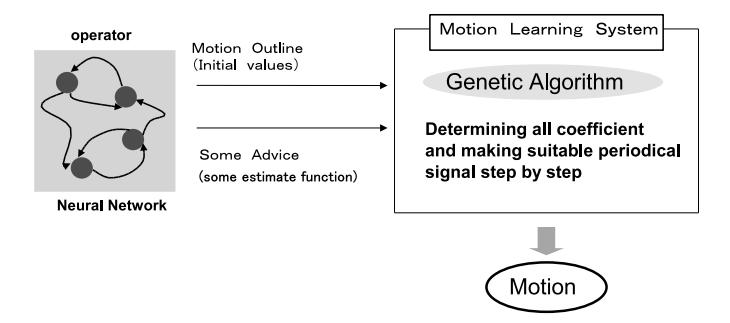
In this paper, we introduce bio-inspired approach that the central pattern generator (CPG) which is a kind of neural networks is used to generate periodical control signals to make humanoid walking patterns with using genetic algorithm as in Fig 1. The genetic algorithm is used to tune the connection weights of CPG based on six objective functions concerning with good locomotive morphology of walking patterns. Specifically each objective function evaluates such as the walking distance, the progress direction, the vertical motion of crotch, the time that foot is under the ground, the stability of walking and the limitation of signal amplitude. Some numerical simulation studies are performed to discuss the applicability of the proposed approach.
2.1 Central pattern generator
We use Fitzhugh-Nagumo equation as a mathematical model of neural networks in CPG. Fitzhugh-Nagumo equation is the approximation that step-down the degree of freedom of Hodgkin-Huxley equation, expressing theoretical behavior of activity of nerve cell's action potential. The equations are shown as following.
$$\tau_r \dot{x_i} = -x_i^3 + 3x_i - \beta_i f(v_i) - \sum_{j=0, j \neq i}^{n-1} \gamma_{ij} f(x_j) + s_i$$
$$\tau_a \dot{v_i} = -v_i + b f(x_i) + a$$
$$f(x) \equiv \max(x, \theta)$$
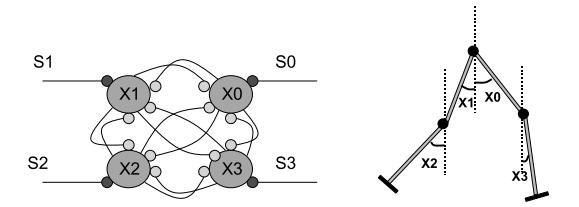
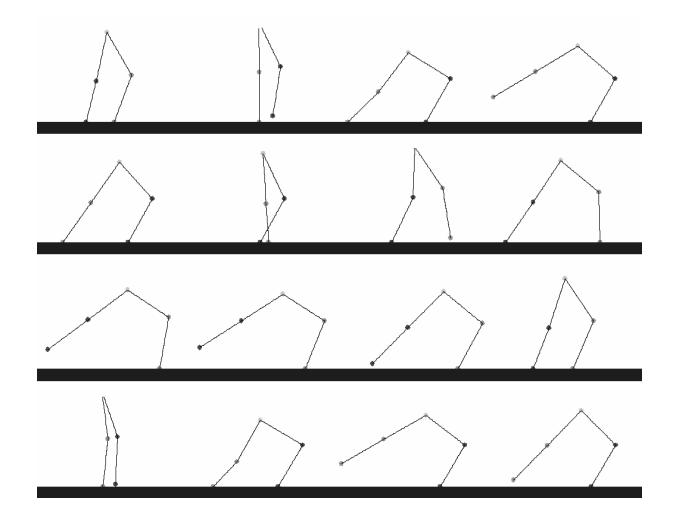
We united four elements mutually to create the complex period signal for generating walking patterns of humanoid robots as in Fig 2. Each unit is connected with the others with excitatory or inhibitory connections. The output of CPG is used to control signals of the actuator of the knee joints and the crotch joints respectively in our simulator experiment. The walking patterns generated by elite individual in evolutive process are shown in Fig 3.
3 Conclusion
In this paper, we have briefly introduced one example that we used to work on related research of humanoid robots. Unfortunately we did not have enough time to apply our proposal method to new humanoid robots in RoboCup Soccer Simulator 3D by the deadline of first stage qualification, but we are sure that this would be done by RoboCup 2007 Atlanta. At the same time, as we mentioned in section 1, we have already had other resources that are able to be reused and applied to scientific aspects of humanoid robots. We are also going to implement these computational intelligence techniques in RoboCup as well as the method we described in this paper in near future.
References
- Heni Ben Amor, Jan Murray and Oliver Obst, "Fast, neat, and under control: Arbitrating between steering behaviors," In Steve Rabin, editor, AI Game Programming Wisdom 3, volume 3 of Game Development Series, Charles River Media, March 2006.
- Heni Ben Amor, Joschka Boedecker, Anita Maas, Irene Markeli, Jan Murray, Oliver Obst, Christoph Ringelstein and Markus Rollmann, "Team Description RoboLog Koblenz 3D." In Proceedings of the RoboCup International Symposium, July 2004.
- Heni Ben Amor, Joschka Boedecker, Rodrigo da Silva Guerra and Yuichi Matsumoto, "Team Description RoboLog Koblenz 3D." In Proceedings of the RoboCup International Symposium, 2006.
- Yuichi Matsumoto, Toshiharu Hatanaka and Katsuji Uosaki, "Adaptive Approximation of State Space by Self-Growing Neural Network," SICE Symposium on Systems and Information 2006.
- Shin Ishimaru, Toshiharu Hatanaka and Katsuji Uosaki, "Evolution strategic particle filter with interactive multiple model," 22nd Fuzzy System Symposium, pp. 99-100, Sapporo, Sept. 6-8, 2006.
- Shuhei Manabe, Toshiharu Hatanaka and Katsuji Uosaki, "Bio-inspired locomotion of biped robot using CPG and noise enhancement," SICE Annual Conference 2005 in Okayama.
- K. Endo, T. Maeno and H. Kitano, "Co-evolution of morphology and walking pattern of biped humanoid robot using evolutionary computation -Consideration of characteristic of the servomotors-," International Conference of Intelligent Robots and Systems, pp. 2678-2683, 2002.
- G. Taga, Y. Yamaguchi and H. Shimizu, "Self-organized control of bipedal locomotion by neural oscillators in unpredictable environment," Biological Cybernetics, Vol 65, pp. 147-159, 1991.