RoboCup 2007 Atlanta 3D Simulation League: Research Proposal by ThinkingAnts 3D
Taiki Kondo, Tatsuya Suzuki, Hiroaki Odajima, Katsuhiko Nakamura
School of Science and Engineering Tokyo Denki University
Abstract This paper outlines research proposals based on preliminary works on the 3D simulation league team Thinking Ants. The research focuses on developing methods for improving actions and action decisions through estimation and prediction of positions of the ball and agents, and acquisition of rules by data mining of game records. These approaches are planned for application to the new version of 3D Simulation League.
Introduction
This paper outlines research proposals based on preliminary works on our 3D simulation league team Thinking Ants. The preliminary works include estimation and prediction of positions of the ball and agents for the previous version of 3D Simulation League and acquisition of rules by data mining for 2D Simulation League [1]. By improving these preliminary works, we are planning to develop the methods for the new version of 3D simulation league.
The group for 3D Simulation League works together with the groups for 2D Simulation League and Four Legged League in the same laboratory. The common research goal of the three groups is improving actions and action decisions by analyzing games, which is the bases of our research proposals.
Estimation and Prediction of Positions of the Ball and Agents
The visual information for the player is generally limited in most LoboCup leagues because of the restricted optic angles and of the presence of noise, which is artificially added in the simulation leagues. Therefore, it is important for each agent to generate a model of outer world based on the visual information that the agent has obtained so far. The model specifies the positions of the ball and agents, by which the agent predicts the future course of the ball.
In each cycle, every agent determines the current positions of the ball and agents. The agent needs to estimate the positions of agents other than those obtained by visual information. It can correctly estimate the moves of agents of the same side, as it knows how they move. The agent estimate the move of enemy agents by the assumption that the agents near the ball approach the ball and the other enemy agents keep their positions.
A agent predicts the positions of other players and the position and velocity and acceleration of the ball in the next ten steps. This prediction needs to repeat estimating the positions of players and balls ten times.
The arrow near the black circle in Fig. 2 shows the move of an agent (the black circle), which predicts the course of the ball (the small circle). The arrows near the white circles show the predicted moves of enemy agents.
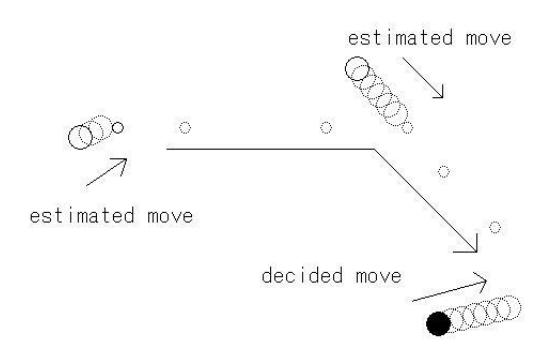
Table 1. Experimental Results of Scores and Pass Success Rates of 3D Thinking Ants
| No Prediction With Prediction | |||
|---|---|---|---|
| Average | Wright Eagle | 0.0 - 1.8 | 0.0 - 1.0 |
| Score | Tsubamegaeshi | 1.3 - 0.0 | 2.9 - 0.0 |
| Pass Succss | Wright Eagle | 56.0 | 66.7 |
| Rate (%) | Tsubamegaeshi | 90.0 | 96.8 |
The experimental results shown in Table 1 demonstrate that both the scores and the pass success rates are considerably improved by the prediction.
Acquisition of Rules by Data Mining of Records of Games
The most important problem in RoboCup is how to select the best action among dribble, pass and shoot. It is generally difficult to design the rules for optimal actions of agents in the situations where the multiple agents interact.
We developed a method of improving the selection of actions, either dribble, pass or shoot, by data mining of records of games. The method is composed by the following steps.
- We extract features related to an action from records of the games, or the log files. The features include the distances to other agents, the positions of balls, stamina of the player, and influence of agents, which are estimated by calculating potential distribution. We also need to estimate the result, success or failure, of the action from the records.
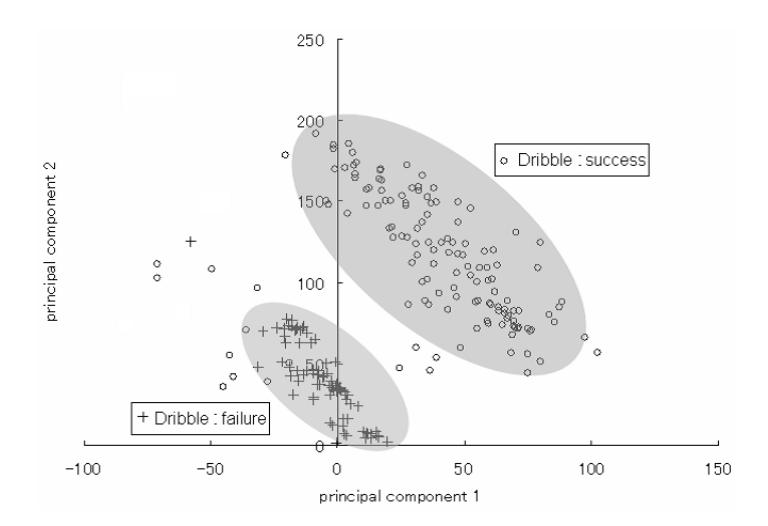
- By data mining, we determine a set of the feature and thresholds of features that are essential to success and failure of the action. We use principal component analysis and decision tree approach of ID3-J48 as data mining methods.
- Based on the result of the data mining, we construct the rules to determine to take the action.
Fig. 2 shows the result of principal component analysis for the action of dribble in 2D Simulation League. From this result, we can select some essential feature for success and failure of dribble.
Concluding Remarks
The approaches outlined in this paper would be effective to improve the actions of agents not only in simulation leagues but also in other leagues of RoboCup. We are working on applying the approaches to the new version of 3D Simulation League.
References
- H. Odashima and K. Nakamura, Improving Action Decision by Data Mining in RoboCup Simulation League, (in Japanese) The 69th National Convention of IPSJ, 2007.