Development of Humanoid Robot Control in RoboCup 3D Soccer Simulation
JinSu Liu, Feng Xue, XingHua Lai, Wei Wang
Department of Computer Science and Technology, University of Science and Technology of China, Hefei, AnHui, 230027, China
Abstract This paper describes the research and development of a humanoid robot soccer team for RoboCup 3D soccer simulation. The work focuses on implementing control methods for biped walking, basic robot actions (walk, stand up, kick, run), and team coordination among 5 robots. The methodology employs dynamic analysis based on Zero Moment Point (ZMP) theory, machine learning techniques including genetic algorithms and artificial neural networks, and biologically-inspired control principles. The project aims to develop a fully autonomous humanoid robot team capable of competing in simulated soccer matches.
History and Background
It is desirable that humanoid robot works for human and/or plays with human in the future. And research of biped robot is absorbing but not easy. Balance of biped robot, which is one of the most important parts, is still difficult, and the research about it progresses a little slowly. So far, the robot walking and balance approaches are mainly based on ZMP(Zero Moment Point ) concept [1, 2] and inverted pendulum model [3].
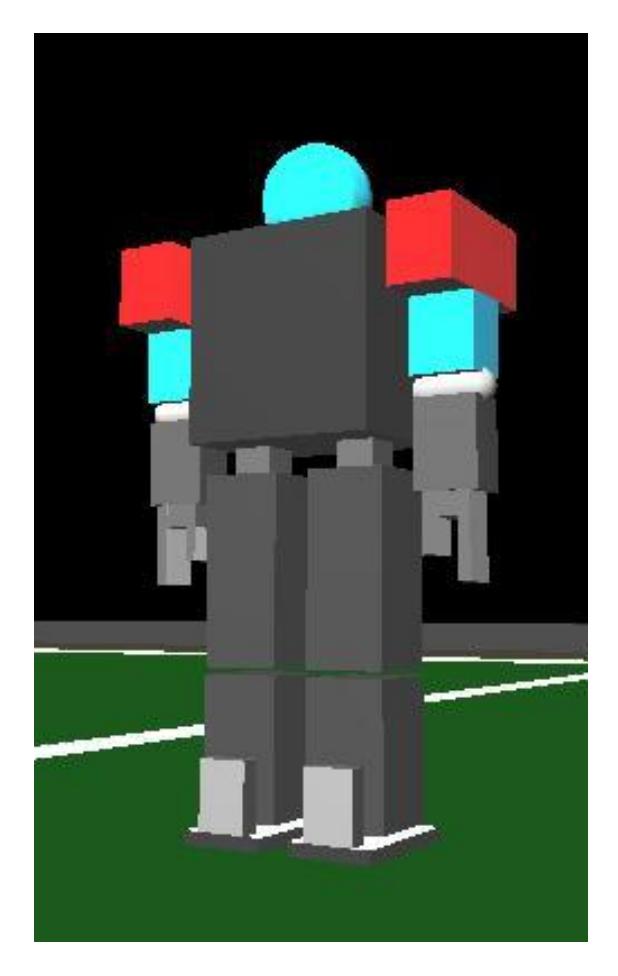
To make our research more effective, we need a simulator, which provides a human like robot that can perform as a human. RoboCup 3D soccer simulation is a good platform for the research. And to achieve the goal of the RoboCup [4, 5], that is to build a team of fully autonomous humanoid robots able to beat the human soccer champion by the middle of the 21th century, we still have a long way to go. Now the new 3D soccer simulation platform is a significant step, because it provides us a platform with human like robots. The biped robot is made up of blocks of different sizes and different density. There is a controller in each joint of the robot. And the control of walking motion and something related are possible. The robot performs like a real humanoid robot so that it can actually advance the research of humanoid robot. Although the new simulator is a good advancement, more and more features are expected in the future.
Goals
- First, we should be familiar with the basic control of the robot and the feathers.
- Second, we should carry out basic actions such as walk, stand up, kick, run and so on.
- Third, we should integrate all the sensors and motions to make our robot perform like a human automatically.
- Fourth, we should form a team of 5 robots. And they can do teamwork with each other.
- Fifth, our team can take part in a real simulation match and beat others.
Methodology
In order to implement a humanoid robot soccer team, the following methodology will be employed.
Dynamic analysis
In biped walking control, the zero moment point is the most important factor to implement a stable walking, so it will be used in the biped walking control. There will be also other dynamic analysis of the movements such as: catching ball, standing up and so on. It will help us to implement stable motions of the agents.
Machine learning
Machine learning has the ability of automatic optimization and the advantage of robustness. Genetic Algorithms and Artificial Neutral Network will be used in the motion control in order to make the agent suits the uncertain environment.
Bionics
In fact, there is not ZMP and so much computation in body control of human being, so we may get some useable inspirations from humans, animals and even insects. The basic biological principles can be applied to form a new framework of motion control.
Related Work
- Reinforcement learning with fuzzy evaluative feedback for a biped robot [6]
- An empirical exploration of a neural oscillator for biped locomotion control [7]
- On the stability of indirect ZMP controller for biped robot system [8]
- Optimal walking trajectory generation for a biped robot using multi-objective evolutionary algorithm [9]
- Controlling biped walking robots using genetic algorithms in mobile agent environment [10]
- Fast Biped Walking with a Sensor-driven Neuronal Controller and Real-time Online Learning [11]
Proposed Research Time-Table
Table 1. research time-table
research time-table
| Date | Task |
|---|---|
| March 11 — March 31 | Literature review |
| April 1 — April 21 | Implementation of a powerful debugger for humanoid robot |
| April 22 — May 26 | Implementation of the basic movements of the robot |
| May 27 — June 23 | Implementation of the cooperation |
| Optimization of the basic movements | |
| June 24 — June 30 | Debugging of the agent |
References
- Vukobratovic, M., Juricic, D.: Synthesis of Biped Gait. Proc. of IFAC Symp. on Technical and Biological Problem on control, Erevan, USSR (1968)
- Napoleon, Nakaura, S., Sampei, M.: Balance Control Anaysis of Humanoid Robot based on ZMP Feedback Control. IEEE/RSJ, (2002)
- Zhu, C., Kawamura, A.: Walking principle analysis for biped robot with ZMP concept, friction constraint, and inverted pendulum model. IEEE/RSJ (2003)
- Kitano, M., Asada, H., Kuniyoshi, Y., Noda, E., Osawa, I., Matsubara, H.: RoboCup: A Challenge AI Problem. AI Magazine, (1997)
- Kitano, H., Asada, M.: The Robocup humanoid challenge as the millennium challenge for advanced robotics. Advanced Robotics, 13, (2000), 723–736
- Zhou, C., Meng, Q.: Reinforcement learning with fuzzy evaluative feedback for a biped robot, IEEE/ICRA, (2000)
- Endo, G., Nakanishi, J., Morimoro, J., Cheng, G.: An empirical exploration of a neural oscillator for biped locomotion control, in IEEE/ICRA, (2004)
- Choi, Y.n, You, B., Oh, S.: On the stability of indirect ZMP controller for biped robot system, IEEE/RSJ, (2004)
- Lee, Joon-Yong, Lee, Ju-Jang: Optimal walking trajectory generation for a biped robot using multi-objective evolutionary algorithm, IEEE/Asian Control Conference, (2004)
- Kambayashi, T., Takimoto, M., Kodama, T.: Controlling biped walking robots using genetic algorithms in mobile agent environment, ICCC, (2005)
- Geng, T., Porr, B., Worgotter, F.: Fast Biped Walking with a Sensor-driven Neuronal Controller and Real-time Online Learning, IJRR, (2005)