Development Architecture of a Humanoid Soccer Simulation Robot Team Description Proposal for Robocup2008 Apollo3D
Junqing Wang, Guoping Luo, Ke Ding, Zhiyong Zhang
Nanjing University of Posts and Telecommunications, China
Abstract This document describes the architecture of our humanoid soccer robot for RoboCup 2008 3D Soccer Simulation – Apollo3D. In order to make our research more efficient, we design and implement a solid system architecture, which is based on simspark. The server and the multiple clients are integrated and skills can be written in script.
Keywords: simspark ruby robocup
1 Introduction
The model of robots in RoboCup soccer simulation 3D turns to be humanoid and so many previous developing framework cannot be directly employed in such this league. In a traditional way, we program in C++, and have to edit the source code, compile it, and then test the binary. It is inefficient that clients have to connect to the server each time when we only want to write skills without playmode on, so we design a framework based on simspark [1] to avoid these problems.
2 Related Conceptions
Before introducing our development architecture, some conceptions should be reviewed, which are SimControlNode, TrainControl and Ruby Script.
2.1 SimControlNode
Simspark regards every components of the simulator as separated nodes, such as InputControl, RenderControl, NetClient, NetControl, AgentControl, MonitorControl, MonitorLogger[2].
When a client connects to simspark, it adds an agent in AgentControl, and AgentControl is responsible for the communications between the server and agents.
2.2 TrainControl
We design a TrainControl modular, and it omits the network of AgentControl. In other words, agents are embedded in simspark, without network connection.
2.3 Ruby Script
In simspark, library zeitgeist implements a mechanism[3] and works with classes objects, it provides a 'built-in' server: ScriptServer, which using Ruby script currently.
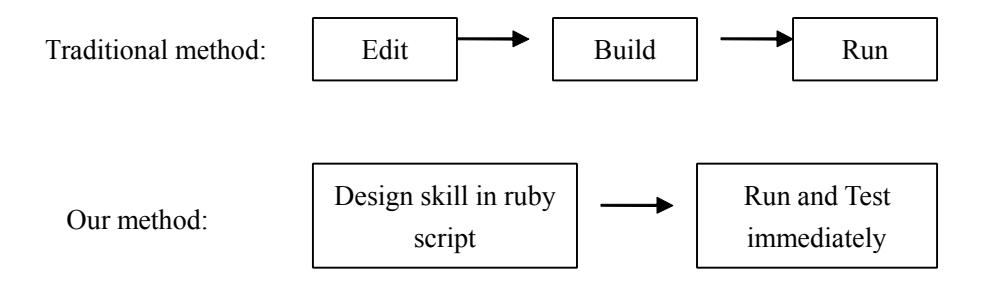
In general, we code in C++, and we have to do our work with the traditional method. However, compilation is time consuming, with the ScriptServer we can develop skills more efficiently with the new method:
3 Apollo3D's Development Architecture
There are two modes that be switched in TrainControl:
1. Network Mode.
An agent connects to ressserver3d
StartCycle:
SenseAgent: network->GetMessage
ActAgent: behavior->Think, network->SendMessage
EndCycle:
In this mode, only one simcontrolnode (TrainControl) is running.
2. Debug Mode.
An agent connects to the internal server without network
StartCycle: agent->RealizeActions
SenseAgent:
ActAgent: behavior->Think
EndCycle: agent->QueryPerceptors
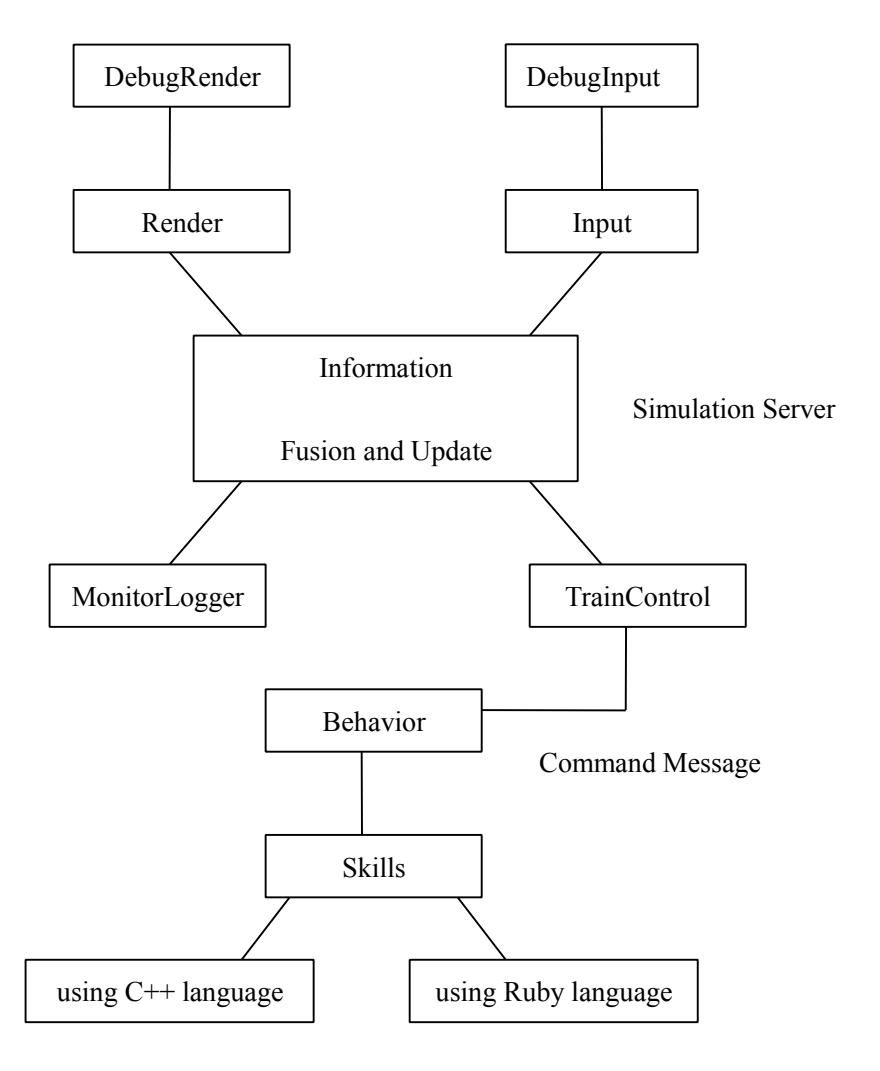
In this mode, we can choose to render, input or logger to run, it's essentially the same as as simspark except that agents communicate without network.
We illustrate a graph of the debug mode as follows:
4 Conclusion
In this paper we present an architecture for developing a humanoid soccer player agent, we'll continue to work out some advanced features, such as setting scenes for creating agents' skills and for cooperation among agents.
References
- Markus Rollmann, Spark-a generic simulator[D]. Diploma thesis, Koblenz-Landau University, 2004.
- RoboCup3d server develop group. RoboCup Soccer Server 3D Manual[Z], 2007
- RoboCup3d server develop group. RoboCup Soccer Server 3D Howtos[Z], 2007