NomoFC Team Description Paper for RoboCup 2008
Takeshi Uchitane, Youichi Akabane, Nobuhiko Kondo, Toshiharu Hatanaka
Department of Information and Physical Sciences, Osaka University, Japan
Abstract This paper describes our first efforts of developing a new team for RoboCup Soccer Simulation 3D League. First, we show our walking controller using central pattern generators (CPG) by which a humanoid agent can walk stably. And then we consider a new walking control system for the adaptation to a diverse environments.
1 Introduction
We took part in RoboCup Soccer Simulation 3D League as the members of Team RoboLog3D since 2006 because some of the members of RoboLog3D affiliated to Osaka University in Japan from Koblenz University in Germany. Now, the team NomoFC take over the results that have been achieved thus far. we have focused the walking skill especially, because it is big advantage to move quickly and stably when humanoid agent plays the soccer game. So we try to develop powerful and useful walking controller by using our study i.e. mathematical modeling, multi-objective optimization. In Section 2 and 3, we briefly introduce previous researches and works about humanoid robots walking, and in Section 4, the architecture of Adaptive Walking Control System is shown. Finally, our conclusion and some future works are discussed in Section 5.
2 Previous Works
In recent years, humanoid robots are receiving much attention because this is worth being discussed for livelihood support and coexistence with human beings in the future and deepen understanding of human body system. Especially some kinds of central pattern generators (CPG) have been studied by many researchers due to the difficulty of self-adaptive walking in dynamic environment in case of using traditional model based approach [1] [2]. However, almost all researches for generating walking pattern by using CPG have been focused on just generating stable, periodic and stationary walking pattern at some places, such as plane, slope and irregular terrain. In case of real world problem like a RoboCup Soccer Simulation 3D, such walking patten generators are not suitable because it is necessary for soccer agent who tries to do some tasks, like kicking the ball, to change his basic behavior stably without falling down. If soccer agent changes his behavior state without thinking about his stability, the probability of falling down would be high due to the inertia force of his previous behavior. To think about agents stability for stable changing of his behavior state, the architecture of adjusting agents stride or walking speed control is needed, but as we mentioned before, most researches have been just for generating stable, periodic and stationary walking pattern. There are less researches about how to control these things by using CPG based walking controller.
From this point of view, we have implemented some representative CPG models for generating walking pattern. In the following section, our implementation is described.
3 Walking Controller
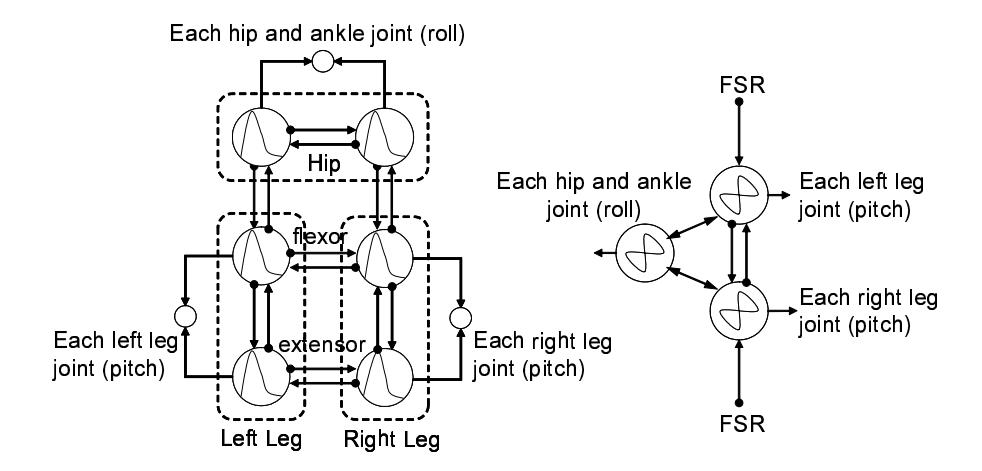
We used two main types of representative CPG modules: Neural Oscillator [3] and Phase Oscillator [4] are the architecture of NomoFC walking contoroller. Fig.1 indicates the structure of each CPG model that we implemented. For this time, we fixed the structure of our walking controller, and tried to optimize some walking gait parameters in these two models so that soccer agent can walk more stable and faster in the RoboCup Soccer Simulation 3D environment. As a tool to optimize these walking gait parameters, we made use of Evolution Strategy (ES). The fitness function evaluates each individual performance were set to be based on walking distance to upright direction before starting walking simulation.
In case of using Neural Oscillator, humanoid agent had a very short stride and high frequency compared to the other one. And unfortunately, it was difficult for designer to adjust stride and walking speed intentionally, which means we could not change behavior state of humanoid agent stably. On the other hand, Phase Oscillator model has two parameters: stride and frequency that are needed when inverse kinematics are calculated, so it 's easy for designer to control stride and walking speed with these parameters and this leads to change behavior state of soccer agent stably.
4 Adaptive Walking Control System
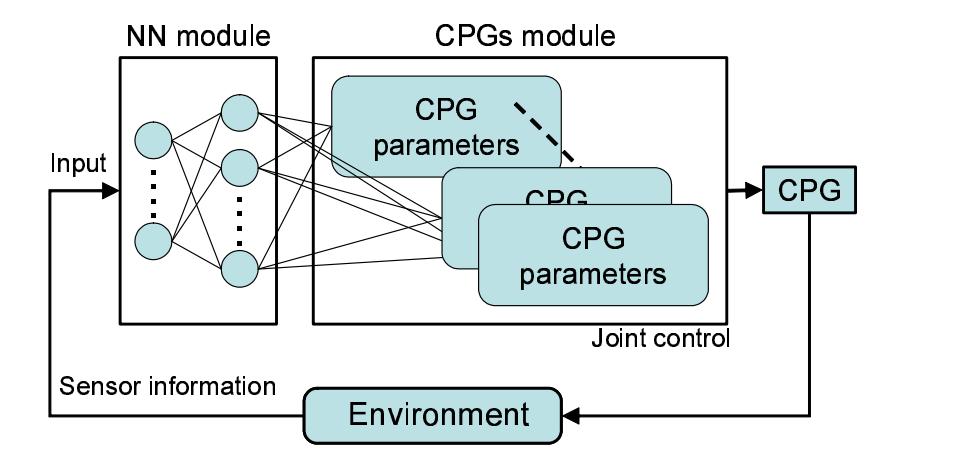
In the above section, a set of CPG parameters for biped locomotion is estimated by using Evolution Strategy under a certain evaluation criterion and in a fixed environment i.e. even dynamic friction and reflection coefficient. However, in the real world it is preferable that CPG parameters are estimated in a diverse environment and/or under multiple criteria, i.e., quickness, stability and so on. So we suggest the adaptive walking control system with Neural Network (NN) module and CPGs module shown in Fig.2 for biped locomotion acquisition in the diverse environments. In CPGs module, diverse CPG parameters are stored as Pareto-optimal solutions of multi-objective optimization problem in which several evaluation criteria are considered. And in NN modules, a set of CPG parameters is selected according to the sensory information from the environment in order to adapt to the environmental changes. By using the system to select a set of CPG parameter, humanoid agent can walk adapting to the diverse environments. We also need to develop an online search methodology of the CPG parameter for an the unknown environment in which the humanoid agent can not walk with stored CPG parameters.
5 Conclusion
In this paper, we have briefly introduced the way of acquirement of the one of our low level skills that we implemented. Humanoid agent with CPG parameters optimized by using ES can walk stably. However, the set of CPG parameters based on a certain evaluation criterion has little ability to adapt to the environmental changes in the real world. So we suggested an architecture of the adaptive walking control system.
References
- H. Kimura and Y. Fukuoka,"Biologically inspired adaptive dynamic walking in outdoor environment using a self-contained quadruped robot: 'tekken2',"Proceedings of the IEEE/RSJ International Conference on Intelligent Robots and Systems, pp. 986-991, 2004.
- S. Miyakoshi, G. Taga, Y. Kuniyoshi and A. Nagakubo,"Three dimensional bipedal stepping motion using neural oscillators - towards humanoid motion in the real world -,"Proceedings of the 1998 IEEE/RSJ International Conference on Intelligent Robots and Systems, vol. 1, pp. 84-89, 1998.
- G. Taga, Y. Yamaguchi and H. Shimizu, " Sel-forganized control of bipedal locomotion by neural oscillators in unpredictable environment,"Biological Cybernetics, vol. 65, pp. 147- 159, 1991.
- K. Tsuchiya, S. Aoi, and K. Tsujita, " Locomotion control of a biped locomotion robot using nonlinear oscillators,"Proceedings of the 2003 IEEE/RSJ International Conference on Intelligent Robots and Systems, pp. 1745-1750, 2003.