OPU hana 3D Team Description Paper
Tomoharu Nakashima, Seiya Fujii, Yukio Shoji, Yosuke Nakamura
Osaka Prefecture University, Gakuen-cho 1-1, Sakai, Osaka 599-8531, Japan
Abstract This paper describes OPU hana 3D, our soccer team that has been submitted to the qualification for the competition in the 3D simulation league of RoboCup 2008. We use interactive evolutionary computation for creating basic behaviors of humanoid robots.
1 Introduction
Team 'hana' has been participating in the RoboCup world competitions since 2002. We first developed 2D agents, and we started to develop both 2D and 3D agents in 2004. Our first participation in the 3D league was in 2005. We change the team name by adding our institute (Osaka Prefecture University), from hana to OPU hana. In order to clearly show which league the team is developed for, we further renamed our team to OPU hana 3D and OPU hana 2D.
In this team description paper, we explain our framework for developing walking gaits of humanoid robots. Interactive evolutionary computation is used in the framework.
2 Interactive Evolutionary Computation for Developing Walking Gaits
In this section, we explain how we develop walking gaits of humanoid robots by using interactive evolutionary computation. We simplify the leg motion of walking gaits in the evolutionary process. The arms are fixed straight down at the robot's sides during the walking. We also consider only the motion of the left leg. The motion of the right leg is realized by shifting the phase of the left leg motion by half period. To summarize, the number of joints to be optimized in the interactive evolutionary computation in this paper is three (hip joint, knee joint, and ankle joint).
2.1 Algorithm Overview
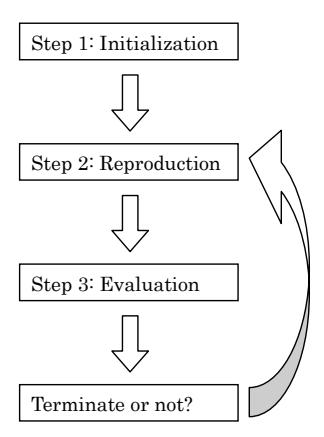
The algorithm of the interactive evolutionary computation is shown in Fig. 1. In Step 1, we randomly generate a single initial individual by using the normal distribution. It should be noted that in this step we only generate one individual. The individual represents the cyclic motion of the left leg. 18 design variables are encoded in a real-coded string for each individual. Step 2 generates other individuals based on the initial one. Correlated mutation technique is used as the reproduction operator in this example application. In this step, two children are generated from one parent individual. In Step 3, a human evaluator is involved in the process of evaluating the three individuals (i.e., the parent and the two children). The phenotypes of the three individuals are simultaneously evaluated based on the subjectivity of the human evaluator. The above procedure is iterated until a pre-specified stopping condition is satisfied. In the following, the step of fitness evaluation is described in detail.
2.2 Fitness Evaluation
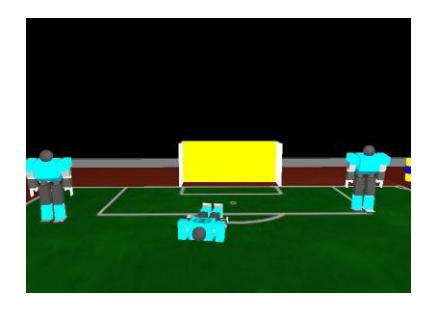
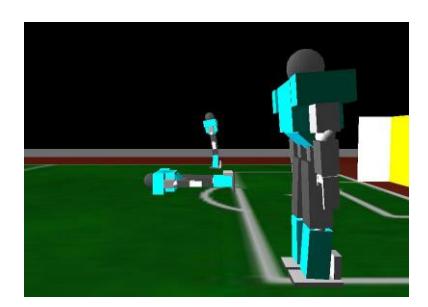
Fitness evaluation is performed in an interactive way with a human evaluator. That is, the human evaluator subjectively evaluates the performance of individuals. For this purpose, we constructed a user interface for evaluating walking gaits of humanoid robots. The robot-human interaction is incorporated in the interactive evolutionary computation via the user interface. We show the screenshot of the user interface in Figs. 2 and 3. We can zoom in and out the screen and also we can change the view angle to any direction. While the human evaluator checks the monitor, individuals try to walk according to the joint trajectories that are specified by their design variables (i.e., 18 variables for three joints). The monitor in the user interface allows the human evaluator to watch three robots walking at the same time.
The human evaluator assigns each robot a rank. This rank is used as a fitness of individuals in the evolutionary process. The rank represents the subjective preference of the human evaluator. It should be noted that this evaluation is made by the human evaluator's subjectivity. If the human evaluator wants to obtain falling-down behavior, she/he can assign the highest rank to the middle robot in Fig. 2.
2.3 Results
In this subsection, we show the experimental results for acquiring the walking gaits. We present two walking gaits: One is forward walking, and the other is backward walking. We did not change any systems for doing the two cases of acquisition. The only difference is that the human evaluator prefers the robot that is walking forward or backward. This is a good and effective way of interactive evolutionary computing. The interactive framework such as the RoboCup monitor and the user interface described in Subsection 2.2 are not necessarily modified for acquiring different behavior.
The following subsubsections show the acquisition of forward and backward walking gaits by the framework of the interactive evolutionary algorithm.
Acquiring Forward Walking
The stopping condition of the interactive evolutionary algorithm is set to 100. Since three individuals are simultaneously evaluated in one generation, the total number of evaluated individuals in a single run of the algorithm is 100 × 3 = 300.
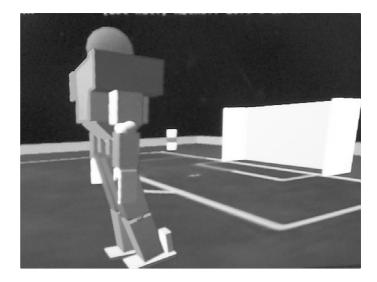
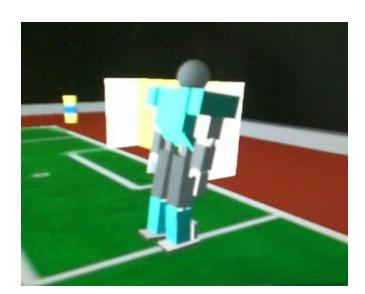
Figure 4 shows the screenshot of an obtained humanoid agent that is walking forward. This walking behavior is acquired at the final generation (i.e., 100-th generation) of the interactive evolutionary computation.
Acquiring Backward Walking
In this subsubsection, the human evaluator changed its subjective preference. That is, the human evaluator prefers robots that walk backward. The experimental procedure is exactly the same as in the case of acquiring forward walking. The only difference is that in the evaluation step of the interactive evolutionary algorithm the human evaluator assigns a higher rank to those robots that moved backwards. The experimental settings such as the stopping condition is also the same as in the case of forward walking. Fig. 5 shows the acquired backward walking. The initial behavior of the robot is just stepping at the same place. However, after 100 generations of the interactive evolutionary algorithm, the robot successfully walked backward.
3 Conclusions
This paper described the development of this year's team OPU hana 3D. An interactive framework was used in the evolutionary process for the development of walking gaits.
Future developments include acquiring other behaviors such as standing up, kicking a ball, and running. These could be done by the interactive framework that was proposed for acquiring walking gaits.