SEU-RedSun 2008 Soccer Simulation Team Description
Xu Yuan, Shen Hui, Qian Cheng, Chen Si, Tan Yingzi
RoboCup Lab, Southeast University, Nanjing 210096, China
Abstract For the RoboCup-2008 competition, most work of SEU-RedSun is concentrated on developing a powerful and developmental base code, primary skills and development tool for the new humanoid soccer simulator. After a few months research and development, SEU-RedSun has made great improvement. This paper shortly describes the main features and implementation of the SEU-REDSUN soccer simulation team, which won the 3rd place in the RoboCup-2007.
Introduction
On the road map towards simulation league finals in real robots, the RoboCup soccer simulation 3D league takes a big step forward to the RoboCup's ultimate long-term goal this year. The competition was very different from matches we had in previous years, simspark with humanoid robots was used in RoboCup-2007. The simspark is a novel experiment platform for researchers of humanoid robots behavior. Comparing with real humanoid robots, humanoid simulation environment has advantage in costs and convenience, so that we can experiment on methods and algorithms for humanoid soccer behaviors in order to optimize them and apply results in real humanoid robots. The RoboCup-2007 3D simulation league has been proved that it is a very successful competition.
SEU-REDSUN has been established in 2005, and successfully attended several competitions based on the sphere agent simulation. After changing into the humanoid simulation, most of the team's work has been spent on developing a powerful and developmental base code, primary skills, and development tool. The results achieved by our new team are delightful: the champion in RoboCup Iran Open 2007 and the 3rd place in RoboCup-2007.
This paper describes the main features and implementation of our team. Section 2 briefly describes our agent architecture. Section 3 discusses the humanoid behavior generation in dynamic and adversarial environment. Section 4 shows our development tool, followed by conclusion and future work in section 5.
Agent Architecture
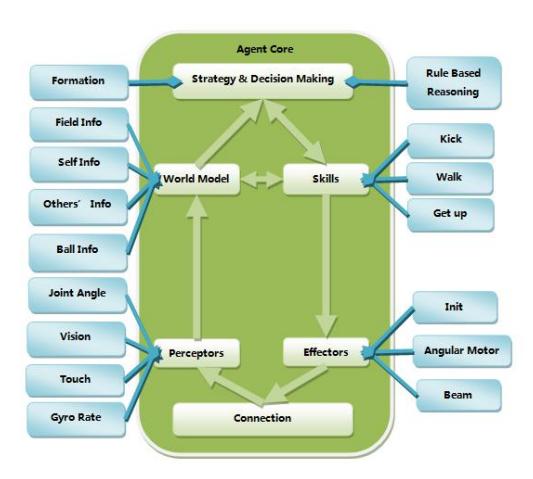
Based on no-strict layered agent architecture with singleton modules[3], the plugin mechanism was added, which enable us only change one module when the server changes. It makes the agent architecture more flexible, considering the server is still under development, there will be many changes of the server in the near future, such as perception, humanoid model, etc.
Humanoid Behavior Generation
For a humanoid robot team, in order to actually play a soccer game, various humanoid behaviors must be implemented including: biped walking, running, kicking, getting-up, etc. Humanoid behavior generation is one of the most formidable issues due to its many degrees of freedom. Coordinating several effectors of the same robot to perform a behavior is the key research problem.
Many studies have been conducted on biped locomotion control, and many biped locomotion methods have been proposed[2]. However, most of the past studies concentrated on the typical periodic and stable biped locomotion, they are not suitable to the dynamic and adversarial environment, with moving objects, some of them rational agents that are playing a game against your team.
For the aforementioned reason, we are interesting in researching on efficient real-time method to generate humanoid adversarial behaviors.
Layered Controller for Omnidirectional Walking
The ability to move into any direction, irrespective of the orientation of the vehicle, and to control the rotational speed at the same time has advantages in RoboCup domains[1].
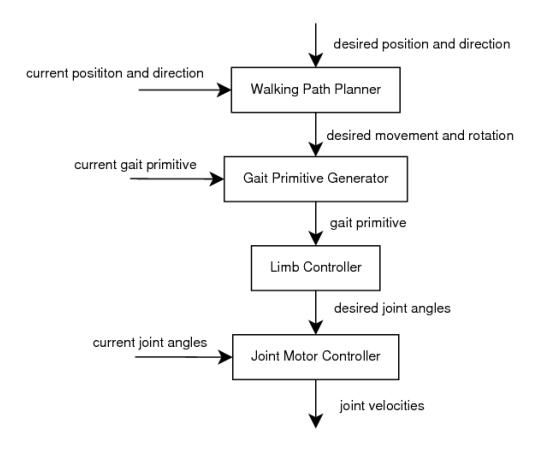
Fig. 2 shows our omnidirectional biped walking controller architecture. Multiple layers that run on different time scales contain tasks of different complexity. The walking path planner receives desired position and direction, passing the properly needed movement and rotation to the gait primitive generator. Then gait primitive generator generates the next gait primitive. At the next layer, the limb controller determines the desired of joint angles, and each joint velocity is produced by the joint motor controller. This structure restricts interactions between the modules and thus reduces the complexity of behavior engineering.
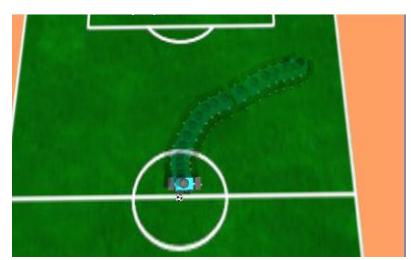
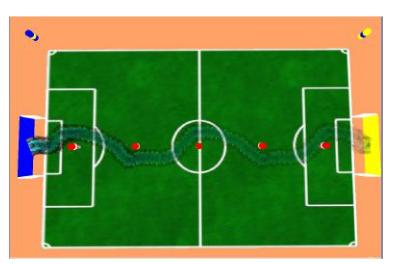
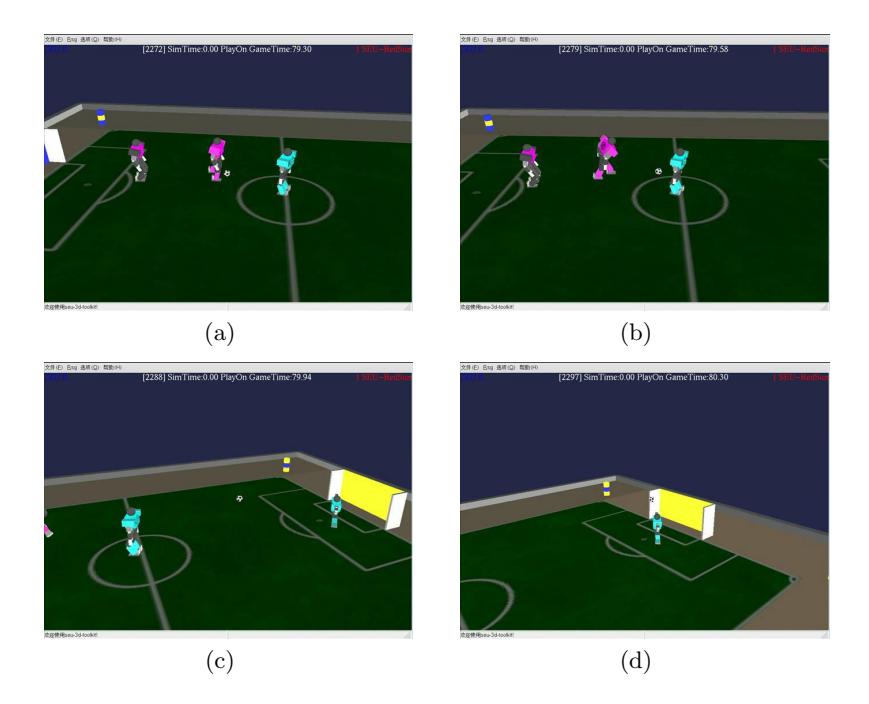
Our approach generates smooth robot trajectories without stop before changing direction or turning (See Fig. 3(a) and Fig. 3(b).), and is fast enough to meet the real-time requirements.
Adaptive Kicking
It's formidable in RoboCup soccer competition to kick accurately irrespective of the relative position between the robot and the ball, as long as the distance between them is not too far.
Our approach generates accurate and forceful kicking, by adjusting the direction of the foot while kicking. Robot can score no matter where the ball is, as long as it's in the field.
Fast Getting Up
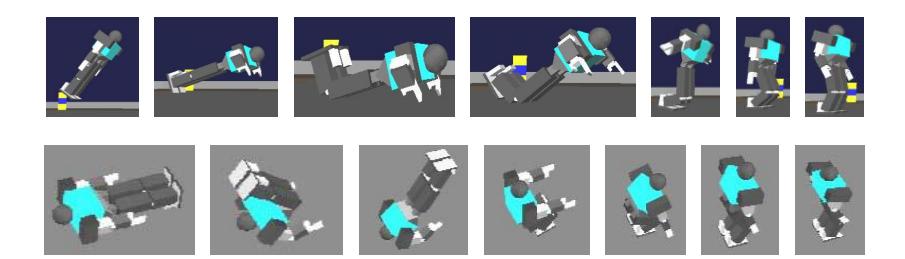
In humanoid soccer match, it's so common that robots falls down to the ground. Therefore fast getting up is useful, especially when collision happens between two robots.
We designed some fast actions for the robot to get up within about 2 seconds. These actions are all based on the powerful Joints in the robot.
Development Tool
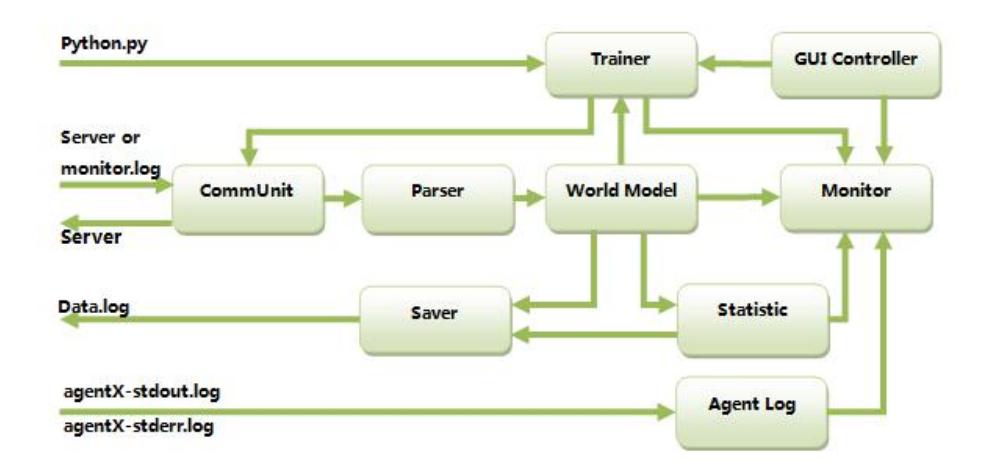
The research on development tool goes on with our other researches. A time saving and high performance tool, named SEU-RedSun-toolkit, is used to test server environment, train the agents and calculate statistics of matches. The architecture of SEU-RedSun-toolkit is designed the same as its predecessor[3] for the humanoid agent simulation. However not all the features are implemented yet.
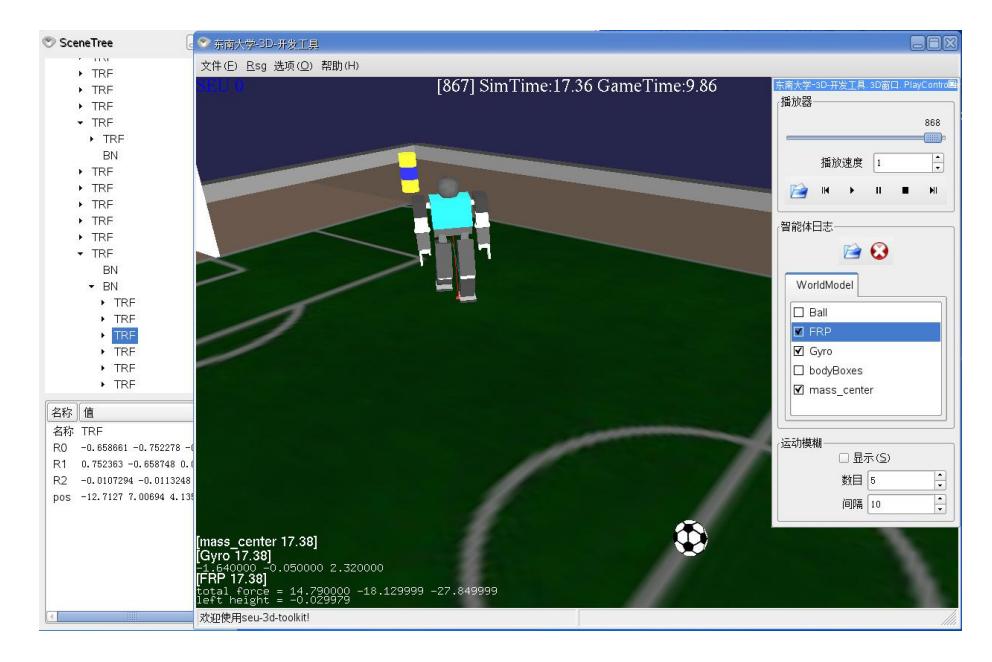
Currently the main features of SEU-RedSun-toolkit are:
- Forward and backward replay in different speeds;
- Output (Printing and drawing) of agent logfiles according to current time;
- Layered logfiles supporting: loading or drawing the content which is selected;
- Camera controller: free or focusing on an object;
- Motion blur for indicating the movement of the robot;
- Rsg file reading: drawing and analyzing the robot model;
- Sense tree: the sense tree of current simulation world in GUI, and the data of any object can be accessed by the tree;
- Multi-languages: Chinese and English;
- Platform independent: working well both in Linux and Windows;
Conclusion and Future Work
In this paper, a few aspects of our current team was described. The way we implemented the agent architecture, world model and humanoid behavior generation are addressed. In addition, the development tools are described.
The results achieved by SEU-REDSUN team are very hopeful. But there is much work to do in the future. In our project, the most two important objectives are improving the individual skills and implementing a good decision and planning algorithm. At the same time, we are keeping on developing the development tool and improving the server in the future.
References
- Sven Behnke. Online trajectory generation for omnidirectional biped walk. In Proceeding of the 2006 IEEE International Conference on Robotics and Automation, Orlando, Florida, May 2006.
- Shuuji Kajita, Hirohisa Hirukawa, Kazuhito Yokoi, and Kensuke Harada. Humanoid Robots. Ohm-sha, Ltd, 2005.
- Xu Yuan, Jiang Chunlu, and Tan Yingzi. Seu-3d 2006 soccer simulation team description. In RoboCup 2006: Robot Soccer World Cup X, Bremen, Germany, June 2006.