Strive3D Team Description 2008
Ming Zhu, Jiangtao Wu, chaoqun Ding, Junwei Hu, Jianjun Ruan
Shanghai University, China
Abstract This paper simply describes the history, background and its solutions of achieved and implemented in RoboCup 3D Soccer Simulation League. Beginning with the introduction of the Strive3D team, the paper firstly describes its history and background. Secondly, it briefly introduces its main technical features including agent architecture and basic individual skills. Conclusion and vision are illustrated in the 3rd part.
I. Brief Introduction of The Team
The RoboCup soccer simulation 3D league has taken a big step forward to the RoboCup's ultimate long-term goal Since the 2007. The simspark with humanoid robots was used in RoboCup-2007. The simspark is an experimentally platform for researchers of humanoid robots behavior. Comparing with real humanoid robots, humanoid simulation environment has advantage in costs and convenience, s o we can experiment on methods and algorithms for humanoid soccer behaviors in order to optimize them and apply results in real humanoid robots finally.
Founded in 2005, Strive3D team started to explore in the frontier of 3D simulation with the ultimate aim to apply its solutio n to real humanoid robots. After the reorganization of Strive3D team in 2006, it participated in the 1 st RoboCup China Open and did not get great achievement in 3D Simulation League. In order to catch up the change from Sphere Agent Model to Humanoid Agent Model happened in 2007, the focus of the team immediately shifted to the research on biped humanoid agent locomotion. Grasping a rough command of controlling the humanoid agent, it attended Iran Open 2007 in which biped humanoid agents premiered in the RoboCup competition. In Latin America Open 2007, it got the 3rd places.
II. Technological Features
1. Agent Architecture
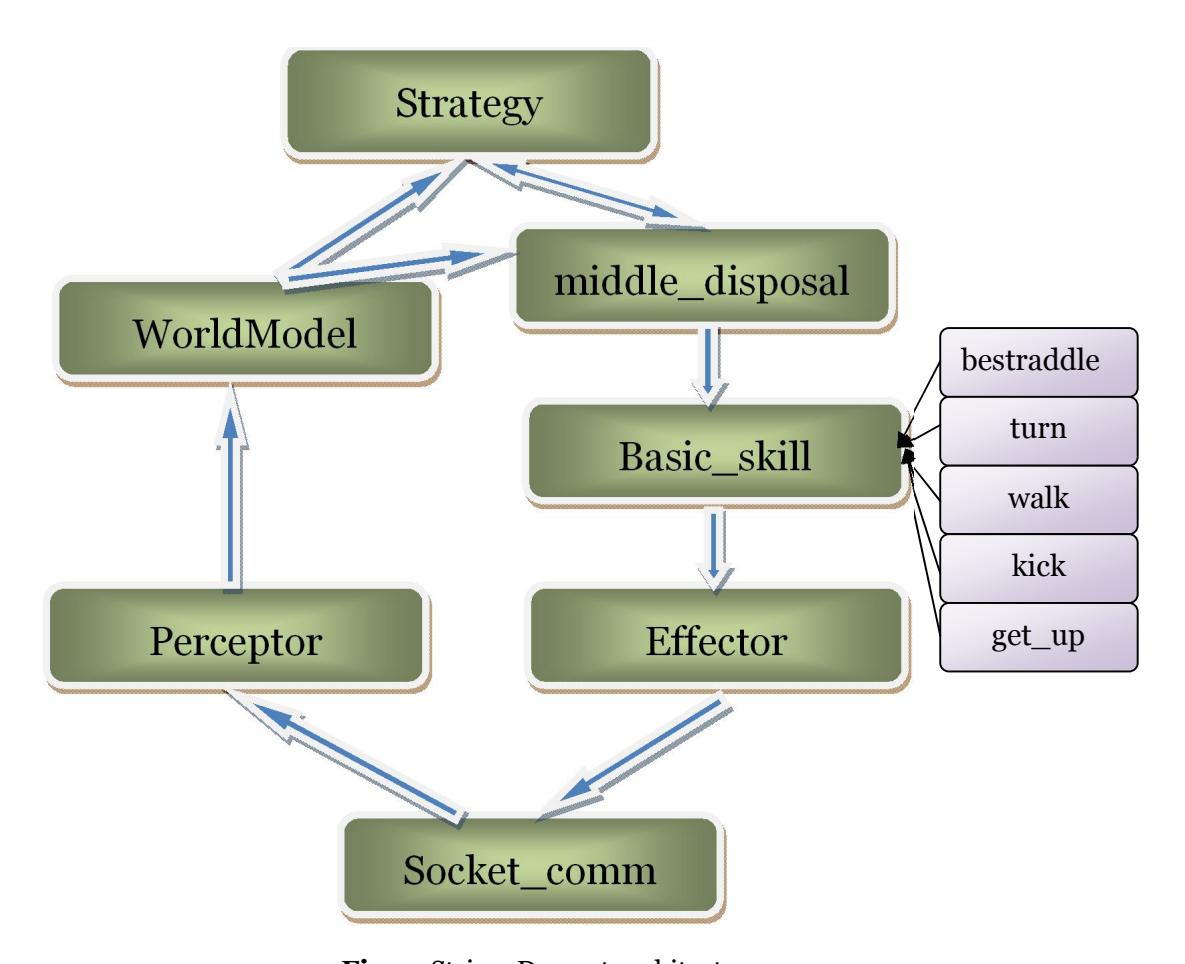
More modules have been added The Strive3D's agent architecture. It makes the agent architecture more flexible. Basic_skill layer is necessary for the humanoid agent. For flexible group the action, middle_disposal layer is added between the Basic_skill layer and the Strategy layer. When more agents cooperate in the match, Strategy layer will deal with the relationship between them. Here is the simple map of Strive team's architecture.
2. Basic Individual Skills
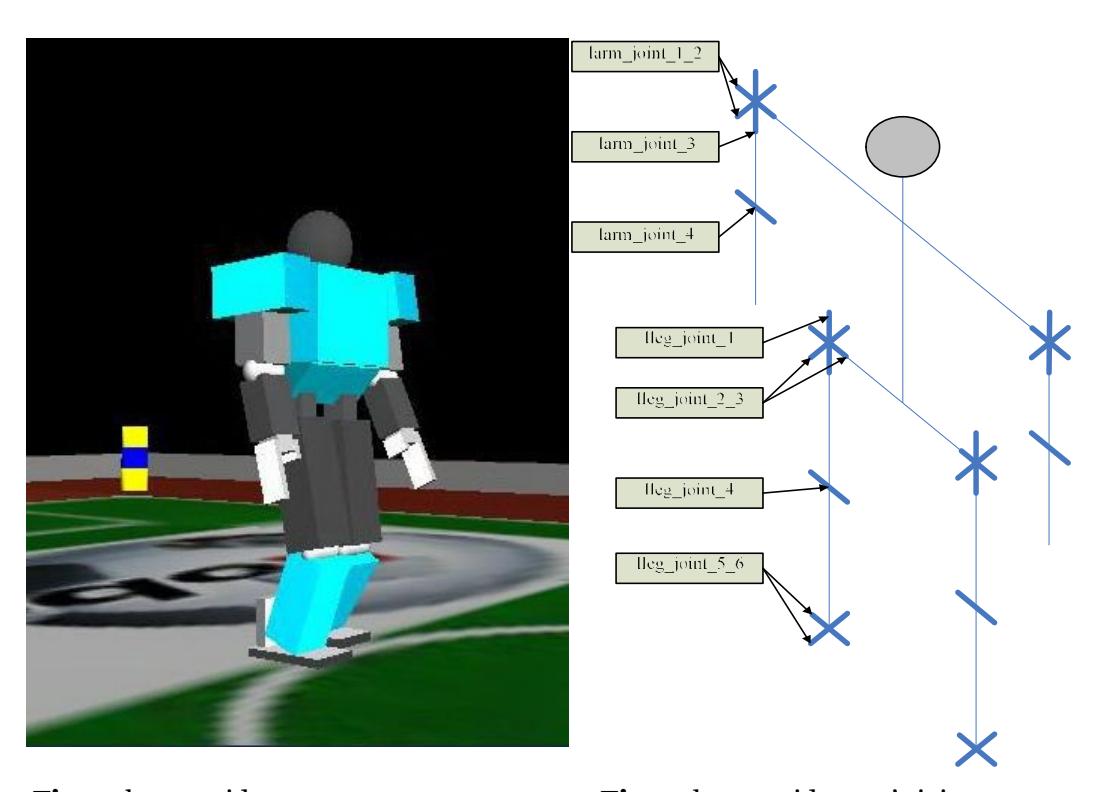
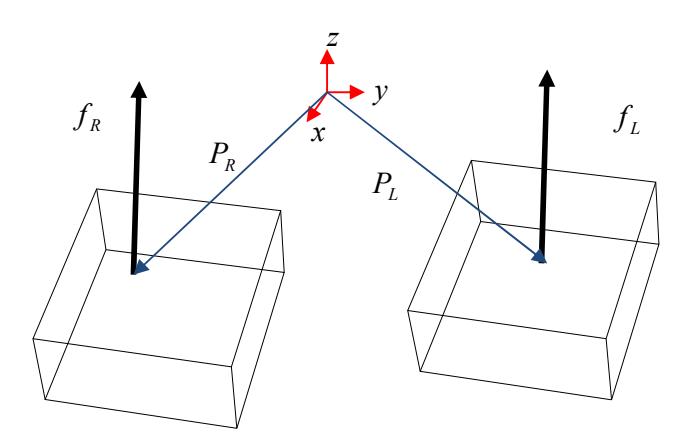
The humanoid model is used in 3D simulation. It was derived from the Fujitsu HOAP-2 robot model[1] So, the basic individual skills will be essential to the further development of the 3D simulation. For instance, biped locomotion is considered to be a very complex task, as it implies controlling a very large number of degrees of freedom (DOFs), the non-linear dynamics of the humanoid body and a wide range of interactions with the environment (gravity, force, collision, perturbations, etc.). The main difficulty is to achieve dynamical stability, and particularly resistance to unexpected perturbations.
III. Conclusion and Vision
With the development and enhancement of the 3D Simulation worldwide, it will strive for making a great forward to more sophisticated i ndividual skills and strategy. For instance, the research on faster and steady walk, smooth transition between actions, etc. Meanwhile, a development tool will be anther focus of its planning.
References
- Fujitsu Humanoid Robot HOAP-2.http://jp.fujitsu.com/group/automation/en/ services/humanoid-robot/hoap2/.
- Shuuji Kajita, Hirohisa Hirukawa, Kazuhito Yokoi, and Kensuke Harada. Hu manoid Robots. Ohm-sha, Ltd, 2005
- Yariv Bachar. Developing Controllers for Biped Humanoid Locomotion . Master thesis, Science School of Informatics, University of Edinburgh, Edinburgh, 200 4.
- J. Pratt. Exploiting Inherent Robustness and Natural Dynamics in the Control of Bipedal Walking Robots. PhD thesi s, Computer Science Department, Massachusetts Institute of Tehcnology, Cambridge, Massachusetts, 2000.