UT Austin Villa 3D Simulation Soccer Team 2008
Shivaram Kalyanakrishnan, Peter Stone
Department of Computer Sciences The University of Texas at Austin
Abstract This paper describes the research focus and ideas incorporated in the UT Austin Villa 3D simulation soccer team entering the RoboCup competitions in 2008.
1 Introduction
In this paper, we describe the agent our team UT Austin Villa is currently developing for participating in the RoboCup 3D Simulation Soccer competition 2008. The main challenge presented by the 3D simulation league is the lowlevel control of a humanoid robot with 20 degrees of freedom, which exposes the contestants to a problem whose nature and scale are dramatically different from those encountered in the 2D league, and indeed the earlier version of the 3D league involving spheres. The simulated environment is a 3-dimensional world that models realistic physical forces such as friction and gravity, in which teams of humanoid robots compete with each other. Thus, the 3D simulation competition paves the way for progress towards the guiding goal espoused by the RoboCup community, of pitting a team of 11 humanoid robots against a team of 11 human soccer players.
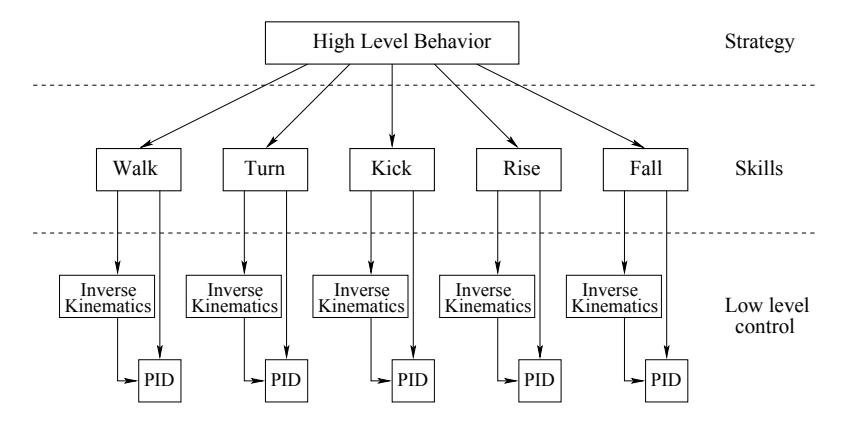
The approach adopted by our team UT Austin Villa to decompose agent behavior is bottom-up in nature, comprising lower layers of joint control and inverse kinematics, on top of which are developed skills such as walking and turning. These in turn are tied together at the high level of strategic behavior. Details of this architecture are presented in this paper, which is organized as follows. Section 2 provides a brief overview of the 3D humanoid simulator. In Section 3, we describe the design of the UT Austin Villa agent, and elaborate on its skills in Section 4. In Section 5, we draw conclusions and present directions for future work.
Portions of this paper are drawn from our earlier technical report [6].
2 Brief Overview of 3D Simulation Soccer
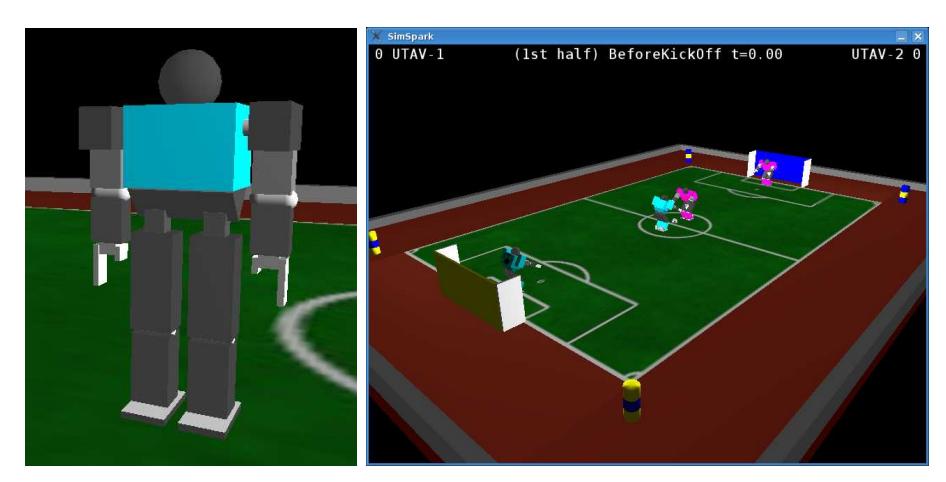
In the 2007 competition, the humanoid robot in the simulation was derived from the Fujitsu HOAP-2 robot model [1]. The robot has 20 degrees of freedom: 6 in each leg and 4 in each hand. Figure 1 shows a visualization of the robot and the soccer field.
Each component of the robot's body is modeled as a rigid body with a mass that is connected to other components through joints. Torques may be applied to the motors controlling the joints. A physics simulator (Open Dynamics Engine [2]) computes the transition dynamics of the system taking into consideration the applied torques, forces of friction and gravity, collisions, etc. Sensation is available to the robot through a camera mounted in its torso, which provides information about the positions of all the objects on the field every cycle. In the 2007 competition, noise-free visual information was provided, with an unrestricted field of vision. The visual information, however, does not provide a complete description of state, as details like joint orientations of other players and the spin on the ball are not conveyed. Apart from the visual sensor, the agent also gets information from touch sensors at the feet, collision sensors, and gyro rate sensors. The simulation progresses in discrete time intervals with period 0.02 seconds. At each simulation step, the agent receives sensory information and is expected to return a 20-dimensional vector specifying torque values for the joint motors.
Since 2007 was the year the humanoid was introduced to the 3D simulation league, the primary focus was on developing robotic skills such as walking, turning, and kicking. This has itself been a challenging task, and is work still in progress. As a consequence, the 2007 competition did not present an ideal opportunity for the development of sophisticated high-level team behaviors. Interestingly, the team sizes were restricted to 2, and the games were conducted on a smaller version of the field than the standard; this was partly because existing computational resources were simply unable to cope with the requirements of running large teams of agents. Each game lasted 8 minutes; tie-breaking challenges included walking to the ball as quickly as possible, and taking a penalty kick.
The transition from the abstract "sphere" agent used until 2006 to the humanoid highlights the resolve of the RoboCup soccer community to embody intelligence in a realistic physical robot. The humanoid robot chosen for the task is indeed challenging to program; we expect that at least in the initial stages, significant time and effort will be devoted in developing low-level control algorithms and skills. Nonetheless, since this is a simulation league, the overhead involved in doing so compares very favorably with the time and labor entailed by a similar endeavor on a real humanoid robot. Indeed, we believe that the convenience afforded by simulation will enable the league to soon progress to tackle increasingly complex problems in humanoid robot behavior, possibly even ones that are yet to be realized in work with real humanoid robots. There are numerous vistas that research in the 3D humanoid simulation league is yet to explore; these provide the inspiration and driving force behind UT Austin Villa's desire to participate in this league.
3 Agent Architecture
At intervals of 0.02 seconds, the agent receives sensory information from the environment. The visual sensor provides distances and angles to different objects on the field from the agent's camera, which is located in its torso. It is relatively straightforward to build a world model by converting this information about the objects into Cartesian coordinates, particularly because visual sensation is complete and noise-free. Once a world model is built, the agent's control module is invoked. Figure 3 provides a schematic view of the control architecture of our humanoid soccer agent.
At the lowest level, the humanoid is controlled by specifying torques to each of its joints. We implement this through PID controllers for each joint, which take as input the desired angle of the joint and compute the appropriate torque. Further, we use routines describing inverse kinematics for the hands and legs. Given a target position and pose for the foot or the palm, our inverse kinematics routine uses trigonometry to calculate the angles for the different joints along the hand or the leg to achieve the specified target, if at all possible. The PID control and inverse kinematics routines are used as primitives to describe the agent's skills.
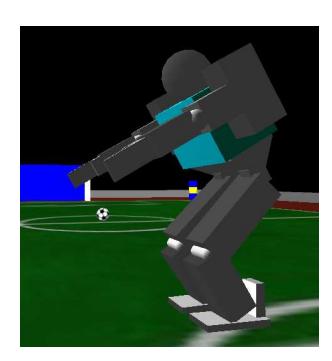
We found that the robot is much more stable while performing skills like walking and turning if it is bent slightly forward (as shown in Figure 3) than it is standing bolt upright. We maneuver the robot into such a position right at the start of the simulation, before it can start executing any of its skills. We elaborate on the agent's skills in section 4.
Developing high-level strategy to coordinate the skills of the individual agents is work in progress. Given the limitations imposed by the set of skills, we employ a simple high-level behavior for 2 versus 2 games. We instruct the goalie to remain standing a little in front of the goal, and to fall to either side to arrest a ball that is heading towards the goal. The other player always attempts to go to a position behind the ball and walk towards the opponent's goal, pushing (dribbling) the ball ahead of it. Ideally, we would have preferred to have the agent kick the ball towards the goal, but unfortunately, we were are yet to implement a reliable kicking skill.
4 Player Skills
Our plan for developing the humanoid agent consists of first developing a reliable set of skills, which can then be tied together by a module for high-level behavior. Needless to say, our foremost concern is locomotion. Bipedal locomotion is a wellstudied problem (for example, see Pratt [9] and Ramamoorthy and Kuipers [10]). However, it is hardly ever the case that approaches that work on one robot generalize in an easy and natural manner to others. Programming a bipedal walk for a robot demands careful consideration of the various constraints underlying it.
We experimented with several traditional approaches to program a walk for the humanoid robot, including monitoring its center of mass, specifying trajectories in space for its feet, etc. Through a process of trial and error, we concluded that a dynamically stable walk is more feasible than a statically stable walk (By "dynamically stable", we mean that the robot is balanced as long as it is moving; by "statically stable", we mean that the robot remains balanced even if it stops moving abruptly.). We achieved a reasonably fast dynamically stable walk by programming the robot to raise its left and right feet alternately (and perfectly out of phase) to a certain height above the ground and then stretching them back to their initial configurations. Inverse kinematics routines determine joint angles for the feet given the target position. As the robot beats its feet up and down, its crouched position causes it to translate forward. Interestingly, it is more appropriate to describe this walk routine as a "run", since there occur points in time during its execution when both feet lose contact with the ground.
By making minor changes to our walk routine, we were able to realize other useful skills for the robot. For getting the robot to turn, all that was required was to orient one of its hips at a slight angle while continuing to beat its feet up and down. Other slight variations of this basic pattern allowed for skills such as walking sideways and walking backwards. In fact, we are able to have the humanoid dribble the ball merely by walking "into" it; this is the only means to propel the ball forwards in the absence of a kick routine. To stop locomotion, the robot gradually slows down the rate at which it takes steps before coming to a complete halt.
Two other useful skills for the robot are falling and rising from a fallen position. We programmed the fall by having the robot bend its knee, by virtue of which it would lose balance and fall to one side. It is not surprising that we found it immensely more difficult to get a fallen robot to rise than to get a standing robot to fall. In our routine for rising, the fallen robot begins to thrash it arms and legs forward and backward until it rests on all fours with its head facing downwards. From this position, it slowly draws its feet closer to its arms, thereby bending significantly at the hips. When it stretches out again, the torso and hands are lifted up, and the robot returns to its upright position. The initial sequence of actions involving thrashing about is somewhat unnatural; however, it serves the purpose of maneuvering the robot into a downward-facing position. The ensuing sequence of actions to return the robot to its upright position strongly resembles a human-like routine for standing up.
Videos of our agent's skills are available at a supplementary web site [3].
5 Conclusions and Future Work
UT Austin Villa is pleased to be a part of the initiative of introducing a humanoid robot in the 3D simulation league. Despite our indifferent showing in the 2007 competition, we believe that significant progress has been made all round from the point of view of research. The simulation of a humanoid robot opens up interesting problems for control, optimization, machine learning, and AI. The initial overhead for setting up the infrastructure is bound to be overtaken by the progress made through research on this important problem in the coming years. While the main emphasis thus far has been on getting a workable set of skills for the humanoid, it is conceivable that soon there will be a shift to higher level behaviors as well. A humanoid soccer league with scope for research at multiple layers in the architecture offers a unique challenge to the RoboCup community and augurs well for the future.
UT Austin Villa has been involved in the past in several research efforts involving RoboCup domains. Kohl and Stone [8] used policy gradient techniques to optimize the gait of an Aibo robot (4-legged league) for speed. Stone et al. [11] introduced Keepaway, a subtask in 2D simulation soccer [4, 7], as a test-bed for reinforcement learning, which has subsequently been researched extensively by others (for example, Taylor and Stone [12], Kalyanakrishnan et al. [5], and Taylor et al. [13]). We are keen to extend our research initiative to the 3D simulation league. Our initial focus for the 2008 competition will be on developing skills like kicking, which we are yet to deploy on our agent, and improve the skills that we have developed through the use of learning and optimization techniques. Banking on a reliable set of skills, we will seek to develop higher level behaviors like passing and intercepting.
References
- Fujitsu Humanoid Robot HOAP-2. http://jp.fujitsu.com/group/automation/ en/services/humanoid-robot/hoap2%/.
- Open Dynamics Engine. http://www.ode.org/.
- UT Austin Villa 3D Simulation Team. http://www.cs.utexas.edu/ ~AustinVilla/sim/3Dsimulation/.
- M. Chen, E. Foroughi, F. Heintz, Z. Huang, S. Kapetanakis, K. Kostiadis, J. Kummeneje, I. Noda, O. Obst, P. Riley, T. Steffens, Y. Wang, and X. Yin. Users manual: RoboCup soccer server — for soccer server version 7.07 and later. The RoboCup Federation, August 2002.
- S. Kalyanakrishnan, Y. Liu, and P. Stone. Half field offense in RoboCup soccer: A multiagent reinforcement learning case study. Proceedings of the RoboCup International Symposium 2006, June 2006.
- S. Kalyanakrishnan and P. Stone. The UT Austin Villa 3D Simulation Soccer Team 2007. Technical Report AI07-348, The University of Texas at Austin, Department of Computer Sciences, AI Laboratory, September 2007.
- H. Kitano, M. Asada, Y. Kuniyoshi, I. Noda, E. Osawa, and H. Matsubara. RoboCup: A challenge problem for AI. AI Magazine, 18(1):73–85, 1997.
- N. Kohl and P. Stone. Policy gradient reinforcement learning for fast quadrupedal locomotion. In Proceedings of the IEEE International Conference on Robotics and Automation, May 2004.
- J. Pratt. Exploiting Inherent Robustness and Natural Dynamics in the Control of Bipedal Walking Robots. PhD thesis, Computer Science Department, Massachusetts Institute of Tehcnology, Cambridge, Massachusetts, 2000.
- S. Ramamoorthy and B. Kuipers. Qualitative hybrid control of dynamic bipedal walking. Robotics: Science and Systems, II, 2007.
- P. Stone, R. S. Sutton, and G. Kuhlmann. Reinforcement learning for RoboCupsoccer keepaway. Adaptive Behavior, 13(3):165–188, 2005.
- M. E. Taylor and P. Stone. Behavior transfer for value-function-based reinforcement learning. pages 53–59, July 2005.
- M. E. Taylor, S. Whiteson, and P. Stone. Comparing evolutionary and temporal difference methods for reinforcement learning. In Proceedings of the Genetic and Evolutionary Computation Conference, pages 1321–28, July 2006.