DreamWing3D3.0 Soccer Simulation Team Description Paper
Weixiang Wang
Key Laboratory of Intelligent Computing & Signal Processing, Ministry of Education; College of Computer Science and Technology; Anhui University; Hefei, Anhui, China
Abstract We continue to carry on the further studied about the edition of DreamWing3D3.0 on the base of DreamWing3D2.0. DreamWing3D has won the third place in Robocup ChinaOpen 2009. In this paper, we mainly present the structure and the techniques of our team.
Introduction
The DreamWing RoboCup Team, starting with only the 2D soccer simulation team, was established in 2007, and then The DreamWing RoboCup Team with 3D soccer simulation team was established in 2008. Now we have focused on Robocup 3D Simulation after two years development. Finally, it had won the 10th place in Robocup ChinaOpen 2008 and then the third place in that of 2009.
Team Structure
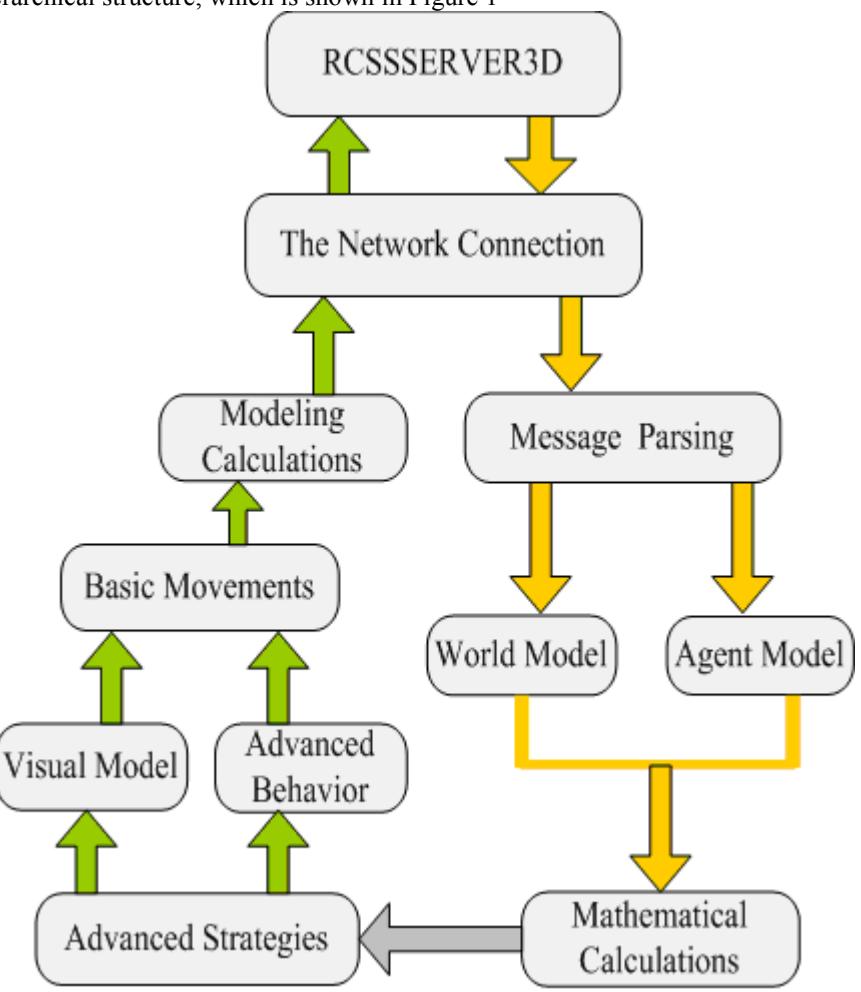
In 2009 we have reconstructed architecture of our agent code and improved the reusability and scalability of it. We divide program into several functional modules: the network connection, message parsing, world model, agent model, mathematical calculations, advanced strategies, advanced behavior, visual model, basic movements, modeling calculations.
From the perspective of artificial intelligence, the most important module is highlevel strategy.
From the perspective of robot, the most important module is the basic movements and modeling calculations
High-level strategy reflects the response of the agent body under different circumstances. Basic movements mainly package a large number of the module robot's basic actions, such as stand up, play, etc.
Modeling calculation module can obtain the optimal value of walking and other movements primarily by way of kinematic model calculation.
The relationship of the various modules of the agents process has shown a clear hierarchical structure, which is shown in Figure 1
Application Techniques
(Section introduction)
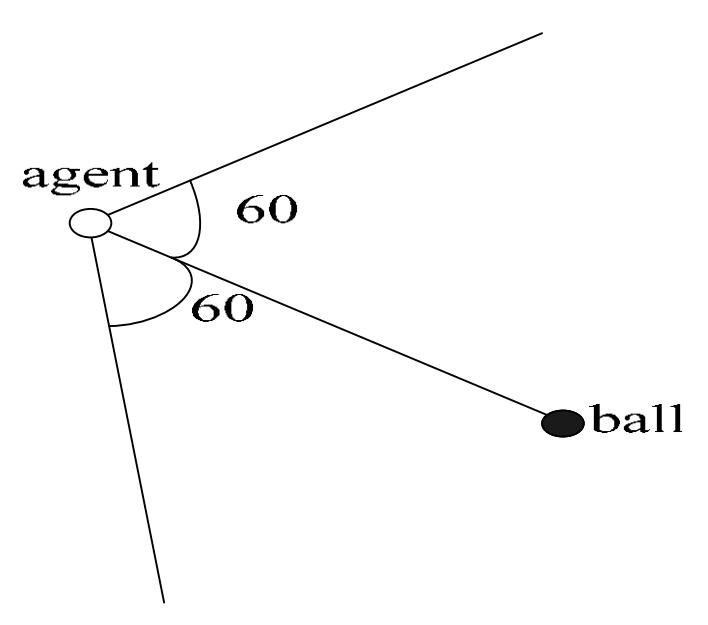
Look for the Ball
Agent's Position
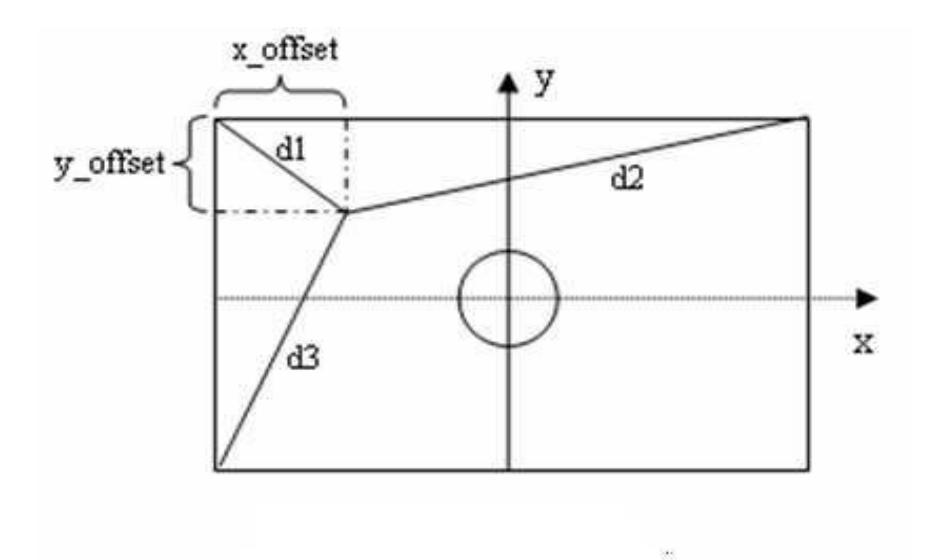
In the case of a person's height is unknown, to calculate one's position needs to see three same height of flags not on the same side at least. It means that must be able to get the three corner's flags, or three goal's flags of the polar coordinates.
Posture
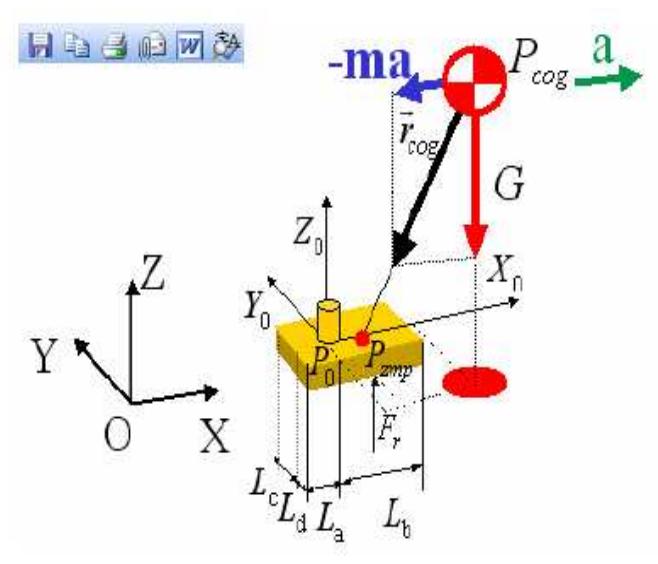
The judgment of standing and downing base on ZMP and gyroscope: It is difficult to calculate relative changes in the world coordinate system matrix ( ) of Torse in the local visual model. So ZMP is used here to determine whether the Agent is hovering, and judge the Agent fall direction through the previous accumulated directions of gyroscope.
3-D Inverted Pendulum
The walking movements of DreamWing2.0 version are manual debugging, whose shortcomings are walking movements instability and slowly. This version uses a dynamic walking algorithm based on the three-dimensional inverted pendulum.
The robot simplified is shown in Figure 4:three-dimensional inverted pendulum model.
3D Gait Pattern
Traditional gait planning is generally considered two-dimensional space, which are the forward and backward. But in many cases, the Robocup 3D Simulation needs to walk in any direction, like the left post, diagonal etc. In DreamWing3D3.0 we used 3D gait planning algorithm, which makes agent to move in any direction without turn around, so it greatly improves the efficiency of the movement.
Multi-Agents
In the bottom, to obtain other agent body positions through the propaganda and visual. In the high-level strategy module, to collaborate with multi-agents by the location information, which we have previously obtained 。
Conclusion
As is shown above, we spent a lot of time in improving the low level implementation details and high level decision making models. We also used a lot of experiments to evaluate our improvements and observed that they are efficient and useful and the results of them are good. All of features above enhance the strength of our team.
We will try to make more progress along the line that we have described in this paper.
References
- Shuuji Kajita, Hirohisa Hirukawa, et al, Humanoid Robots. Tsinghua University Press. Vol.1 Mar 2007.
- Saeed B. Niku. Introduction to Robotics Analysis, Systems, Applications. Publishing House of Electronics Industry. Vol.2 Nov 2006.
- Tan Min, Xu De, et al, Advanced Robot Control. Higher Education Press. Vol.1 May 2007.