FUT-K Team Description Paper 2010
Masahito Yashiki, Kenta Miyajima, Kazutomi Sugihara, Kazumasa Ohkuma, Teruya Yamanishi
Department of Management Information Science, Fukui University of Technology Gakuen, Fukui 910–8505, Japan
Abstract This paper describes concepts of movements for agents and current statuses of team FUT-K on Robocup Soccer 3D Simulation. In addition, strategy which makes soccer game interesting and the future work are mentioned.
Introduction
FUT-K that is mainly composed of undergraduate students of Fukui University of Technology in Japan has been organized since fall 2007. The purposes of our team are to grow knowledge and experience of the computer language and the information science through applying themselves to Robocup Soccer 3D Simulation. Though almost members of our team are unskilled at programming yet, we believe that now our team are developing with getting advice from other teams.
Last year, we got first chance to participate in the world competition, RoboCup 2009 Graz, and were able to acquire a lot of things about soccer strategy and techniques of the movements for humanoid robot as the 3D soccer agent from this competition. By obtaining this experience and knowledge at RoboCup 2009, the movements of agent are evolutionarily advanced at present.
In this paper, we introduce the improvements on the the 3D soccer agent during this year as follows:
- Stable and continuous movements of the agent
- Smooth and omnidirectional movements of the agent
- Total football by collaborative agents who play the role of both defense and offense
The details are explained in following sections.
Improved Movements of the Agent and Collaborative Actions for Soccer Game
In order to play the soccer, humanoid robots of the soccer 3D agent must be implemented in the basic movements such as walking (running), kicking, getting– up, veering, and so on. In addition, these movements should be stable and quick to win the soccer game. In this section, we explain improvements on our agent after RoboCup 2009 Graz.
Stable and continuous movements of the agent
A simple algorithm for the biped walking of the humanoid robot was suggested in [1]. In this algorithm, the biped walking is achieved by the linear combination of three elementary motions: centroid correction, forward movement, and stepping. According to this idea, we have implemented these motions in the agent, and succeeded in the realization of the biped walks. But, the agent frequently falls over by not only contacting other agents but also the off-balance from the inadequate position for the centroid of moving agent. Thus, at first we tried to improve to achieve more stability in motion. Though former agent had the stride control for the forward and backward biped walking, they did not have the stride control for lateral walking [2]. Therefore, the stride control is added in the lateral walking to restrain the rapid centroid movement. That control is realized by following form :
$$S_{\perp} = Y_{\perp} \frac{1}{1 + e^{(H\alpha_{\perp} + \beta_{\perp})}}$$
where $Y_{\perp}$, $\alpha_{\perp}$, and $\beta_{\perp}$ are the ideal stride, the gain, and threshold value of agents, respectively. In addition, $H$ represents the number of the step from the start. Though the value of $S_{\perp}$ is the positive and small value at the start point, it becomes gradually close to the theoretical stride. Thus, introducing $S_{\perp}$ makes the tremor of the agent smaller when the agent starts up. The result of gyrosensor measurement in the upper body of the agent are shown in Fig. 1 and Fig. 2 for two cases at the lateral walking: One is taken into account the stride control (Fig. 1) and the another is without the stride control (Fig. 2). Comparing Fig. 1 and Fig. 2, we can see that the upper body becomes stable by adding the stride control in few steps, and, in particular, the swing of back and forth keeps to be very small over all.
Next we make the mention on reduced movements of the agent inconsistent to the stability of the motion. In order to make movements quick with keeping the stability, we attempt the time crunch of the procedure between the movement and the next one. For conventional way, our agent always had to stop and stand with both feet together for a few seconds before starting next movements. So, by implementing in the agent a stepping movement for the transition to the next movement from the previous one, we build up the continuous movements of the agent. Now, we consider two cases of the continuous movements in order to find effects of the stepping movement:
Movement 1: Agent stands on the circle line of the center circle on the soccer field, and goes for middle of the circle, Making 90-degree turns on the middle of the circle, it moves to the circle line.
Movement 2: Going back and forth for the diameter of the center circle on the soccer field.
The walking trajectories of the agent for Movement 1 and 2 are indicated in Fig. 3, and the travel time for two cases of the continuous movements is listed on Table 1. From the Table 1, one can find that the travel time becomes decreases of about 13% $\sim$ 25%. Thus, we succeeded to improve the movement of the agent.
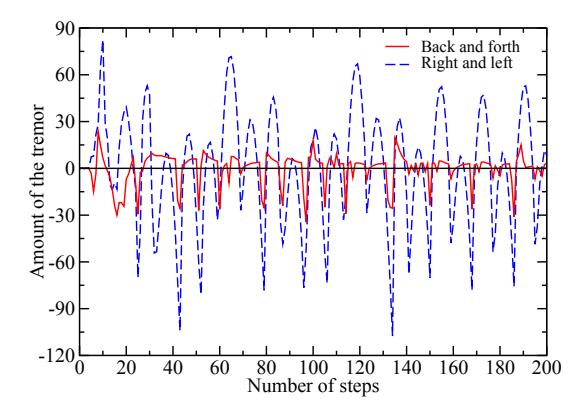
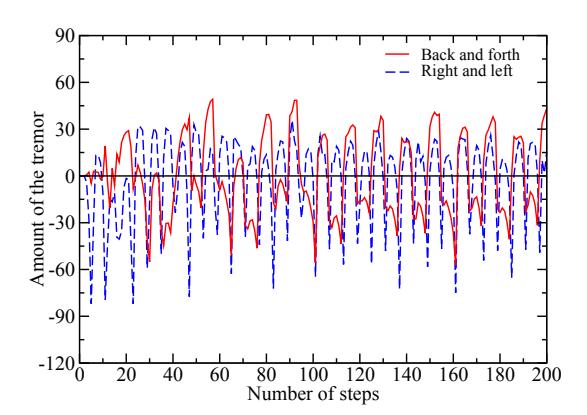
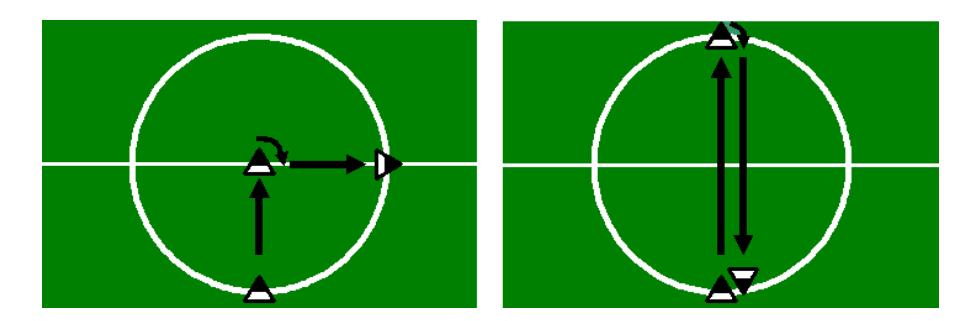
Table 1. The travel time time for two cases of the sequence of movements with the stepping walk or without one.
| Sequence of movement Stepping walk No stepping walk | ||
|---|---|---|
| Movement 1 | 12 [s] | 16 [s] |
| Movement 2 | 20 [s] | 23 [s] |
Omnidirectional movements of the agent
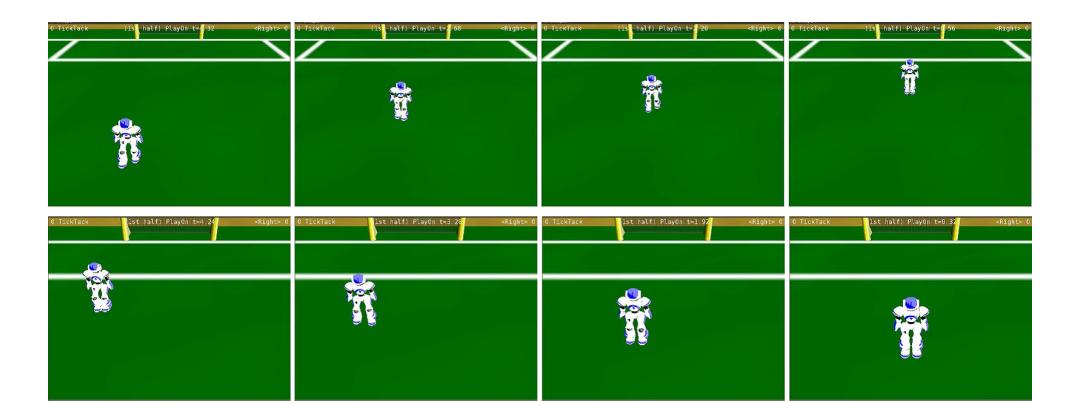
Let us consider a movement for skew walking. When our previous agent walks in an oblique direction, they go forward after a change of direction. It has taken much time for the ambulatory movement. Here we establish an omnidirectional movement of the agent by implementing skew movements using a superposition of the forward (backward) movement and the lateral one [3], which is given as a function of the direction of movement $\theta$ by
$$J(\theta) = \frac{M_{\text{Forward(Backward)}}}{M_{\text{Lateral}}}$$
where $M_{\text{Forward(Backward)}}$ and $M_{\text{Lateral}}$ are the forward (backward) movement and the lateral one, respectively. The screenshots of this omnidirectional movement are shown in Fig. 4. By implementing omnidirectional movements, the agent can transfer on optimal shortest path.
Total Football by collaborative agents carrying the role of both defense and offense
At 1974 FIFA World Cup Germany, Dutch team surprised opponents and scorelines tactically. Because Dutch team brought the new kind of strategy that no player in this team was fixed in his nominal role; anyone was able to be successively an attacker, a midfielder and a defender. Thus, the player of the team who moved out of his position was replaced by another player, so retaining the team's intended organizational structure. Today, this way is so-called "Total Football", and recently, the Total Football is utilized by several teams, such as F.C. Barcelona in Spanish team, Arsenal F.C. in English team and Dutch team A.F.C. Ajax. In particular, we guess that the Total Football is exceptionally beneficial, especially for the game of the small-players match-up like 3 on 3 players of 3D simulation league.
Now, we try to control the agents with collaborative behaviors that is not fixed in one role as the defense or offense according to the consideration of the "Total Football". Namely, two agents simultaneously behave the role of the defense or offense as the situation demands except for one goal-keeper player agent. But there is one problem for the realization of this idea. Each agent must be always get an information on the distance or location of other agent because it keeps off that two agents simultaneously go to take the ball, and run into each other. One of answers for the problem might use transmitting the messages bi-directionally between two agents. The 3D simulation server has "Say-Hear" command as a communication function between friend agents. This command transmits the message of up to 512 Byte from a agent to a nearest friend and/or foe agent. Using the Say-Hear command, our agents transmit the message encoding distance to the ball each other, and the nearest agent to the ball begins actions in order to take the ball. By developing this message, it is possible to play the collaborative behavior like the passing ball and shooting by waiting another friend agent at open space occupied by foe agents. Fig.5 shows the output log-file of the message by the server.
Conclusions and Future Works
In this paper, we mentioned the way of implementation on movements and collaborative behaviors for our soccer 3D agent. The agent got continuous movement by introducing the stepping between previous movement and next one, and made movements quick. Also, it was implemented the omnidirectional movements on our agent from a superposition of the forward (backward) movement and the lateral one. As a result, the agent was able to walk on a skew at any angle, and reduced the rotation movement in the sequence of movements become successful.
For the strategy of the soccer game, we attempted to realize the "Total Football" by taking into account of the small-players match-up for 3 on 3 players. It is very important for this strategy to synchronize behaviors of each agent and harmonize their actions. By using the "Say-Hear" command to send the message of location and action for oneself to another agent, the agents communicated each other, and created collaborative behaviors.
However, it is not enough for our agent to win the soccer game yet. There are a few problems. For example, the walking of curved motion is not realized and it has limitations for creating behaviors of agent from programming configuration under the "IF - THEN" rule as well-known in the field of artificial intelligence. To solve these problem is not currently easy, but the problem on the actionemergent like creating behaviors of agent is grand challenging. We will try to establish the intelligence of agent using new ways on the intelligent informatic science alternative to the "IF - THEN" rule, for example neural network.
Acknowledgements
This work is supported in part by research grants from Fukui Prefecture and Fukui University of Technology and, also a Grant-in-Aid for Scientific Research (C-21500962) from the Japan Society for the Promotion of Science.
References
- Chang, M., Mitsui, T., Asai, H., Sugiyama, M.: Neural–Oscillator–based Algorithm for Humanoid Robot Locomotion. In: Ann. Rep. of Gifu Prefecture Research Institute of Information Technology 5. pp. 77–79 (2003)
- Nakamura, A., Yamanishi, T.: A development of simple gait methods for 3D agents. In: The 71th National Convention of IPSJ pp. 2-87 – 2-89 (2009).
- van Dijk, S., Polani, D: Principled Construction of Perception and Action Skills for Bold Hearts 3D 2009. In: the Team description paper of 3D simulation league in RoboCup 2009 Graz (2009).