NomoFC Team Description Paper for RoboCup 2010
Takeshi Uchitane, Youichi Akabane, Toshiharu Hatanaka
Department of Information and Physical Sciences, Osaka University, Japan
Abstract We deal with an evolutionary computation based approach to acquiring bipedal walking. In this paper, a basic idea is described to set adequate parameters for walking system, including Central Pattern Generator, robotic angle control systems and foot trajectories. Then we suggest a match against human players by using 3D soccer simulator since we can know the completion rate of soccer robot's skill through this match.
1 Introduction
In 2006 and 2007, we took part in RoboCup Soccer Simulation League 3D as the team RoboLog3D , because some people of RoboLog3D affiliated to Osaka University from Koblenz University. Since 2008, NomoFC has taken part in RoboCup Soccer Simulation League 3D. And the origin of the name of Nomo is from our division name that is "NOnlinear systems, Modeling and Optimization group".
A big advantage is expected if a humanoid is able to move quickly and stably at a soccer game and is able to get correct positions of any objects on the field. Hence, we are especially focusing on a fast walking skill with NAO model in a few years.
The purpose of our study is to bring a fast and robust locomotion to 3D simulation robot because the RoboCup 3D Soccer simulator is a good tool for studying humanoid walking, we deal with the humanoid robot's walking with Central Pattern Generators (CPGs) by using RoboCup 3D Soccer simulator.
In this paper, first of all, we describe an idea to make humanoid robot be able to walk fast. Because we have to build a model and adjust many parameters in the model, as you know, it is hard to take on NAO's locomotion. Therefore, some team has much effort to get their walking modules. From this viewpoint, we propose an automatic parameter tuning method, by introducing Evolution Strategies that is one of Evolutionary Computations. We show the idea to tune the some parameters for walking in the section 3.
Then we suggest a match against human players. In RoboCup world competition, sometimes the robot's soccer match has took place against human. And we could understand the gap to accomplish the goal to beat the human players and find next issues. So we consider that it is very important that we know the the completion rate of soccer robot's skill through this match. Therefor we suggest some interface to make a match against human players as if the human player would play a TV game. We show the detail of this idea in the section 3.
2 previous works
In recent years, humanoid robots are receiving much attention to develop a robot system coexisting with human beings such as a livelihood support robot and also to understand human beings by constructing a human like robot. To achieve such robots, nowadays nature mimicking methodologies are widely used to develop architecture of robot motion and intelligence. Especially some kinds of central pattern generators (CPG) have been studied by many researchers due to the difficulty of self-adaptive walking in dynamic environment in case of using traditional model based approach [1] [2] [3]. The gait that is generated by the CPGs is expected to be stable and robust to disturbance from the environment. A plenty of researches have been focused on just generating stable, periodic and stationary walking pattern at some places, such as a flat, a slope and an irregular terrain.
2.1 Walking model with CPG
We examined the phase oscillator [1] as a basic walking control unit of our agent. The dynamics of Phase oscillator is
$$\dot{\phi}i(t) = \omega + \sum{j(j \neq i)}^3 w_{ij} \sin(\phi_j(t) - \phi_i(t) + \delta\theta_{ij})$$
Where ω and wij are internal parameters in the CPG.
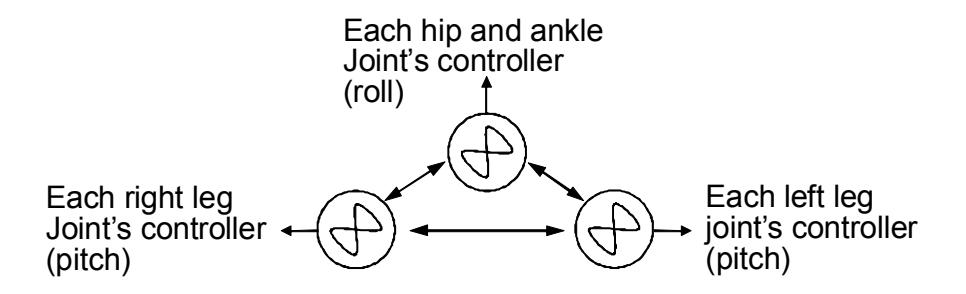
Fig.1 indicates the structures of each CPG model implemented in our agent. We use three Phase oscillators and these oscillators are affected by the output signal from the others. So we can make a motion of robot by using the signals because the output of these oscillators automatically converges to a stable pattern.
3 How to tune the parameters
Evolution Strategy (ES) and Genetic Algorithm are the powerful tools for searching some optimization solutions. In this section, we introduce ES for tuning walking parameters.
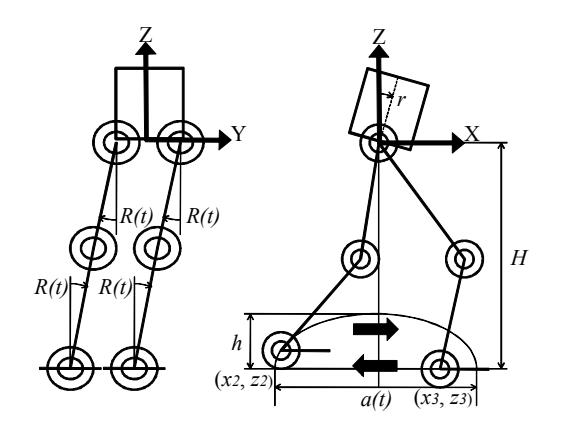
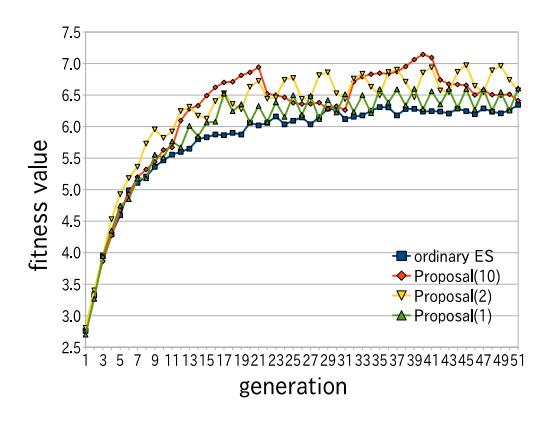
In Evolution Strategy, the all parameters are mutated when some children are made from their parents. But this method of mutation is not reasonable when the parameters include some kinds of modules because the set of parameters in a module may affects the other set of modules parameters. So we suggest to separete the phase of searching and verify this idea is effective to tune the parameters. During a first few generations, we only tune the CPG's parameters and controller's parameters. Next, during same generations, we only tune the parameters which rotbot's stance in walking.
4 Future works
In this section, we suggest new idea that the simulated agents make a match against human players, in order that the agent will be able to play soccer against human team by 2050.
The robot's soccer match against human has taken place in humanoid league, but such match has not taken place in simulation league 3D.
In the national conference of PRIMA 2009, a one of Japanese team showed the interface which makes us be able to have a game against simulated soccer agent in soccer simulator 3D. The human players controlled soccer player with game pad as if they played a TV game. Before the match, we thought the human players can win easily but they could not play the game with advantage although they could detect the strategies of the opponents during the match.
We think that it is a reason why the human player faced an uphill battle that the robot's motion was not polished. And the match against human players may imply the completion rate of a player's skills. According to this assumption, we can know the level of our accomplishment. And the match will make the AI learn the human's skill too. Therefor we suggest that we make a common interface to fight against simulated agents and we will have to take place some match against human in RoboCup simulation league 3D.
5 Conclusion
In this paper, we have briefly introduced our achievements in the acquirement of a gait pattern, which is lower level control system of a soccer agent. A humanoid agent is able to walk fast and stable by tuning the parameters. And we show the two ideas. The first is for tuning walking parameters and the second is for the match against human. In the future, we believe that this ideas will be more exciting the robot's soccer game with us.
References
- K. Tsuchiya, S. Aoi, and K. Tsujita, " Locomotion control of a biped locomotion robot using nonlinear oscillators,"Proceedings of the 2003 IEEE/RSJ International Conference on Intelligent Robots and Systems, pp. 1745-1750, 2003.
- H. Kimura and Y. Fukuoka,"Biologically inspired adaptive dynamic walking in outdoor environment using a self-contained quadruped robot: 'tekken2',"Proceedings of the IEEE/RSJ International Conference on Intelligent Robots and Systems, pp. 986-991, 2004.
- S. Miyakoshi, G. Taga, Y. Kuniyoshi and A. Nagakubo,"Three dimensional bipedal stepping motion using neural oscillators - towards humanoid motion in the real world -,"Proceedings of the 1998 IEEE/RSJ International Conference on Intelligent Robots and Systems, vol. 1, pp. 84-89, 1998.