CIT3D Soccer Simulation Team Description for RoboCup 2011
Chunguang Li, Ren Liu, Xiaopei Feng, Yinghua Chen, Shengtao Lu
School of Computer and Information Engineering, Changzhou Institute of Technology, Changzhou 213002, Jiangsu, PR China
Abstract This paper describes some main features of the CIT2011 3D soccer simulation team. After a brief introduction to CIT 3D team, the characteristics of CIT2011 3D soccer simulation team are represented. These include the following aspects: agent architecture, walking gait planning, and fast getting up action. Finally we make a summary of this work and our future research works are showed in this paper.
Introduction
CIT 3D team, formerly named CZU 3D, which was built in 2005, has taken part in serveral RoboCup competitions. We won the 13th place in RoboCup2006, the 2nd place in RoboCup ChinaOpen2007, the 4th place in RoboCup2008 and the 3rd place in RoboCup ChinaOpen2008. Due to various reasons, we could not participate in RoboCup2009 and RoboCup ChinaOpen2009, but we did not give up the research work in this field. In 2010, we won the 5th place in RoboCup ChinaOpen2010.
This paper introduces the features of our team. Section 2 offers a brief introduction to general framework of CIT agent. Section 3 introduces the skills of agent, include walking skill and fast getting up skill. Section 4 describes our localization method. In Section 5, we draw conclusions and present directions for future work.
Agent Architecture
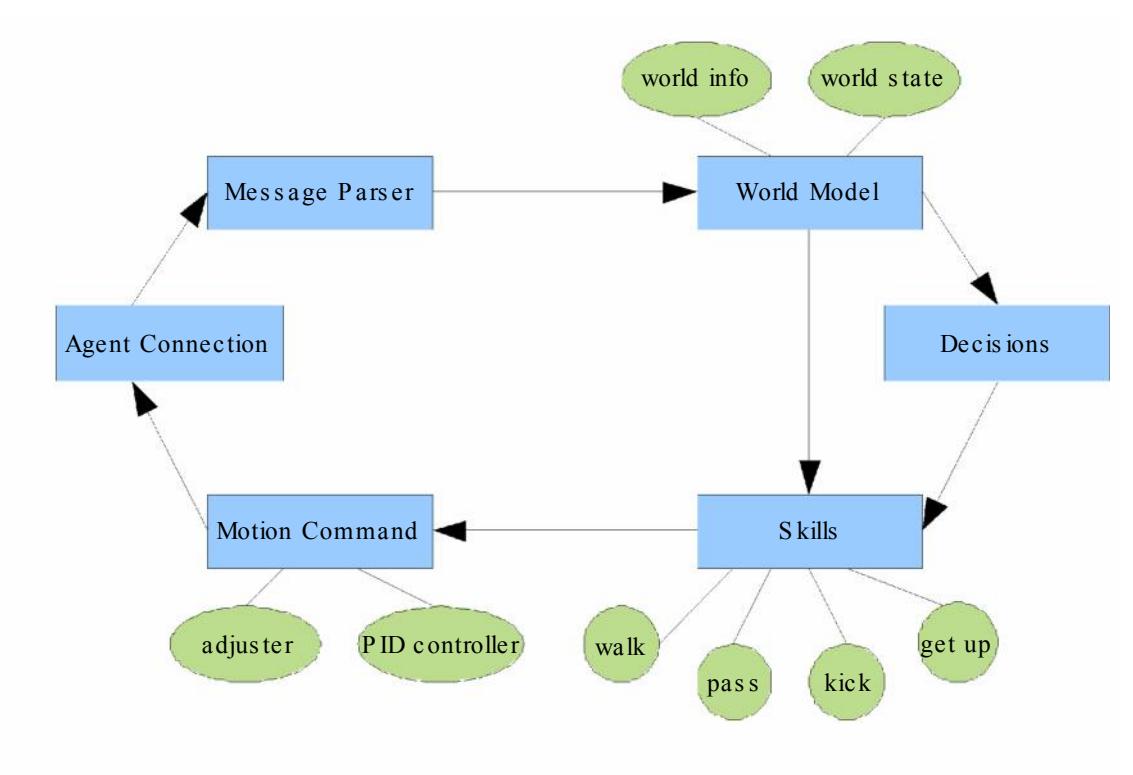
After RoboCup 2008, we rewrote all program of our team, enhanced the readability and maintainability. The overall structure of our program is consits of many modules, such as AgentConnection, MsgParser, WorldModel, Decisions, Skills and so on. Nonsingle modules not only facilitate the development of the normal programming, but strengthen the flexibility, differentiation, and coordination between the agents. The agent architecture of our team is displayed in Fig. 1.
Agent Skills
In this section, we introduce the skills of CIT agent. As we all know, it is difficult to create stable and smooth walking gait of humanoid robot. Thus, we give a lot of details about walking gait planning method of our agent. After the introduction of walking gait planning, we offer a brief description of fast getting up action.
Walking Model
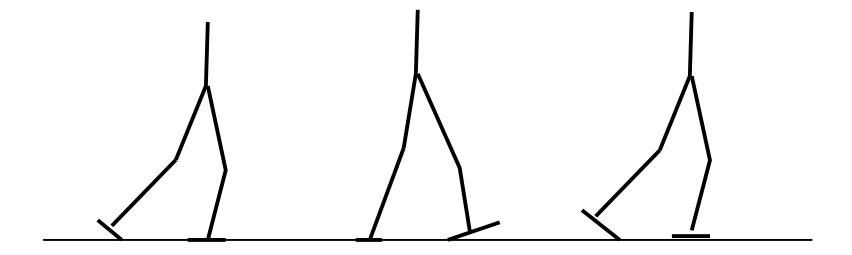
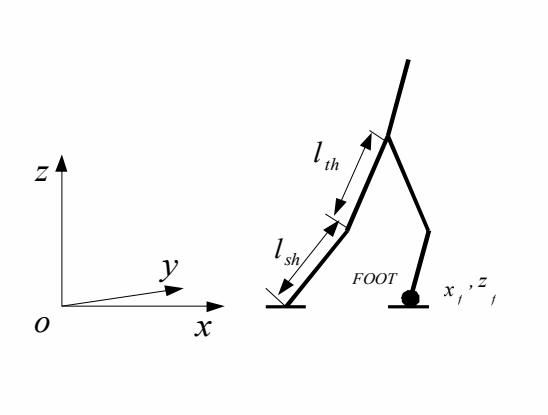
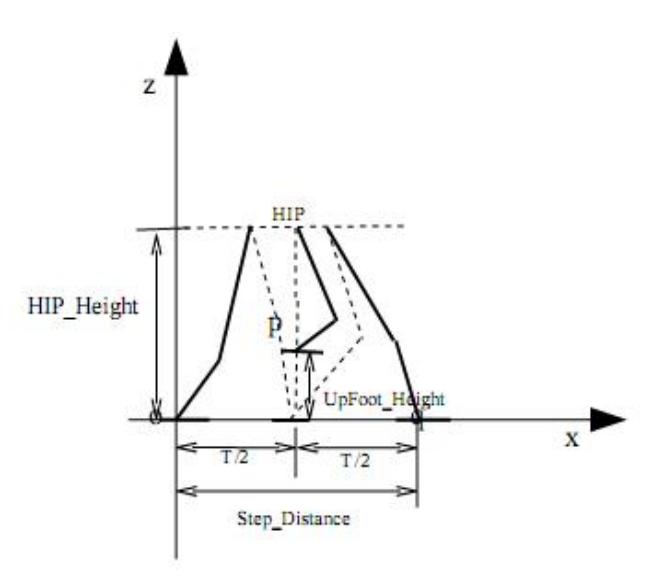
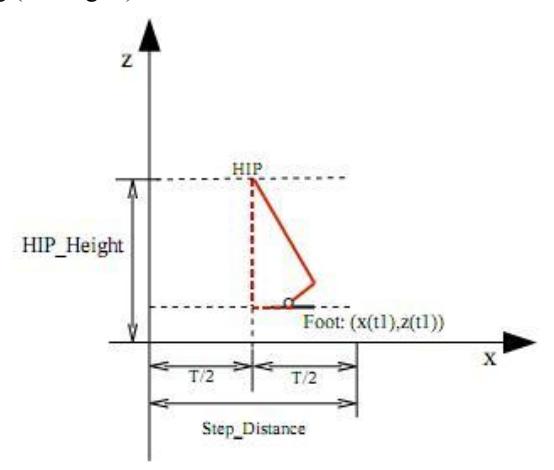
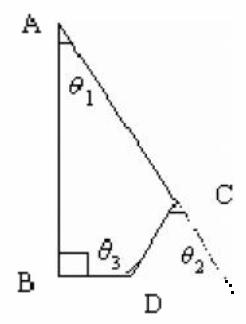
Implementation of the agent's walking gait is the most difficult part and is the gist in the 3D simulation competition. The walking gait implementation become difficult because of the stability problem since a biped robot only has two legs and the stability is much compromised compare to a quadruped or hexapod. Walking gait is the steps taken by the biped robot to be able to walk. The walking gait of the biped robot is based on the walking gait of a human being. Based on human's gait pattern analysis, we could find the typical walking process of human can be divided into two phases: single support phase and double support phase. When the two phases alternately, forward movement is taken at the same time. The action above is repeated uninterruptedly while the body balance is kept and then, the walking function comes true. (See Fig. 2)
Getting Up Action
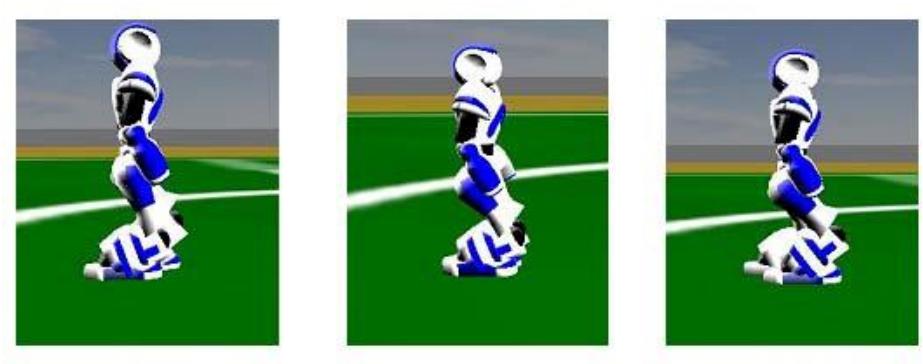
Getting up action have a direct impact on the performance of a 3D simulation team. Hence, we also do a large number of studies on it. As getting up action is off-line action, we encapsulate the action which created by debugger. In the simulation competition, agent can call the action directly. A good getting up action should be stably and rapidly. Inspired by the getting up action of human, we design our own getting up action, as showed in Fig. 8. This action needs about 1.6 seconds, and has a strong anti-interference capability.

PID Controller
After obtained the angles of leg joints during the process of walking by the abovementioned method, if just directly send the angle command to the soccer server, we found there would be an error between given angle and actual angle of joint after several cycles. Therefore, we need a good method to correct the error between a measured angle and a desired angle. We design a PID controller to the angle of joint to compensate the error and it work perfectly.
Conclusion and Future Work
In this paper, we offer an introduction to the current status and some main achievements of our CIT2011 team. In the coming time, we will improve the motion and actions of agent, for instance, making the agent pass the ball faster, closely cooperating with each other among the teammates and etc. By this, our CIT2011(3D) will get very powerful.
References
- A Goswami, V Kallen, Rate of changes of angular momentum and balance maintenance of biped robots[C]. Processdings of the 2004 IEEE international conference on robotics and Automation. New Orleans, LA, 2004: 3785-3790.
- K Harada, S, Kajita, K. Kaneko, H. Hirukawa. Pushing Manipulation by Humanoid considering Two-kinds of ZMPs[C]. Proceedings of the 2003 IEEE International Conference on Robotic and Automation. Taipei, Taiwan, 2003:1627-1632.
- Y. Ogura. Stretch Walking pattern generation for a biped humanoid robot[C]. In Proceedings of 2003 International Conference in Intelligent Robots and Systems. Las Vegas, Nevasa, October 2003.
- Nima Jamshidi, Mostafa Rostami, Gait Optimization of Biped Robot during Double Support Phase by Pure Dynamic Synthesis. American Journal of Applied Sciences 5 (9): 1175-1181, 2008
- Xu Yuan, Shen Hui, Qian Cheng, Chen Si, and Tan Yingzi, SEU-RedSun 2008 Soccer Simulation Team Description. In RoboCup 2008: Robot Soccer World Cup, Suzhou, P.R.China, July 2008.
- Xue Feng, Tai Yunfang, Xie Jiongkun, Zhou Weimin, Ji Dinghuang, ZhangZhiqiang, Xiaoping Chen, WrightEagle2008 3D Team Description Paper. In RoboCup 2008: Robot Soccer World Cup, Suzhou, P.R.China, July 2008.
- Shivaram Kalyanakrishnan, Peter Stone, UT Austin Villa 3D Simulation Soccer Team 2008. In RoboCup 2008: Robot Soccer World Cup, Suzhou, P.R.China, July 2008.
- Pengcheng Lian, Yanbin Zhuang, Yiqing Song, Chunguang Li, CZU3D Soccer Simulation Team Description for RoboCup2008. In RoboCup 2008: Robot Soccer World Cup, Suzhou, P.R.China, July 2008.