Apollo3D Team Description Paper
Chonghu Zheng, Yue Hao, Qiyuan Cong, Zan Gao, Jie Jiang, Zhiwei Liang, Zhiyong Zhang
College of Automation; Nanjing University of Posts and Telecommunications
Abstract Apollo3D is a team in RoboCup soccer simulation 3D league. We mainly aim at building a systematical architecture of intelligent and skillful robots. During the past year we achieved to create the new cooperation tactics to handle the current vision. The 9vs9 version requires a more and better complicated tactic to avoid robots's being in a disorder. And given to the noise added to the server, Apollo3D Soccer Simulation Team adopts another new method of localization, WorldModel construction and OppModel construction. Based on the solution of inverse kinematics of a leg by combining analysis method with numerical method, trajectory planning method is used to implement the humanoid robot walking skill in the 3D simulation environment, and also Omni-directional walk under certain conditions is achieved.
1 Introduction
Apollo Simulation 3D Team was established in 2006, and successfully attended several competitions. We have won the 1st place in Robocup 2010 and the 3rd place in Robocup 2011 recently. The Nao robot is much like the real robot. This creature attracts a large amount of students to devote to the research field. Thanks to the devotion and cooperation of these students, several achievements had been achieved in the past year. In the following section2, the new method of localization is presented.
Biped walking pattern is one of the most difficult problems in the humanoid robot area, and there exists no ideal algorithm for a generalized walking scenario. The method for planning walking patterns is presented in section 3. The new tacitic will be shown in section 4. It is followed by conclusion and future work in section 5.
2 Localization
We have the same vision mode with last year's. According the feature of the vision mode, we gain the equation as follow:
$$(x-x_1)^2 + (y-y_1)^2 + (z-z_1)^2 = r_1^2$$
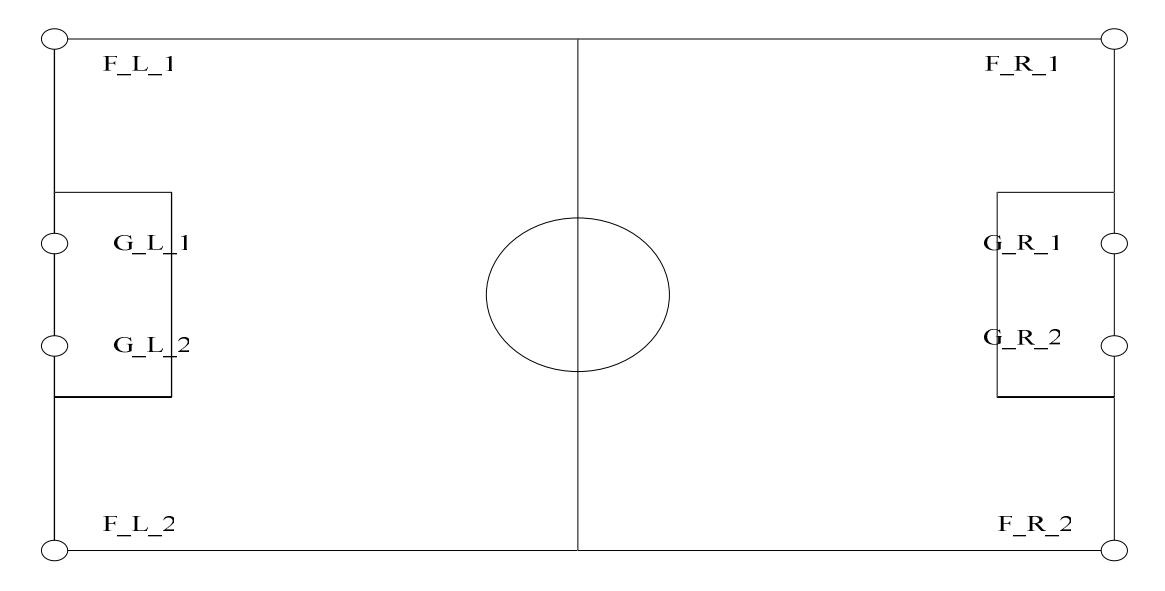
where x, y and z that are describe as $(x, y, z)$ is the position of the center of the robot, and $x_1, y_1, z_1$ that describe as $(x_1, y_1, z_1)$ is the position of the flag namely of the field in the Fig.1. And $r_1, r_2, r_3$ that describe as $(r_1, r_2, r_3)$ is the distance between the center of robot and the flag of the field. So we gain one equations set including eight equations.
Thanks to the same height for z direction of all the flags of the field, we can solve the x or y easily form of two equations of the equations set that have the same y or x. For example choosing two equations formed from flag F_L_1 and flag F_L_2, we can calculate the y directly. To improve the accuracy, we select the equations with the same x coordinates to calculate the y coordinates, and then take average. The final result will be the y coordinates of the center of the robot. As the same way, we can also gain the x coordinates of the centered.
3 Walking Trajectories
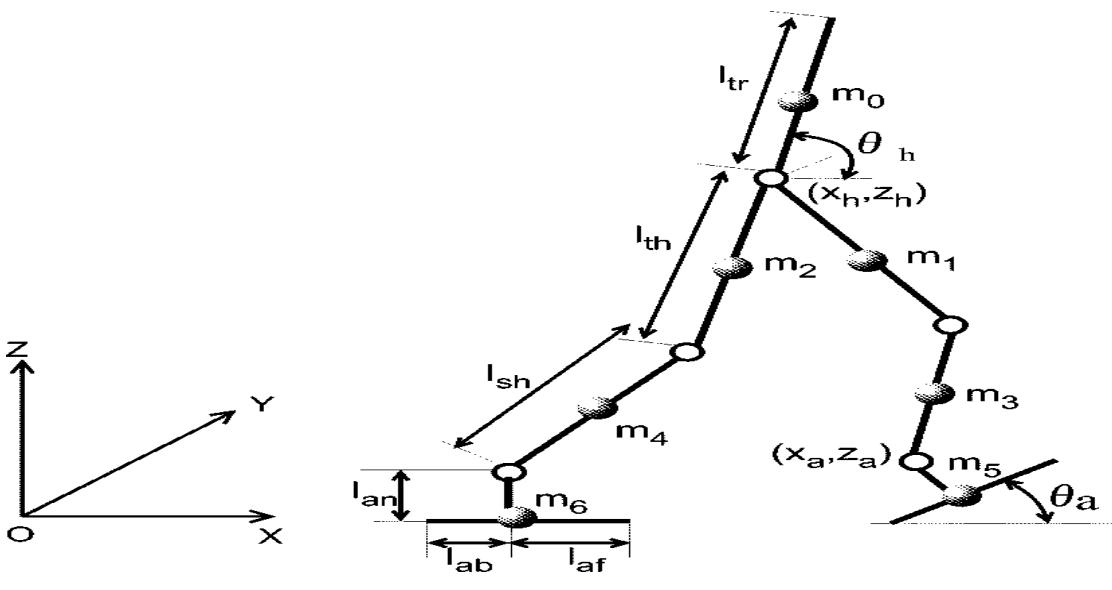
See Fig.2, each foot trajectory can be denoted by a vector $^T$ $X^a = [x_a(t),z_a(t),\theta_a(t)]$, and the hip trajectory can be denoted by a vector $^T$ $X^h = [x_h(t),z_h(t),\theta_h(t)]$.
3.1 Foot Trajectories
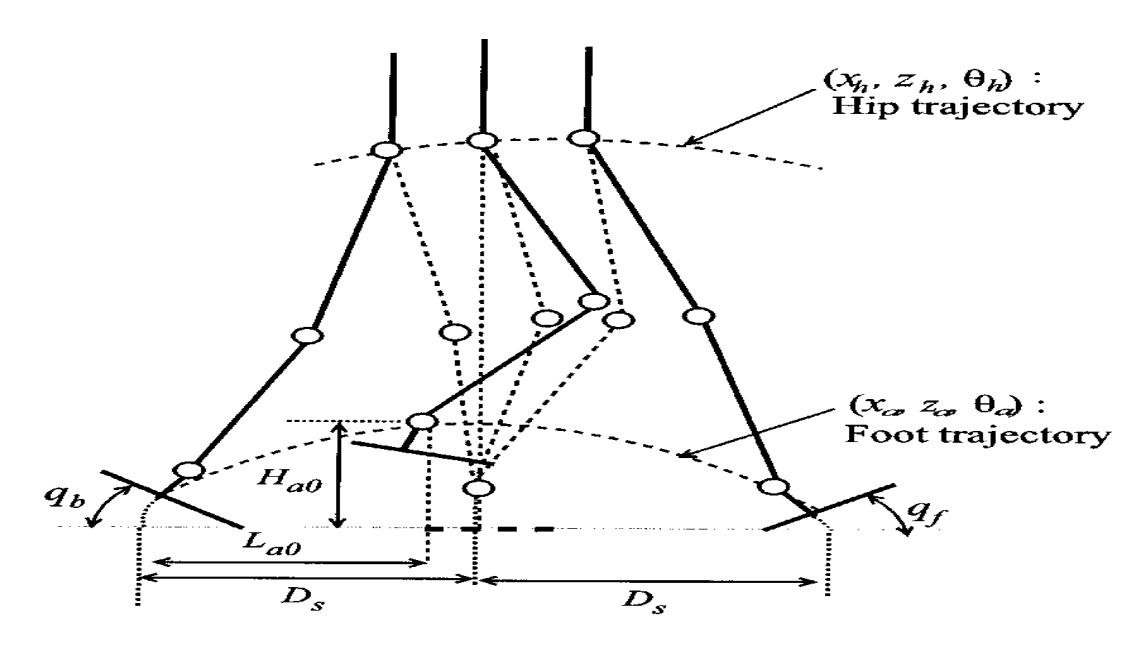
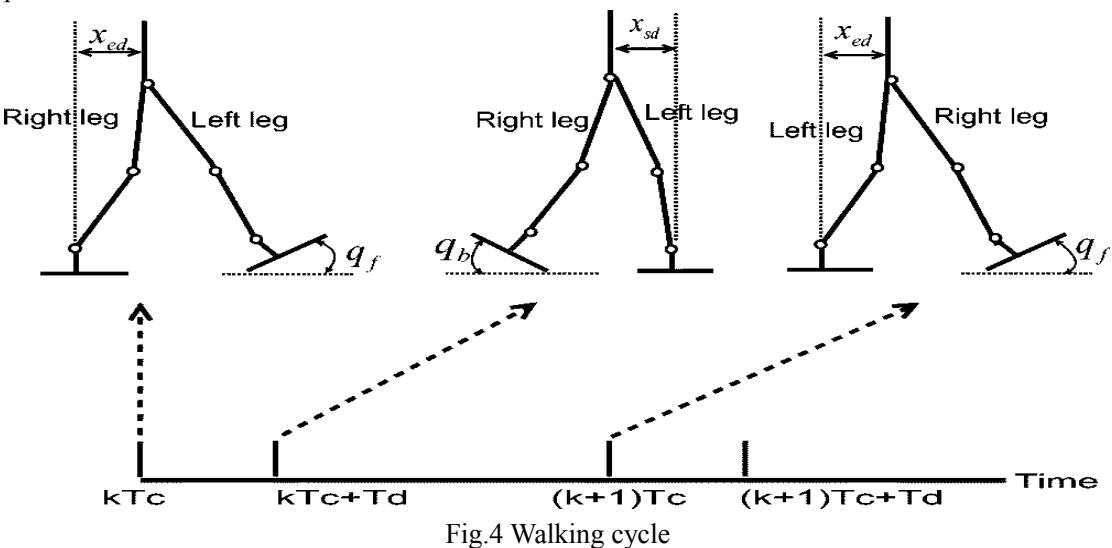
Assuming that the period necessary for one walking step is $T_C$, the time of the $K_{th}$ is from $kT_c$ to $(k+1)T_c$, k=1,2,...,K, K is the number of steps. To simplify our analysis, we define the $K_{th}$ walking step to begin with the heel of the right foot leaving the ground at $t=kT_c$, and to end with the heel of the right foot making first contact with the ground at $t=(k+1)T_c$. In the following, we discuss only the generation of the right foot trajectory. The left foot trajectory is same as the right foot trajectory except for a $T_C$ delay.
3.2 Hip Trajectories
From the viewpoint of stability, it is desirable that hip motion parameter $\theta_h(t)$ is constant when there is no waist joint; in particular, $\theta_h(t) = 0.5\pi$ rad on level ground. Hip motion $z_h(t)$ hardly affects the position of the ZMP. We can specify $z_h(t)$ to be constant, or to vary within a fixed range. Assuming that the hip is at its highest position $H_{h\text{max}}$ at the middle of the single-support phase, and at its lowest position $H_{h\text{min}}$ at the middle of the double-support phase during one walking step, $z_h(t)$ has the following constraints:
$$Z_{h}(t) = \begin{cases} H_{h\min}, t = kT_{c} + 0.5T_{d} \ H_{h\max}, t = kT_{c} + 0.5(T_{c} - T_{d}) \ H_{h\min}, t = (k+1)T_{c} + 0.5T_{d} \end{cases}$$
The trajectory of $z_h(t)$ that satisfies (8) and the second derivative continuity condition also can be obtained by third spline interpolation. The change of $x_h(t)$ is the main factor that affects the stability of a biped robot walking in a sagittal plane. The defects of these methods are that not all desired ZMP trajectories can be attained and the hip acceleration may need to be very large. To solve these problems, we propose a method consisting of the following steps: 1) generate a series of smooth $x_h(t)$; 2) determine the final $x_h(t)$ with a large stability margin.
A complete walking process is composed of three phases: a starting phase in which the walking speed varies from zero to a desired constant velocity, a steady phase with a desired constant velocity, and an ending phase in which the walking speed varies from a desired constant velocity to zero. First, the hip motion $x_h(t)$ of the steady phase is obtained with the following procedure.
4 More and better complicated tactics
Since the 9vs9 mode has been adopted, it is essential to figure out a systematic tactic instead of a looseness of tactic struct in order to consider more complicated environment. Attack Tactic and defence tactic are available respectively under certain circumstances. Especially defence tactic in our team's own field. Defenders are given different roles when they are in different positions. Robots may adopt different behaviour while opponents is close or far away from the goal. What's more, goalkeeper has been given a more important role with a much more effective block action.
5 Conclusion and Future Work
Humanoid robot research is a popular and trends in robot research, many researchers and engineers focus their research on this field. The planning method in this paper based on given parameters, it is not easy to implement this method to general robots. Our further work will focus on improving the current tactic and building a kind of walking control model of the robot.
References
[1] Obst, O. and Rollmann, M. Spark---A Generic Simulator for Physical Multi-agent Simulations. Koblenz-Landau University[D]. 2005. [2] Robocup3D Server Develop Group. RoboCup Soccer Server 3D Manual. 2009. [3] M.Harts K.Kreutz-Delgado and J.W.Helton. Optimal Biped Walking with a Complete Dynamical Model. ProcCDC'99.1999:2999-3004. [4] L.Roussel et al. Generation of Energy Optimal Complete Gait Cycles for Biped Robots. Proc ICRA'98.1998:2036-2041. [5] Y.hasegawa T.Arakawa and T.Fukuda. Trajectory Generation for Biped Locomotion Robot. Mechatronics.2000, 10:67-89. [6] Qiang Huang, Kazuhito Yokoi, Shuuji Kajita, Kenji Kaneko, Hirohiko Arai, Noriho Koyachi,Kazuo Tanie. Planning Walking Patterns for a Biped Robot. IEEE TRANSACTIONS ON ROBOTICS AND AUTOMATION. VOL.17, NO.3, June 2001. [7] K.Nagasaka M.Inaba and H.Inoue. Dynamic Walking Pattern Generation for Humanoid Robot based on Optimal Gradient Method. IEEE Ini.Conf.on Systems, Man and Cybernetics.1999:908-913. [8] J.Yamaguchi E.Soga and A.Takanishi. Development of a Bipedal Humanoid Robot-Control method of Whole Body Cooperative Dynamic Biped Walking. IEEE Int.Conf.On Robotics and Automation.1999:368-374.