CIT3D Soccer Simulation Team Description for RoboCup 2012
Chunguang Li, Wei Chen, Deng Wu
School of Computer and Information Engineering, Changzhou Institute of Technology, Changzhou 213002, Jiangsu, PR China
Abstract This paper describes some main features of the CIT2012 3D soccer simulation team. After a brief introduction to CIT 3D team, the characteristics of CIT2012 3D soccer simulation team are represented. These include the following aspects: agent architecture, walking pattern based on the Three-Dimensional Linear Inverted Pendulum Mode (3D-LIPM), and localization method . Finally we make a summary of this work and our future research works are showed in this paper.
1 Introduction
CIT 3D team,formerly named CZU 3D, which was built in 2005, has taken part in serveral RoboCup competitions. We won the 2nd place in RoboCup2011,the 4th place in RoboCup2008 ,the 13th place in RoboCup2006, top 16 place in RoboCup IranOpen 2011,the 2nd place in RoboCup ChinaOpen2011,the 5th place in RoboCup ChinaOpen2010,the 3rd place in RoboCup ChinaOpen2008,the 2nd place in RoboCup ChinaOpen2007.
This paper introduces the features of our team. Section 2 offers a brief introduction to general framework of CIT agent. Section 3 introduces the walking pattern based on 3D-LIPM.Section 4 describes our localization method. In Section 5, we draw conclusions and present directions for future work.
2 Agent Architecture
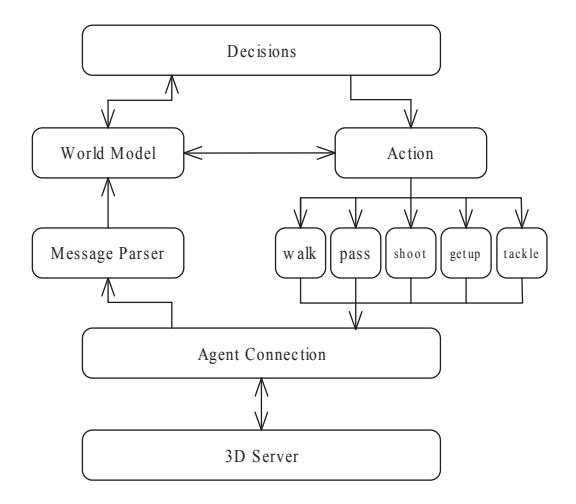
This year,the overall structure of our program is almost the same as before,consits of many modules, such as AgentConnection, MsgParser, WorldModel, Decision, Action and so on. In order to make the team quickly adapt to rule changes and make the team more intelligent, we rewrite the decision-making module,add a dynamic role assignment function. In order to get more stable and smooth walking gait ,we rewrite walking pattern generation module based on the Three-Dimensional Linear Inverted Pendulum Mode,which will be described in detail in the next section.In order to improve positioning accuracy,we researched the visual system, rewritten the visual positioning module.The agent architecture of our team is displayed in Fig. 1.
3 Walking pattern generation
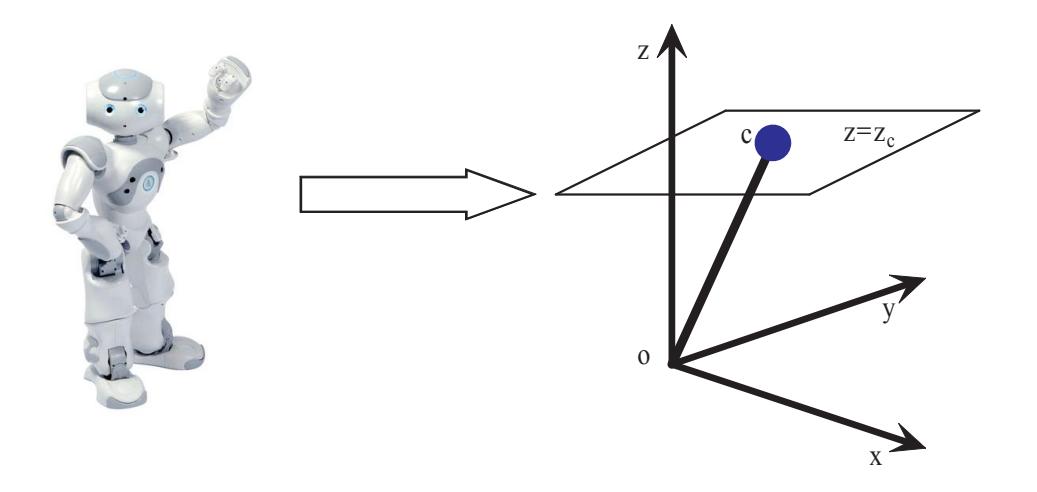
In this section, we introduce the new walking pattern generation method of CIT agent. As we all know, it is difficult to create stable and smooth walking gait of humanoid robot.Many walking pattern generation methods of humanoid robot have been proposed based on all kinds of dynamics models. In place of using complex full dynamics models, a simple model is more suitable to control the humanoid robot. Kajita et al. proposed a well-known 3-D linear inverted pendulum model (LIPM) to generate the real-time trajectory of the ZMP and the center of mass (CoM)[1–3]. Many researchers have utilized LIPM as a simplified humanoid robot model[4–10]. In LIPM, a humanoid robot is simplified as an inverted pendulum that has CoM as a mass point and two massless legs that is able to expand or contract. The movement of the robot is determined by trajectory planning of CoM and the ankle of the swing leg. With the assumption of a fixed height for the robot CoM a linear system which is decoupled in the sagittal (x-z) and the lateral (y-z) planes is obtained. The simplified humanoid robot model described above is shown in Fig. 2.
The movement of CoM is restricted on a plane and the equation of motion is shown in (1). (1) is about CoM in x direction. The origin of coordinates is set at the ankle of the supporting foot.
$$\ddot{c}_x(t) = \frac{g}{Z_c} c_x(t) \tag{1}$$
$c^x$ and ¨$c^x$ denotes CoM position and acceleration in x direction. $Z^c$ is the height of the plane where the motion of the CoM is constrained. g means gravity. Applying the Laplace transform, we can obtain the CoM trajectory in x direction
$$c_x(t) = c_x(0)\cosh(\frac{t}{T_c}) + T_c\dot{c}_x(0)\sinh(\frac{t}{T_c})$$ $$\tag{2}$$
$$\dot{c}_x(t) = \frac{c_x(0)}{T_c} \sinh(\frac{t}{T_c}) + \dot{c}_x(0) \cosh(\frac{t}{T_c})$$ $$\tag{3}$$
$$T_c = \sqrt{\frac{Z_c}{g}}$$
$cx$(0) and ˙$cx$(0)are the initial position and the velocity.
If the supporting point is not the origin of coordinates ,we set the supporting point is ($orgx, orgy,$ 0),we can obtain the CoM trajectory in x direction which is expressed in (4) and (5).
$$c_x(t) = (c_x(0) - org_x)\cosh(\frac{t}{T_c}) + T_c\dot{c}_x(0)\sinh(\frac{t}{T_c}) + org_x$$ $$\tag{4}$$
$$\dot{c}_x(t) = \frac{(c_x(0) - org_x)}{T_c} \sinh(\frac{t}{T_c}) + \dot{c}_x(0) \cosh(\frac{t}{T_c})$$
$$\tag{5}$$
Also we can obtain the CoM trajectory in y direction. The inverted pendulum is controlled by expansion and contraction of the support foot so that CoM moves on the plane.We can get a realtime walk generation based on this 3-D linear inverted pendulum model.
4 Localization method
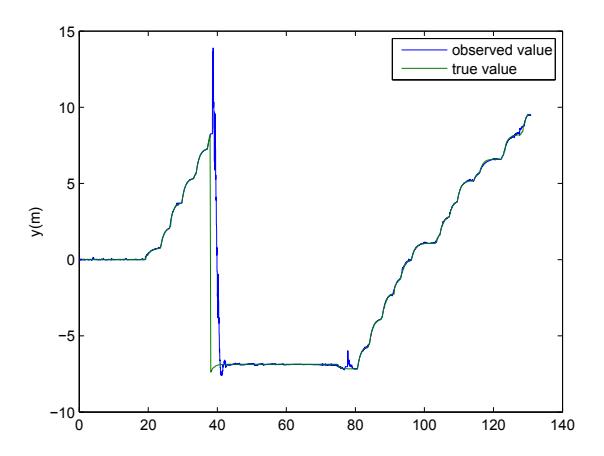
Because the restricted vision perceptor is installed on robot in rcssserver3d ,the robots can not see all marker flags at one time. We designed the vision localization module based double flags and single flag to get coordinates of ball and robots from vision message.The precision of our vision localization module is shown in Fig. 3.
5 Conclusion and Future Work
In this paper, we offer an introduction to the current status and some main achievements of our CIT2012 team. In the coming time, we will improve the motion and actions of agent, for instance, making the agent pass the ball faster, closely cooperating with each other among the teammates and etc.
References
- Kajita, S., Tani, K.: Experimental study of biped dynamic walking in the linear inverted pendulum mode. In:Proceedings of the IEEE International Conference on Robotics and Automation,pp. 2885–2891.Nagoya, Japan(1995)
- Kajita, S., Matsumoto, O., Saigo, M.: Real-time 3D walking pattern generation for a biped robot with telescopic legs. In:Proceedings of the IEEE International Conference on Robotics and Automation, pp. 2299–2308.Seoul, Korea(2001)
- Kajita, S., Kanehiro, F., Kaneko, K., Fujiwara, K., Yokoi K., Hirukawa,H.: A realtime pattern generator for biped walking. In:Proceedings of the IEEE International Conference on Robotics and Automation, pp. 31–37.Washington, DC(2002)
- Bum-Joo Lee, Daniel Stonier, Yong-Duk Kim, Jeong-Ki Yoo,and Jong-Hwan Kim.:Modifiable walking Pattern of a Humanoid robot by using allowable ZMP variation. IEEE Transactions on Robotics, Vol. 24, NO. 4,pp.917–925(2008).
- Seokmin Hong, Yonghwan Oh, Doik Kim , Syungkwon Ra and Bum-Jae You. Walking Pattern Generation Method with Feedforward and Feedback Control for Humanoid Robots.In:Proceedings of the 18th IEEE International Symposium on Robot and Human Interactive Communication , pp.263–268(2009)
- Choi,Y. B. J. You, and S. R. Oh. On the stability of indirect ZMP controller for biped robot systems.In:Proc. Int. Conf. Intell. Robots Syst. vol. 2, pp. 1966–1971.Sendal, Japan(2004)
- Kemalettin Erbatur, and Okan Kurt. Natural ZMP Trajectories for Biped Robot Reference Generation. IEEE Transactions on Industrial Electronics, Vol. 56,NO. 3, pp. 835–845(2009)
- A. Dasgupta and Y. Nakamura. Making feasible walking motion of humanoid robots from human motion capture data. In: Proc. IEEE Int. Conf. Robot. Autom, pp. 1044–1049.Detroit, MI(1999)
- K. Erbatur, A. Okazaki, K. Obiya, T. Takahashi, and A. Kawamura. A study on the zero moment point measurement for biped walking robots. In: Proc. 7th Int. Workshop Adv. Motion Control, pp. 431–436.Maribor, Slovenia(2002)
- C. Zhu, Y. Tomizawa, X. Luo, and A. Kawamura. Biped walking with variable ZMP, frictional constraint, and inverted pendulum model. In:Proc. IEEE Int. Conf. Robot. Biomimetics, pp. 425–430.Shenyang, China(2004)