FUT-K 3D Team Description Paper 2012
Minoru Shibata, Masato Ishitaka, Yuuki Kamada, Kazutomi Sugihara, Kazumasa Ohkuma, Teruya Yamanishi
Department of Management Information Science, Fukui University of Technology Gakuen, Fukui 910–8505, Japan
Abstract This paper describes concepts of movements for agents and unique tactics of team FUT-K in the simulation league of RoboCup 3D Soccer here. In addition, our future work is mentioned based on the experiments.
1 Introduction
FUT-K that is mainly composed of undergraduate students of Fukui University of Technology in Japan has been organized since fall 2007. The purposes of our team are to grow knowledge and experience of the computer language and the information science through applying themselves to RoboCup Soccer 3D Simulation. Though almost members of our team are unskilled at programming yet, we believe that now our team is developing with getting advice from other teams.
Last year, we got the third chance to participate in the world competition, RoboCup 2011 in Istanbul, Turkey, and could to get a lot of things about soccer strategies and techniques of the movements for humanoid robot as the 3D soccer agent from this competition.
In this paper, we introduce the improved points for the 3D soccer agent of this year as follows:
- Improvement in stable and speedy walking of the agents
- Simultaneous updating of the probabilities on every Probabilistic Behavior Selection in the similar situations
The details are explained in the following sections.
2 Improvement in the stable and speedy walking
In order to play the soccer, humanoid robots of the soccer 3D agent must be implemented in the basic movements such as walking (running), kicking, getting– up, veering, and so on. Especially, a walking of agents should be stable and speedy to give our team an edge to the soccer game. In the previous work, we tried to improve to increase stability in motion [1]. Recently, we are attempting to adjust the angular velocity of agent's hip joints, knees and ankles in preparation for more stable and speedier walking. In the latest attempt, even if we increase the length of an agent's stride to some extent, one does not have to lift its knee up higher. As a result, our agents continue to reduce the frequency of fall at a constant speed.
Table 1. Results of the experiment for walking (10 times)
| Latest | Previous | |
|---|---|---|
| Average Time | 16.33 [s] | 28.68 [s] |
| Standard Deviation | 0.13 [s] | 0.35 [s] |
3 Previous Work (Probabilistic Behavior Selection)
Last year, our agents were implemented the function called "Probabilistic Behavior Selection" that even if they encounter the identical situation, they stochastically select one action from multiple pre-defined behavior.
3.1 Definition of selectable behaviors
Before the implementation, we defined the behavior to be selected. There are three types: "Passing", "Turing-aside" and "Breakthrough" and then the following eight options on these types.
- Passing: Direction(Right or Left)
- Evasion: Direction(Right or Left) and Speed(Quick or Slow)
- Breakthrough: Kicking or Dribbling
When a specific condition(e.g. one enemy's agent approaches our agent) was satisfied, the agents keeping a ball stochastically selects one from these options.
3.2 Judgment of game situation and Setting probabilities of each behavior
In order to perform the function Probabilistic Behavior Selection, we made our agent discriminate the situations in a game: that is, situations are described by five factors, "Area of our agent keeping a ball", "Distance between our agent keeping a ball and the nearest enemy's agent", "Distance to the nearest friend's agent", "Elapsed time" and "Point Spread". Our attempt made the distinction between 384 patterns in a game. The probabilities of each behavior under each situation were calculated by following.
- STEP1: We pick up some situations at random as samples. By Analytic Hierarchy Process(AHP), the probabilities to select each behavior are given in each sample situation.
- STEP2: Using the three layer neural network, the probabilities in the remaining situations are estimated based on the probabilities obtained in STEP1.
Furthermore, we tried to update the probabilities during a game, based on the result of Probabilistic Behavior Selection. The results are expressed by three states, "Success", "Failure" and "Behavioral incapacitation". The conditions of three states on each behavior and the method of updating are described in the last year's TDP [1].
4 Simultaneous updating of the probability in the similar situations
In the experiment of the previous work, it was noticed that the frequency of updating the probabilities during a game is too low to affect the results. We devise the updating method to raise the frequency during a game. Our new method is to update simultaneously the probabilities on every Probabilistic Selection Behavior in the similar situations. This idea came to a soccer game between humans and sometimes they make little distinction between a part of the above 384 patterns. From this view point, in Soccer 3D simulation, it is reasonable that the probabilities should be simultaneously updated in their situations. Introducing the simultaneous updating makes it possible to appropriately change agent's principle during a game, depending on opponent's tactics during within a restricted time frame.
4.1 Similarity of situations
To raise the frequency of the updating, we introduce the similarity of situations in a soccer game. A set of situations is expressed by U and the probability of behavior b ( $b \in B$ ) in a situation X ( $X \in U$ ) is denoted as p (b|X). The similarity of situations is defined as follows:
$$sim(X, X') = \prod_{i=1}^{k} c(x_i, x_i'),$$
where $x_i, x_i'$ is a dummy variable of with respect to a factor i and $c(x_i, x_i')$ , which is satisfied with $0 \le c(x_i, x_i') \le 1$ , is a coefficient of a factor i.
4.2 Updating of the probabilities
When an agent selects a behavior $b_0$ ( $b_0 \in B$ ) under a situation X, the selection probability $p(b_0|X)$ is updated, based on the result of $b_0$ , as follows:
$$p(b_0|X){new} = p(b_0|X){old} + v(r),$$
where v(r) is an increase or decrease of probability assigned to a result r of $b_0$ . At the same time, the probabilities of other behaviors $b(b'_0 \in {B \setminus {b_0}})$ are done by the following equations.
$$p(b_0'|X){new} = p(b_0'|X){old} - \frac{v(r)}{card(B) - 1}.$$
In addition, for the other situations $X'(X' \in {U \setminus {X}})$ , the probabilities are updated with the similarlity $\operatorname{sim}(X, X')$ as follows:
$$p(b_0|X'){new} = p(b_0|X'){old} + v(r)\sin(X, X'),$$
$$p(b'0|X){new} = p(b'0|X){old} - \frac{v(r)\sin(X, X')}{card(B) - 1}.$$
As the proposed updating method brings the possibility that the selection probabilities are negative, the threshold of probability is set to avoid a negative value.
5 Experiment
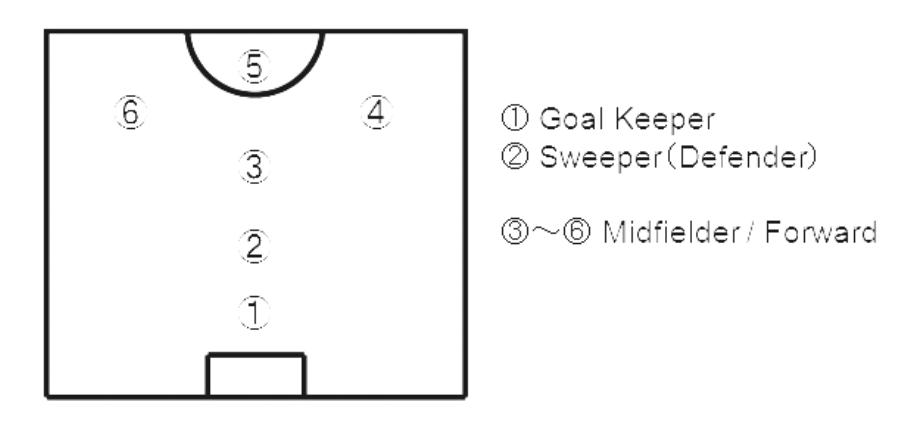
To verify the validity of our method, we attempted the following experiment. Our agents except "goalkeeper" and "sweeper" are implemented Probabilistic Behavior Selection. Our team, contained the implemented agents, played against three teams("A", "B" and "C"), possessing different skills and abilities according to the format of RoboCup 2010. Table 2 shows the result of 100 games with each team. From this results, there are not significant outcome about these indexes. Moreover, the frequencies of updating the probabilities for each agent are tabulated in Tables 3-5. ③-⑥ means the number of our agents as shown in Fig.1. It can be said that the frequencies of updating the probabilities are different by positions, opponents. Especially, Player ⑤(with a role of "center forward") is the most frequent player in the four agents and the games with stronger opponent become more frequent updating.
Table 2. Results of the experiment
| Win-Lose-Draw | Goal For | Goal Against | |
|---|---|---|---|
| A | 06-65-29 | 126 | 18 |
| A (non-implemented) | 08-60-32 | 104 | 18 |
| B | 16-24-60 | 78 | 20 |
| B (non-implemented) | 15-21-64 | 25 | 18 |
| C | 78-01-21 | 123 | 2 |
| C (non-implemented) | 79-02-19 | 3 | 150 |
Table 3. Frequencies of updating the probabilities in the games with team A
| No. | Success | Failure | Action failure | Subtotal |
|---|---|---|---|---|
| 3 | 362(50.99%) | 710 | ||
| 4 | 151(17.24%) | 350(39.95%) | 375(42.81%) | 876 |
| (5) | 156(14.51%) | 459(42.70%) | 460(42.79%) | 1075 |
| 6 | 107(14.19%) | 315(41.78%) | 332(44.03%) | 754 |
Table 4. Frequencies of updating the probabilities in the games with team B
| No. | Success | Failure | Action failure | Subtotal |
|---|---|---|---|---|
| 3 | 118(15.21%) | 293(37.76%) | 365(47.04%) | 776 |
| 4 | 114(15.12%) | 291(38.59%) | 349(46.29%) | 754 |
| (5) | 148(15.42%) | 381(39.69%) | 431(44.90%) | 960 |
| 6 | 93(13.90%) | 268(40.06%) | 308(46.04%) | 669 |
Table 5. Frequencies of updating the probabilities in the games with team C
| No. | Success | Failure | Action failure | Subtotal |
|---|---|---|---|---|
| 3 | 225(43.44%) | 518 | ||
| 4 | 97(17.54%) | 206(37.25%) | 250(45.21%) | 553 |
| (5) | 352(39.37%) | 894 | ||
| 6 | 92(16.58%) | 208(37.48%) | 255(45.95%) | 555 |
6 Conclusions and Future Works
We adjusted the angular velocity of three joints to improve the walking of our agents. From the result of the experiment for comparing the previous and latest walking, it can be said that the latest work could provide the additional stability and the increase of walking.
For the autonomous decision of agents, we have implemented Probabilistic Behavior Selection and then update of the probabilities of each behavior during a game. In the previous work, the frequency of updating the probabilities during a game was too low to affect the results. We devised the updating method to raise the frequency during a game. Our new method is to update simultaneously the probabilities on every Probabilistic Selection Behavior in the similar situations. Introducing the simultaneous updating is expected to appropriately change agent's principle during a game depending on opponent's tactics within a restricted time frame. However, we could not find a significant outcome from the results of games with three teams possessing different skills.
The future work leaves plenty of room for creativity. For example, "Increasing elements to describe situations in a game", "Developing more stable movement of agents", we will continue to exercise our ingenuity which the updating of the selection probabilities affect the results in the simulation league of RoboCup 3D soccer.
Acknowledgements
This work is supported in part by research grants from Fukui University of Technology and a Grant-in-Aid for Scientific Research (C-21500962) from the Japan Society for the Promotion of Science.
References
- Yashiki, M., Miyajima, K., Sugihara, K., Ohkuma, K., Yamanishi, T. : FUT-K Team Description Paper 2010, Soccer 3D Simulation Team Description Paper for RoboCup2010 (2010).
- Sugihara, K., Shibata, M., Kamada, Y., Ohkuma, K., Yamanishi, T. : Update of the selection probabilities by considering the similarities of situations in the simulation league of RoboCup 3D soccer, The 27th fuzzy system symposium(FSS2011), (2011).
- Sugihara, K., Shibata, M., Kamada, Y., Ohkuma, K., Yamanishi, T. : Update of probabilistic behavior selection and its influence in the simulation league of RoboCup 3D soccer, The 74th National Convention of IPSJ, (2012).