Miracle 3D Soccer Simulation Team description 2013
Lei Wang
Department of Computer Science and Technology Hefei Normal University China
Abstract 3D inverted pendulum model applied to a humanoid robot walking humanoid robot, now. The robot's gait is abstracted into a three-dimensional inverted pendulum to analysis. To solve the equations of motion of the robot centroid time walking robot. Method using inverse kinematics calculated the angle of each joint of the leg, and can achieve humanoid robot gait planning to write code.
Keywords: 3D inverted pendulum, Gait Planning, Kinematics
1 Introduction
Hefei Normal University Miracle3D Simulation Robot Soccer Team was established in September 2009. Miracle3D took part in the national competition. The bottom comes from Anhui University of underlying early version. Stopped in the middle of the competition for years, and now re-join the project.
The following are some of the preparation and the results of the work of our group for the entries.
2 Structure of Miracle
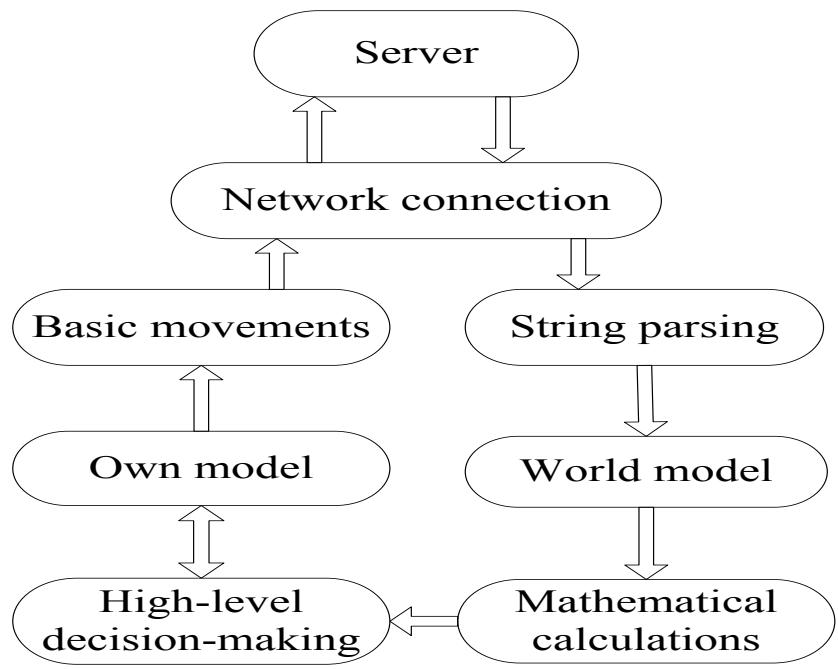
For now the competition requirements, we optimized code structure and expansion. The relationship between the various modules of the player program shows a clear layered structure. As shown in Fig1.
Our underlying modules by the message parsing layer and action layer, highlevel decision-making four blocks.
Message parsing layer:The message sent by the server parses out the stadium and Agent required information.
Mathematical calculation layer:Agent gait planning, and calculate the angle of each joint of the leg you want to walk.
Actions layer:Agent action packed, and when needed call forward, backward, diagonal walking, and then evolved to a lateral direction to walk.
High-level decision-making:The design strategies pitch Agent it humanlike offensive and defensive.
2009 player program on the basis of functional modules, we increase their own models and mathematical calculations. Joint angles and pitch information obtained from string parsing through the gait planning to work out the right trajectory, kinematics knowledge re-use for mathematical calculations, and highlevel decision-making, to update its own model, and then fed back to the highlevel decision-making, better to work out its own model, to call most appropriate walking action, thus completing the robot walking.
3 Miracle Kinematics
The forward kinematics solves rod position according to the joint angles. Usually used for robot center of gravity, a graphic description of the robot state and decision collision with the environment, the robot simulation on the basis of. 6-degree-of-freedom robot kinematics equation is defined as (1):
$$T_1 T_2 T_3 T_4 T_5 T_6 = P \quad (1)$$
The matrix $T_i$ is defined as (2)
$$T_i = \begin{bmatrix} R_i & P_i \ 0 & 001 \end{bmatrix} \tag{2}$$
Ti homogeneous transformation matrix $\sum_{i}$ to $\sum_{i-1}$ from the coordinate system, $R_i$ is a rotation matrix, $P_i$ is the position vector. Known the rotation matrix and the position vector, solves the end actuator relative to the position P of the reference coordinate system for the forward kinematics solver.
Currently we have achieved through the rotation of the centroid of the matrix and the position, the rotation matrix and the position of the leg portions, each joint angle of the leg be solved by the inverse kinematics.
Here we use analytical method for solving successively through artificial methods to get the optimal joint angle method, the accuracy of the above have greatly improved in accuracy.
4 Miracle Gait Planning
Centroid trajectory is actually a robot trajectory. Here, we adopt a model of three-dimensional linear inverted pendulum gait planning, the method has been realized. We can use the latest action in the World Cup. The following is the movement of the center of mass of the three-dimensional linear inverted pendulum model obtained the formula
$$x(t) = x(0)\cosh(t/Tc) + Tc \dot{x}(0)\sinh(t/Tc)$$
$$Tc = \sqrt{z/g}$$
(z is the height of the centroid, g is the acceleration due to gravity). x(0), $\dot{x}(0)$ are zero moments the centroid position and speed . Since the robot walking certain speed, where the termination of a walk cycle speed as a walk cycle began to speed, then:
$$\begin{bmatrix} \dot{x} \ x \ \vdots \ y \end{bmatrix} = \begin{bmatrix} (C+1)/(T_c S)x \ (C-1)/(T_c S)y \end{bmatrix} \quad (4)$$
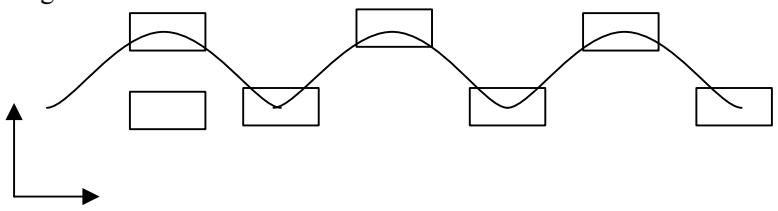
Among cosh($T/T_c$) = $C$, sinh($T/T_c$) = $S$, $\dot{x}$, $\dot{y}$ are respectively the x-direction and y-direction speed [67]. $T_{sup}$ is the supporting time. It is assumed that the starting point is ($x_0$,0), endpoint is ($x_1$, $y_1$). The initial velocity of the walking cycle can be calculated by the formula (4) [810]. The initial velocity and the initial position into (3), one can obtain the trajectory of the centroid is shown in Fig2.
Here we confront prior position and velocity of the heart to be set, and then the game progresses process, the real-time dynamic adjustment of the location of the centroid.
5 Future Work
From past experience, the robot walking speed is one of the key to winning in the game. Our team in action layer is still not perfect. Oblique walking there are problems to be solved. In addition, good decision-making is also vital win. Our decision-making is still in the initial construction phase. Implementation of the decision-making is also a focus of future work. Our team is still a long road to go.
6 Summary
Although to carry out the RoboCup simulation of 3D time is not long, but through their own efforts and experience to ask each team has formed a brand new team. Despite my limited capacity to carry out a short time, but I am still overcome a lot of difficulties, solve a lot of problems. We also work harder to achieve higher goals. Finally, we are very much looking forward to be able to participate in the competition, get more opportunities for the exchange of learning!
References
- Fan Wang, Wang Xia, Li Long-shu. Research of the Direct Kinematic of NAO model in RoboCup simulation platform[J]. Journal of Hefei Normal University. 2011,29(3):50-51.
- MA Hongwen, WANG Liquan, ZHONG Zhi, YAO Shaoming. A desired landing points walking method enabling a planner quadruped robot to walk on rough terrain[J]. CAAI Transactions on Intelligent Systems. 2011,6(5):464-467.
- XING DengPeng, SU JianBo. Arm/trunk motion generation for humanoid robot[J]. SCIENCE CHINA Information Sciences. 2010,53(8):1605-1607.
- Lin Fang, Bao Jing-Dong. Environment-dependent continuous time random walk[J]. Chin. Phys. B. 2011,20(4):040502-2.
- LI Long-shu, WANG Wei-xiang, WANG Fan. GaitPlanningofBipedRobotBasedon3D LinearInvertedPendulun[J]. COMPUTER TECHNOLOGY AND DEVELOPMENT. 2011,21(6):67-68.
- Wei Hui, Shuai Mei, Wang Zhongyu. Dynamically Adapt to Uneven Terrain Walking Control for Humanoid Robot[J]. CHINESE JOURNAL OF MECHANICAL ENGINEERING. 2012,25 (2): 216-220.
- Wei Hui, SHUAI Mei, WANG Zhongyu, ZHANG Chuanyou, and LI Li. Novel Flexible Foot System for Humanoid Robot Adaptable to Uneven Ground[J]. CHINESE JOURNAL OF MECHANICAL ENGINEERING.2010,23(6):726-728.
- XU Tao, CHEN Qijun. Learning Gait of Quadruped Robot without Prior Knowledge of the Environment[J]. CHINESE JOURNAL OF MECHANICAL ENGINEERING. 2012, 25(5): 1069 – 1070.
- TANG Zhe, SUN Zengqi, ZHOU Changjiu, HU Lingyun. Reference Trajectory Generation for 3-Dimensional Walking of a Humanoid Robot[J]. TSINGHUA SCIENCE AND TECHNOLOGY. 2007,12(5)579-582.
- LI Zhao-Hui, HUANG Qiang, LI Ke-Jie.Stability Criterion for Humanoid Running[J]. ACTA AUTOMATICA SINICA. 2005,31(4):607-608.