Bahia RT 2014 - Team Description Paper
Alan Santos, Camila Laranjeira, Danilo Lima, Diego Frias, Emmanuel Argollo, Josemar Souza, Lorena Pereira, Marco A. Lago, Marco A. C. Simões
Bahia State University (ACSO/UNEB), Salvador, BA, Brazil
Abstract The competitiveness of a soccer team of humanoid robots depends on the movements optimization and cognitive level of robots. This paper describes the current stage of team BahiaRT with its new architecture and its works in progress. We also describe the future work.
1 Introduction
After RoboCup 2013, our group performed an exhaustive evaluation about our research focus in multiagents coordination and planning. As our 2013 team presented poor low-level skills such as walking and dribbling, we have decided to use a base team with good low-level skills so we can focus the work in our main research focus.
Some weeks after RoboCup, we have entered into an international scientic cooperation partnership with team FC Portugal from Universities of Aveiro, Minho and Porto in Portugal. As part of this agreement they have released for us a base team containing limited versions of their low-level skills.
Bahia RT 2014 is developed over this base team called FCPBase. In this paper we describe the original FCPBase team and the enhancements we have made over it. With some few enhancements we won the Brazilian Robotics Competition 2013 (CBR 2013) in October, defeating the 2012 champion by 5x0 in the nal match.
Now our main focus is to develop a good pass strategy as base for high-level planned and coordinated behaviour. In this paper we describe our pass strategy as a work in progress.
2 Base Team description
In the world model some important information is located for decision-making of the agent, containing all information related to the environment, such as moving objects, obstacles, players and game status. There are many auxiliary methods to support low-level skills and movements.
The walking movement is always forward. If the agent needs to go sideways or backwards it must spin using dynamically calculated poses. This is one of the main limitations of this base team, because the absence of an omnidirectional walking movement turns the agent slower than most teams.
The FCPBase Team has a wide variety of kick scripts, although none of them was active in the player high-level behavior. Even after enabling these scripts, the kick movements were not working ne. It was necessary to perform optimizations to adjust these scripts parameters towards an ecient kick movement.
The agents were able to bypass obstacles and follow a specic formation. This formation may be modied throughout the game on predened conditions. Also the agent only carried the ball to the opponent goal line. It never performs pass or kicks, which resulted in no real attempt to score a goal.
A tool called MatchFlow is able to make dierent formations for the team, using triangulation and the ball as center of attraction to organize the agents in the eld.
So the main agent behavior was to dribble the ball towards the opponent goal line. It never scores a goal, but it always tries to take the ball when it is not owned by a team mate or by itself.
3 Walking and strategy enhacements
The FCPBase uses pre-dened parameters to generate the movement and is not based on the control Center of Mass (CoM) neither on the Zero Moment Point (ZMP) to walk. The basic principle of the walk is to nd out which rotation angle puts the agent standing in front of the goal, what is the best speed to execute the movement and the ultimate target. Each pose of the movement is generated based on the basic parameters of general movements and a set of parameters that determines the target position.
In order to improve the walk, the study of motion control using CoM was conducted, looking at FCPBase to nd what was necessary to generate an omnidirectional movement[1]. From the study, we developed a new movent for BahiaRT making the necessary adjustments.
The current movement is based on the balance control of the agent and on calculating the position of each joint. The balance control is based on CoM and ZMP[2].
To enhance the FCPBase standard behavior we have created a new formation using the provided matchow tool. Our rst eorts were to make the agent dribble the ball to the opponent goal. These new formation was successfully used in CBR 2013.
4 Pass Strategy
Coordination can be seen in various ways, where agents need to share resources for the implementation of its activities, when the group of activities contributes to solving major problems or when there are several options available on how to achieve a goal[3]. The idea is to develop the coordination to enable scheduled moves and plays.
The Pass Strategy is an important movement because it provides greater mobility to the team. When playing against strong teams with good defences it is very hard to reach the opponent goal using only the dribble movement. Using the pass gives the agent the opportunity to bypass the opponents defenders when free space is narrow.
However it can be dangerous if an adversary intercepts the ball during the pass and starts a counter attack. To avoid this risk, in this rst version the pass only executes when the team in the attack eld, with possession of the ball and at a safe distance from the nearest opponent.
The player with the ball checks if one of its team mates is positioned further forward and no opponents are around to intercept the ball, in which case the team mate can receive the pass. After deciding whether or not to pass the ball, the agent broadcasts a message stating the receiver player and the estimated position where he will pass the ball.
To the success of the play it is necessary that all parts (kick, positioning and communication) work ne.
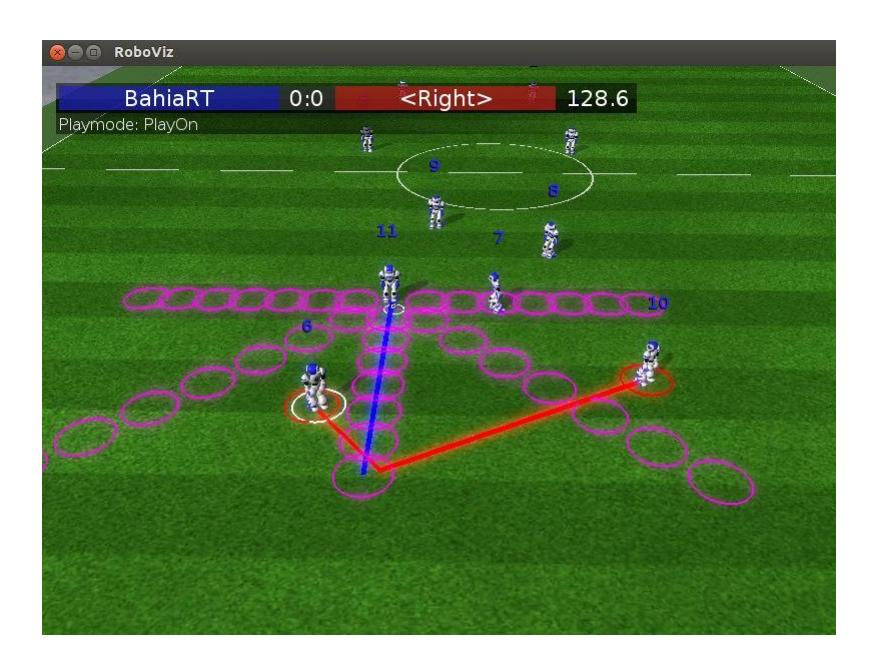
The point was to incorporate a way of deciding which move to make according to the current context of the game, and thus a play is planned by the whole team to achieve the common goal: to be closer to penalty area. Figure 1 illustrates the whole pass movement.
4.1 Kick
For the pass to be successful the agent must kick in the right direction and to a certain distance.
After choosing the best target for the agent to pass the ball, the kick module is initialized by changing the type of omnidirectional movement to use footstep planning, an attempt to place the agent for the kick.
Before starting the path planning, the agent bases itself on the distance to the target chosen and determines the best kick for the ball to reach the goal. After choosing the type of kick, the path planning is started.
The footstep planning aims to dene the required trajectory for the correct positioning for the agent to kick the ball. With the complete positioning, the agent kicks the ball as close as possible to the chosen target.
Since the kick was inactive on FCPBase, some adjustments of parameters and other improvements were made so that the kick could be used with the eciency needed to execute the pass.
4.2 Positioning
In order to a pass to be successful, the receiving end of the pass must be in position to get the ball in time, otherwise, an adversary could intercept it. To do so, we used two complementary approaches.
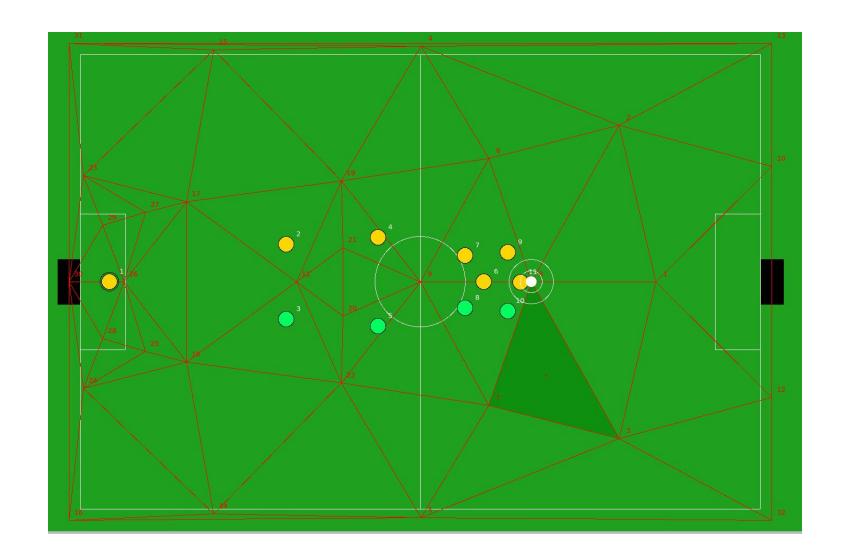
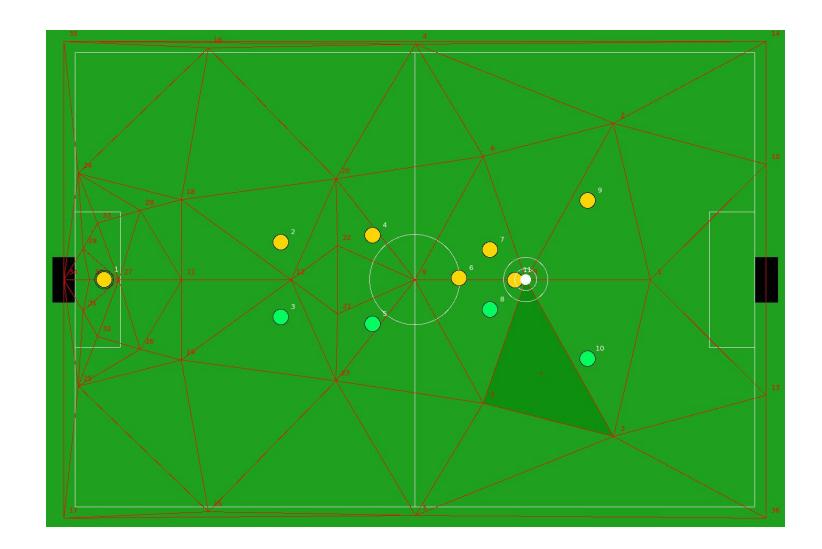
First, every agent on the eld should know if a pass is possible, or even valid, following some conditions. We decided the pass would only be worth trying if we had the advantage, meaning we should both be in our attacking side of the eld, and one of the allies, or the agent itself, should have the ball. Also, we shouldn't risk having the ball taken by an opponent, so we dened a minimum distance from the ball to all adversary agents. If such conditions are valid, then the team switch formations. Two of the attackers go forward into the opponent's eld, these allies become possible passing targets. Figures 2 and 3 shows the standard team formation and the modied formation to enable the pass.
Second, once the team is in the new formation, the player with ball possession veries passing possibilities, and decides to which of the two allies it should pass, it then calculates the position of the receiving ally, the position of the adversaries and the length of the kick. From this data, it decides the best position the ally should be in order to get the ball once the passing is done. Once calculations are done, it informs the receiving agent, which changes behaviour and goes to the passing position.
4.3 Communication
The communication protocol used is a round-robin algorithm based on the game time and in the number of players, in a way that none of them has any priority over the channel using the resource in the same fraction of time. This prevents conicts and message loss, ensuring the eectiveness of the system.
Currently we sent through a message the number of the second closest player to the ball and the position in which he will receive the pass. This message is replicated to all the other agents, including the one that will get the ball. When each player receives the message, it checks if the number sent is the number of its shirt and if so, it walks to the indicated pass target, or else it disregards the message.
If the receiver agent waits up to a predened deadline with no new message from the agent who made the pass, he gives up considering that the pass has failed.
5 Conclusion
The pass is an ecient option to attack the opponent team when there is few space to dribble the defenders. For this reason this is our main eort to RoboCup 2014 to perform a good pass trying to bypass the best teams defences enabling our strikers to score many goals.
At this point our pass strategy is under development, but it is possible to see the formation changes and some pass attempts. We need to enhance current status towards a better successful tax.
To do this we will work in a better kick movement and an enhanced coordination and positioning system. We are using some optimization strategies to achieve this goal [4][5][6].
We also plan to develop an omnidirectional kick [7] enabling more options when the agent choose a pass to be performed. These are our future work up to RoboCup 2014.
References
- Shai, N., Abdolmaleki, A., Ferreira, R., Lau, N., Reis, L.: Omnidirectional walking and active balance for soccer humanoid robot. Volume 8154 LNAI of Lecture Notes in Computer Science (including subseries Lecture Notes in Articial Intelligence and Lecture Notes in Bioinformatics). Springer (2013 2013)
- Strom, J., Slavov, G., Chown, E.: Omnidirectional walking using zmp and preview control for the nao humanoid robot. In: RoboCup 2009: robot soccer world cup XIII. Springer (2010) 378389
- Frozza, R.: Critérios para avaliação de coordenação multiagente. PhD thesis, UNI-VERSIDADE FEDERAL DO RIO GRANDE DO SUL (2004)
- Cruz, L., Reis, L.P., Lau, N., Armando, S.: Optimization approach for the development of humanoid robots' behaviors (2012)
- Simões, M.A.C., Lima, G., Camponogara, E.: A ga-based approach to dynamic reconguration of real-time systems. In Almeida, L., Fischmeister, S., Lee, I., Proenza, J., eds.: Proceedings of First International Workshop on Adaptive and Recongurable Embedded Systems (APRES '08), St. Louis, MO, USA (April 2008) 4346
- Simões, M.A.C., Lima, G., Macêdo, R.: An autonomic approach for dynamic reconguration on real-time bandwidth-reservation schedulers. In: Proc. of the 11th Brazilian Workshop on Real-Time and Embedded Systems (WTR 09), Recife, Brazil, Brazilian Computer Society (May 2009) 123128
- Ferreira, R., Reis, L.P., Moreira, A.P., Lau, N.: Development of an omnidirectional kick for a nao humanoid robot (2012)