BahiaRT 2015: Team Description Paper for RoboCup 3D Soccer Simulation League
Marco A C Sim˜oes, Camila Laranjeira, Claudia Elizabete Ramos, S´ergio Souza Jr., Alan dos Santos Soares, Diego Frias, Josemar Rodrigues de Souza
State University of Bahia (UNEB/ACSO), Salvador, BA, Brazil
http://www.acso.uneb.br/bahiart/
Abstract For this year our main research focus is on enhancement of static and dynamic movements. We are creating a long distance kick to take advantage in set pieces and if it is possible also during play on. We are also creating a new dyamic pass that can provide our pass strategy with more options to perform better passes. Some minor developments in strategic formation and new defensive behavior will also be developed.
1 Introduction
Since RoboCup 2014, the main focus of our research was divided in two main topics: improving low level skills and team strategy. On low level skills, we enhanced existing movements due to the introduction of heterogeneous agents, which caused the old movements to behave improperly, because they could not adapt to the new body types. A new movement was also developed, called superkick, a long distance kick that should increase BahiaRT's competitive advantage in set plays, if used along with a proper coordination strategy.
On team strategy, we started developing a new defensive behavior during RoboCup 2014, in order to regain possession of the ball by intercepting an opponent attack before it reaches our goal. We also continued the development of a strategic pass play, which can be very useful both as a defensive strategy as well as an offensive advantage. The pass can also be used in set plays, since the team has extra time to rearrange its formation and try to perform a specific play. And finally we reorganized the group formation as well as the AI in offensive corner kicks, which increased the amount of goals scored in this scenario.
This TDP describes this work and also our work in progress. Since 2013, team BahiaRT is based on a source base, code named FCPBase 2013, as part of an international scientific cooperation partnership with team FC Portugal from Universities of Aveiro, Minho and Porto in Portugal.
2 Team Strategy
Since 2012, the 3D league reached the maximun number of players in a real soccer game, which also required increasing the size of the field compared to the previous year. Since then, the teams had to improve both their strategy and their low level skills (movements).
Believing artificial intelligence is capable of overcoming movement disadvantages, BahiaRT focuses on developing an efficient team strategy, serving one of the main goals of the league: cooperation between players. For this purpose, three main works were developed: (1) a defense strategy, focused on regaining possession of the ball; (2) strategic pass plays, strengthening the team as a group; (3) specific formations for set pieces, focusing mainly on the corner kick.
2.1 Defense Strategy
At the beginning of the last edition of RoboCup, which took place in Jo˜ao Pessoa, Brazil, BahiaRT's intelligence module had three behavioral states:
- (1) Limited: The agent is not capable of participating in any play, it is either fallen (trying to stand up again), or it was beamed out of the field. Its short-time goal is to recover its ability to participate in the game.
- (2) Active: The player is either with the ball or has higher chances of gaining possession of it. Only one player at a time can take this position, avoiding crowded ball situations. The active player leads the next play, analyzing all information available of the environment, and based on it decides which is the best move.
- (3) Cooperative: Players not limited and not active were considered cooperative. Their role is to follow a formation defined on the strategy module, which is fundamentally based on the ball's position on the field.
During RoboCup 2014, BahiaRT realized our players were slower than the best opponent teams, which ended up leading to a big issue: the active player, while trying to regain possession of the ball, was outran by the opponent. To solve this problem, a prototype of a defense module was developed during competition, which created a new behavioral state: defensive. The player who takes this position behaves as a man marker from real soccer, supporting the active player and positioning itself in order to assume the active role if required.
Whenever the opponent team has possession of the ball, the defensive module chooses an agent between the ones currently behaving as cooperative to take the defensive position. The player chosen to take this role is the one with better chances of intercepting the opponent. This play assumes the opponent is moving towards our goal, in that case, the fittest ally to intercept it should be between the opponent and our goal (danger area).
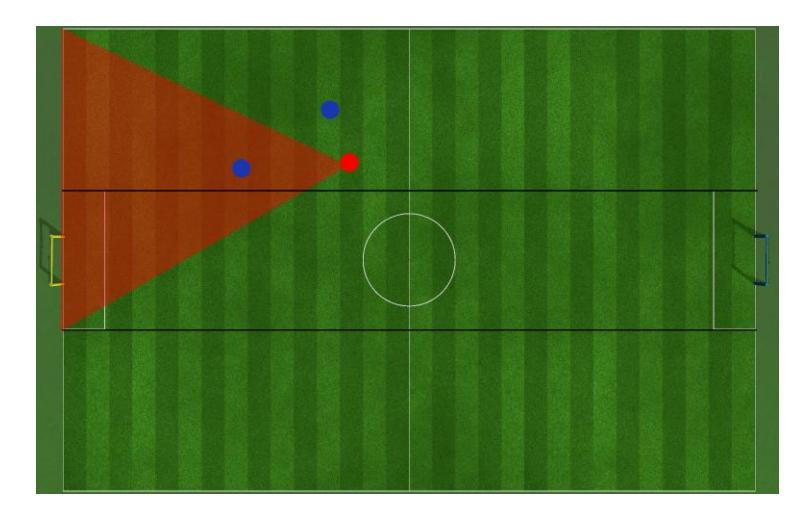
Figure 1 illustrates how a defensive player is chosen for a specific scenario. Represented in red are both the opponent player and the danger area, while in blue there are two players of the allied team. The defensive player is the one inside the red triangle, even though it is not the one closest to the opponent, it has higher chances of intercepting the attack.
The proytotype developed in competition presented positive results and later on was improved and tested, significantly reducing the number of goals conceded.
2.2 Strategic Pass
The pass strategy consist in kicking the ball to an ally who is in a better position in the field (closer to the opponent's goal) or better off (less marked by the defense) to receive and continue to play. In the first case, the strategic pass is convenient to gain offensive advantage, while in the second case it is necessary to avoid losing the ball and turning into defensive mode. In the current stage of the 3D simulation league, the robot does not uses its hands, so most of the moves in set pieces depends on passing the ball, i.e. in free kick, side kick, kick in, goal kick and corner kick.
The pass always involves the kicker and the receiver regardless of the cause or motivation. The kicker is the ally player who is in possession of the ball at the moment and the receiver is that allied player who will receive the ball. The pass in a soccer game played by humans can happen with or without communication between the kicker and the receiver. In the latter case the receiver reacts after realizing the ball was kicked to him, making an instant prediction of the ball's trajectory and choosing the best place to intercept it. Therefore, among the challenges for a pass to succeed there are:
- (1) Certain timing of the pass;
- (2) Right choice of the receiver;
- (3) Right choice of target to pass.
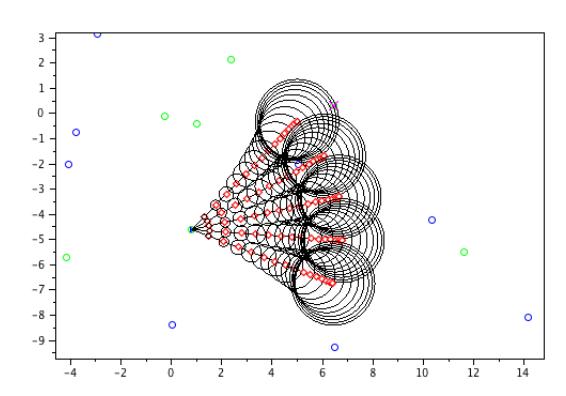
Our model aims to choose the best trajectory to kick ball. First, the trajectories are calculated using points that were marked in the field. According with the position of the ball, the numbers of trajectories can change. The markers and the angle between two trajectories define the quantity of targets.
The choice of the best path takes into account a merit that depends on the amount of opponent agents within a set of circles. The circles are formed using as displacement the distance of the ball, that is, the larger the displacement, the larger the circle. The figure 2 shows the mapping of trajectories.
The idea is that the larger the displacement, the lower the speed of the ball and consequently it might be easier for an opponent to intercept the ball. However, only agents within the circle are considered, once those outside it have no chance to intercept the ball.
2.3 Corner Kick Formation
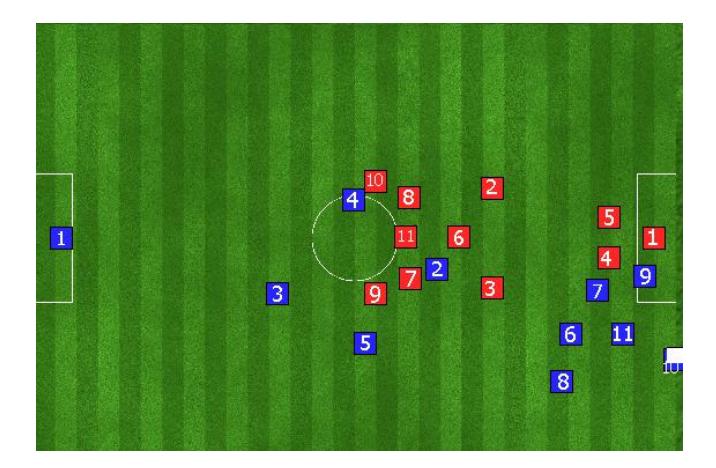
The corner kick is one of the most important set plays, because of the high chances of scoring. At the same time (and for the same reason), the zone surrounding the goal tends to get crowded, which increases the chances of collision between agents. During corner kick situations for the allied team, BahiaRT's old formation placed only one player inside the goalie area, giving it full responsability to intercept the ball and score. If that player fails for any reason (e.g. falling, colliding, or even letting the ball pass through it), it put the opponent goalie in a position of advantage, because there was no support player inside the goalie area to continue the play.
Figure 3 illustrates the old formation where the agent number 9 is responsible for intercepting the ball.
To solve this issue, a study was performed on the scenarios that followed corner kick fails, which led to the decision of putting an extra player inside the penalty area to play a supportive role during corner kick. Figure 4 illustrates the new formation, where agent 7 is responsible for intercepting the ball, and agent 9 is responsible for recovering the ball in case its ally fails.
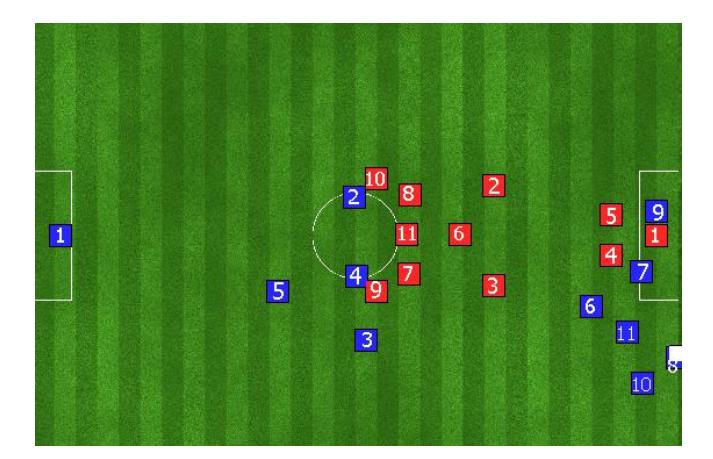
The objective of the new formation is to increase BahiaRT's amount of goals scored during corner kick situations. Further tests confirmed the effectiveness of this change.
3 Low Level Skills
The introduction of mandatory use of heterogeneous players has demanded several adjustments and enhancements on existing movements, due to poor adaptation to the physical characteristics of the new agents. Although some of the movements did work, it was also necessary to enhance them to get better performance.
We also have developed a new movement named superkick. It is used in kickoffs to perform a long distance kick that can score a goal or give a good offensive advantage in the kikcoff playmode. This section describes all enhancements in low level skills.
3.1 SuperKick Development
During the Robocup 2014, we realized that the best opponents use a long distance kick to start the game with competitive advantage and can advance to attack quickly in sequence. In the kickoff, our team had used an average distance kick to advance through the adversaries front lines, but this kick has two main negative points:
- The kick is creeping, so the ball can colliding with an opponent on the way, eliminating our chances of advancing.
- The kick does not have enough distance to force the enemy team to go to the defense position, so we can end up near the center of the field fighting for the ball possession.
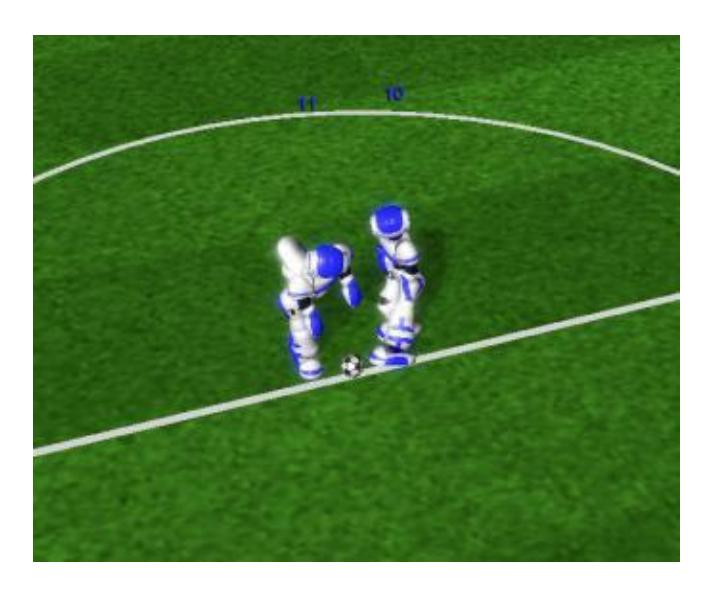
To start the half time with an advantage, we have made an strategy based on UT-AUSTINVILLA's[1] initial kick using adaptation of FC-PORTUGAL's[2] long distance kick script but, instead of using an support agent to touch the ball moving it as little as possible, we have used the support agent to kick the ball to a predefined position and positioned the second agent to the location that the ball will be, as can be seen in the figure 5.Thus, we can use the first touch in the ball as a pass rather than touch it as little as possible, because the minimum noise can further damage the movement. The downside of this strategy is that the server's noise can disturb the movement and change the movement, resulting in a kick whose strength, speed and distance can vary a little.
The main objective of this strategy is to score a goal early in the match, but even when it is not possible, there still be a great offensive breakthrough that may indirectly end up in a goal scored.
3.2 Movements Enhancements
Our AI and strategy reached a level that allows us to match against top level opponents in equal conditions, however our movements ( kick, get up, etc. ) are not in the same level. Therefore, our team has chosen to improve some of our low-level skills, because even if we have a good AI we can't make good use of it if our basic movements are not as good. The introduction of new types of agents made it worse, because some of the movements didn't work properly with different body types, so it was necessary to adapt them.
For the walking model we have included the oscillation of arms using the angular components of the agent's legs and reflecting them back to the arms, so that the oscillation between the arms and legs is balanced. We also realized most of the falls happened due to an unexpected inclination of the torso, so we also adjusted the torso's angle by compensating the angle of the hip joints, first calculating the total inclination of the torso (both frontal and lateral) and using this value to balance the support leg, thus keeping the torso erect.
We have also made a new movement to get up when agent is fallen. The new movement can be executed faster, reducing the time our agents is fallen. The disadvantage of this movement is that it is less stable than the old one, which means any small collision will interrupt the behavior completely, and the player has to start all over again. However, since we use the reactive get up (which occurs even before the fall actually happens) the agent can try to stand even before it is completely on the ground and so we can get the most out of this reaction, reducing the time our agents remain fallen and ensuring an advantage in situations where the one who gets up faster can ensure the ball's possession.
4 Work in Progress
The environment of a soccer game is highly dynamic and, as the league evolves, it gets less and less advisable to use script-based movements. Therefore, BahiaRT started working on a dynamic approach to the kick behavior, allowing the player to adapt the kick to the current situation instead of taking a long time preparing to execute a scripted behavior. The team hopes to develop a solution which lets the agent adjust the parameters of the kick, such as strength, direction, and even determine a specific target. This work will be very useful for other works developed by the team, specially the strategic pass, which needs a reliable kick behavior for the strategy to work as planned.
One of our main works in progress is adapting the superkick for other situations, such as kick in, goal kick and corner kick. This will be very helpful by ensuring a competitive advantage in set plays, because they provide a very favorable scenario to score. The superkick is a script-based movement, which means it cannot adapt to different situations other than the one it was built for, so the team hopes to develop different scripts in order to choose the specific one for each scenario. Thus, along with our team's AI we hope our attack will be strengthened, as we will have better kicks for each of the set plays.
With the new faults model that should be introduced in this year's competition, the team's defense module will be modified to adapt to it. Now the markers need to avoid collisions not to concede a free kick to opponent team.
Our AI is also being improved to include long-term planning, considering coordination and multiagent requirements.
Acknowledgements
This project is partly funded by CNPq/PIBIC, FAPESB/IC and Uneb/PROFORTE.
References
- Patrick MacAlpine, Mike Depinet, Jason Liang, and Peter Stone. Ut austin villa: Robocup 2014 3d simulation league competition and technical challenge champions. 2015.
- FCPortugal. Fcportugal project. Retrieved February 2, 2015, from http://paginas.fe.up.pt/ lpreis/FCPortugal.htm, 2000.