Miracle 3D Soccer Simulation Team Description
KunPeng Zhao
School of Computer Science and Technology Heifei Normal University Anhui , Hefei ,China
Abstract This paper simply describes the architecture of Miracle3D team. In order to control a biped robot with high degree of freedom to get smart, I decide use a dynamic value to map the Court, And use Logistic Regression and Gradient ascent algorithm.
Introduction
Hefei Normal University Miracle 3D simulation robot soccer team participated in the 2012 state competition for the first time. Miracle3D obtain the right to participate in the 2013 World Cup in the Netherlands, but due to funding problems, was unable to attend. Miracle3D get Anhui Robocup3D championship in 2013, the same year, get Robocup3D national first prize in China and Robocup3D IranOpen2014 the final eight. Miracle3D get Anhui Robocup3D bronze in 2014, the same year, get Robocup3D national a fourth in China.
The following are some of our group for the preparation and outcome of the work done by the 2015 World Cup. Also we get second price in China Open.
Team Architecture
For now the competition requirements, we optimized code structure and expansion.
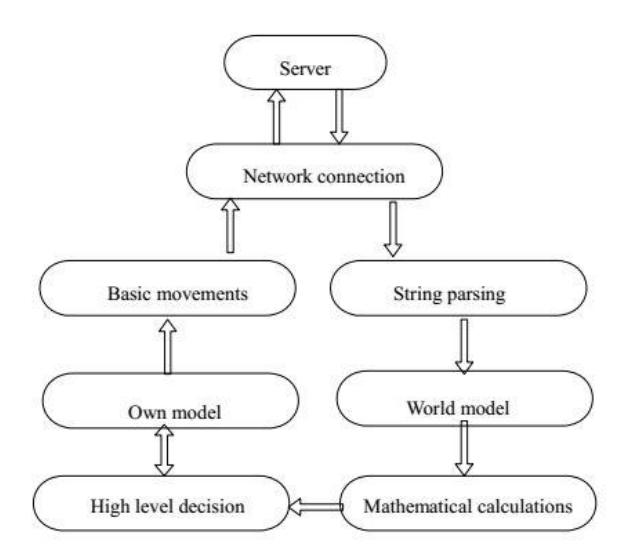
The relationship between the various modules of the player program shows a clear layered structure. As shown in Fig1.
Our underlying modules by the message parsing layer and action layer, high-level decision-making four blocks.
Message parsing layer :The message sent by the server parses out the stadium and Agent required information.
Mathematical calculation layer:Agent gait planning, and calculate the angle of each joint of the leg you want to walk.
Actions layer : Agent action packed, and when needed call forward, backward, diagonal walking, and then evolved to a lateral direction to walk.
High-level decision-making:The design strategies pitch Agent it humanlike offensive and defensive. 2009 player program on the basis of functional modules, we increase theirown models and mathematical calculations. Joint angles and pitch information obtained from string parsing through the gait planning to work out the right trajectory, kinematics knowledge re-use for mathematical calculations, and high-level decision-making, to update its own model, and then fed back to the high-level decision-making, better to work out its own model, to call most appropriate walking action, thus completing the robot walking.
Logistic Regression
Learn from the 2D soccer simulation,we also can transplant it to 3D. Especially, the use of Evaluation Value. So, we can map it rise value from one side to other side. Basic, And the Goal has max value.But the Evaluation Value is altered.
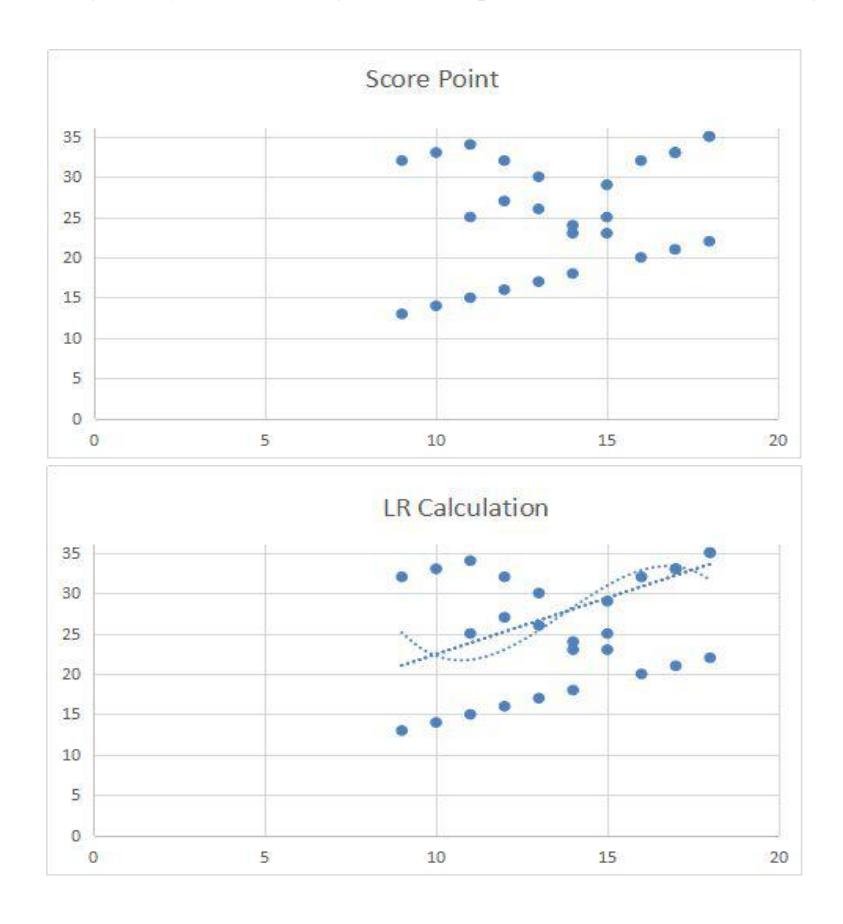
In the match, When team get a score, Record the point. Then increase the Evaluation Value in this point.After through all cycles, We can get a Scatter plot, And Calculate it Like Fig2:
But the value it's not so accuracy, it uncertainty. So we need more train test. And use Logistic Regression get a Function. We can make train with different team, and can get different function. So , function format like Fig3:
Use The LR Function get the trend, and depend the robot's location , Calculate the short distance between the line and goal, return the point to robot,and Use Gradient ascent algorithm Architecture to quickly walk to it.
Gradient Ascent Algorithm Architecture
Now, We get the point which most possible to get kick. So, due to the Evaluation Value's distribution, Sometimes We shouldn't directly go to this point.Because the Evaluation Value is dynamic. So We Use Gradient ascent algorithm Architecture, It's mean we always in the Probability growth curve.
Actually, Gradient Ascent is basic on Gradient Descent. Just changed the direction from down to up.
Gradient Ascent: $$w := w + \alpha \nabla_w f(w)$$
And change the Robot's walk function, in the walking process, should set a time flag, calculate the max probability point.
Conclusions and Future Work
Robot basic motions should be design perfect. Only motions was stable , we can focus AI in the simulation. Wish the robot work better.
References
- Peter Harrington ,Machine Learning in Action,China:The People's Posts and Telecommunications Press,2013
- Wikipedia https://en.wikipedia.org/wiki/Logistic_regression
- Robert Kabacoff,Data Analysis and Graphics with R,Manning Publications,2011-8-27