The magmaOffenburg 2022 RoboCup 3D Simulation Team
Nico Bohlinger, Hannes Braun, Klaus Dorer, Lukas Ehlers, Danny Huber, Hannes Huber, Stefan Glaser, Rico Schillings, Jannes Scholz, Maren Wolffram
Hochschule Offenburg, Elektrotechnik, Medizintechnik und Informatik, Germany
https://github.com/hill-a/stable-baselines · https://youtu.be/sHlkRaljtjY · https://youtu.be/F82hqicRYZQ
Abstract Team description papers of magmaOffenburg are incremental in the sense that each year we address a different topic of our team and the tools around our team. In this year's team description paper we address our approach to learn a model free kick with Nao toe using deep reinforcement learning.
1 Introduction
Behavior learning plays a key role since the early days of robotics and in RoboCup specifically. Good progress has been made by applying genetic learning algorithms to the optimization of parameters of model based behaviors [6, 9] and even model free behaviors [4]. However, especially the model free approaches had the limitation that they are open loop: the behaviors learned do not take the current observations and state of the agent into account. They are replayed as learned and fail, if they are triggered in situations that differ from the situation during learning.
Reinforcement Learning does not have this limitation, but had been limited to small observation and action spaces. In recent years however, deep reinforcement learning (DRL) algorithms like off-policy algorithms DDPG or DQN or on-policy like A2C or PPO [7] have overcome these limitations and work in comparably huge continuous observation and continuous action spaces.
While this has already been applied very successfully to learning to walk in the simspark domain [2, 5], progress on kick behaviors and the usage of toed robots remains an open issue. Also, in these works there is a gap between the extremely successful behavior performance in training setup and the benefit from it during real game play. This paper summarizes magmaOffenburg's efforts to overcome these limitations. For more details see [3].
2 Approach
Learning is performed using the OpenAI stable baselines implementation of PPO named PPO2. Technically, an environment wrapper was created to send actions via sockets to the java client controlling the robot and receive the observations and rewards from the robot. The java client itself also uses sockets to send the motor commands to the simspark server (written in C++) and receive the sensor information.
2.1 Observation Space
The observation space has been inspired by work of [1]. Table 1 shows the 120 entries of the observation space. Entries in bold font are raw sensor values and their derivatives (marked with * when applicable). The force sensors include the 3D point of force as well as the force vector itself resulting together with the derivatives in twelve values per sensor. In difference to [1], the usage of the NAO robot with toes not only adds two additional joint angle sensors, but also one force sensor per toe. Also, it turned out useful to add the torso's x and y components of the up vector, which are derived values, mainly from camera localization. The relative angle of the ball used is somewhat redundant to the relative ball position.
Inputs 118 and 119 are used to tell the network which direction and distance the kick is desired to achieve. It was fixed to 0 and 20 for the straight kicking experiments of section 3.2. In section 3.4 these 'observations' were successfully used to learn kicks in a range of -30 to 30 degrees and for distances from 3 to 10 meters.
Table 1. Observation Space.
| Index | Count | Observation |
|---|---|---|
| 0 | 1 | Counter |
| 1-4 | 4 | head joints* |
| 5-20 | 16 | arm joints* |
| 21-48 | 28 | hip, knee, ankle, toe joints* |
| 49-54 | 6 | 3D relative ball position* |
| 55-102 | 48 | foot and toe force sensors* |
| 103-108 | 6 | accelerometer* |
| 109-114 | 6 | gyroscope* |
| 115-116 | 2 | torso up vector x,y |
| 117 | 1 | ball relative angle |
| 118 | 1 | desired kick direction (-90–90°, relative) |
| 119 | 1 | desired kick distance (0–20m) |
2.2 Action Space
For the kicking behavior, only the leg joints are part of the 28 entries action space (see Table 2). For each joint, the action space contains two values: the destination angle to achieve, which is mapped to the possible values of each joint and the maximum angular speed to be used. Variants that only use the desired angle or only uses the angular speed produced worse results. Also, having angle and speed for each motor makes it possible to use the genetically learned kicks, that also use angle and speed, for pretraining the networks with expert behaviors.
Table 2. Action Space.
| Index | Count | Joint | Orientation |
|---|---|---|---|
| 0-5 | 6 | left hip | YawPitch, Roll, Pitch |
| 6-7 | 2 | left knee Pitch | |
| 8-11 | 4 | left foot | Roll, Pitch |
| 12-13 | 2 | left toe | Pitch |
| 14-27 | 14 | right leg | YawPitch, Roll, Pitch |
2.3 Reward Function
Since kicking is a relatively short behavior (18 cycles), the reward function did not contain continuous reward, but only end reward. The final reward for the straight kicking experiments included the sum of achieved kick distance in xdirection, the negative absolute deviation in y-direction and a negative penalty for falling: reward = x − |y| − (1 − s/88), where s is the number of stable cycles after triggering the kick. To save time, an episode is stopped if the agent falls or if after 88 cycles (approx. 1.5s) after triggering the kick we can be sure that the agent is stable. In both cases, the achieved kick position is estimated as the 8s future ball position.
The final reward for the multi-directional kicking experiments is a mixture of the relative distance to the desired kick position and a penalty for falling: reward = a1∗(d0−d)/d0−a2∗(1−s/88), where d0 is the desired kick distance and d the distance of the (estimated) ball end position to the desired kick position and a1, a2 are parameters balancing both penalties tuned to 100 and 25 respectively in earlier learning runs.
2.4 Training Setup
The setup of the learning plays an important role with respect to creating initial conditions that are similar to the conditions during a game. This usually increases learning time, but simplifies the transition from a learned to a successfully used behavior. The goal is that the robots use the learned kick during games when stepping slowly towards the ball or at the ball. Therefore, a training episode is designed as follows: the NAO robot is beamed randomly into a rectangle near the ball (see section 3.3). After few initialization cycles, it steps in place for one second without trying to achieve a desirable position! The kick behavior with the right leg is then triggered when foot force sensors indicate just touching the ground (first force indication after at least five cycles without force). The robot then performs an 18 cycles deep kick behavior that is subject of learning. 18 cycles was found to be sufficient in preliminary experiments to kick the ball and stabilize after the kick. After the kick, the robot steps again in place for 1.4s to see if the robot was able to avoid a fall. This means that only 18 of the roughly 150 simspark simulation cycles of an episode are learning steps with respect to PPO.
2.5 Asynchronous Training
PPO2 allows to use multiple threads that collect data from parallel environments to train one model. To do so, it has to receive an observation from each environment per cycle. Since the actual kick is only performed in 18 of 150 cycles, it often happens that several threads have to wait for a few other environments to setup or wait for the result.
In this work, we designed an asynchronous mode to provide observations. The environment wrapper waits for k% of the environments to return an observation. For all other environments still busy performing preparation cycles, a dummy observation with zeros is returned to PPO and the corresponding action ignored. The learning process and quality do not decrease by this. This reduces the syncing problem between all environments and makes sure that threads are less likely to freeze and wait for some other thread to finish. The results are shown in Table 3 with a used threshold of a minimum of 70% valid observations per cycle. The table contains the average reward received after 48 hours of learning, the network updates performed in that time and completed episodes in 20 minutes. It can easily be seen that asynchronous training increases performance and made the following research much more feasible in a given amount of time.
Table 3. Synchronous vs. Asynchronous.
| Sync | Async | |
|---|---|---|
| Average Reward, 48h | 6.834 | 8.967 |
| Updates, 48h | 166 | 1627 |
| Episodes in 20min | 5644 | 20782 |
2.6 Mirroring Behaviors
Kicking is an unsymmetric behavior. To reduce learning times, the robots learn a right leg kick that is then mirrored to its left leg. Mirroring a DRL-kick is considerably more difficult than mirroring a genetically learned kick. The later only requires to mirror the action space since they are typically open loop. For a DRL-kick, also the observation space has to be mirrored.
For the action space, right side joints have to be replaced with left side joints. Also, all roll joints and the arm yaw joints need to be mirrored. Mirroring means to negate the desired joint angle. This can either be done after the mapping to the co-domain of the network of [-1..1]. If done before, also the joint min and max values have to be mirrored, at least for the roll joints that have a non-symmetric co-domain (e.g. of -25 to 45 degrees).
For the observation space, all joints have to be mirrored as described above. Additionally, the 3D relative ball position needs to be mirrored at the y-axis, the foot force and its force origin have to be mirrored at the y-axis, the accelerometer at the y-axis, the gyroscope at the y- and z-axis, the torso roll angle and the ball relative angle also need to be mirrored. Finally, also the relative desired kick direction is mirrored.
3 Results
In order to evaluate the described approach, extensive simulation runs of more than 7000 server hours (Intel Xeon E5-2630 v4 @ 2.2 GHz, 10 Cores) were conducted and are documented in this section. The first part concerns the DRL approach PPO, while the second part deals with the results of the domain itself.
3.1 Hyperparameter Evaluation
PPO defines a couple of hyperparameters that are evaluated in detail in [3].
3.2 Straight Kick Distance and Precision
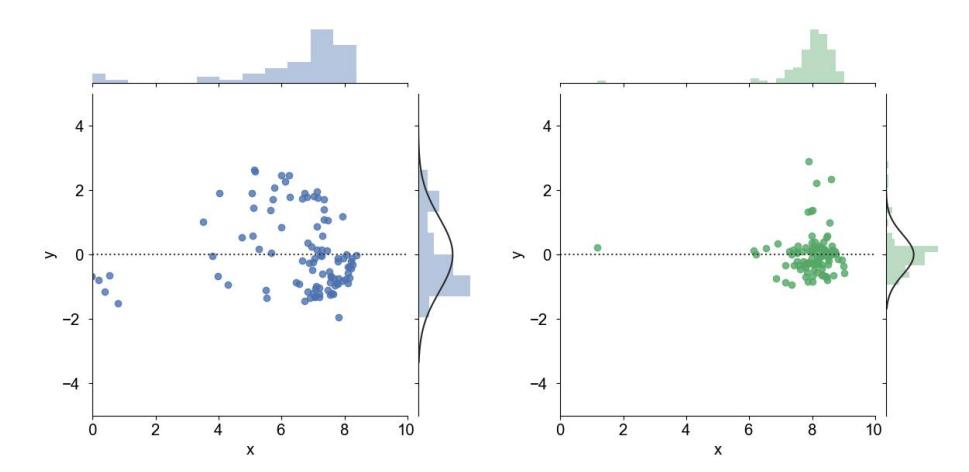
Figure 1 shows a comparison of the final position of 100 kicks from starting coordinate (0,0). The PPO kick is slightly longer on average and has considerably less spread in x and y direction. Also, the number of failed kicks is significantly lower. In a series of 1000 kicks, the achieved distance of the PPO kick was only in three cases less than 5m.
3.3 Kickable Area
The usage of a DRL policy network for controlling the agent's behavior has a fundamental advantage over behaviors learned with genetic learning: they are closed-loop. The action is calculated based on the current observation while a genetically learned behavior in joint space is simply replayed no matter what the current situation is.
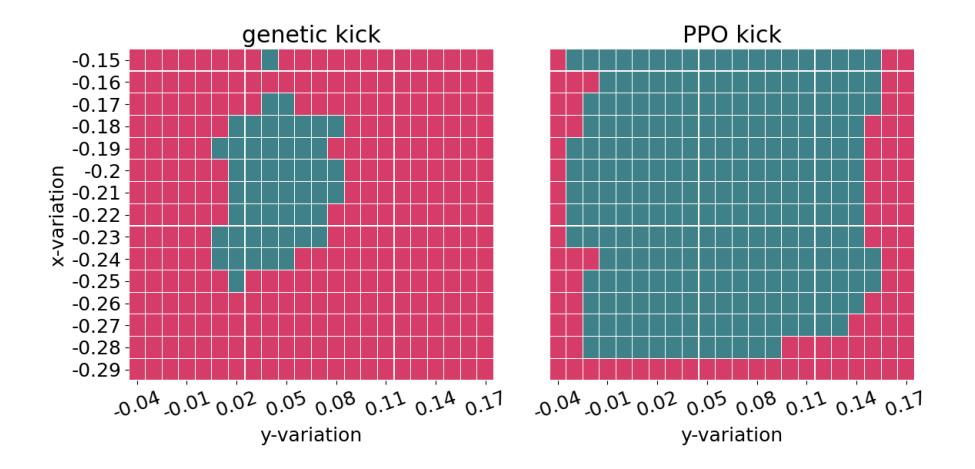
The DRL-Kick makes use of this, for example, with adjusted movements depending on the relative position of the ball, which is part of the observation space. In order to show this, the initial position of the player relative to the ball during learning was randomly set within a rectangle of 10x13cm with respect to the ball (at position (0,0)) (see Figure 2). The vertical axis represents the position of the robot with respect to the ball in the frontal plane. A value of less than 0.15m causes the robot to touch the ball already while stepping in place.
The horizontal axis represents the player position with respect to the sagittal plane.
Each position in Figure 2 is the average reward of 50 kicks from the corresponding position relative to the ball. As can be seen, the robot learned a successful kick in the whole area and slightly outside it. The huge difference in size of the kickable areas of the PPO and the genetic kick is shown in Figure 3. The genetic kick used as comparison uses a similar action space with joint angles and maximum speeds for each joint, but limited to four keyframes with learnable duration (for details see [4].
Fig. 2. The kickable area of the PPO kick. The green rectangle shows where the robot was beamed to during learning.
| -0.04 | -0.03 | -0.02 | -0.01 | 0.0 | 0.01 | 0.02 | 0.03 | 0.04 | 0.06 | 0.09 | 0.1 | 0.11 | 0.12 | 0.13 | 0.14 | 0.15 | 0.16 | 0.17 | |
|---|---|---|---|---|---|---|---|---|---|---|---|---|---|---|---|---|---|---|---|
| -0.15 | 2.6 | 4.9 | 7.4 | 9 | 5.5 | 6.3 | 7.4 | 7.5 | 8 | 7.4 | 7.4 | 7.2 | 6.8 | 6.8 | 7.2 | 6.6 | 6.9 | 6.9 | 6 |
| -0.16 | 1.5 | 2.3 | 3.3 | 6.5 | 10 | 9.9 | 10 | 10 | 10 | 10 | 10 | 10 | 10 | 10 | 9.8 | 9.7 | 9.4 | 9.1 | 7 |
| -0.17 | 1.6 | 2.7 | 4.5 | 8.3 | 11 | 11 | 11 | 11 | 11 | 11 | 11 | 11 | 10 | 10 | 10 | 10 | 9.3 | 7.2 | 5 |
| -0.18 | 1.9 | 3.7 | 6.9 | 10 | 11 | 11 | 11 | 11 | 11 | 11 | 11 | 11 | 11 | 11 | 10 | 10 | 10 | 9.4 | 7.3 |
| -0.19 | 1.9 | 4.7 | 8.1 | 10 | 12 | 12 | 12 | 11 | 12 | 11 | 11 | 11 | 11 | 11 | 11 | 10 | 10 | 9.6 | 5.9 |
| -0.2 | 2.4 | 4.7 | 7.8 | 11 | 12 | 12 | 12 | 12 | 12 | 12 | 12 | 11 | 11 | 11 | 11 | 10 | 10 | 9.2 | 6.3 |
| -0.21 | 2 | 4.5 | 8.1 | 10 | 11 | 12 | 12 | 12 | 12 | 12 | 12 | 12 | 11 | 11 | 11 | 11 | 10 | 8 | 6.4 |
| -0.22 | 2.4 | 4.9 | 7.9 | 11 | 11 | 12 | 12 | 12 | 12 | 12 | 12 | 11 | 11 | 11 | 11 | 10 | 9.4 | 8.4 | 5.9 |
| -0.23 | 2.9 | 4.6 | 7.4 | 8.9 | 11 | 11 | 11 | 12 | 11 | 11 | 11 | 11 | 11 | 10 | 9.9 | 10 | 10 | 9.5 | 6.4 |
| -0.24 | 2.1 | 3.6 | 4.1 | 6.8 | 9.4 | 11 | 12 | 11 | 11 | 11 | 11 | 11 | 11 | 10 | 10 | 10 | 9.3 | 9 | 6.9 |
| -0.25 | 1.4 | 2.1 | 5.2 | 8.6 | 12 | 11 | 12 | 12 | 11 | 11 | 11 | 11 | 10 | 10 | 9.6 | 8.8 | 8.6 | 8 | 6.9 |
| -0.26 | 2.4 | 3.8 | 5.3 | 9.7 | 11 | 11 | 11 | 11 | 10 | 10 | 10 | 9.8 | 9.5 | 8.9 | 8.3 | 7.8 | 7.5 | 6.7 | 6.7 |
| -0.27 | 3.3 | 4.1 | 6.5 | 7.6 | 8.9 | 9.4 | 9.8 | 9.7 | 9.6 | 9.5 | 9.2 | 8.6 | 8.1 | 7.8 | 7.3 | 6.9 | 5.9 | 4.8 | 3.4 |
| -0.28 | 3.4 | 4.4 | 7 | 7.9 | 8 | 7.8 | 8.2 | 8.2 | 8.3 | 7.9 | 7.8 | 6.7 | 6.7 | 5 | 3.3 | 2.5 | 1.9 | 1.7 | 1.5 |
| -0.29 | 2.2 | 3 | 2.9 | 3 | 3.1 | 4 | 4.4 | 4.2 | 3.6 | 3.2 | 3.2 | 2.8 | 2.8 | 2.8 | 2.2 | 1.1 | 1 | 0.9 | 1 |
3.4 Multi-Directional Kick
The extreme flexibility of DRL is shown in this experiment. In addition to beaming the player into various positions relative to the ball, now the two steering inputs of desired distance and direction are used to learn a multi-directional kick.
In a first experiment, the network learned during straight kicking was used as a starting point for the NAOToe. During learning, the desired direction was randomly selected for each kick in a range from -45 to 45 degrees. The desired kick distance was randomly selected between 3 and 10 meters.
Figure 4 shows the results of roughly one week of kick learning. Each rectangle is an average of 100 kicks with a corresponding fixed desired direction and distance. As can be seen, the robot is able to learn to kick into a considerable range of directions and distances despite the big variance of the relative ball position. Two videos that demonstrate the kick are available here and here.
Fig. 4. Reward with respect to desired direction and distance of NAOToe.
| -45 | -40 | -35 | -30 | -25 | -20 | -15 | -10 | -5 | 0 | 5 | 10 | 15 | 20 | 25 | 30 | 35 | 40 | 45 | |
|---|---|---|---|---|---|---|---|---|---|---|---|---|---|---|---|---|---|---|---|
| 3 | 54.9 | 62.9 | 66.8 | 72.6 | 72.5 | 72.3 | 75.0 | 74.6 | 74.2 | 75.7 | 68.4 | 70.5 | 73.1 | 69.4 | 63.2 | 60.9 | 56.5 | 50.2 | 48.1 |
| 3.5 | 62.7 | 66.2 | 69.7 | 77.9 | 77.2 | 77.3 | 78.7 | 80.7 | 80.2 | 81.0 | 74.2 | 76.8 | 77.8 | 73.2 | 75.2 | 72.1 | 66.8 | 63.0 | 59.1 |
| 4 | 62.0 | 70.5 | 74.4 | 77.4 | 82.8 | 86.2 | 86.9 | 84.3 | 85.6 | 82.8 | 81.4 | 82.2 | 77.4 | 77.7 | 75.9 | 75.0 | 69.7 | 71.6 | 64.8 |
| 4.5 | 64.2 | 70.0 | 74.6 | 80.8 | 84.0 | 85.7 | 82.8 | 87.5 | 86.9 | 87.2 | 86.9 | 83.5 | 82.4 | 79.2 | 78.1 | 76.1 | 75.0 | 68.1 | 64.5 |
| 5 | 60.9 | 71.3 | 76.2 | 83.5 | 85.7 | 83.4 | 87.4 | 87.3 | 86.4 | 86.1 | 85.3 | 84.7 | 83.3 | 79.6 | 75.3 | 75.2 | 72.9 | 70.7 | 66.6 |
| 5.5 | 63.6 | 70.5 | 79.0 | 83.1 | 86.7 | 83.5 | 84.5 | 87.7 | 87.6 | 86.6 | 85.0 | 84.4 | 82.7 | 79.8 | 78.8 | 74.2 | 73.0 | 68.9 | 65.9 |
| 6 | 64.8 | 73.2 | 75.1 | 82.3 | 82.6 | 85.2 | 87.1 | 86.8 | 88.9 | 87.7 | 86.2 | 83.4 | 81.4 | 75.8 | 77.7 | 81.3 | 70.3 | 69.3 | 67.0 |
| 6.5 | 63.4 | 70.5 | 78.5 | 83.1 | 84.8 | 82.4 | 88.1 | 89.1 | 88.0 | 86.5 | 81.9 | 82.7 | 80.1 | 78.3 | 78.2 | 73.7 | 76.2 | 70.1 | 64.1 |
| 7 | 67.9 | 73.5 | 80.5 | 85.0 | 86.2 | 85.8 | 85.5 | 86.6 | 86.4 | 84.7 | 82.8 | 82.7 | 80.5 | 80.9 | 78.1 | 78.1 | 72.8 | 66.6 | 63.9 |
| 7.5 | 65.6 | 71.8 | 81.6 | 86.1 | 86.7 | 88.2 | 88.6 | 89.4 | 86.2 | 86.3 | 83.0 | 82.8 | 81.5 | 80.9 | 76.6 | 68.6 | 74.0 | 69.2 | 64.5 |
| 8 | 68.4 | 72.2 | 81.0 | 86.3 | 86.9 | 88.6 | 90.5 | 90.6 | 88.7 | 87.9 | 85.8 | 83.5 | 80.9 | 77.9 | 75.4 | 69.8 | 67.8 | 65.9 | 58.1 |
| 8.5 | 64.0 | 74.8 | 77.2 | 85.8 | 87.1 | 88.0 | 88.2 | 87.4 | 86.4 | 88.6 | 85.2 | 83.5 | 80.5 | 77.0 | 79.5 | 74.0 | 69.9 | 62.3 | 57.8 |
| 9 | 63.9 | 71.1 | 78.1 | 84.5 | 88.2 | 87.7 | 85.7 | 86.0 | 86.8 | 85.7 | 84.8 | 83.8 | 78.4 | 76.8 | 73.5 | 68.4 | 64.8 | 61.1 | 56.1 |
| 9.5 | 64.0 | 69.5 | 77.1 | 84.0 | 83.6 | 85.2 | 85.3 | 84.7 | 83.9 | 84.4 | 83.6 | 81.8 | 79.5 | 72.9 | 72.9 | 65.1 | 59.0 | 56.7 | 53.1 |
| 10 | 62.2 | 67.2 | 74.8 | 78.0 | 81.7 | 82.0 | 80.6 | 81.8 | 80.2 | 80.0 | 78.1 | 80.2 | 77.2 | 72.4 | 68.6 | 68.3 | 62.4 | 55.6 | 54.4 |
The same procedure was performed in a second experiment with a NAO robot without toes. Figure 5 shows the difference of the toed robot to the robot without toes for each direction and distance. As can be seen, the robot with toes has a considerable advantage on longer kick distances while the robot without toes is more precise on shorter kicks. For game playing, longer kicks are of higher value though.
Fig. 5. Relative kick success of NAOToe compared to a NAO without toes.
| -45 | -40 | -35 | -30 | -25 | -20 | -15 | -10 | -5 | 0 | 5 | 10 | 15 | 20 | 25 | 30 | 35 | 40 | 45 | |
|---|---|---|---|---|---|---|---|---|---|---|---|---|---|---|---|---|---|---|---|
| 3 | -20.0 | -10.4 | -5.6 | -0.2 | 0.7 | -4.4 | -0.7 | -3.2 | 5.8 | -0.6 | -10.9 | -7.7 | -1.1 | 2.2 | -6.4 | -5.0 | -14.4 | -10.0 | -10.4 |
| 3.5 | -5.9 | -6.1 | -7.4 | -0.4 | 1.0 | -3.4 | -1.3 | 1.3 | 8.2 | 4.2 | -4.6 | -4.2 | -2.9 | -2.5 | 0.9 | -5.7 | -7.0 | -6.1 | -5.5 |
| 4 | -6.8 | -2.8 | -1.3 | -3.8 | 2.3 | 6.6 | 7.9 | 0.5 | 3.7 | -1.2 | -1.3 | 1.5 | 0.9 | -0.5 | -2.1 | -1.4 | -3.0 | -4.3 | -1.1 |
| 4.5 | -0.3 | 3.2 | 2.6 | 3.9 | 3.5 | 4.0 | 0.6 | 6.6 | 5.2 | 3.1 | 5.1 | 6.5 | 3.9 | 5.9 | 4.1 | 8.0 | 2.5 | 1.8 | 1.6 |
| 5 | -2.5 | 4.6 | 1.4 | 5.9 | 3.7 | 1.0 | 4.2 | 3.1 | 6.1 | 0.5 | 3.6 | 4.2 | 4.9 | 4.7 | 0.9 | 6.2 | 0.1 | 0.7 | 1.9 |
| 5.5 | 3.0 | 4.5 | 4.7 | 5.2 | 2.9 | 1.4 | -2.9 | 4.1 | 2.0 | -0.8 | 0.1 | 3.5 | 6.4 | 1.2 | 5.9 | -0.9 | -0.7 | -2.3 | 3.4 |
| 6 | 5.8 | 7.7 | 3.4 | 1.5 | -1.5 | -0.3 | 2.1 | -0.6 | 2.6 | -0.6 | 1.1 | -0.9 | 2.3 | -1.4 | 1.8 | 2.5 | -0.3 | 1.0 | 7.7 |
| 6.5 | 6.8 | 7.2 | 3.2 | 3.4 | -1.9 | -0.5 | 3.0 | 6.0 | 1.4 | -1.9 | -1.1 | -0.2 | -2.1 | -2.3 | 11.9 | 2.1 | 14.3 | 8.6 | 3.8 |
| 7 | 10.3 | 5.2 | 8.7 | 6.5 | -2.4 | 0.0 | -1.9 | -1.1 | 3.2 | -3.0 | -3.7 | 2.1 | 0.7 | 3.0 | 3.5 | 6.2 | 5.2 | 12.8 | 9.4 |
| 7.5 | 10.0 | 4.4 | 10.5 | 6.5 | 4.3 | 2.7 | 7.3 | 1.6 | -1.1 | -1.9 | 0.5 | 3.1 | 4.3 | 4.7 | 7.4 | -1.7 | 7.4 | 13.7 | 11.9 |
| 8 | 13.1 | 11.0 | 9.6 | 8.8 | 6.5 | 4.3 | 10.6 | 7.8 | 4.4 | 5.3 | 3.7 | 5.5 | 8.0 | 3.0 | 5.4 | 7.6 | 10.7 | 9.1 | 7.9 |
| 8.5 | 9.8 | 12.8 | 10.2 | 11.4 | 9.1 | 10.6 | 12.3 | 10.0 | 6.9 | 7.9 | 7.1 | 7.5 | 8.0 | 5.5 | 15.1 | 11.4 | 11.2 | 9.4 | 8.6 |
| 9 | 10.0 | 10.9 | 11.3 | 14.2 | 14.4 | 20.0 | 12.5 | 9.6 | 9.8 | 7.4 | 7.8 | 9.0 | 7.6 | 10.7 | 9.5 | 9.0 | 8.0 | 8.6 | 6.7 |
| 9.5 | 8.9 | 16.5 | 15.5 | 14.6 | 11.8 | 18.0 | 10.9 | 12.4 | 9.4 | 11.0 | 15.2 | 12.8 | 11.7 | 9.7 | 11.3 | 6.5 | 3.6 | 6.0 | 7.2 |
| 10 | 10.3 | 12.2 | 12.3 | 15.3 | 16.8 | 9.6 | 8.4 | 12.2 | 9.9 | 14.4 | 11.7 | 14.3 | 12.7 | 8.3 | 10.3 | 10.6 | 9.4 | 6.8 | 14.1 |
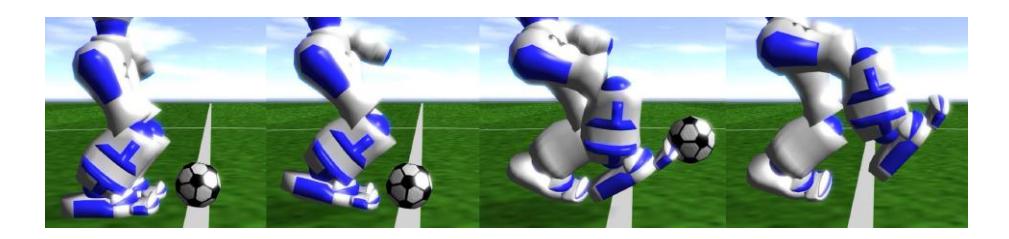
As can be seen in Figure 6, the robot has learned to step on its support toe to improve the kicking geometry and keep the stability of its stand. In 93 of 100 kicks the NAOToe did not fall during or after the kick. This is only slightly less stable than the NAO (94 out of 100), but more effective for longer kicks (see Figure 5).
3.5 Performance in Games
The setup of the kick learning has been chosen in a way to simplify the introduction of that behavior into real games. In fact, the PPO kick behavior can replace the genetical kick by changing a single line of code, that adds the kick to the list of available kicks instead of its predecessor. The performance of the new straight kick was tested in a series of 200 games of two identical teams of eleven robots with the only difference that one team was using the PPO straight kick while the other used the old genetic kick instead. The PPO team scored 0.665 goals on average which is significantly more than the 0.385 goals for the comparison team. Of the 200 games, the PPO team won 83 games, tied in 76 and lost 41.
In another series of 200 games, seven of the eleven players of one team had toes and used the multi-directional kick (seven is the highest number of identical robot types allowed). The other team was identical except that the toed robots used the PPO straight kick learned. The multi-directional team scored 0.695 goals on average compared to 0.460 goals of the team without multi-directional kick (signif.). Of the 200 games, the multi-directional team won 79 games, tied in 72 and lost 49.
References
- Abreu M, Lau N, Sousa A and Reis L P (2019). Learning low level skills from scratch for humanoid robot soccer using deep reinforcement learning. In Proceedings of 2019 International Conference on Autonomous Robot Systems and Competitions (ICARSC). IEEE.
- Abreu M, Reis L P, Lau N (2019). Learning to Run Faster in a Humanoid Robot Soccer Environment Through Reinforcement Learning. In RoboCup 2019: Robot World Cup XXIII (pp. 3–15). Springer International Publishing.
- Spitznagel M, Weiler D, Dorer K (2021) Deep Reinforcement Multi-Directional Kick-Learning of a Simulated Robot with Toes. In: Santos, Lau, Neto, Lopes (eds.) Proceedings of the IEEE International Conference on Autonomous Robot Systems and Competitions (ICARSC), IEEE Xplore.
- Dorer K (2017). Learning to Use Toes in a Humanoid Robot. In Akiyama H, Obst O, Sammut C, Tonidandel F: RoboCup 2017: Robot World Cup XXI, Nagoya, Japan, Springer Verlag.
- Melo L and Maximo M (2019). Learning Humanoid Robot Running Skills through Proximal Policy Optimization. arXiv:1910.10620.
- MacAlpine P (2017). Multilayered Skill Learning and Movement Coordination for Autonomous Robotic Agents. Ph.D. Thesis, The University of Texas at Austin, Austin, Texas, USA.
- Mnih V, Badia A, Mirza M, Graves A, Lillicrap T, Harley T, Silver D and Kavukcuoglu K (2016). Asynchronous Methods for Deep Reinforcement Learning. arXiv:1602.01783.
- Obst O and Rollmann M (2005). SPARK A Generic Simulator for Physical Multiagent Simulations. Computer Systems Science and Engineering, 20(5).
- Peters J, Kober J, Mülling K, Nguyen-Tuong D and Kroemer O (2012). Robot skill learning. In 20th European Conference on Artificial Intelligence (ECAI 2012), pages 1–6.
- Teixeira H, Silva T, Abreu M and Reis L P (2020). Humanoid Robot Kick in Motion Ability for Playing Robotic Soccer. 2020 IEEE International Conference on Autonomous Robot Systems and Competitions (ICARSC), Ponta Delgada, Portugal, 2020, pp. 34-39, doi: 10.1109/ICARSC49921.2020.9096073