Austrian Cubes Team Description Paper for RoboCup 2010
Helmut Grassberger, Marko Locher, Christoph Lueginger, Martin Trapp, Alexander Hofmann, Walter Craffonara
Graz University of Technology, Rechbauerstr. 12, 8010 Graz, Austria; University of Applied Sciences Technikum Wien, Hoechstaedtplatz 5, 1200 Vienna, Austria
Abstract This paper provides an overview of the small-size league team Austrian Cubes 2010, formerly Vienna Cubes. The team description paper describes both the robot hardware, mechanics and electronics, and the software, vision computing and artificial intelligence, of our team.
1 Introduction
The Austrian Cubes is a cooperation of the University of Technology Graz and the University of Applied Sciences Technikum Wien. This cooperation exists since 2008 and is the regeneration of the Vienna Cubes.
The Austrian Cubes combines the knowledge of the University of Technology Graz in the field of Mechanics and Electronics with the knowledge of the University of Applied Sciences Technikum Wien in the field of Vision Computing and AI.
2 Mechanical Design
2.1 Introduction
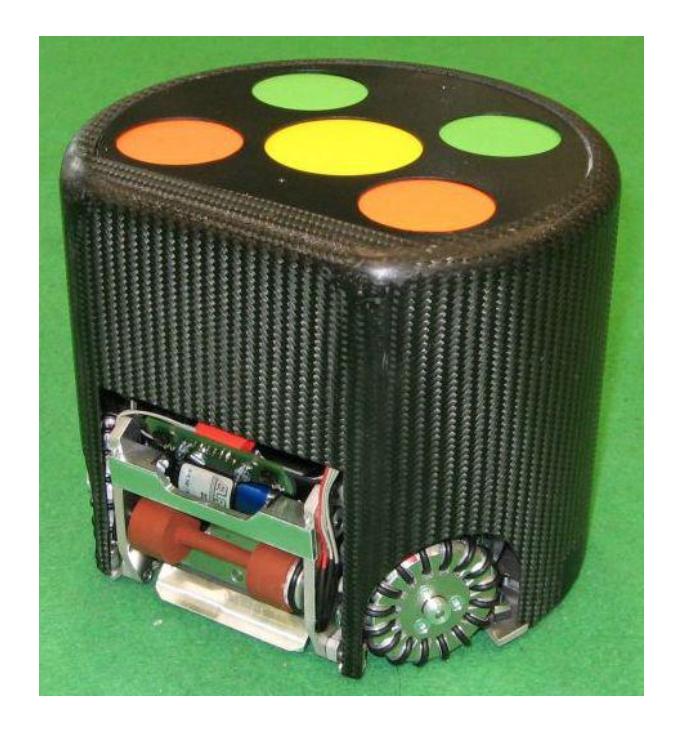
For 2010 we took our robots (Figure 1) from the season before and did some minor changes in order to enhance performance and to fix some problems. To view the main data of our robot please look at our team description paper 2009.
2.2 Drive System
To improve our drive control it was necessary to put new encoders onto our motors which have to be integrated in our mechanical design. The omniwheels and the gearbox were very reliable and had a good performance during competitions and tests, so we left them as they are.
2.3 Kicking System
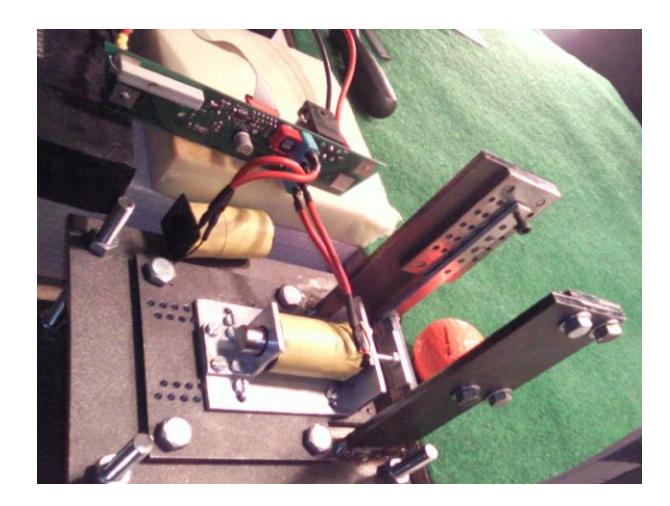
The chip kicking device in our actual robot doesn't have a good efficiency. Therefore we built a test bench to try a new geometry for the chip kicker (Figure 2). We testet many possible alternatives and finally were able to improve our kicking range by about 900
2.4 Dribbling System
Here we did some simulation and tests in order to enhance the speed of the ball, when the robot recieves a pass. Basically we tried out many different materials for our damping system to find the best alternative and then put all the data in our simulation to do further development.
2.5 Chassis
To observe the new rules for the vision we had to change our robots skin. Additionally we improved the mounting parts of our skin, which came out to be not reliable enough.
3 Electronics
Basicly we use the same configuration as last year. The electrical part of each robot is built around a Blackfin 32/16-bit embedded processor from Analog Devices. This powerful processor uses an AMB2520 wireless module to communicate with the control PC. The processor interprets the commands sent by the control software on the PC and executes motion control mechanism, kicker control, ball detection by light barriers, dribbler control or self calibration routines. The robot is supplied by a 2200mAh 3-cell LiPo-pack.
The brushless motors are controlled by a STM32 processor from STMicroelectronics which is connected to the Blackfin processor by SPI interface. As mentioned already in the mechanical chapter there was a need to implement AS5134 rotary encoders from austria micro systems to achieve a reliable motor control at low speeds. Due to electromagnetic compatibility issues we had to modify our boost converter for the kicker device, which generates 120V from the LiPo-pack.
4 Vision
To use the Shared-Vision System we developed a library that receives the data of the Shared-Vision system. Depending on usage, the library is either loaded so the data can be accessed directly or the library can be started by its own and access the data over Java RMI which is very useful for debugging. The first step of the library is to receive data from the Vision system. First, the position data got stored in light-weighted business objects, which will be used by the AI. Then the received positions are merged from both cameras, to create a complete overview from the positions of both cameras. As well a discrete kalman-filter is applied to the positions, to smoothen the positions and calculate the speed of the objects. Depending on the settings the position data is converted to the coordinate system of our AI. After filtering, the data objects are stored in a synchronized class where they can be accessed through a interface. Actually we don't calculate any high shots because we don't need the height of the ball for the AI yet, this may be implemented until next year.
5 AI
5.1 Introduction
The Artificial Intelligence of the Austrian Cubes uses three different methods: system delay, potential field method and trajectory generation. The AI gets the information about the game from our vision sent by UDP. The external refereebox is appended by a serial port. At the end the AI sends the commands to our robots using the AMB2520 wireless module.
5.2 Playbook
The Artificial Intelligence of the Austrian Cubes uses a playbook in order to make decisions. This playbook consists of strategies that can be played by the team, functions that can be played by a roboter and skills that a robot can have. The functions are set dynamically for the robots depending on the game situation.
5.3 Goals for RoboCup 2010
Some of the goals we plan to implement for the 2010 RoboCup.
Neural Net We plan to implement a neural net to coordinate the movement of the robots.
Improvements to Attacker role We want to completly overhaul the decision process for the attacking robots.
Chip-Kicking We plan to implement the ability to chip-kick.
6 Conclusion
This team description paper gave an overview of the Austrian Cubes 2010 and covered robot hardware and software. Finally the competition results of the Vienna Cubes, respecively Austrian Cubes, since 2004 are listed in table 1. The team of the Austrian Cubes believes that the small-size league will continue to be a great domain for research on real-time autonomous robotics in both the field of hardware and software.
Table 1. Results of the Viena Cubes from 2003 to 2009.
| Year | Event | Rank |
|---|---|---|
| 2009 | Robocup Graz | group phase |
| 2006 | Robocup Bremen | 5th |
| 2005 | Robocup Osaka | 5th |
| 2005 German Open Paderborn | 2nd | |
| 2004 | Robocup Lissabon | 5th |