Botnia Dragon Knights - Team Description Paper for RoboCup 2010 Small Size League
Yang Liu
Department of Information Technology, Vaasa University of Applied Sciences, Wolffintie 30, 65200 Vaasa, Finland
Abstract This paper describes the Botnia Dragon Knights RoboCup Small Size League team, the current development status and some significant improvements to the previous years. It gives an overview of the new generation robot platform including the electronics, mechanics, strategy system, GUI, vision system, communication system, and simulator.
1 Introduction
The Botnia Dragon Knights team is a joint international RoboCup project and research team at Vaasa University of Applied Sciences in Finland and Hubei University of Technology in China. The primary goal of this project is to build a robot soccer team that is capable to compete in the RoboCup tournaments, as well as many additional goals to promote the education and research. Botnia Dragon Knights joint team, created in 2007, is the successor of Botnia team which has started in 2004 and has participated in the German Open 2005 (3rd place), Dutch Open 2006 (4th place), RoboCup 2006 (12th place), German Open 2007 (3rd place), RoboCup 2007 (9th place), German Open 2008 (3rd place), RoboCup 2008 (10th place) and China Open 2009 (6th place). The upcoming competition we are heading for this year will be RoboCup 2010 in Singapore.
The previous Botnia models showed many design and implementation flaws. Intensive investigations of the old design have been carried out. Improvements and redesigns are proposed and implementations are on the way. The major improvements over the old generation robot include precisely modeled mechanics, more advanced electronics, optimized power consumption, more stable kicking system, more reliable wireless communication, fully threaded strategy system with many new features and a newly built simulator. The new 5th generation robot hardware has been completely redesigned with new mechanics and new electronics. Also a major redesign of strategy software which can seamlessly adopt with the new standard SSL-Vision system has been carried out in this year. The completed hardware and partially finished software have been successfully tested in China Open competition in December 2009.
2 Overview of Botnia Robots
As an overview, Botnia team has built first three generations of robots and the Botnia Dragon Knights joint team has built the forth generation SR4 and fifth generation SR5 which both have been tested in real competitions and proved to have reached all design goals. Based on the highly successful SR4 and SR5 models we are starting to build the enhanced version SR4E which will combine some advantages from both models.
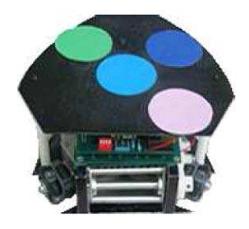
The first generation Botnia SR1 in Figure 1 was built in early 2005 to participate German Open 2005. It was based on 3-omni-directional-wheel design using Faulhaber DC motors and 9.7:1 gearhead, with spinner bar kicker. The electronics involved Atmel ATmega microcontroller, discrete motor controllers, and Radiometrix RF module. It showed many design flaws during the competition and an enhanced version Botnia SR1E was built in early 2006 to participate Dutch Open 2006. SR1E used same platform as SR1 but eliminated major flaws in SR1, with major improvements of motor control and vision system. However due to a very weak kicker, SR1E was still far behind competitors during the games. After Dutch Open 2006, a hard decision was made to build completely new second generation Botnia SR2 to participate the forthcoming RoboCup 2006, with major goals to use solenoid kickers and to improve the drive system.
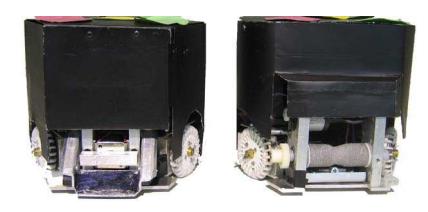
Botnia SR2 was completely handmade due to the extremely limited time. From design to implementation it took just one and half month, with all days and nights' work. SR2 was still based on 3-omni-directional-wheel design using Faulhaber DC motors, with higher resolution encoders (128/rev compared to 16/rev used in SR1 series), enhanced 24-subroller wheel, and enhanced 9.7:1 ball bearing gearhead. The main circuit was completely redesigned with optimized high efficiency DC converter and noise reduction capability, with SMD 4-layer PCB. The power supply voltage was increased from 8-cell to 10-cell 2600 mAh Ni-MH battery pack. The wireless communication system was redesigned to be able to switch modules between 433 MHz and 869 MHz. A standalone kicker circuit was built to supply 300V high voltage and charge a 470uF capacitor to power the solenoid kickers. An additional IR ball detector circuit was used to trigger the kickers. For an original factory made solenoid without changing the winding, the forward kicker achieved ball speed of 5 m/s. The kicker circuit was totally isolated with optical couplers and together with self discharging circuit which made it very safe against electric shock. Due to the lack of mechanical experience and time, SR2 was not able to combine the forward kicker, chip kicker and dribbler bar all together. Eventually two variant modes of SR2 were built, namely SR2C and SR2D. SR2C was the model with forward kicker and chip kicker. SR2D was the model with forward kicker and dribbler bar. We managed to use SR2C and SR2D to play as a mixed team during RoboCup 2006. SR2C was proved to be a quite successful model and scored all goals during the competition. The main weaknesses of SR2 series were the fragile and slippery wheels (handmade with plastic material) along with non-precision handmade mechanics, and its weak wireless communication performance under heavy interferences.
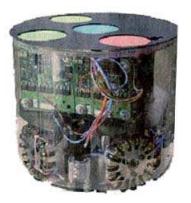
After RoboCup 2006, Botnia team planned to build its third generation Botnia SR3 for RoboCup 2007 as well as enhanced SR2E for backup and testing purpose. The major improvements of SR2E included upgrading the whole mechanics with CNC-made precision parts, redesigned wheels for better grabbing and enhanced wireless communication. In addition the kicker circuit was considered to be redesigned to reduce its size. The power source was also considered to be replaced with high performance Li-Po batteries. The third generation SR3 design was modified several times due to the inexperience of the team members and the outcome was not able to fulfill the design targets. 3D CAD was first time used to design mechanical parts for SR3 but the manufactured parts were not precise enough to meet the design requirements. SR3 was based on 4-omni-directional-wheel design using Maxon brushless motors with external 4:1 gear transmission. The major improvements of SR3 were using completely new architecture of electronic design and strategy software. SR3 used ARM7 processor running RTOS with discrete motor drivers. It was designed with capability of processing part of intelligence on robot itself, i.e. extracting wheel vectors from coordinates, autonomous lining up robot towards ball, logging function of status of robot (battery level, power consumption, travel distance, communication performance), etc, however such functions were not implemented in time and therefore left to 4th generation design. The kicker circuit was redesigned to supply 200V high voltage and charge altogether 6600uF capacitors to power the solenoid kickers. It was capable to switch maximum 200A current with 1024 grades fine adjustable kicking strength. At the full kicking strength, the forward kicker could achieve ball speed of 8 m/s and the chip kicker could achieve chip distance of over 3 m in prototype testing. The safety was also assured by using totally isolated circuit with optical couplers as used in SR2. The wireless communication in SR3 was significantly improved by using universal exchangeable modular design. SR3 could easily switch plug-in wireless modules between 1.9GHz DECT, 916MHz Linx, and 2.4GHz IEEE 802.15.4 radio. Multi antenna diversity was also taken into consideration to improve wireless communication performance. The prototype SR3 was tested in RoboCup 2007 with a major failure of its embedded software and incapable hardware. Nevertheless SR3 was later on completed after the RoboCup 2007 competition and used for educational demos.
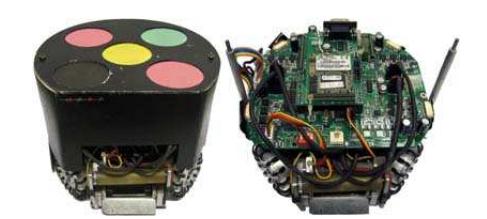
Despite of the failure of SR3, we have redesigned completely 4th generation SR4 in cooperation with the partner team in China. The SR4 is supposed to consummate all features designed in SR3 with additional improvements. SR4 still uses 4-wheel subsystem with a forward kicker, a chip kicker and a dribbler mounted on the platform. Modeling of the omnidirectional robot is based on [1], [2] and [3]. The forward kicker mechanism of SR4 has been significantly improved with much more powerful kicking strength. The chip kicker mechanism of SR4 has been redesigned to reduce significantly the ball coverage percentage compared to previous versions. The mechanics are completely manufactured with CNC machines. The electronics improvements are significant over SR3. The main control system uses ARM7 and Altera Cyclone II FPGA with extended data bus. All brushless motors are driven directly with FPGA plus MOSFETs solution. The wheel motors are equipped with 360 CPR optical encoders for high precision control. An IR array is implemented for self ball positioning. For wireless communications there are now both DECT and Linx modules on-board and no need to switch between each other. The power systems are optimized to achieve over 80% high effiecency DC step up/down convertion. SR4 has successfully competed in German Open 2008 and RoboCup 2008 by reaching the design goals.
For RoboCup 2009 we have initiated the 5th generation design SR5. The SR5 design is a successor based on highly successful SR4. In addition to SR4, SR5 mainly emphasizes maintenance-free mechanics and electronics, e.g. the motor assembly has integrated all-in-one 30W brushless motor with 1024 CPR MR encoder and precision internal gearbox, improved efficiency of kicker mechanism and dribbler device, single chip FPGA with soft CPU core, local feedback e.g. acceleration sensor and gyroscope, and on-board intelligence. The wireless communication is still the highly robust DECT operating in protocol mode. SR5 has been first time tested in China Open 2009, and during the entire competition there has been no need even for a screw driver to fix or maintain the robots.
3 Mechanical Design
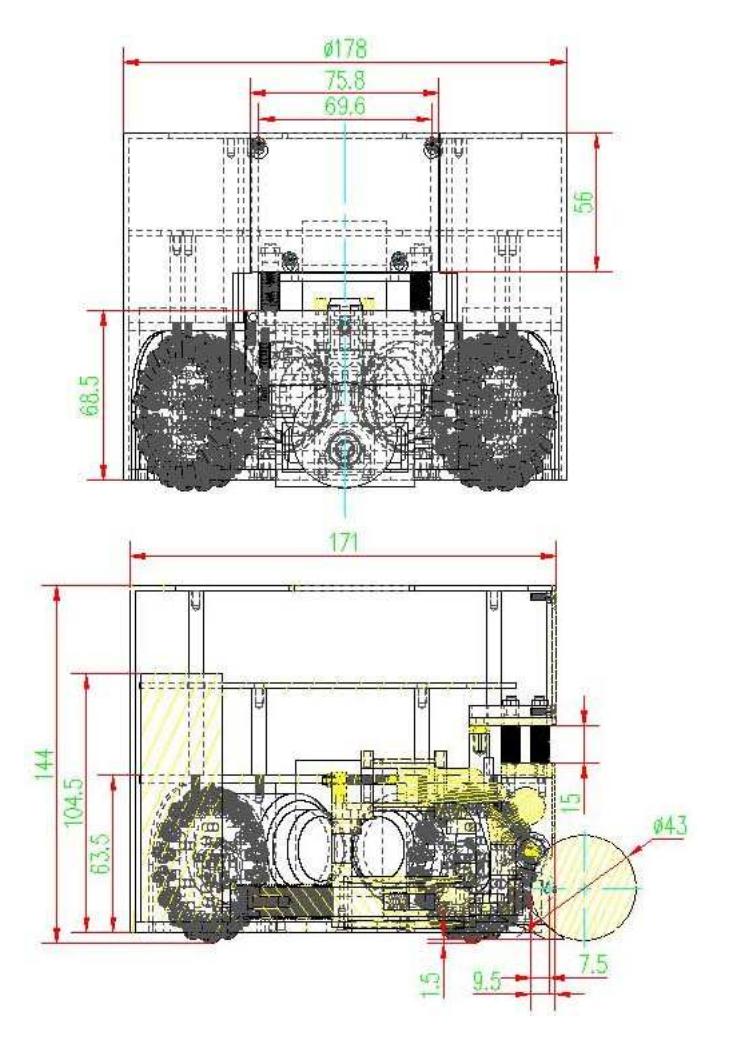
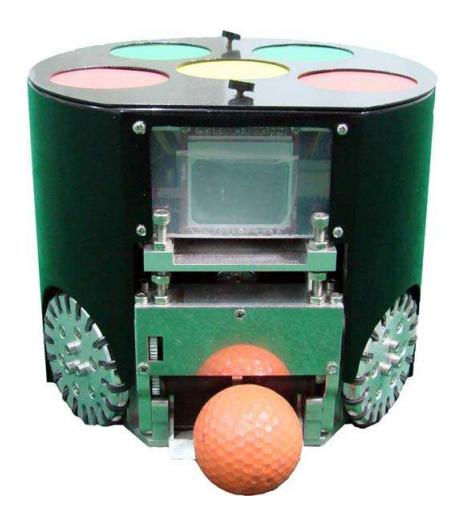
The new generation Botnia SR5 is designed based on the RoboCup F180 smallsize league rules [4]. The height of the robot is 144 mm, and the maximum diameter of its projection to the ground is 178 mm, as shown in Figure 5. The maximum projected ball coverage distance is 9.5 mm, which yields the maximum percentage of ball coverage of 16.41%. Figure 6 shows a fully assembled SR5.
4 Software Design
The Botnia software system consists of strategy with simulator system, and vision system.
4.1 Strategy with Simulator System
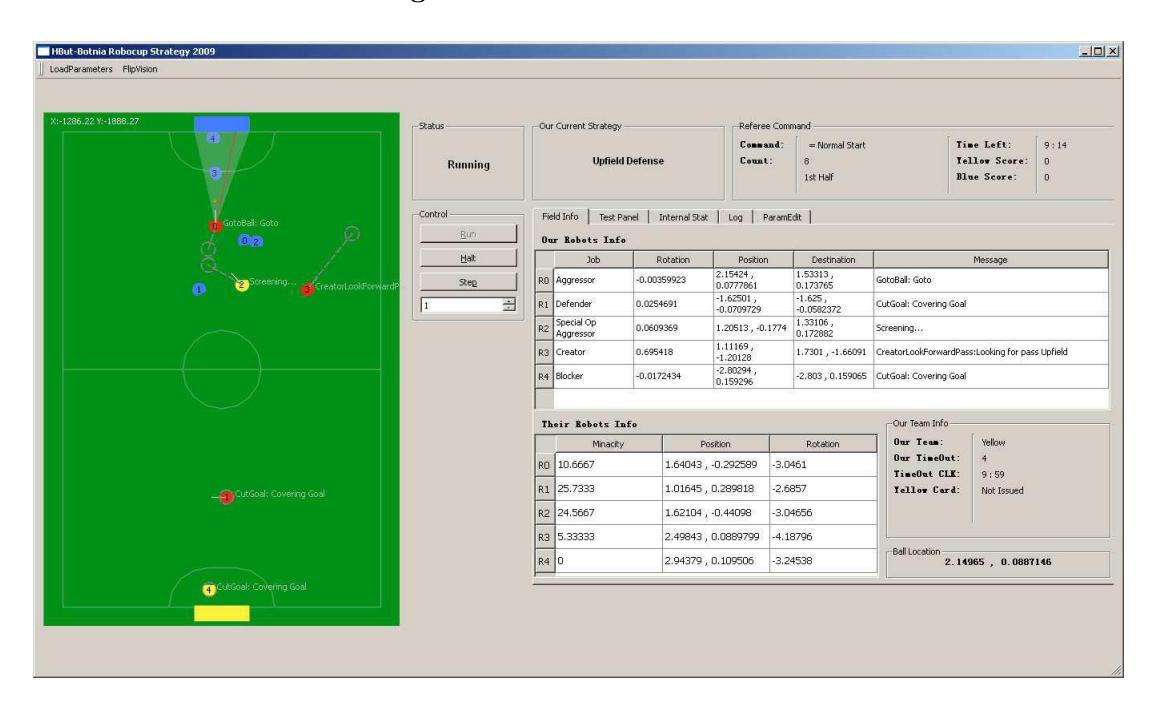
A completely new strategy and simulator system under code name Botnia2009 has been developed from scratch. The algorithms are based on released code of Cornell Big Red and Carnegie Mellon CMDragons in 2002, and programmed in Visual C++ with QT. The new strategy has employed Extended RRT (ERRT) [5] algorithm for path planning and trapezoidal velocity profiles (bang-bang acceleration) [6] as motion planning. The simulator is capable to take into account with real word noise and provide more realistic simulations. Due to the very limited development time, there are still many bugs in the new strategy which need to be fixed and consummated in the future. Figure 7 shows the GUI outlook of the new strategy.
4.2 Vision System
Due to the major drawbacks of the old vision system, we have made a major redesign of the entire vision system. The new vision system uses the latest AVT Stingray F-046C IEEE1394b standard cameras with extremely low distortion lenses, capturing at 780 x 580 resolution. The new vision software is developed based on CMVision 2.1, and OpenCV with DirectShow. The calibration is based on classic Tsai algorithm [7].
With new butterfly color markers, identification reliability of own robots is greatly improved. The new vision system can also nicely solve our old problems such as ball misidentification and ball tails on white line. Besides, now it's possible to identify the orientation from opponent robots by given color marker templates. The new vision system is capable to run at 60 FPS. Since the whole small-size league is moving to shared SSL-Vision, we have successfully adopted to the new SSL-Vision system.
5 Conclusion
This paper described the current development status of Botnia Dragon Knights team. A new generation of physical robots with completely new electronics, mechanics, communications as well as software have been designed and implemented, which have a number of significant improvements compared to last generation system. The strategy system is currently still under heavy improvements.
References
- Muir, P.F. and Neuman, C.P. 1987: Kinematic modeling of wheeled mobile robots, J. Robotic Systems, 4(2): 281-340
- Sahn, S.K., Angeles, J. and Darcovich, J. 1995: The design of kinematically isotropic rolling robot with omni-directional wheels, Mechanism and Machine theory, 30(8): 1127-1137
- Leow, Y.P., Low, K.H., and Loh, W.K. 2002: Kinematic Modeling and Analysis of Mobile Robot with Omni Directional Wheels, Proceedings of the Seventh International Conference On Automation, Robotics, Control And Vision, Singapore
- RoboCup Organization Official Home page http://www.robocup.org [cited on 14.02.2007]
- Bruce, James R. and Veloso, Manuela 2002: Real-time randomized path planning for robot navigation. In Proceedings of the IEEE Conference on Intelligent Robots and Systems (IROS).
- Bruce, James R., Bowling, Michael, Browning, Brett and Veloso, Manuela 2003: Multi-robot team response to a multi-robot opponent team. In Proceedings of the IEEE International Conference on Robotics and Automation, Taiwan.
- Tsai, Roger Y. 1987: A versatile Camera Calibration Technique for High-Accuracy 3D Machine Vision Metrology Using Off-the-Shelf TV Cameras and Lenses, IEEE Journal of Robotics and Automation, Vol. RA-3, No. 4, pages 323-344