Field Rangers Team Description Paper
Yusuf Pranggonoh, Buck Sin Ng, Tianwu Yang, Ai Ling Kwong, Pik Kong Yue, Changjiu Zhou
Advanced Robotics and Intelligent Control Centre (ARICC), Singapore Polytechnic, 139651, Singapore
www.robo-erectus.org/RobotSmall/RobotSmall.php
Abstract This paper describes an overview of Field Rangers robot team as an entry requirement for participation in RoboCup 2010 Small Size League (SSL) Competition. The overview focuses on the new mechanical design, hardware design and overall Artificial Intelligent (AI) structure of Field Rangers.
1 Introduction
Field Rangers is a Small-Size League (SSL) robot team from Advanced Robotics and Intelligent Control Centre (ARICC), Singapore Polytechnic, Singapore. Field Rangers had been participating in RoboCup SSL Competition from 1999 to 2006 (in the year 1999 with the team name SingPoly) and achieved a respectable result over the participation years. Field Rangers came in 2nd place in the Small Size League (SSL) in RoboCup 2001. In 2005, Field Rangers won the 3rd place in SSL and 1st on Shooting Challange. In 2006, it finished 4th in SSL. After the RoboCup 2009 in Graz, the team was re-launched with the same project name. The team members decided to redesigning the mechanical structure of the robot and redeveloping the hardware in order to participate in the RoboCup 2010 in Singapore.
This year, the vision system will be shared among the participanting teams using SSL Shared Vision System. Therefore, the focus of the software development will be in implementation of the low level motion controller to make the robot more robust and the new Artificial Intelligent structure for competing with current technology.
2 Hardware Systems
(no text in this section header)
2.1 Robot Mechanical Design
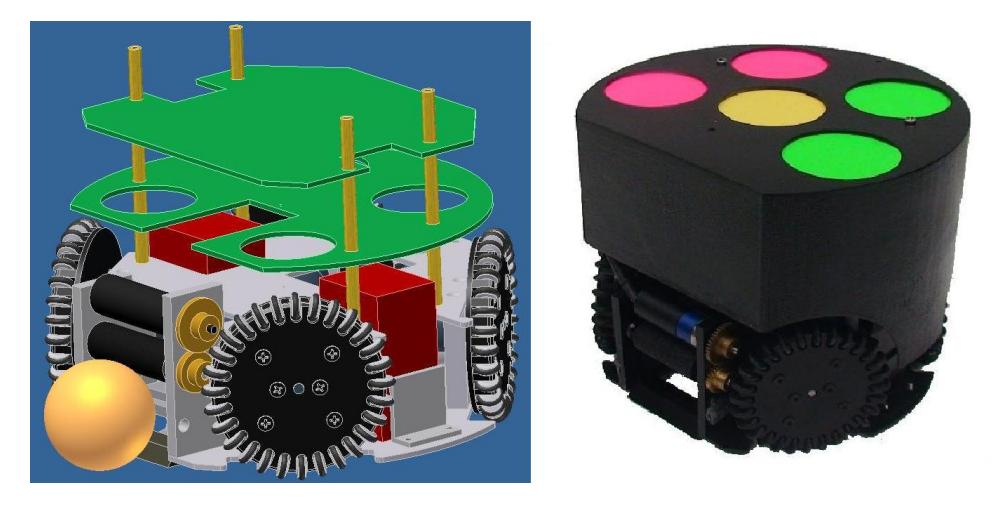
Field Rangers robot has a diameter of 178mm and a height of 146mm. It uses four omni-directional wheels which are made with 28 small rollers to get more friction with the playing field. The two front wheels have an angle of 55 degree to the front axis and 45 degree for the two back wheels to the back axis. Each wheel is driven by a Faulhaber 2232U009SR DC-Motor with nominal torque of 10mNm and gear ratio of 9.7:1.
The dribbler is mounted above the kicking mechanism and is driven by Faulhaber Brushless DC Motor with gear ratio of 14:1. The Brushless DC Motor will be attached to the dribble holder that is connected to the suspension through a gear. The dribble covers about 18 percent of the ball.
To be able to compete with current game play of SSL Competition, Field Rangers robot will have two kicking mechanism, straight kick and chip kick. An additional chip kick was implemented in order to do the passing or shooting over an opponent robot. The straight kick has an ability to kick the ball with speed of 10m/s using cylindrical solenoid. The chip kick mechanism was designed similar with the straight kick, but it will be attached with aluminium plate with 60 degree slope at the front of the contact point with the ball and pivoted in the dribble holder. The chip kick has an ability to chip the ball with distance of 6 meters. Both of the solenoids are driven by two 2200uF/250V capacitors.
Figure 1 below shows the 3D model and actual robot of the Field Rangers 2010 robot.
2.2 Robot Electronic System
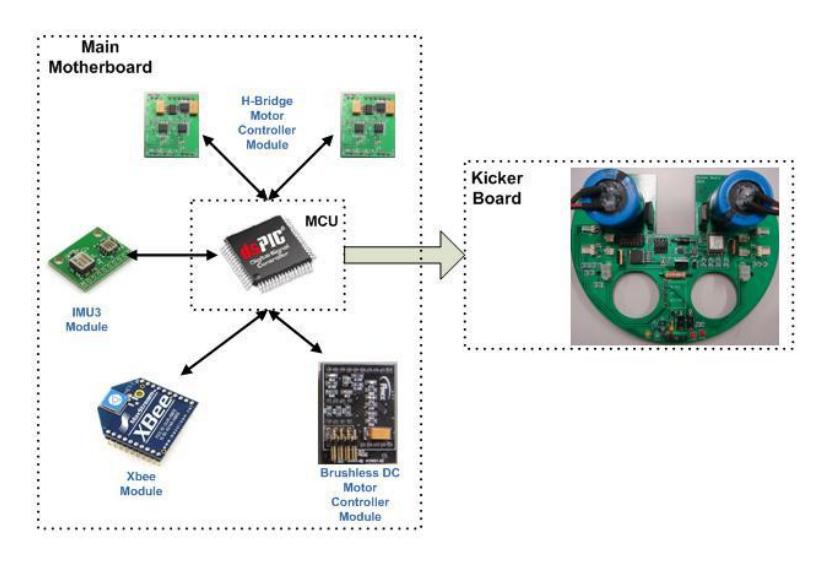
Field Rangers robot electronic system consists of two main parts, the main motherboard and the kicker board. There are many modular parts supporting the main motherboard to give the ease of replacing them when the main motherboard is damaged.
The main motherboard will be using dsPIC30 series chip as a central and main microcontroller unit with 16-bit processor. The modular parts that attaching to the main motherboard are: H-Bridge Mosfet Motor Controller module, Brushless DC Motor Controller Module, IMU3 Board Module, and XBee Module. It runs on embedded MPLAB platform, which was used to generate, configure and debug the necessary robot low level firmware.
The Kicker Board is directly controlled by the dsPIC30 Series on the main motherboard. The kicking strength can be varied from 1 to 10m/s depends on the timing given by the central controller unit to the high power mosfet. The Kicker board was designed for both straight kick and chip kick capabilities.
Figure 2 shows the overall electronic system of Field Rangers.
3 Software Systems
Field Rangers software system consists of two main parts, the Vision system and Artificial Intelligent (AI) system. As for RoboCup 2010 in Singapore, SSL Competition will be using a Shared Vision System that will be implemented during the game play; means the competing teams will be using the same and shared vision system prepared by the Competition committee. One reason of such implementation is flexibility in organizing and preparing for the competition. Therefore, the below explanation will describe the current vision system that Field Rangers' used.
3.1 Vision System
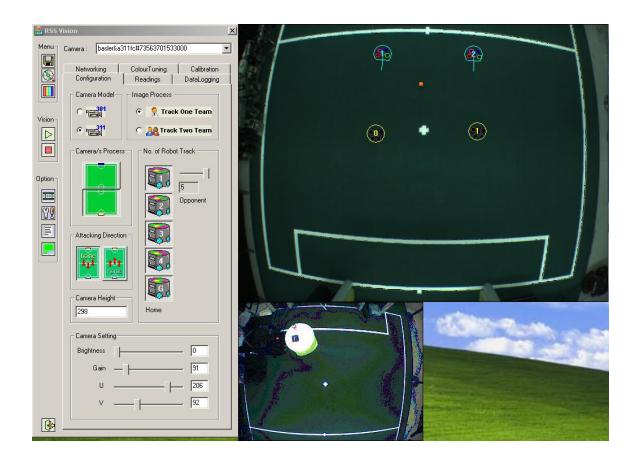
The Vision system is used to identify the robot identification by capturing their unique colour coded on the playing field as well as its coordinates and ball, and it also distinguishes between the player robots and the opponent robots.
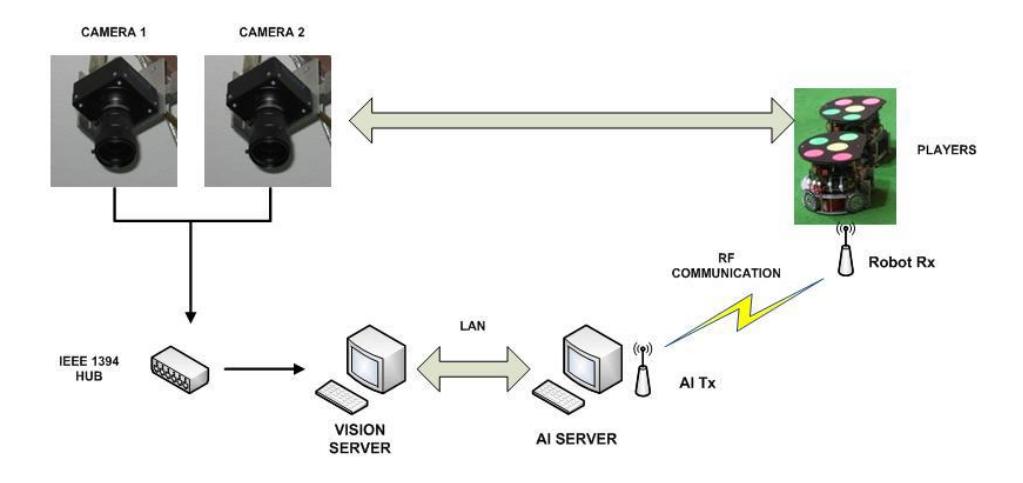
For each half of the field, there is one BCAM camera (A311fc Series) connected with IEEE 1394 cable to single IEEE 1394 Hub and through IEEE 1394 repeater before finally connected to Vision Server (Host). The frame rate is at 60 frames/second for optimal frame rate.
The use of wide-angle lens to capture the full field resulted in image distortion particularly at the field edges. Using the least square error method, physical Cartesian coordinate on the field is translated and mapped onto the image coordinate. The corrected images attained deviations of less than 20mm.
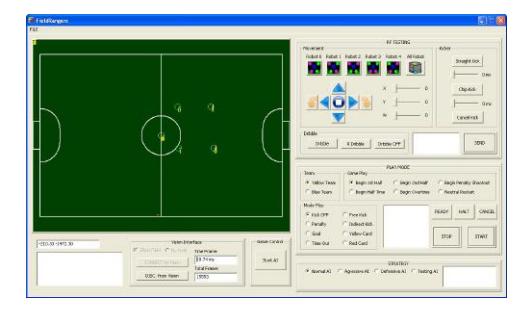
The Figure 3 shows the current user interface of the vision system.
3.2 AI System
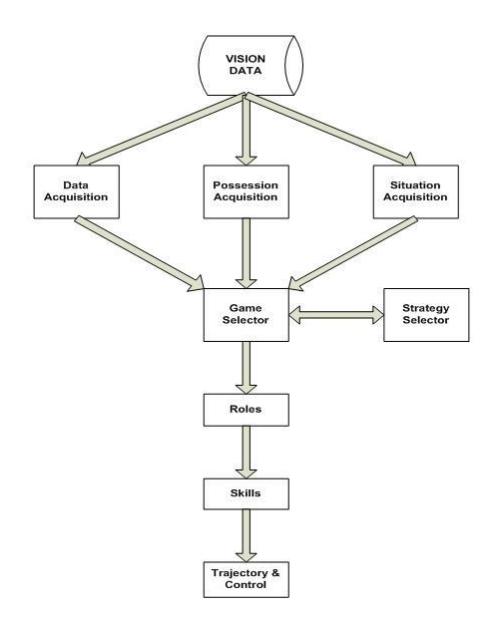
The AI system is used to determine the game situation, the strategy, the coordination, the roles and the skills of each robot. The 'Vision Data' is received and processed for performing the AI structure. The AI Structure is shown in Figure 4.
Data Acquisition provides information about the location of the balls, player robots and opponent robots. It also predicts the locations of the ball and the roots in the next frame.
Possession Acquisition determines the possession of the robot by calculating the possession of the ball by each team. The nearer the ball comes to a robot, the higher the percentage of possession is obtained by the robot.
4 System Overview
The following Figure 6 shows the Field Rangers' system overview:
5 Conclusion
Field Rangers 2010 robots will have new mechanical design, hardware design and low level motion controller. The robot is improving in term of speed, control and strength with more precisely control and coordination of strategy. It is a good platform on research and development with collaboration to other technology to develop an autonomous robot project in the near future. We hope that Field Rangers 2010 will perform better in coming RoboCup 2010 held in Singapore after four years absent in the competition. We are also looking forward to share knowledge, experience and technology with other great teams around the world.
Development Team
Yusuf Pranggonoh - Mechanical Design and Hardware Design (Team Leader)
Ng Buck Sin - Vision System and Motion Control
Ong Tat Yeong, Torin Nguyen - Communication
Dr. Yang Tianwu, Robin Quek, Kwong Ai Ling - AI System
Dr. Zhou Changjiu, Yue Pik Kong - Advisor
Acknowledgments
The authors would like to thank the project team who developed Field Rangers in the past, in particular Yuen Siong Lim and David Li and students at the Advanced Robotics and Intelligent Control Centre (ARICC) and higher management of Singapore Polytechnic for their support in the development of our Small Size Robot.
References
- L. Huang, Y. S. Lim, David Li and Christopher E. L. Teoh, "Design and Analysis of a Four-wheel Omnidirectional Mobile Robot", 2nd International Conference on Autonomous Robots and Agents, pages 425-428, 2004.
- Liver Purwin, Raffaello D'Andrea, "Trajectory generation and control for four wheeled omnidirectional vehicles", Cornell University, USA, October 2005.
- Lim Yuen Siong and David Li Chung Ping, "SP Field Rangers: Technical Description Paper", RoboCup 2005, 2005.
- Ng Buck Sin, "Advanced Image Processing For Tracking of Multi Agent Autonomous Robots", Technical Report, Singapore Polytechnic, 2005.
- James Robert Bruce, "Real-Time Motion Planning and Safe Navigation in Dynamic Multi-Robot Environments", School of Computer Science, Carnegie Mellon Univeristy, USA, December 2006.