STOx's 2013 TEAM DESCRIPTION PAPER
Saith Rodríguez, Eyberth Rojas, Katherin Pérez, Jorge Lopez, Heison Baez, Juan Manuel Calderón
Faculty of Electronics Engineering Universidad Santo Tomás Bogotá, Colombia
Abstract This paper shows the status of Small Size League team of Santo Tomas University. The team is active in RoboCup since 2011 and intends to participate in Eindhoven 2013. The software and hardware designs are described emphasizing on the improvements made of this year.
1 INTRODUCTION
STOx's SSL Team was built by The Robotics Research and Development Group (GED). The group is attached to Electronics Engineering Faculty of Santo Tomas University, in order to join the global initiative RoboCup. In 2010 we participated for the first time in Latin American Open RoboCup which we got placed second. Subsequently, we participated by first time in 2011 at RoboCup Worldchampionship, in which the team got ranked in top 12 and then we participated in RoboCupWorld-Championship 2012 where team were left in Round Robin.
Over 2012 competition, we detected some problems with communications system that limits and reduces the performance of robots and therefore this year the team has decided to implement a new communications system that will be explained in greater detail forward.
Hardware Robot design includes mechanical devices and electronics control systems. These systems have had a very good performance so far, so we decide to keep almost the same structure with a little modification.
Software design is composed by modules as Filtering, Prediction, High Level Control and Artificial Intelligence (AI) system that determine team strategy. All of these modules have been restructured to improve the team performance, also the robots performance.
As a result, for this year our team main advances are: an implemented new communication system, an incorporated more robust intelligence architecture. This architecture is supported by the creation and implementation of a new software platform.
2 HARDWARE DESING
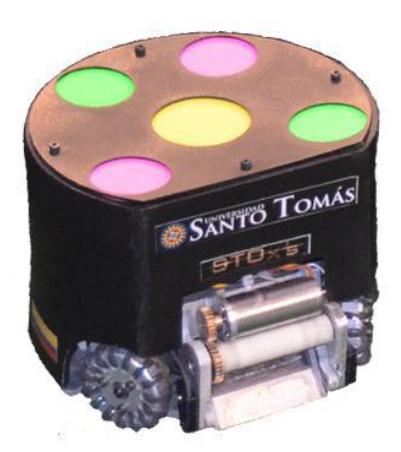
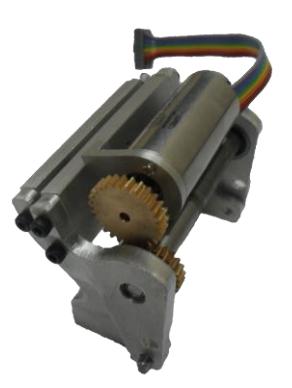
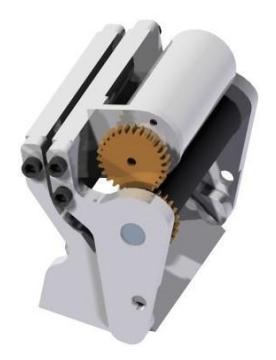
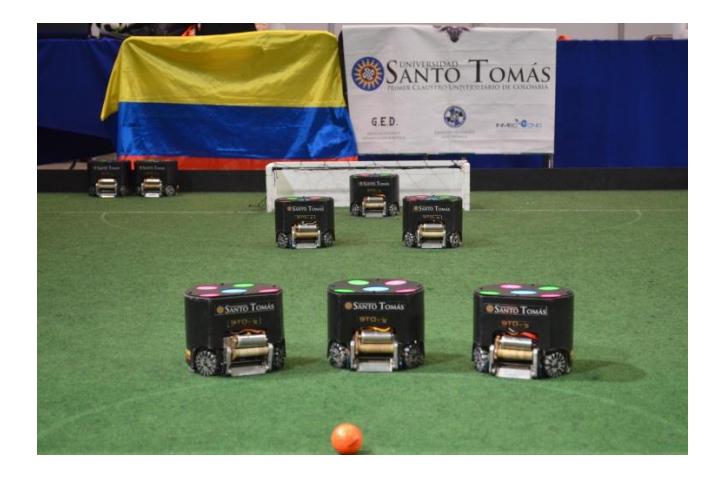
Initially, our equipment consists of eight identical robots built in 2011. The mechanical design of these robots won't be significantly changed. The robot measures are 178 mm in diameter and 145 mm high. The driving system (dribbler) covers the ball by 18%, complying with the competition rules. The real robot is showed at Fig. 1.
2.1 MECHANICS
Mechanical components are based on previous designs of teams in the league, and developed its own designs to meet the needs of the robots and game requirements.
Chassis: The chassis was built based on the design of Skuba 2009. All pieces were made with CNC machinery using aluminum 7075. The material and the fabrication process provide to robot a good balance between strength and weight, also a high similarity of parts.
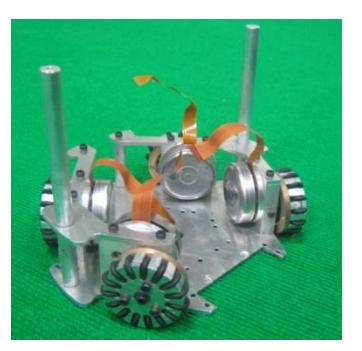
Traction: The robot's traction is omni-directional, with four custom-built wheels. Each wheel has a diameter of 50mm with 15 rollers; these wheels are connected with the motors through a gearbox of 61:17 based on the design of Skuba 2009. The robot has four brushless motors "Maxon EC45- Flat 30W", these motors provide a maximum speed of 3.2 m/s to the robot. We implemented double seal o'rings to the rollers to provide more grip to wheels. The Robot's chassis with wheels and motors is shown in Fig. 2.

2.2 ELECTRONICS
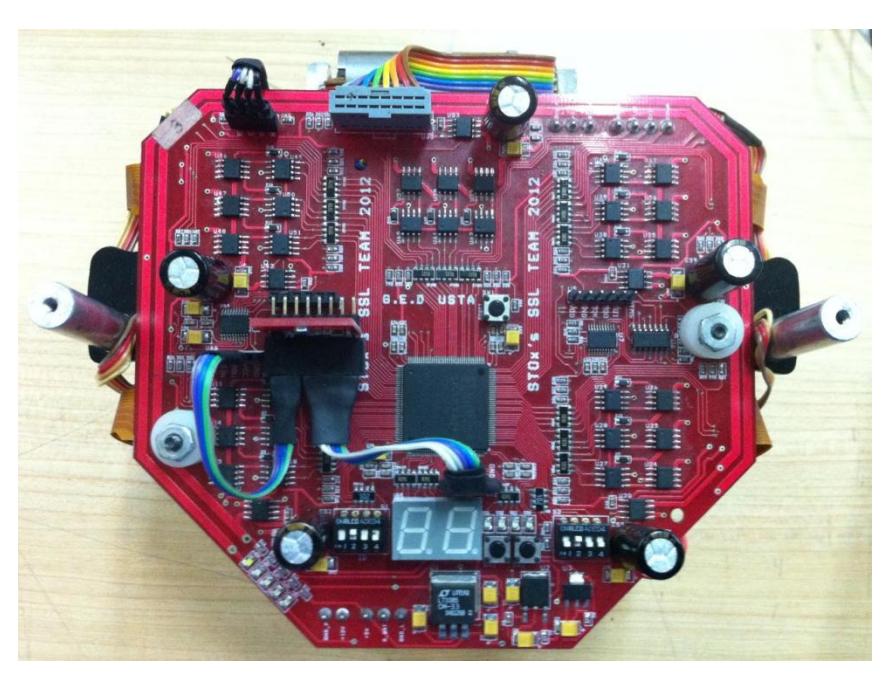
By 2012 we designed a custom board. This board allows us to get over electronics system problems, so this board is used in our robots so far and its performance is very good. Figure 6 shows the Main Board.
2.3 COMMUNICATION
Until last year we use X-Bee modules, which provide full-duplex communication between the robots and the central system. The X-Bee modules operate in broadcast mode at 2.4GHz frequency and can be set up in 8 different channels. However, during RoboCup 2012 we detect that communications are the most relevant problem affecting team performance. This problem was evident during communication between central system and robots because of the latency. It was found that the process of sending and receiving data takes more than 16ms, which means there is an accumulation of information and latency is generated. For that reason, this year we decide to change the communications system and also we developed a new module based on nRF24L01 module. This module works in the range between 2.4GHz and 2.5GHz, it depends on the channel selected. The channel and the addresses of receiving and sending data can be assigned by software also the transmission power and the air data rate. In our case, the air data rate is 250 Kbps and the transmission power is 0 dBm.
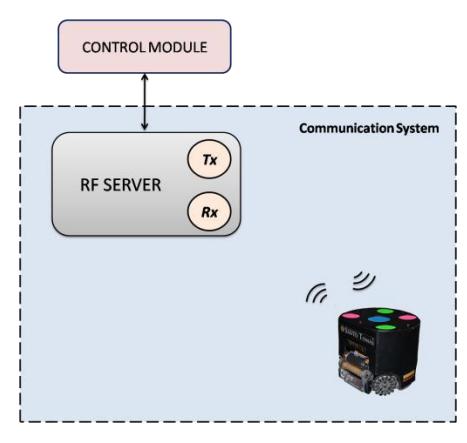
Communication system has a RF server who makes a connection between main control module and robots. This allows to system to send convenient information every time. The server has two main modules; the first one is dedicated to data transmission and the second one to reception.
At this system each robot information status is not updated permanently but it happens when the robot has the ball, as a result every robot has only a single module to transmit and receive information. The communication system is shown in Figure 9.
3 SOFTWARE
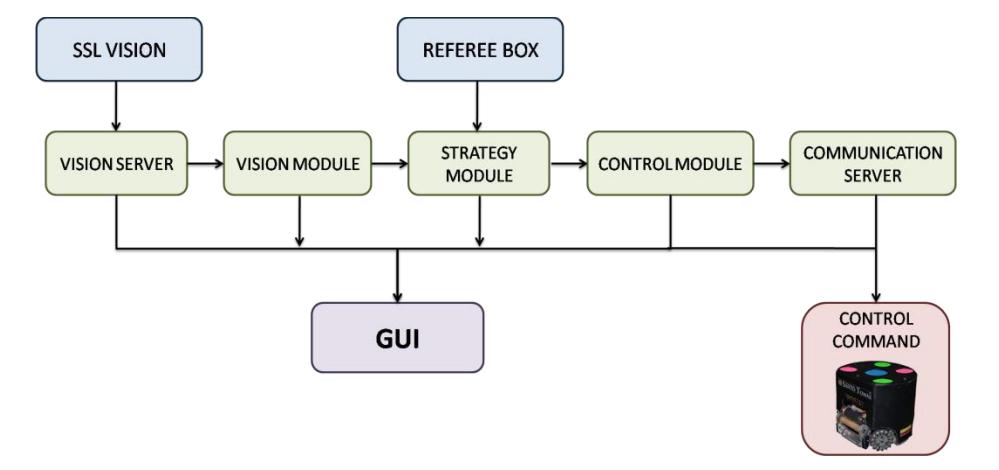
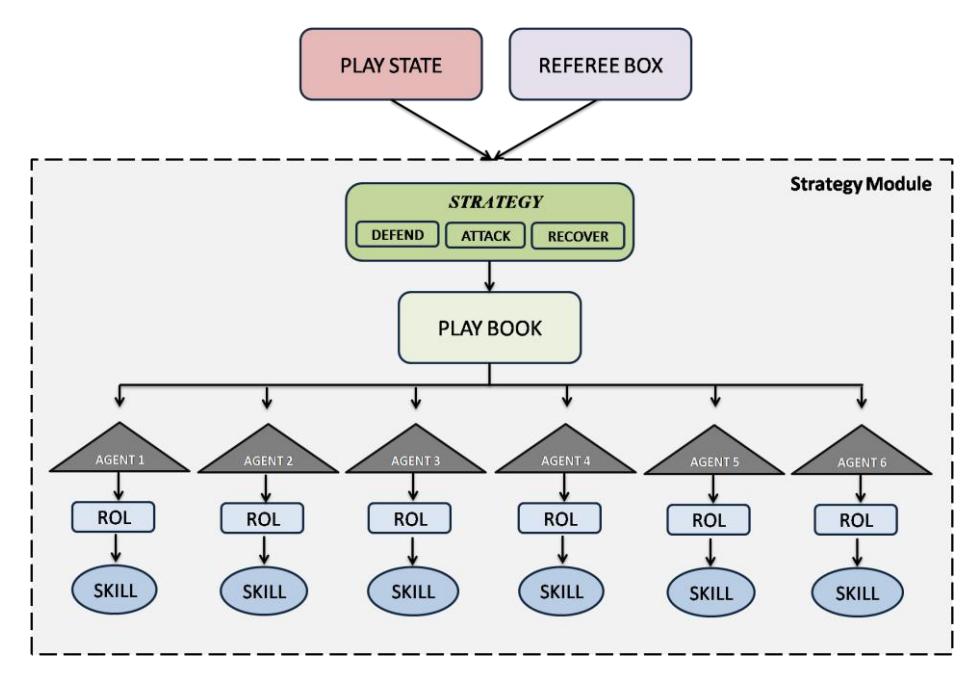
By this year STOxs team software was developed on Microsoft Visual Studio 2010. The software is compounded by such modules as filtering, prediction and control. It developed an intelligent multi-agent architecture. By this year we added new game strategies based on our past competitions experiences. The software architecture is shown in Fig. 10
4 CONCLUSIONS AND RESULTS
Since 2011 when we participate for a first time in a RoboCup World Championship, the team has improvements in the behavior, performance and efficiency of robots. Following the competitions path, we found difficulties and problems that had been solved thanks to every challenging experience and collaboration of other teams' members. We appreciate that other teams have shared with us some of their knowledge and useful ideas achieved so far.
This year we are eager to show our advances and improvements, beating some problems detected in 2012. We expect to continue improvement and evolution of our robots Intelligence System. We want to provide our experience and knowledge to growth of Small Size League.
References
- Skuba 2012 Extended Team Description. http://robocupssl.cpe.ku.ac.th/tdp/etdp2011/SKUBA_ETDP_2011.pdf
- Skuba 2011 Extended Team Description. http://robocupssl.cpe.ku.ac.th/tdp/etdp2011/SKUBA_ETDP_2011.pdf
- ZJUNlict Extended Team Description 2012. http://robocupssl.cpe.ku.ac.th/_media/robocup2012:2012_zjunlict_etdp.pdf
- FOSLER, R.: Generating High Voltage Using the PIC16C781/782. Application note, Microchip Technology Inc. (2005)
- BRUCE, J., VELOSO, M.: Real-time randomized path planning for robot navigation. In: Proceedings of the IEEE Conference on Intelligent Robots and Systems. (2002)
- RODRÍGUEZ, Saith and ROJAS, Eyberth. Diseño e implementación de un equipo Small Size robot League para la RoboCup, Universidad Santo Tomas, 2010
- PAVÓN, Juan. PÉREZ, José. Agentes software y sistemas multi-agente. Prentice Hall. 2004.
- RUSSELL, N. Inteligencia Artificial: Un Enfoque Moderno. Prentice Hall, 2004.