IRSS Deluxe Team Description Paper
Gabriel Ahumada, Sebastián Arriagada, César Banda, Cristóbal Barrientos, Edwars Callejas, Camila Carrasco, Marcelo Jara, Cristóbal Nettle, Marcela Polanco, Pablo Riquelme, Tomás Rodenas, Miguel Solis, Melanie Suárez
Centro de Robótica Universidad Técnica Federico Santa María, Chile
http://robotica.elo.utfsm.cl/robocup/
Abstract This paper describes the current development status of our SSL team, IRSS Deluxe, with the purpose to qualify for the RoboCup 2014. We present the design and implementation we have got so far in order to achieve this goal, showing the electrical, mechanical and software topics involved in our work, which were designed according to satisfy the RoboCup rules.
Introduction
Centro de Robótica founded at 2001, corresponds to an agroupation of undergraduate and graduate students from many faculties, whose members are mainly from Electronics, Informatics and Mechanical Engineering Departaments at this University. This RoboCup team belongs to one of several projects at this agroupation, where we can found students specialized on computer science, control and automation, or power electronics, as well as mechanical engineering students.
This document describes our design and the implementation we have got so far, showing all the work made in the different areas involved at this category. In particular, we describe mechanical design, electronics design for different devices and algorithms implementation for the (robotic) team coordination, and also the expected implementation we are planning to reach by the time of the competition.
Mechanical Design
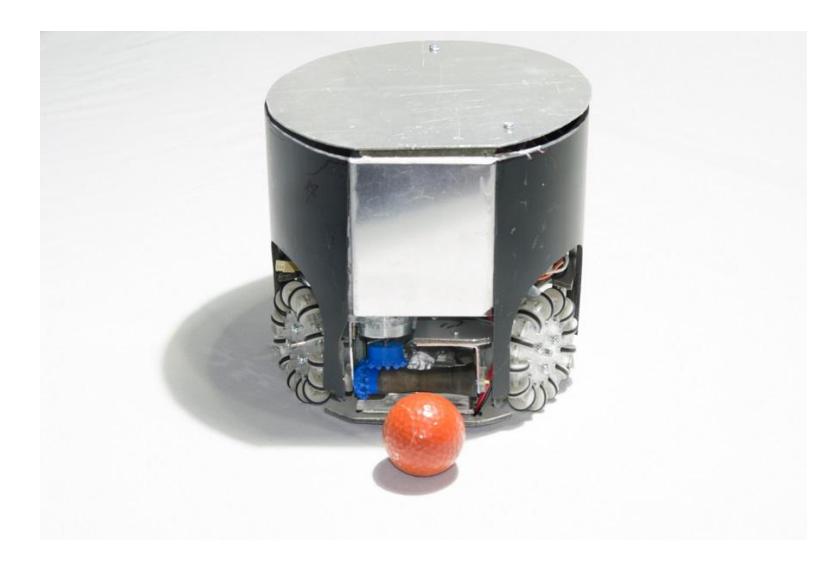
This corresponds to the first generation of robots of our team, whose dimensional specifications are:
– Height: 148 mm – Diameter: 176 mm
– Maximum coverage of the ball: 18 %
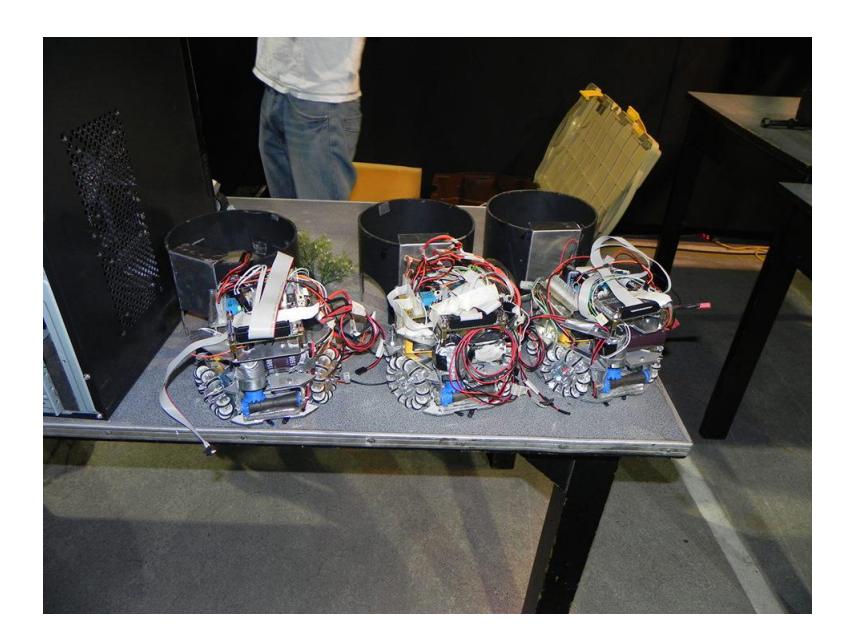
Figure 1 shows the three robots built at the time, yet only two of them are availables due to electrical failures of a couple of motors and long shipping dates.
Drive system
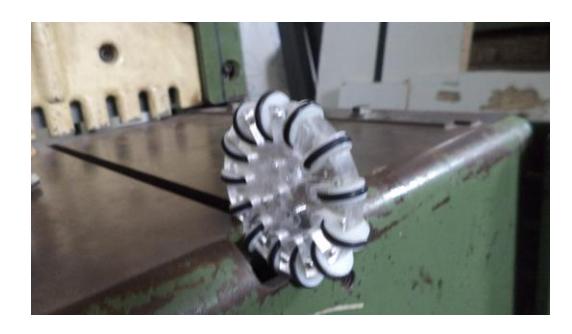
Each robot has 4 omnidirectional wheels, each one with 61 mm of diameter and 13 sub-wheels of 15.5 mm of diameter, so the robot can move in all directions.
Each omnidirectional wheel is driven by a motor Maxon EC 45, 30 Watts and integrated electronics which enable us to program a velocity control for each motor, ensuring that the robot moves to our desired speed.
This wheel is shown in Figure 3.
Hardware
Each robot is controlled by an Altera Cyclone IV FPGA, using DE0-Nano development board. This model was chosen because of its reduced size (given that it doesn't have so many peripherals, display, switches and VGA as other models), and it does include an accelerometer and ADC wich simplifies the electronic work.
We choose the FPGA more than a microcontroller because the simplicity for generating PWM and synchronic signals, and we also could achieve a multitask approach as movement, data receiving, sensor data processing wich leads to a faster action response.
Kicker
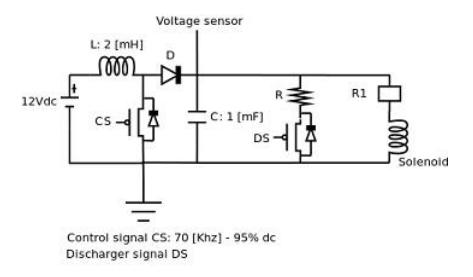
The kicker device consist of a boost circuit that elevates the voltage coming from a 12 [V] battery to 200 [V] charging a capacitor, saving 80 [J] that are discharged to the kicker solenoid. This circuit uses the L inductor characteristics injecting the current created switching the left mosfet of the diagram, closing the sourceinductance path. This current remains and is passed through the upper diode to the C capacitor. The circuit implemented allows to control the voltage, and therefore the energy, in the capacitor. This makes controllable the strength of the hit to the ball. If the voltage is too high than the desired stroke, the mosfet controlled by the DS signal is fed connecting the resistance and discharging the capacitor through that path.
When the robot is ready to stroke, the R1 relay connects the solenoid to the circuit, discharging almost instantaneously the capacitor and finally shooting the ball.
Dribbler
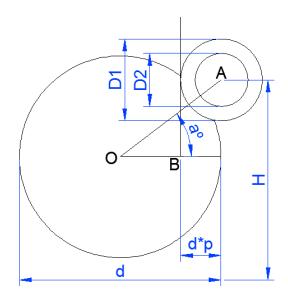
According to RoboCup rules, the robot is allowed to cover up to 20% of the ball. Experimentally, it has been proved that it's easier to catch the ball when the dribbler has a slightly curve to center the ball on its own. So, this design involves two diameters, $D_1$ and $D_2$ and based on this information, maximum height possible is calculated and we obtain this expression:
$$H = \sqrt{\frac{1}{4} \left( D_2 \left( 2d + D_2 \right) + D_1 \left( 4pd - 2d - D_1 \right) + 4pd^2 \left( 1 - p \right) \right)} + \frac{d}{2}$$
where d and p corresponds to the ball's diameter and maximum coverage of the ball respectively. Figure 5 shows the relation between those variables.
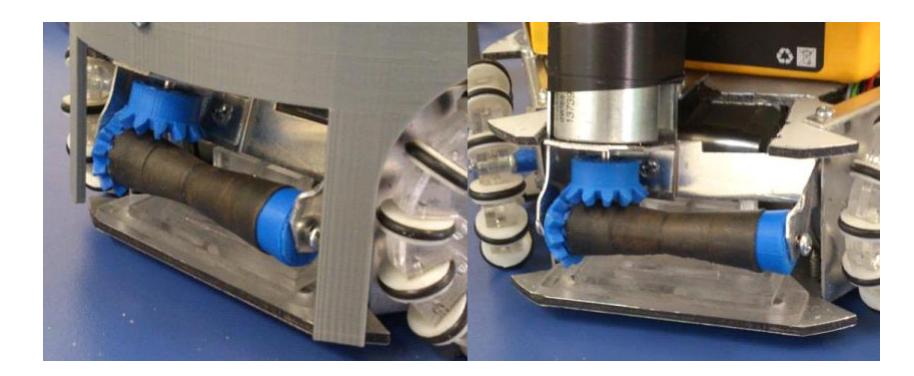
Then, on the implementation (which is shown in Figure 6) we use a DC Motor, Maxon RE-max 29, 22 watts and the dribbler is driven by a gear system, whose gears were built on a 3D printer.
Communication
For wireless communication between robots and the main computer, we use Xbee Series 2 devices, selected by their transmission features, transmission range and power consumption. The network consists on a coordinator (computer), which sends sequential instructions to all robots in broadcast mode, where each robot (equipped with an Xbee END Point) codes only the first part of messages, recognizing if this message is intended to be for that robot or discarding in case it is for another one. Instructions protocol consists on 13 bytes per package, formed by:
- 1 byte: Pattern wich indicates that this is the first byte of the package and id of the selected robot. This byte also has the kicker and dribbler instructions.
- 1 byte: id of the selected wheel of the robot, this wheel will have a velocity (and direction) given by the next bytes.
- 2 bytes: This contains the velocity within a 12 bits resolution
- 9 bytes: These bytes are used for the other wheels (3 bytes per wheel).
This transmission is set to a 38400 baudes rate.
Software
[Software section introduction]
Simulation
In order to simulate the robotic team coordination, and test different multi-agent algorithms, we make use of GrSim [4], software that has been very helpful to test game strategies.
In simulation, we evaluate the best candidates to pass the ball, in order to shoot to the goal area. The idea is to develop a gameplay more focused on attacking, and then the decision maker evaluates the game for deciding if we are in disadvantage and then change to a defensive gameplay.
Team coordination
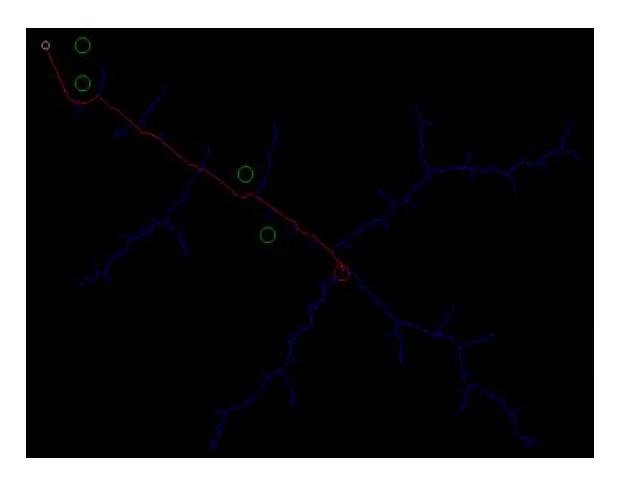
An important aspect of a RoboCup team intelligence is Path Planning. We have tested different methods looking for a suitable algorithm which gives good results at the moment of avoiding obstacles.
The first method tested was Potential Field algorithms [2]. This proposes a potential field representation for obstacles and target, using sources for the prior and sink for the latter. In this way, vector trajectories are generated avoiding obstacles and leading the agent to the target, as we let a ball fall down. A disadvantage of this method, is that we could obtain local minimums without reaching the target.
The second method tested was Rapidly Exploring Random Trees (RRTs) [3], which consists on expanding a tree on the target zone, avoiding to add nodes that could produce collitions with targets. The added points to the tree are randomly chosen with probability p in a straight line to the target, and with probability 1−p selecting a random point on the space, making more exploration and avoiding to get stucked on a different location to the target.
For improving its performance, we have implemented and tested some of the algorithms based on RRT, waypoints, smoothing and some extensions like RRT* presented on 2011 [1].
Expected Capabilities
By the time of the competition we expect to have built at least four robots, if there were not any more electrical failures in hardware we would expect to have built five robots, and have improved some aspects like:
- Improve the motion control for each robot, in order to be able to follow the ball facing it in a more efficient way. At the time of qualifications, robots are not able to face the ball at the same time they are chasing the ball, this is the reason why shots and passes are not shown in the video, nevertheless dribbler and kicker devices are already implemented and working fine.
- Referee box has already been tested, but there are remaining constraints in order to cover all rule cases.
- Test the implementation of game strategies with the final team (with the final number of robots).
References
- Adam Bry and Nicholas Roy. Rapidly-exploring random belief trees for motion planning under uncertainty. In Robotics and Automation (ICRA), 2011 IEEE International Conference on, pages 723–730. IEEE, 2011.
- Shuzhi Sam Ge and Yan Juan Cui. New potential functions for mobile robot path planning. Robotics and Automation, IEEE Transactions on, 16(5):615–620, 2000.
- Steven M LaValle. Rapidly-exploring random trees a ew tool for path planning. 1998.
- Valiallah Monajjemi, Ali Koochakzadeh, and Saeed Shiry Ghidary. grsim–robocup small size robot soccer simulator. In RoboCup 2011: Robot Soccer World Cup XV, pages 450–460. Springer, 2012.