ZJUNlict Extended TDP for RoboCup 2015
Chuan Li, Wenjian Tang, Lisen Jin, Yangsheng Ye, Xiaoxing Chen, Lingyun Chen, Rong Xiong
National Laboratory of Industrial Control Technology Zhejiang University Zheda Road No.38, Hangzhou Zhejiang Province, P.R. China
http://www.nlict.zju.edu.cn/ssl/WelcomePage.html
Abstract ZJUNlict have participated in Robocup for about ten years since 2004. In this paper, we summarizes the details of ZJUNlict robot soccer system we have made in recent years. we will emphasize the main ideas of designing in the robots' hardware and our software systems. Also we will share our tips on some special problems.
1 Introduction
Our team is an open project supported by the National Lab. of Industrial Control Technology in Zhejiang University, China. We have started since 2003 and participated in RoboCup 2004-2014. The competition and communication in RoboCup games benefit us a lot. In 2007-2008 RoboCup, we were one of the top four teams in the league. We also won the first place in Robocup China Open in 2006-2008 and 2011. We won the first price in 2013 and 2014, which is a great excitation to us. And we incorporate what we have done in recent years to this paper.
Our Team members come from several different colleges, so each member can contribute more to our project and do more efficient job.
2 Hardware
(Section header only)
2.1 Mechanical Improvement
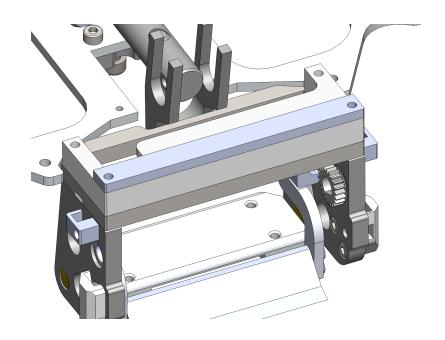
According to last years fabrication and assembly process, we slightly modify some components to reduce the interference, such as the lower plate and dribbling structure frame. In the past years, linear open-loop motion in y axis direction wasnt accurate. After mass distribution analysis, we decide to add clump weight in front of the robot. So we can balance the mass distribution specifically on every robot to improve robots kinematic accuracy. In the meantime, we can change the mass damper to test the ball handling stability. It is shown in Figure.1.
2.2 Independent Brushless Motor Drive Circuit
The drive circuits of 5 brushless motors in old edition were placed in a common layer of PCB. But it took us lots of time to detect the error or to find the damaged component when the whole module didnt work. Thus, firstly we separate each three-phase full-bridge drive circuit and place them on a tiny piece of PCB with an interface. That makes the board easily to be pulled out from the base board and changed. Secondly we add an LED to each board so that once the fuse on the board burned, we can notice directly. Thirdly is the phase current detecting function. We replaced every 2-channel voltage comparator with a 4-channel voltage comparator to reduce the quantity of components.
2.3 Frequency Test and Labview Tools Improvement
In order to inspect the communication capabilities of robot more precisely and conveniently, we improved the Labview tool and the five communication check modes, which are listed below.
- I. Robot Receive Mode
- II. Robot Send Mode
- III. Robot Receive and Send Mode
- IV. Transmitter Receive Mode
- V. Action Mode
Considering that actions of robot may exercise an influence over the communication of robot, we add action model specially. In Action Mode, robot are asked to do several action and we test its communication simultaneously, so we can acquire its real package lose rate in the contest. With the help of the improved communication-test software, we could test every parts of the communication system and acquire more precise package lose rate.
Besides, we add the frequency test function into Labview to simplify the operation. Thus, we can easily press a button to replace the complex operation of serial ports debugging tools.
2.4 Improvement of offline-test-mode
In order to improve the convenience of testing our robots, we modify former offline-test-mode. To be more specific, we need to test our robots to confirm they can communicate well with transmitter in certain frequency without operating the computer to send the packet. So we add offline communication tests as a subsidiary of offline-test-mode. In this mode, robots can automatically communicate with the computer and tell us the test result through the Led.
3 Intelligent Control System
(Section header only)
3.1 Hierarchical Architecture of Strategy
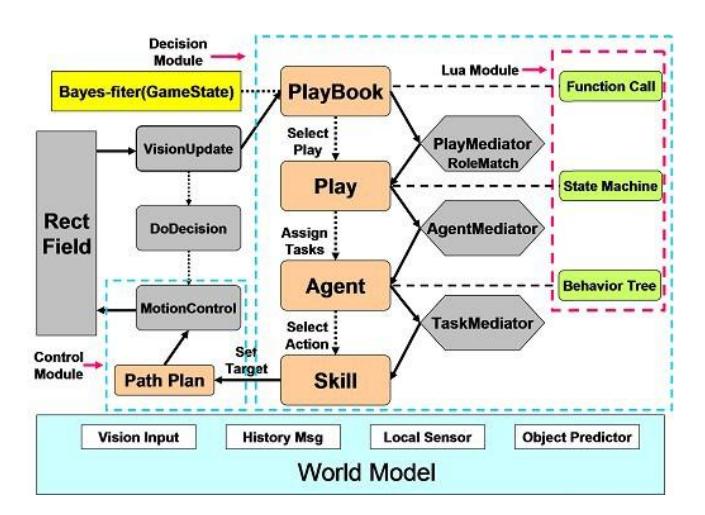
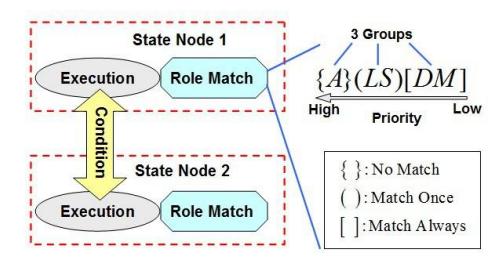
The software architecture of the intelligent control system is shown as Fig.2. It is the central module for planning and coordination among robots in both attack and defense modes. The whole system is composed of the World Model, the Decision Module and the Control Module [1].

3.2 Defense Strategy in AI System
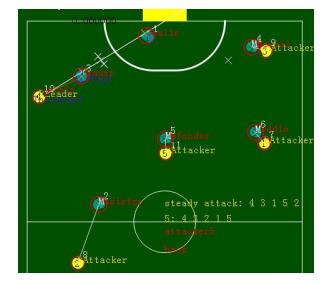
In this section, we mainly introduce our defense which is a vital part for competition and a superiority of our team. We only lost one point in the RoboCup 2014 tournament, which verifies the effectiveness of our strategy. Our defense is called Close-Marking Defense.
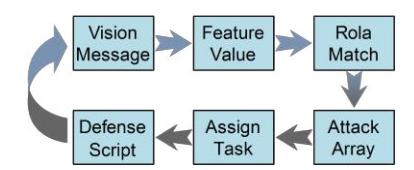
A flow chart of Close-Marking Defense is shown as Fig.6. We get the information about all opponent robot and calculate feature value. According to the attribute value we will match the role for every opponent robot,such as leader, passer, etc. Then attack array is set up to describe the robot in order and design defense strategy at last.
3.3 Log Analysis
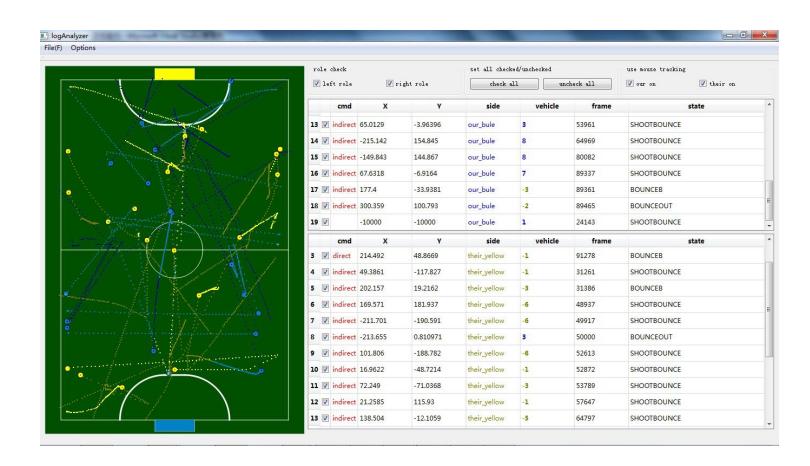
An application for analyzing the log file is shown as Fig.9.Through this application, we can just open the specified log file, and it will read the file, analyze the game information both sides automatically, finally display the information on screen. Therefore we can obtain the critical information in a few seconds instead of having to view the entire log file frame by frame.
The graphical user interface of this application is based on Qt4.8.6, and the core algorithm is implemented by C++ language. On the left side of the main window is the venue, the right is a list showing the details of shooting. For each shot, passing and shooting trajectory is drawn in the left venue, and some information (such as coordinate, the offensive, car number and sate)is displayed in the right list. The state information is represented by a enumeration variable in C++.
By using this application, our strategy will be more effective and targeted.
4 Conclusion
Owing to our all team member hard work, we can obtain this result. If the above information is useful to some new participating teams, or can contribute to the small size league community, we will be very honor. We are also looking forward to share experiences with other great teams around the world.
References
- Yonghai Wu, Penghui Yin, Yue Zhao and Yichao Mao, Rong Xiong: ZJUNlict Team Description Paper for RoboCup2012. In: RoboCup 2012 (2012)
- B. Browning, J. Bruce, M. Bowling and M. Veloso: STP: Skills, tactics and plays for multi-robot control in adversarial environments. In: J. Syst. Control Eng., vol. 219, no.I1, pp. 33-52 (2005)
- J. Munkres: Algorithms for the assignment and transportation problems. In: Journal of the Society for Industrial & Applied Mathematics 5.1: pp. 32-38. (March 1957)
- S. Thrun, W. Burgard, and D. Fox: Probabilistic robotics. Vol. 1. Cambridge: MIT press (2005)
- R. Ierusalimschy. Programming in Lua. Lua.org, 2nd edition (2006)
- Yonghai Wu, Yue Zhao, Rong Xiong, ZJUNlict Team Description Paper for RoboCup2013 (2013)