Anorak Team Description Paper
Hamza Munir, Aamir Sheikh, Amras Masood, Hamza Azmat
Anorak Artificial Intelligence and Controls, Center for Advanced Studies in Engineering, Islamabad, Pakistan
Abstract This year's paper describes the changes in hardware of both metal and acrylic robots. Improvements to the embedded system have also been made, including the radio communication technique. In software, we are developing a zone based defense method and using a different approach to path planning. The team has maintained its focus on developing low cost (financial and computational resource) platforms on both the hardware and software side.
1 Introduction
This is Anorak's third participation in the RoboCup Small Size League tournament. During these two years, the team has made significant improvements in its capabilities for developing low cost robotic systems. At Anorak, our focus is on developing all hardware and software in-house and use the minimum amount of commercial services in hardware fabrication and software packages. The purpose of this is to find out to what extent a small team can produce high reliability systems. The findings of this effort are relevant in our country where automation and robotics is still a very small industry with very limited industrial resources.
2 Team Targets
This year the team is focusing on developing a good defense system which can perform against the faster robots and well-planned strategies of the major SSL teams. This includes: developing a comprehensive set of defense algorithms keeping in mind the common strategies used to score, hardware which can execute the defense techniques accurately in time, and an analysis module which can return performance metrics for the defense system so improvements can be made.
Our initial goals from the 2015 TDP mentioned lofty ambitions for developing adaptive AI. Most of the reviewers indicated the difficulty and hurdles in developing such a system. In our endeavors, we have found the reviewer suggestions to be true. We therefore planned out a detailed breakdown and are now working on adaptive strategies at small levels in order to achieve it for our complete system in the coming years. At the moment, some basic operations in our defense strategy are being used to explore such an implementation.
3 Hardware Changes
In hardware, the main challenges we had were with the wiring and connectors we had been using. During the 2016 RoboCup, having unreliable wiring was the main reason why our robots were non-operational. This year we have shifted all of the signal connections to a circuit board and only the power connections are now carried by wire. This has improved reliability to a great extent. We are still working on reducing noise in our PCBs, which is largely down to low quality of the PCB fabrication materials and dry solder issues.
3.1 Motor Driver Improvements
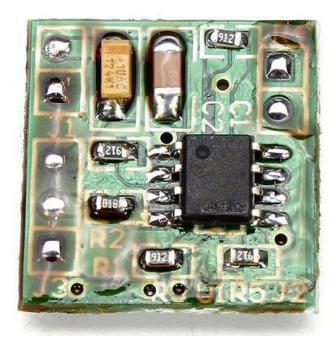
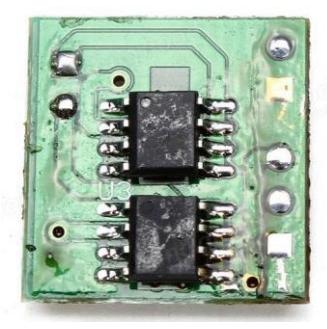
A second issue faced by our robots was failure of the motor driving circuit. We were facing repeated failure of the L298 IC due to current surges when the robots would suddenly change direction or collide with another robot. We are now developing new motor driver modules using MOSFET based ICs to prevent this from happening. This also helps reduce the volume footprint of the motor driving unit because the L298 based modules took up a fair amount of space.
3.2 Radio Module
The radio module was improved by adding a filter circuit. This has improved our radio communication considerably. We have not faced communication issues since making the improvements.
3.3 Chipper Assembly
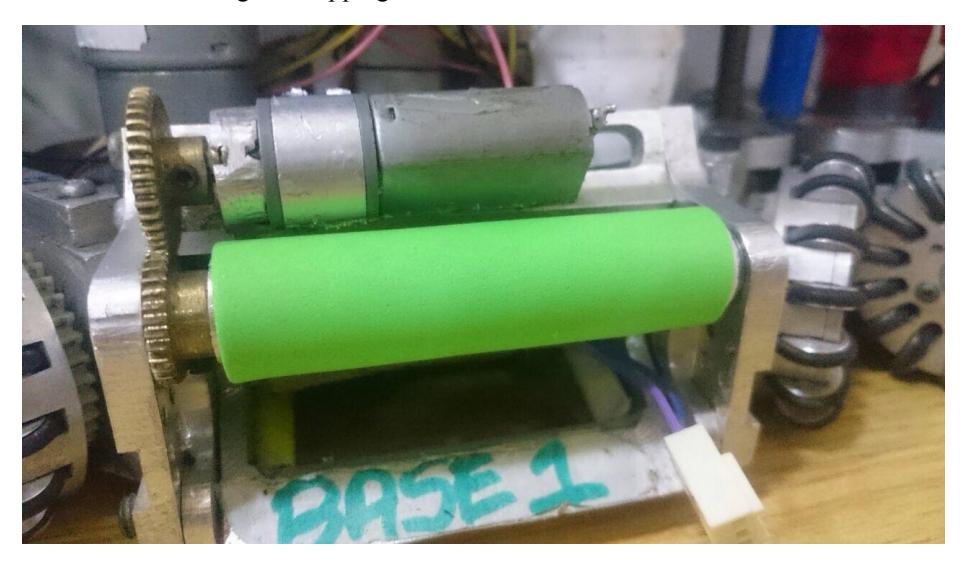
Till now our robots did not have a chipper tool. This year we've designed the chipper module and are currently in the fabrication process. With the chipper added, we will start with adding the chipping skill to the robot software.
4 Software Changes
After last year's RoboCup, we began the process of shifting our software from C# to C++ and Java. The motivation behind this shift was to use Linux as the OS for our AI work. The AI modules were re-written in C++ and the User Interfaces were written in Java to enable the interfaces to be available on a Windows environment as well. The two sections communicate over the local network.
4.1 Focus on Defense Strategies
The focus of our AI team is on developing a good defense system for this year. In simulations, we have been testing our algorithms and methods. Translating the AI onto the real robots has been a challenge due to the many variables involved in accurate robot motion.
This lead us to start work on improving the motion control of the robot. We have added high resolution encoders to our metal bases and are working on improving the motion control of the robots. As seen in the defense section of the qualification video, the robots have improved motion. According to our implementation plan, the robots will have very reliable motion control by April, and will enable us to have a good defense AI for RoboCup 2017.
5 Conclusion
Participating in RoboCup 2016 provided considerable exposure to the level of reliability and performance required to become a good SSL team. Since then, we have been working on making our systems more robust and have been following a thoroughly planned approach.
During 2016 we worked on solving all issues faced by our hardware in RoboCup 2016. Our current robots have not had those issues since then. In terms of robot hardware, the focus now is on developing accurate motion control using the onboard sensors.
On the AI side, this year our target is to perform well as a defending team. Our current progress shows promise in doing so and we are working on having our robots execute the defense strategies to match the simulation results.
References
- Ross, I. M. A Primer on Pontryagin's Principle in Optimal Control, Collegiate Publishers, San Francisco, 2009.
- Ohlmeyer, E.J., Phillips, C.A., Generalized Vector Explicit Guidance Journal of Guidance, Control, and Dynamics 2006; 0731-5090 vol.29 no.2 (261-268)
- Survey of Numerical Methods for Trajectory Optimization;John T. Betts Journal of Guidance, Control, and Dynamics 1998;0731-5090 vol.21 no.2 (193-207)
- Kalman, R. E. (1960). "A New Approach to Linear Filtering and Prediction Problems". Journal of Basic Engineering 82 (1): 35–45.
- Wan, Eric A. and van der Merwe, Rudolph "The Unscented Kalman Filter for Nonlinear Estimation"
- Minsky, Marvin (1967). Computation: Finite and Infinite Machines. Englewood Cliffs, N.J.: Prentice-Hall. ISBN 0-13-165449-7.
- Aamodt, A. and Plaza, E. (1994). Case-based reasoning: foundational issues, methodological variations, and system approaches. AI Communications, 7(1): 39-59.
- Bacchus, F. and Grove, A. (1995). Graphical models for preference and utility. In Uncertainty in Artificial Intelligence (UAI-95), pp. 3-10.