AMC – Team Description Paper
A. Boussicault, P. Felix, L. Hofer, O. Ly, S. N'Guyen, G. Passault, A. Pirrone
LaBRI, University of Bordeaux, 33405 Talence, FRANCE
Abstract This paper presents a short overview of the design of the robots of the SSL Robocup team AMC. The team is new, this is the first attempt of qualification. We present the main hardware and software components in their current state.
Introduction
This is our first attempt to get qualified. Our goal this year is to set up a reliable platform, suitable for experiment and strategy development.
Our goal in launching this team is to create a support for research on the one hand, and for educational purposes on the second hand. Students of various majors will participate to the project: computer science students, electrical engineering and mechanics. Concretely, the current platform will be the object of two projects: one in second year of computer science with a group of 12 students, and the other one in master of electrical engineering. Concerning research, the initiators of the project are members of the computer science laboratory of Bordeaux University: the LaBRI. We want to develop and apply various multi-agent technics to synthetise game strategies.
Let us mention that some of the authors are members of the Rhoban Football Club with several years of experience in kid-size soccer humanoid league, including a victory, in 2016 and 2017 as well as the best humanoid award in 2017. Our design are largely inspired by other teams, e.g. [3,2].
Architecture
Mechanical Structure
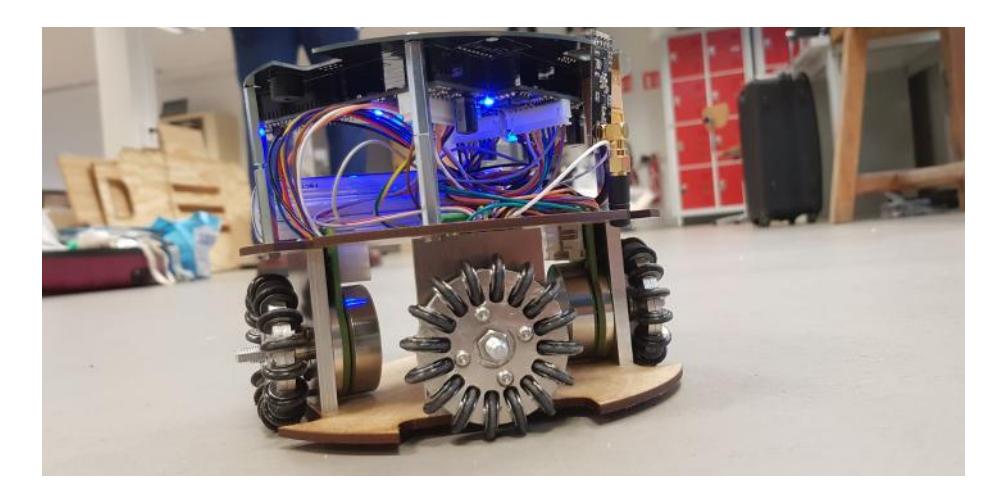
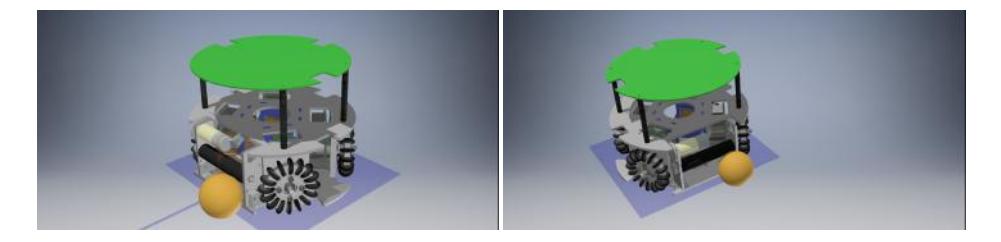
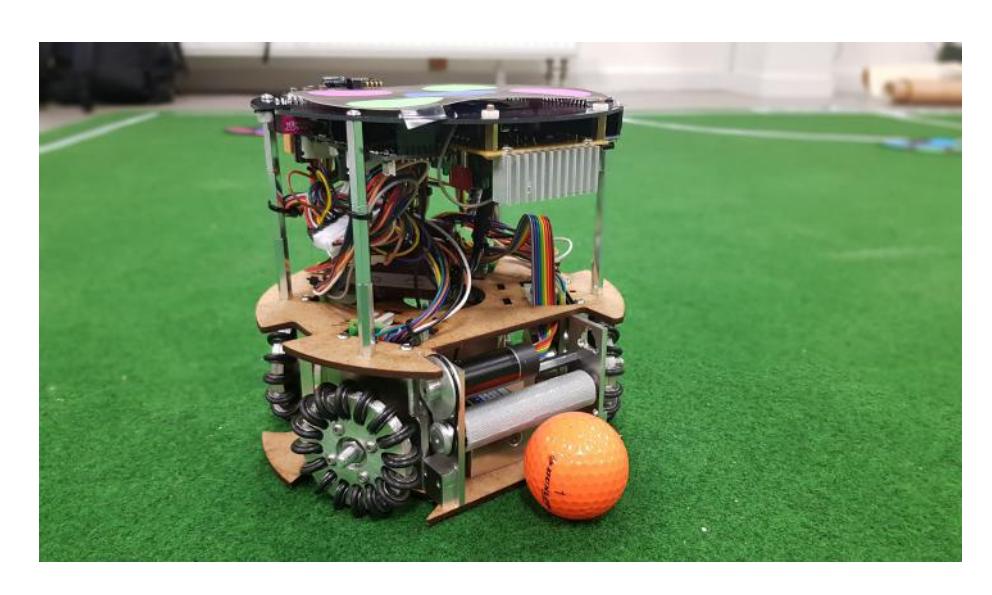
Figure 1 is a global view of the robot. The architecture is structured in layer. The motors are at the bottom. The second layer include the battery and the capacitor. The last layer is the mother board.
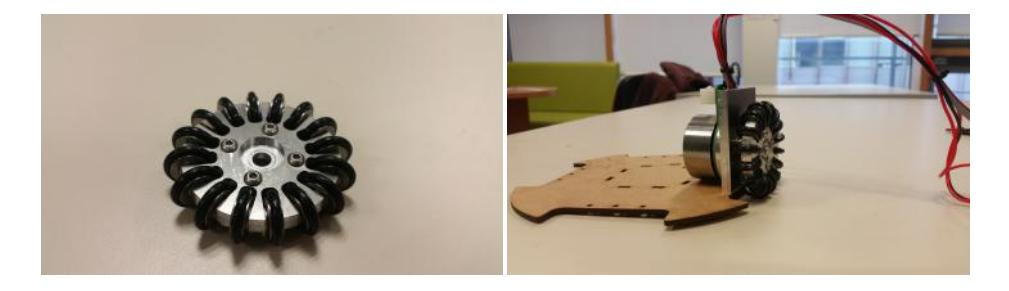
The four wheels of the robot are standard holonomic wheels of 60mm diameter, they are milled within two pieces of aluminium, and integrates 16 rubber joins supported by ball bearings (see Figure 3) for free orthogonal little wheels.
The propulsion is supported by brushless motors used in direct drive. We use MAXON outrunner brushless motors EC45 flat, we are currently experimenting two variants: 12V powered 30W and 24V powered 70W, also, one is encoded by optical encoder, the other one is using magnetic hall-based 14-bits precision sensors. Power is given by two 3S-LiPo batteries.
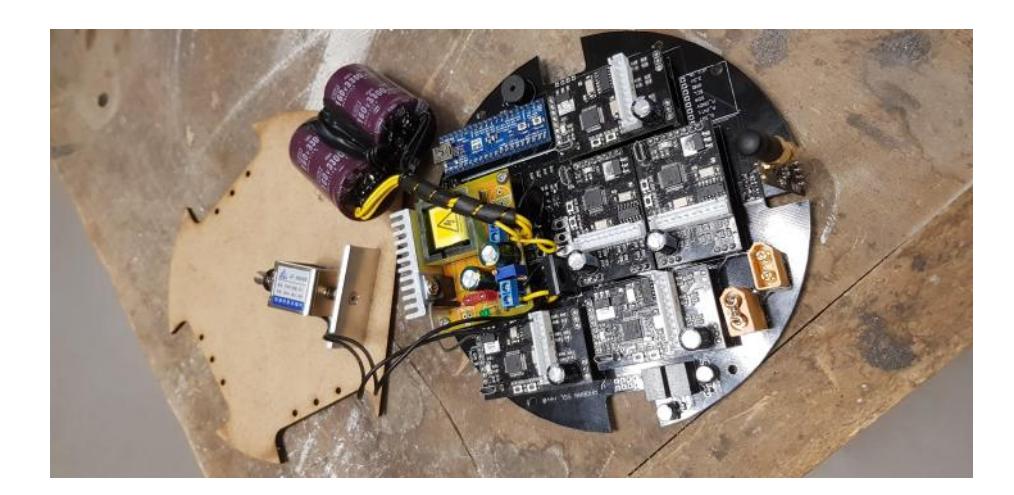
The kicker is powered by a 12 to 300V circuit; energy is managed by two capacitors (see Figure 6); in a standard way, it is actioned by a solenoid coil. The power of the kick is controled by the software.
We have a prototype of dribbler composed by a roller part driven by a 30W EC16 motor.
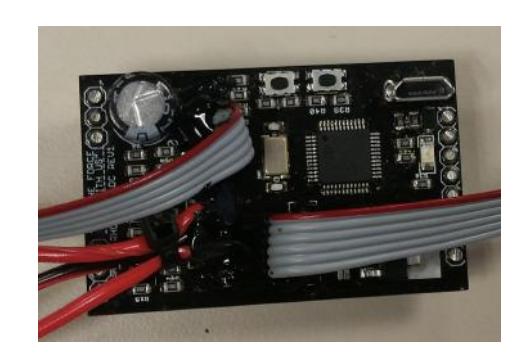
The electronic board is architectured around a Cortex M3 microcontroler. The microcontroler controls 4 brushless drivers, also designed by the team, each one implementing a PID controler driving the wheels in velocity at 1 KHz. Each brushless controler integrates also a Cortex M3 microcontroler.
The robot receives orders from an external station at 100Hz. Orders have the following form:
- global velocity vector
- global rotation velocity
The transmission is ensured by a nRF24L01 system at 2.4GHz with short antenna. Let us mention that we have a redundant system including 3 modules per robot.
Robot Components
| Diameter | 180mm |
|---|---|
| Height | 150mm |
| Supply voltage | 24V |
| Driving Motor | Maxon 70W EC 45 Flat |
| Driving Reduction | No (direct drive) |
| Wheel Diameter | 60mm |
| Dribbler Motor | Maxon 30W EC16 motor |
| Dribbler Reduction | 1:2 |
| Low level control frequency | 1 KHz |
| High level distant control frequency | 100 Hz |
Optimizing ball approach
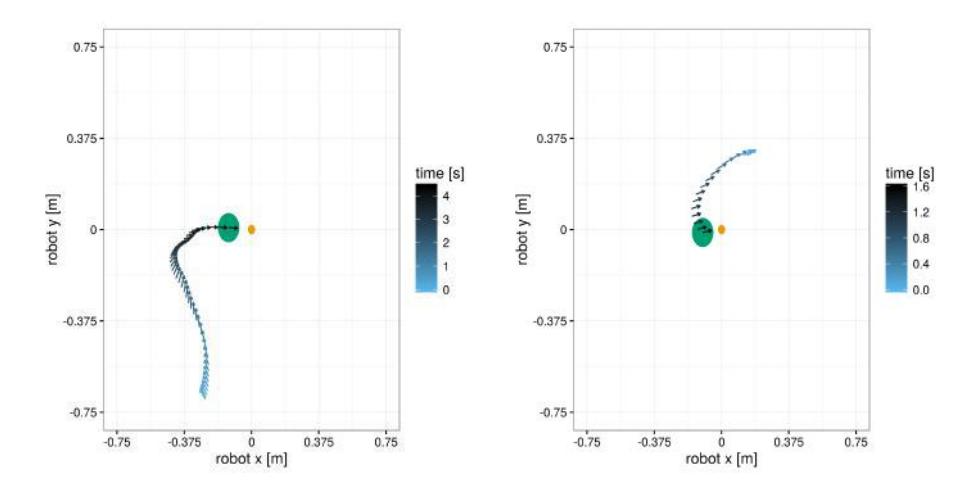
Reducing the time required to reach a target by optimizing control and trajectories is a crucial skill for robots playing soccer. We presented in [1] a procedure to train a predictive motion model for humanoid robots and optimize their control in order to reduce the time required to reach a kicking position. An important aspect of this work is to include noise in the predictive motion model and to consider it for the optimization of control policies.
We present in Figure 7 an example of kick trajectory obtained when using a control policy trained offline based on the predictive motion models of our robots. While this work has only been tested in simulation yet, we are confident that we will be able to deploy it on the robots for the competition.
Perspectives
At the moment, we reached a reliable mechatronical system together with the integration of the full system, i.e. the vision, the centralized control and the robots.
We demonstrate it by a basic autonomous behaviour involving a goal and an attacker (see qualification video).
We use the standard SSL software environment including ssl-vision and Gr-Sim simulator. In particular, we started to develop strategies in the simulator. But of course, lot of work remains to do before the competition, including:
- Streamline electrical integration in order to get practical and reliable system, from the electrical point of view.
- Upgrading the motion control of the robots. Indeed, at the moment, low level layer of the control is operational. The direct drive control is difficult at low speed and need some more additional effort. However, the control along a given trajectory must be upgraded.
- Tuning the design of the dribbler. Our first prototype of dribbler is not sufficiently efficient.
- Developing the team strategy. We have to set up the team behaviour, in particular in connection with the referee box.
References
- Ludovic Hofer and Quentin Rouxel. An Operational Method Toward Efficient Walk Control Policies for Humanoid Robots. In Proceedings of the Twenty-Seventh International Conference on Automated Planning and Scheduling, {ICAPS} 2017, Pittsburgh, Pennsylvania, USA, June 18-23, 2017., pages 489—-497, 2017.
- J.P. Mendoza, J. Biswas, D. Zhu, R. Wang, P. Cooksey, S. Klee, and M. Veloso. CMDragons - Extended Team Description Paper. In RoboCup, 2016.
- A. Ryll, M. Geiger, N. Ommer, A. Sachtler, and L. Magel. TIGERs Mannheim Extended Team Description Paper. In RoboCup, 2016.