NEUIslanders Team Description Paper RoboCup 2018
Prof. Dr. Rahib H. Abiyev, Nurullah AKKAYA, Mustafa ARICI, Ahmet CAGMAN, Seyhan HUSEYIN, Can MUSAOGULLARI, Ali TURK, Gorkem SAY, Tolga YIRTICI, Berk YILMAZ, Ersin AYTAC
NEU Robotics Lab, Department of Computer Engineering, Department of Electrical and Electronic Engineering, Department of Mechanical Engineering Near East University(NEU), Lefkosa, TRNC
Abstract This paper presents the detailed description of 3rd generation of NEUIslanders robotics team of small size league in RoboCup 2018 which is going to be held in Montreal, Canada. The major improvements of the mechanical, electronics and software design are described. The robots are designed under the RoboCup 2018 rules.
1. Introduction
NEUIslanders is an interdisciplinary team of undergraduate and graduate students at Near East University. The team has been attending to RoboCup events since 2012, and currently seeking qualification for RoboCup 2018. Since last year, NEUIslanders team focuses on improvement of more efficient energy use, high accuracy passing and shooting and more efficient path finding. The paper is going to outline the progress in implementation of the current model of robots.
NEUIslanders robots consists of three major component, which are; the robot mechanical parts, electronic control board, and control software. Changed mechanical parts and the improved cover are going to be explained in detail and illustrated. Dribbler motor driver and more accurated kicking electronics is described. Also the implementation of fuzzy logic in software is outlined.
2. Electronic Design
This year, the major changes have been performed on the electronic design. To get faster response, increase efficiency, better robustness and reliability, the main processor, power electronic section and autokick section have been improved.
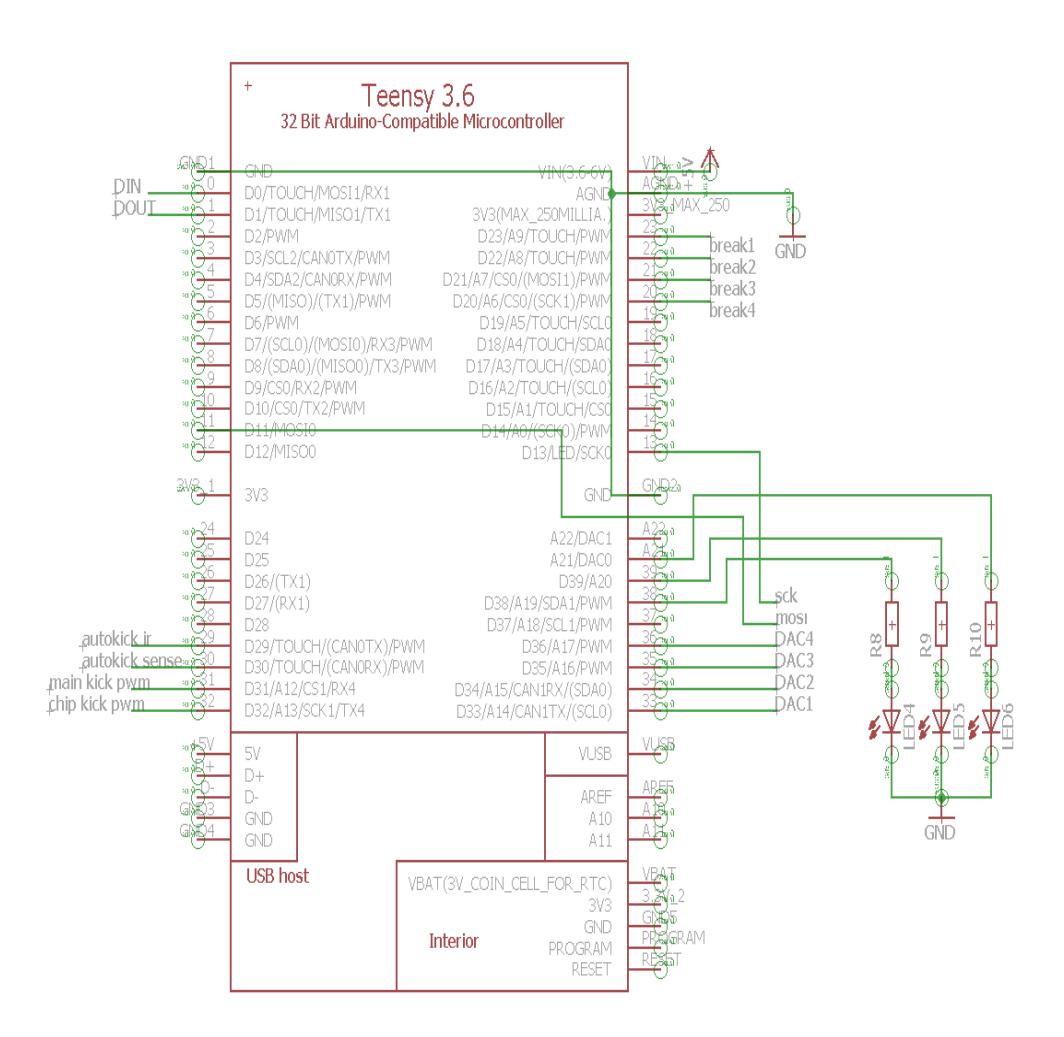
One of the major improvements is the main processor. The old main processor was ATMEGA328P. This year, the teensy 3.6 is the main processor. The teensy 3.6 is low cost 32-bit ARM Cortex-M4 platform to engineers. The teens 3.6 has 180 MHz ARM Cortex-M4 with floating point unit, 1M flash 256K RAM and 4K EEPROM. The robots will gain more abilities with that specifications. The communication speed and processor speed have increased according to ATMEGA328P. Another benefit is the memory of processor and number of digital analogue I/O have increased.
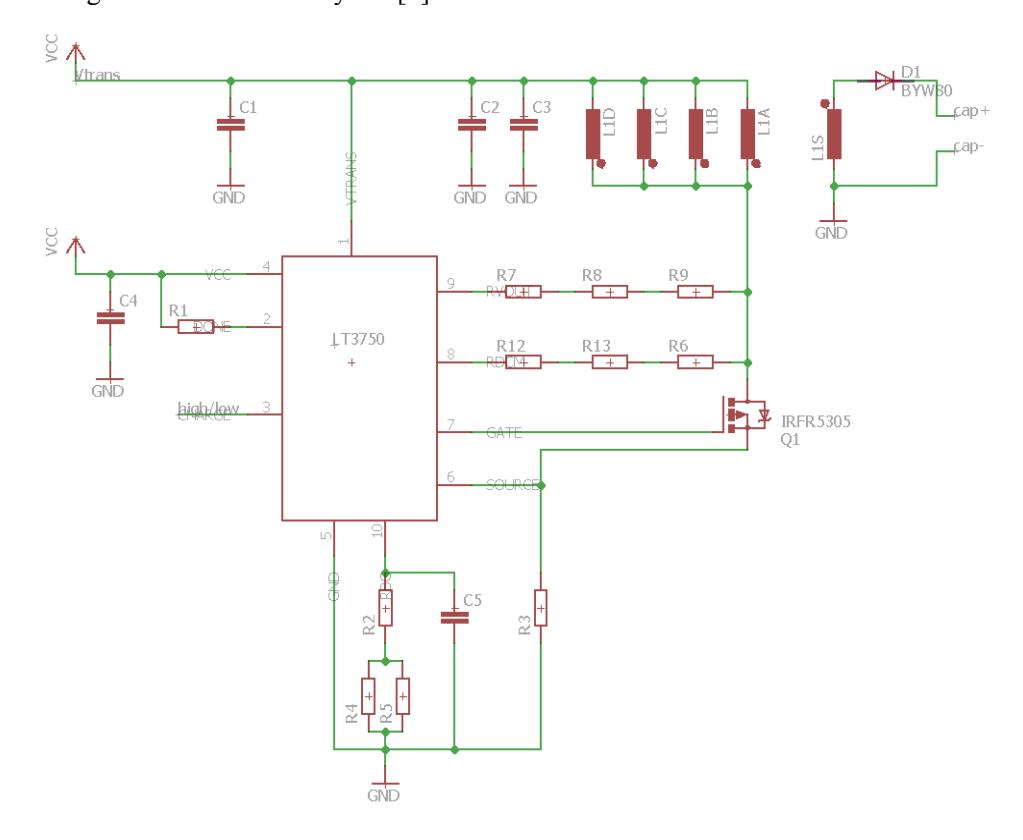
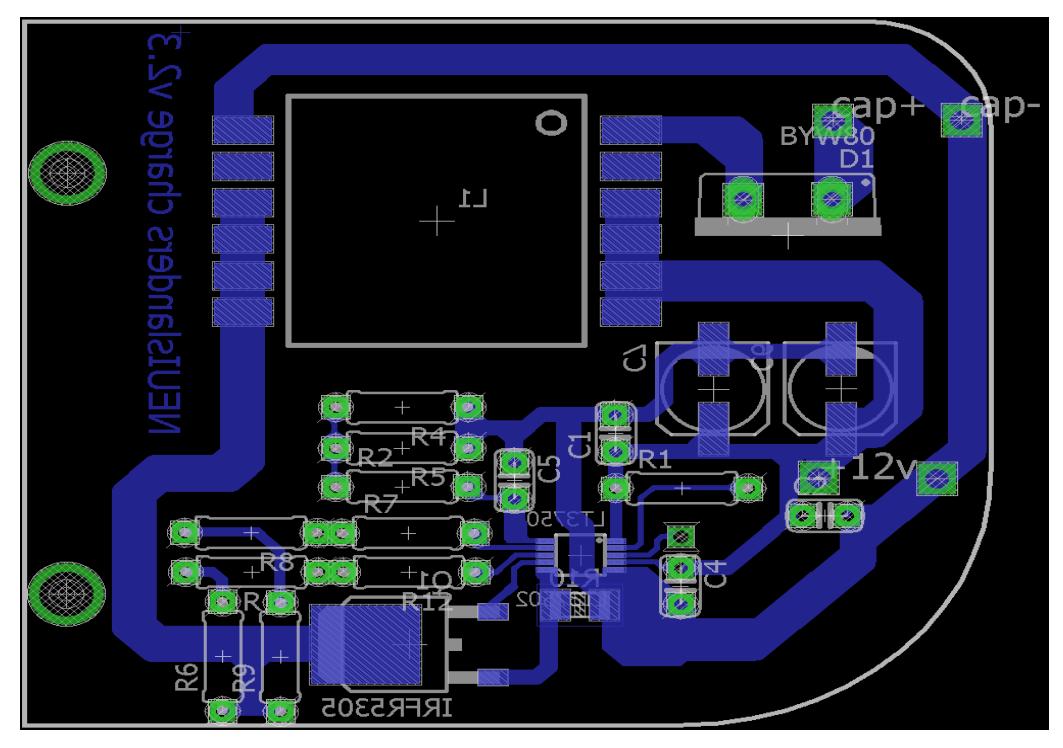
Another major improvement is the capacitor charge circuit. The new charging topology is flyback converter. By changing the topology, the capacitor charge time has decreased. Also, the components sizes reduced. Furthermore, the control of the topology is easy. The LT3750 is the capacitor charger controller to charge capacitor rapidly with wide output voltage range. The CHARGE pin (pin 3) gives full control of the LT3750 to the user. DONE pin (pin 2) shows us the capacitor has reached to demanded value. The RBG pin (pin 10) senses the voltage of RBG resistor to disable or enable the charge. This topology has many advantages. One of the advantages is there is an isolation between input and output voltage because of the flyback transformer. Furthermore, no output voltage divider needed because of Primary-Side sense. Also, there isn't any high voltage stress on MOSFET and other passive elements so losses of switching component and passive components have been reduced. The charging unit schematics shown below figure 2 and the PCB layout. [3]
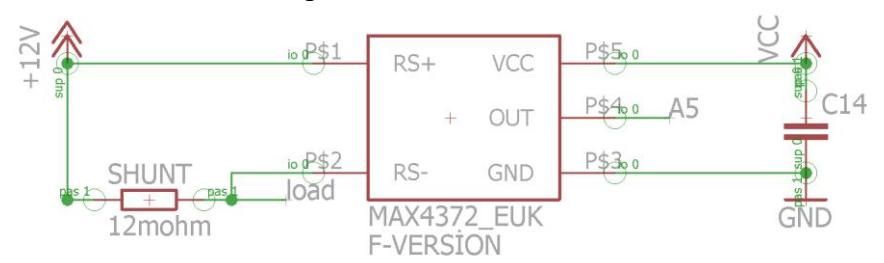
Another improvement is auto-kick infrared led. Last year, the red LED has made trouble to vision. The electronic team decided to switch infrared led. The IR LED is high power IR LED SFH 4350. It has 850 nm wavelength. Except for these improvements, the battery tracker also added. With the MAX4372 current-sense amplifier, the battery information can be easily tracked. The MAX4372 schematics can be shown in figure 4.
3. Software Design
Throughout last year NEUIslanders software team identified two major issues related to AI software. One was non-deterministic delays and second was experimenting with various control and AI techniques for our research. In order to address both issues whole AI software was rewritten. Former problem of non-deterministic delays are fixed by moving allocation heavy code from JVM side to native code loaded as shared libraries. Latter problem is fixed by implementing controllers and path finding algorithms as interfaces so various controllers can be mixed and matched i.e In order to go from A to B our robots rely on two controllers one to correct for the speed and one to correct for cross track error, now robots can use fuzzy speed controller and PID cross track controllers or vice versa. Same is also true for path finding. Robots depending on heuristics or user configuration can use either obstacle avoidance or pathfinding. Our new module structure is depicted in Fig 5.
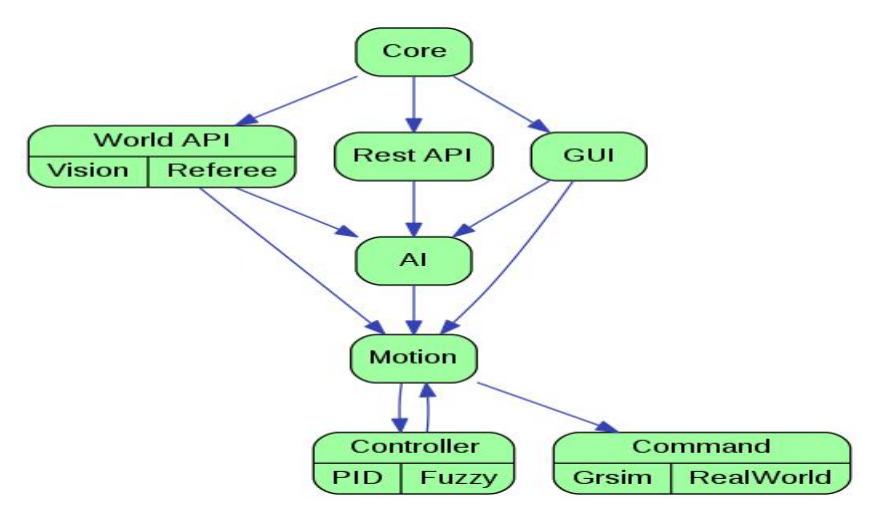
World API
Keeps track of the state of the world.
Handles SSL-Vision / grSim / Referee communication.
Motion Handles all robot movement.
Controller Provides a common interface for supporting different types of controllers. Currently PID and Fuzzy Logic Controllers are supported.
Command Commands are sent to the robots via the control interface, AI does not know if it is controlling virtual robots or real ones, it just sends commands, control interface dispatches them to correct implementation depending on the configuration.
AI Main Playbook.
UI User Interface Graphical and web based.
Misc
- Filter Implementations for various filters used through out the system.
- Configuration Keeps track of system configuration. All default settings are defined here. Also responsible for loading/resetting saved configurations.
- Logging Provide an API for logging.
Core Loads all other modules and boots the system.
3.1. AI
AI system for NeuIslanders is based on the concept of A behavior tree is a technique for organizing collections of states and the decision processes for when to move between them. Behavior trees have many similarities to FSMs but unlike FSMs it is very easy to see logic, they are fast to execute and easy to maintain, which makes them suitable for representing complex and potentially parallel behaviors.
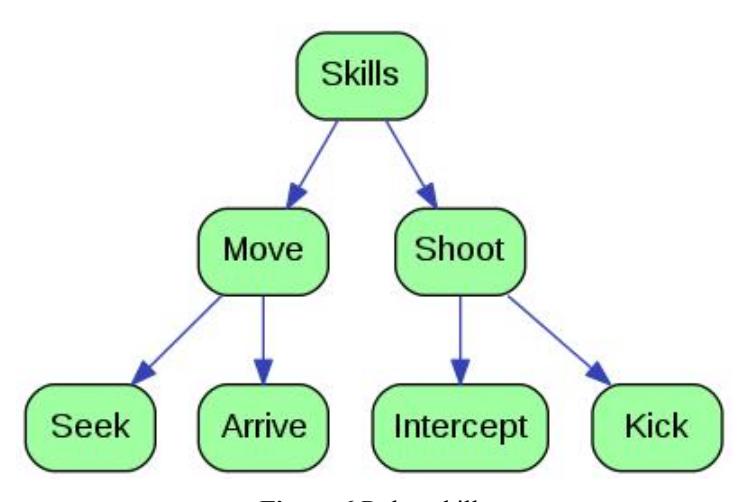
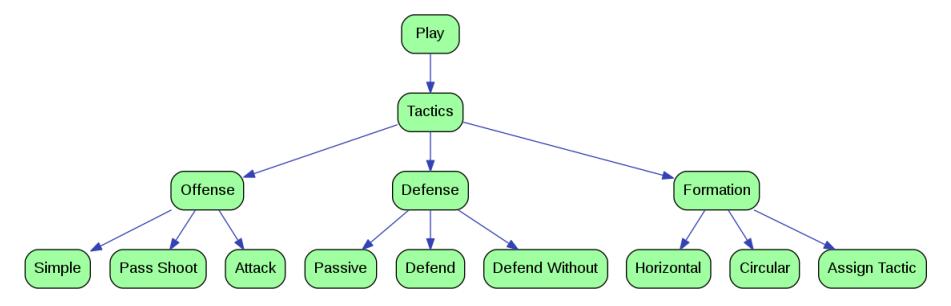
The high-level strategy code is organized to be as modular as possible. To do this, it's been split up into three main parts: Skills, Tactics, and Plays.
- Skills are behaviors that apply to a single robot. They include things like intercept the ball, moving to a position on the field, and kicking the ball.
- Tactics can coordinate a single robot or many and generally encapsulate more complex behavior than skills. This includes things such as passing, defense, and the goalie.
- Plays are responsible for coordinating the whole team of robots (some robots may be unused).
Used together, skills, tactics, and plays form a tree structure with the Play at the root and other behaviors below it.
3.2. Fuzzy Logic Control
The environment where omnidirectional robots move is characterized by uncertainty having static and also fast changing dynamic areas with moving dynamic obstacles and also a dynamic goal. In these situations, the next position of obstacles and also goal are unknown to the robot. In addition, the nonlinearities existing in robot dynamics greatly affect the robot velocity as well as the behavior of the robot. These nonlinearities are caused by friction, vibrations, payload variation, slippage between wheels and terrain and disturbance. Because of these, the dynamics of the robots have high-order nonlinearity and it is difficult to obtain an exact mathematical model for the design of the control system.
Recently numerous significant developments have been proposed for the design of mobile robots' control system. One of them is the use of classical PI, PD and PID controllers [4]. The performance of these classical control systems depends on the accurate estimation of the controller coefficients, which are based on the system model. However, it is difficult to analyze and formulate the system model and this model is not always available. Based on the uncertainties that are related to unknown nonlinearities and external disturbances of robot systems, one of the effective ways is the use of the fuzzy logic controller. The fuzzy logic controllers, which are the rule-based systems, are based on knowledge of human experts and widely used for control of mobile robots. The performance of the fuzzy control algorithm depends on the development of its proper rule base. The rule base often uses linguistic terms for input and output signals. In this rule base, the used type-1
fuzzy sets are able to handle uncertain and imprecise information to some degree. Zadeh, in his paper, shows that the reliabilities of used linguistic terms are very important and they can be used for the valuation of the values of fuzzy variables. Zadeh extended the concept of fuzzy number and proposed Z-number characterized by two components- constraint and reliability parameters, which are the ordered pair of fuzzy numbers[5]. Here the first component is used to represent uncertain information, and the second component is used to evaluate the reliability or the confidence in truth. The reliabilities of the linguistic values of the variables in the rules are an important issue in the modelling of the fuzzy systems and they affect the accuracy of the decision determined by the rules. Taking into consideration the uncertainties existing in omnidirectional robot system, Z-number can be more effectively used for the construction of control algorithm.
4. Mechanics
For the last three years NEUIslanders robots are the same but having some little changes to improve the stability of the robots. We make four minor changes on our robots; redesigned electronic board and battery holder, cover, omni-wheel, and kicking and dribbling mechanism.
4.1. Electronic Board and Battery Holder
With the changes on electronic board, NEUIslanders robots required a new design to hold electronic board, battery, and capacitor. Since we were satisfied with the 3d printed part that we designed last year, we just added a capacitor holder in between the four electronic speed controllers. Since we can mount the capacitors lower, which also make our robots shorter.
4.2. Cover
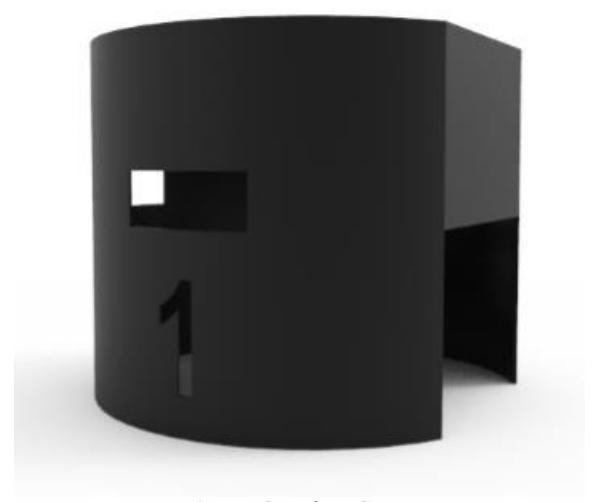
For the last two years our cover was manufactured from 2mm thick poly methyl methacrylate. It was causing us problems while giving the cylindrical shape and also the material wasn't strong enough to protect our electronics. Specially, with some heavy collusion games in RoboCup 2017 Nagoya, we faced broken covers. This year we are changing our covers to 1mm thick polypropylene and expecting better results.
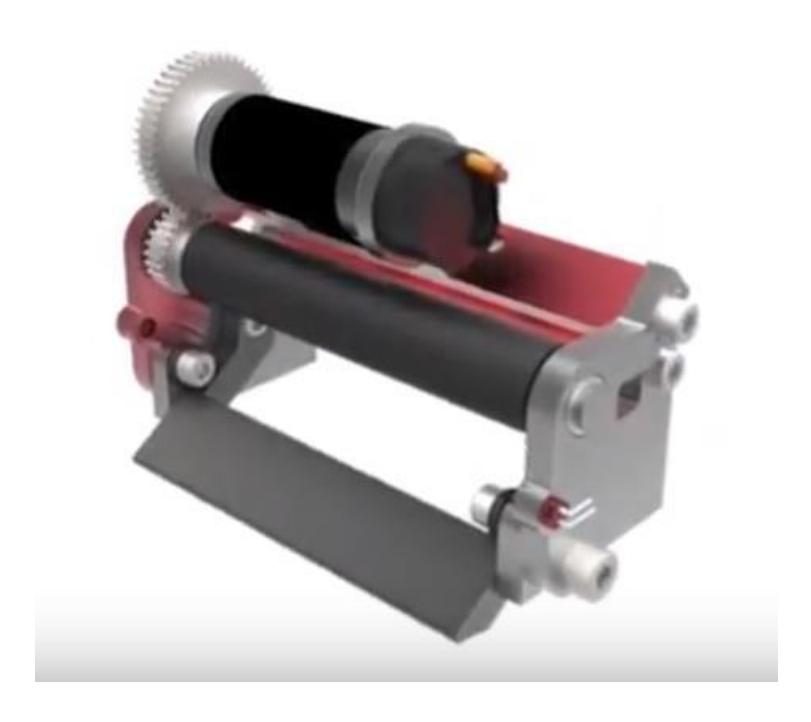
4.4. Kicking and Dribbling Mechanism
We were facing with stuck kicking mechanism and because of not strongly mounting the dribbling motor there were gear meshing problems. An improved design is made and it will be implemented on the robots in couple of months and the results will be shared with community on our next TDP.
References
- Prof. Dr. Rahib H. Abiyev, Assist. Prof. Dr. Irfan Gunsel, Nurullah Akkaya, Murat Arslan, Mustafa Arici, Ahmet Cagman, Seyhan Huseyin, Fatih Emrem, Berk Yilmaz, Huseyin I. Ercen, Ersin Aytac Team Description Paper 2016, Robocup SSL, Leipzig, Germany
- Prof. Dr. Rahib H. Abiyev, Assist. Prof. Dr. Irfan Gunsel, Nurullah Akkaya, Mustafa Arici, Ahmet Cagman, Seyhan Huseyin, Berk Yilmaz, Ersin Aytac Team Description Paper 2017, Robocup SSL, Nagoya, Japan
- David Ng: Tiny Controller Makes It Easy to Charge Large Capacitors (March, 2006)
- Rahib H.Abiyev, Senol Bektas, Nurullah Akkaya, Ersin Aytac. Behaviour Tree Based Control of Holonomic Robots. International Journal of Robotics and Automation. WSEAS conference, Limasol, Cyprus, 2013
- L. A. Zadeh, "Fuzzy sets", Information and Control, 1965, Vol. 8, pp. 338–353