ZJUNlict Extended Team Description Paper for Robocup 2020
Zheyuan Huang, Haodong Zhang, Dashun Guo, Shenhan Jia, Xianze Fang, Zexi Chen, Yunkai Wang, Peng Hu, Licheng Wen, Lingyun Chen, Zhengxi Li, Rong Xiong
Zhejiang University, Zheda Road No.38, Hangzhou, Zhejiang Province, P.R.China
Abstract ZJUNlict has won the champion of the Small Size League of RoboCup 2019 because of the great effort made in hardware and software. In this paper, we detailedly describe the major improvements that have contributed to our success. In hardware, we optimize our robots' mechanical structure and electronic board for better stability and stronger ball control ability. Also, we increase our robots' control frequency to achieve more accurate and stable control. In software, we develop a dynamic passing strategy and an off-the-ball running module which help us gain a high possession rate and offensive threat in the game.
1 Introduction
ZJUNlict has been participating in the Small Size League of RoboCup since 2004. We seek innovation and progress in software and hardware every year, which improves our competitiveness in the game and also brings us the champion of the Small Size League of Robocup 2019[1]. Our teammates come from different majors and have done excellent work in the software and hardware groups. This paper presents our work and is organized as follows: In Sects.2 and 3, we introduce our main optimization on hardware, including mechanical structure and electronic board. In Sects.4, we described how we increase the robot control frequency to achieve better motion control. In Sects.5 and 6, we discuss the dynamic passing strategy and the off-the-ball running module respectively which helped us gain a ball possession rate of 68.8% during 7 matches in RoboCup 2019. In Sect.7, we analyze the performance of our algorithms at RoboCup 2019 with the log files recorded during the matches.
The possession rate is calculated by comparing the interception time of both sides. If the interception time of one team is shorter, the ball is considered to be possessed by this team.
2 Modification of Mechanical Structure of ZJUNlict
2.1 The position of two capacitors
During a match of the Small Size League, robots could move as fast as 3.25 m/s. In this case, the stability of the robot became very important, and this year, we focused on the center of the gravity with a goal of lower it. In fact, there are already many teams got there hands busy with lowering the center of the gravity, eg, team KIKS and team RoboDragons have their robot compacted to 135 mm, and team TIGERs have their capacitor moved sideways instead of regularly laying upon the solenoid [2].
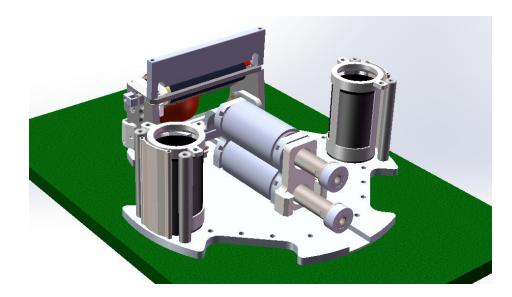
Thanks to the open source of team TIGERs [2], in this year's mechanical structure design, we moved the capacitor from the circuit board to the chassis. On the one hand, this lowers the center of gravity of the robot and makes the mechanical structure of the robot more compact, On the other hand, to give the upper board a larger space for future upgrades. The capacitor is fixed on the chassis via the 3D printed capacitor holder as shown in Figure 1, and in order to protect the capacitor from the impact that may be suffered on the field, we have added a metal protection board on the outside of the capacitor which made of 40Cr alloy steel with high strength.
2.2 The structure of the dribbling system
The handling of the dribbling part has always been a part we are proud of, and it is also the key to our strong ball control ability. In last year's champion paper, we have completely described our design concept, that is, using a one-degree-offreedom mouth structure, placing appropriate sponge pads on the rear and the lower part to form a nonlinear spring damping system. When a ball with certain speed hits the dribbler, the spring damping system can absorb the rebound force of the ball, and the dribbler uses a silica gel with a large friction force so that the ball can not be easily detached from the mouth.
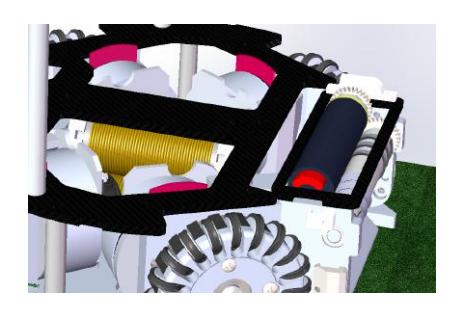
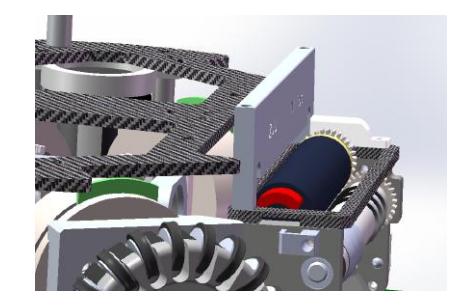
The state of the sponge behind the mouth is critical to the performance of the dribbling system. In RoboCup 2018, there was a situation in which the sponge fell off, which had a great impact on the play of our game. In last year's design, as shown in Figure 2, we directly insert a sponge between the carbon plate at the mouth and the rear carbon plate. Under frequent and severe vibration, the sponge could easily to fall off[3]. In this case, we made some changes, a baffle is added between the dibbler and the rear carbon fiberboard, as shown in figure 3, and the sponge is glued to the baffle plate, which made it hard for the sponge to fall off, therefore greatly reduce the vibration.
3 Modification of Electronic Board
In the past circuit design, we always thought that the board should be designed into multiple independent boards according to the function module so that if there is a problem, the whole board can be replaced. But then we gradually realized that instead of giving us convenience, it is unexpectedly complicated, on the one hand, we had to carry more spare boards, and on the other hand, it was not conducive to our maintenance.
3.1 The new motherboard design
For the new design, we only kept one motherboard and one booster board, which reduced the number of boards, making the circuit structure more compact and more convenient for maintenance. We also fully adopted ST's STM32H743ZI master chip, which has a clock speed of up to 480MHz and has a wealth of peripherals. The chip is responsible for signal processing, packet unpacking and packaging, and motor control.
Thanks to the open source of TIGERs again, we use Allergo's A3930 threephase brushless motor control chip, simplifying the circuit design of the motor drive module on the motherboard. The biggest advancement in electronic this year was the completion of the stability test of the H743 version of the robot. In the case of all robots using the H743 chip, there was no robot failure caused by board damage during the game. In addition, we replaced the motor encoder from the original 360 lines to the current 1000 lines. The reading mode has been changed from the original direct reading to the current differential mode reading.
3.2 The new attitude transducer: IMU
To increase the motion performance of our robot, we add an IMU on our motherboard. The IMU can measure the acceleration in three directions and the angular velocity of the robot. Then it calculates the angular velocity integral and gets the real time heading angel. It is a MEMS device and can be put on the PCB. To ensure the stability of the measurements of the angular velocity we tested the IMU and got a satisfying result. The temperature drift and the time drift are low. We put the robot on the level ground and let it stay static. The deviation of the heading angel in 5 minutes is less than 0.5 degree.
With the real time heading angel data got, we can control the heading angel in the lower computer and increase both the control frequency and the accuracy. This will be further discussed in Sects.4.
4 Increase the Control Frequency
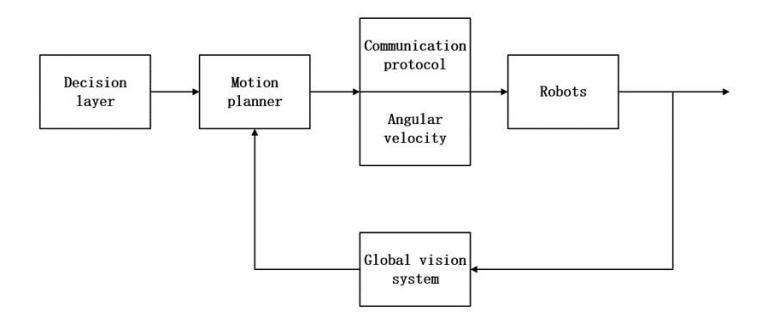
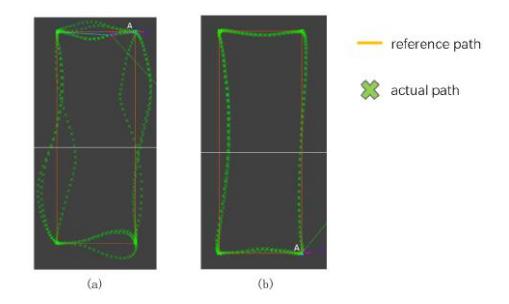
On our research platform, ZJUNlict small size soccer team, the frequency of the global vision system is 75 Hz, which determines the frequency of coordination decision, motion planning and other control instructions.
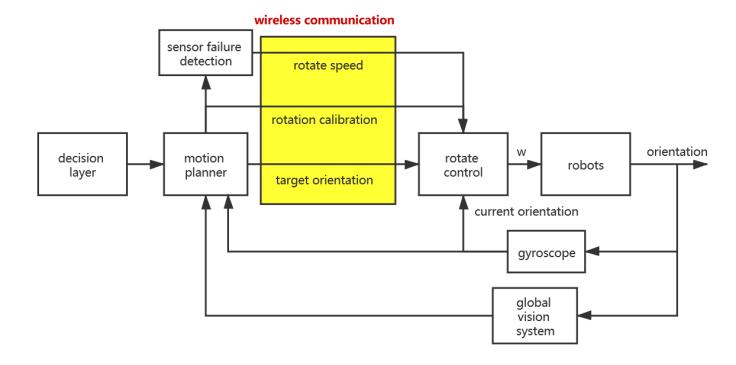
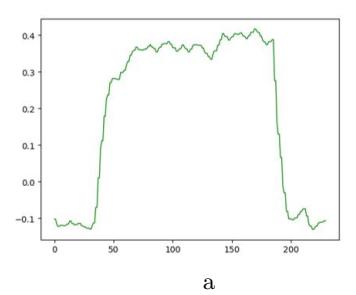
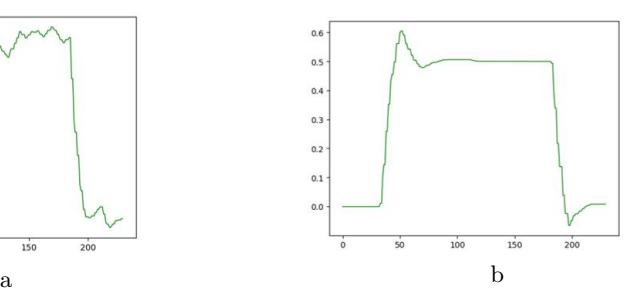
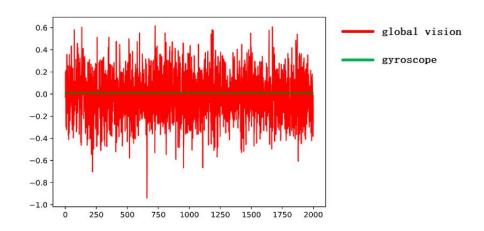
As Figure 4 shows, after obtaining the target position and target orientation from the strategy layer (only the target orientation is concerned here), the motion planner plans next step according to the current orientation and speed obtained from the global visual system, and then sends the next speed instructions to the robot.
5 Dynamic Passing Strategy
5.1 Real-time Passing Power Calculation
Passing power plays a key role in the passing process. For example, robot A wants to pass the ball to robot B. If the passing power is too small, the opponent will have plenty of time to intercept the ball. If the passing power is too large, robot B may fail to receive the ball in limited time. Therefore, it's significant to calculate appropriate passing power.
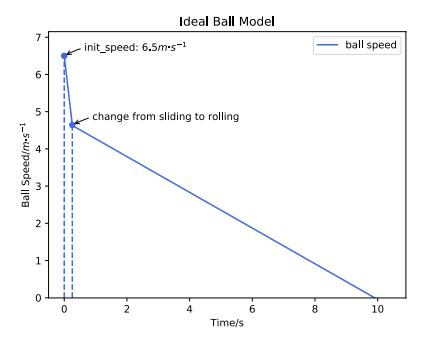
Suppose we know the location of robot A that holds the ball, its passing target point, and the position and speed information of robot B that is ready to receive the ball. We can accurately calculate the appropriate passing power based on the ball model shown in Figure 9. In the ideal ball model, after the ball is kicked out at a certain speed, the ball will first decelerate to 5/7 of the initial speed with a large sliding acceleration, and then decelerate to 0 with a small rolling acceleration.
5.2 SBIP-Based Dynamic Passing Points Searching (DPPS) Algorithm
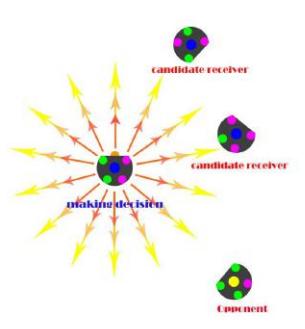
Passing is an important skill both offensively and defensively and the basic requirement for a successful passing process is that the ball can't be intercepted by opponents. Theoretically, we can get all feasible passing points based on the SBIP (Search-Based Interception Prediction) [3][4]. Assuming that one of our robots would pass the ball to another robot, it needs to ensure that the ball can't be intercepted by opposite robots, so we need the SBIP algorithm to calculate interception time of all robots on the field and return only the feasible passing points.
In order to improve the execution efficiency of the passing robot, we apply the searching process from the perspective of passing robot.
5.3 Value-based best pass strategy
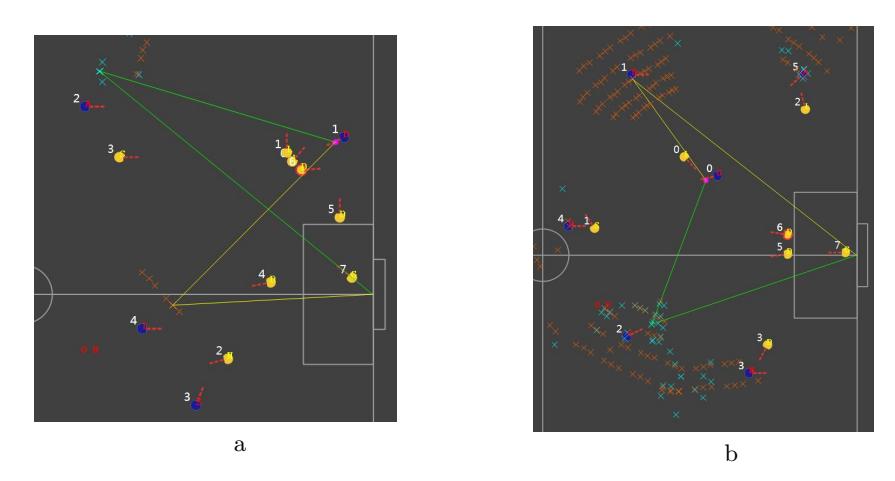
After applying the DPPS algorithm, we can get all optional pass strategies. To evaluate them and choose the best pass strategy, we extract some important features xi(i = 1, 2, ..., n) and their weights (i = 1, 2, ..., n), at last, we get the scores of each pass strategy by calculating the weighted average of features selected by Equation 8 [9][10]
$$\sum_{i=1}^{n} \omega_i \cdot x_i \tag{8}$$
For example, we chose the following features to evaluate pass strategies in RoboCup2019 Small Size League:
- Interception time of teammates: close pass would reduce the risk of the ball being intercepted by opposite because of the ideal model.
- Shoot angle of the receiver's position: this would make the teammate ready to receive the ball easier to shoot.
- Distance between passing point and the goal: if the receiver decides to shoot, short distance results in high speed when the ball is in the opponent's penalty area, which can improve the success rate of shooting.
- Refraction angle of shooting: the receiver can shoot as soon as it gets the ball if the refraction angle is small. The offensive tactics would be executed smoother when this feature is added.
- The time interval between the first teammate's interception and the first opponent's interception: if this number is very small, the passing strategy would be very likely to fail. So only when the delta-time is bigger than a threshold , the safety is guaranteed.
5.4 Implementation of Passing Skill
Based on the good dribbling ability of our robot, we developed a "break" skill to find enough space for our robot to pass or shoot while dribbling.
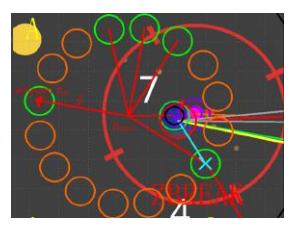
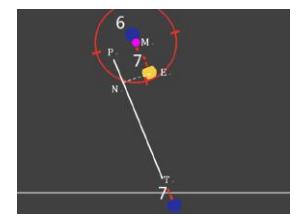
During the dribbling, we want to find the best point to move to, where we can ensure the feasibility to pass the ball to our target point Ptarget. To find such point, we developed a search-based algorithm. In one actual game, according to the rule, a robot must not dribble the ball further than 1 meter, so we define the point Pstart where a robot start dribbling as the reference point. Then we use a vector v added to Pstart to define the point to be searched. We search the length and angle of v at equal intervals with a fixed minimum interval of ∆l and ∆a(the max length is limited according to the rule above). At certain li and tk, we can get a point Pik, as shown in the Figure 12. To assess the feasibility, we make a list of the opponent robots near Pstart, which may have chance to intercept the ball. As shown in the Figure 13, assume that we are on the blue side, location M is the location of the robot dribbling the ball, location P is one of the searched points, location E is one of the opponent robots, location T is the target point we want to pass the ball to and location N is the projection point of E on the segment PT. For each opponent robot, we take the length of segment MN, EN and PE into consideration and decide whether we can finish a pass or shoot when we move to that point (If we can, we call the point "shootable point" ). For each point, we record whether we can shoot and the minimum length of PE. Among those shootable points, we will choose the one that has the maximum length of PE and then the minimum length of PT as the best point, since longer PE shows less ability of opponent to obstruct our robot and shorter PT makes it easier to pass our ball to target point. Even if none of the points is shootable points, we will still choose one according to the same rule, which seems to have more possibility to finish a pass.
Algorithm 1 Search Move Point
Require: ∆l,∆α,dribbling initial point Pstart,our dribbling robot point Pme,pass target
point Ptarget,threatening oppent robots enemy[k],vector−→v
maximum dribbling length lmax,total number of threatening enemy kmax, m ←
0,n ← 0,k ← 0
repeat
  n ← n + 1
  repeat
    m ← m + 1
    repeat
       vmn ← testV ector(m∆l, n∆α)
       Pmn ← testP oint(Pstart, −−→vmn)
       Penemy ← enemy[k]
       Analysis passing feasibility according to Pmn,Pme,Ptarget and Penemy
       k ← k + 1
    until k ≥ kmax
    dmin ←the minimum distance between Pmn and Penemy
    dt ←the distance between Ptarget and Pmn
    Pbest ← if "can shoot",choose the can shoot one
                  then choose the one with farther dmin
                      then choose the one with shorter dt
  until m∆l ≥ lmax
until n∆α ≥ 2π
5.5 Shooting Decision Making
In the game of RoboCup SSL, deciding when to shoot is one of the most important decisions to make. Casual shots may lead to loss of possession, while too strict conditions will result in no shots and low offensive efficiency. Therefore, it is necessary to figure out the right way to decide when to shoot. We developed a fusion algorithm that combines the advantages of shot angle and interception prediction.
In order to ensure that there is enough space when shooting, we calculate the valid angle of the ball to the goal based on the position of the opponent's robots. If the angle is too small, the ball is likely to be blocked by the opponent's robots. So, we must ensure that the shot angle is greater than a certain threshold. However, there are certain shortcomings in the judgment based on the shot angle. For example, when our robot is far from the goal but the shot angle exceeds the threshold, our robot may decide to shoot. Because the distance from the goal is very far, the opponent's robots will have enough time to intercept the ball. Such a shot is meaningless. In order to solve this problem, the shot decision combined with interception prediction is proposed. Similar to the evaluation when passing the ball, We calculate whether it will be intercepted during the process of shooting the ball to the goal. If it is not intercepted, it means that this shot is very likely to have a higher success rate. We use this fusion algorithm to avoid useless shots as much as possible and ensure that our shots have a higher success rate.
5.6 Effective free kick strategy
We generate an effective free kick strategy based on ball model catering to the new rules in 2019[5]. According to the new rules, the team awarded a free kick needs to place the ball and then starts the game in 5 seconds rather than 10 seconds before, which means we have less time to make decisions. This year we follow our one-step pass-and-shoot strategy, whereas we put the computation for best passing point into the process of ball placement. Based on the ball model and path planning, we can obtain the ball travel time tp−ball and the robot travel time tp−robot to reach the best passing point. Then we make a decision whether to make the robot reach the point or to kick the ball firstly so that the robot and the ball can reach the point simultaneously.
Results in section 7 show that this easy-executed strategy is the most effective strategy during the 2019 RoboCup Soccer Small Size League Competition.
6 Off-the-ball Running
6.1 Formation
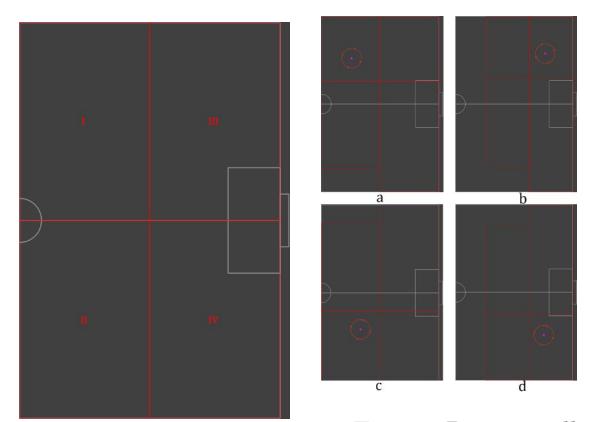
As described in the past section, we can always get the best passing point in any situation, which means the more aggressiveness our robots show, the more aggressive the best passing point would be. There are two robots executing "pass-and-shot" task and the other robots supporting them[11]. We learned the strategy from the formation in traditional human soccer like "4-3-3 formation" and coordination via zones[12]. Since each team consists of at most 8 robots in division A in 2019 season[5], a similar way is dividing the front field into four zones and placing at most one robot in every part (Figure 14). These zones will dynamically change according to the position of the ball (Figure 15) to improve the rate of robot receiving the ball in it. Furthermore, we rasterize each zone with a fixed length (e.g. 0.1m) and evaluate each vertex of the small grids with our value-based criteria (to be described next). Then in each zone, we can obtain the best running point xR in a similar way described in section 5.5.
There are two special cases. First, we can't guarantee that there are always 8 robots for us on the field for yellow card and mechanical failure, which means at this time we can't fill up each zone. Considering points in the zone III and IV have more aggressiveness than those in the zone I and II, at this time we prefer the best point in the zone III and IV. Secondly, the best passing point may be located in one of these zones. While trying to approach such a point, the robot may be possibly interrupted by the robot in this zone, so at this time, we will avoid choosing this zone.
6.2 Value-based running point criteria
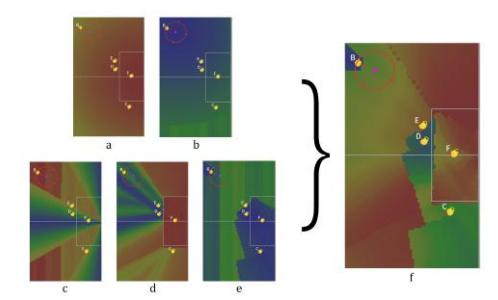
We adopt the similar approaches described in Section 5.3 to evaluate and choose the best running point. There are five evaluation criteria xi(i = 1, 2, ..., n) as follows. Figure 16 shows how they work in common cases in order and with their weights ωi(i = 1, 2, ..., n) we can get the final result by Equation 8 showed in f of Figure 16 (red area means higher score while blue area means lower score).
- Distance to the opponent's goal. It is obvious that the closer robots are to the opponent's goal, the more likely robots are to score.
- Distance to the ball. We find that when robots are too close to the ball, it is difficult to pass or break through opponent's defense.
- Angle to the opponent's goal. It doesn't mean robot have the greater chance when facing the goal at 0 degree, instantly in some certain angle range.
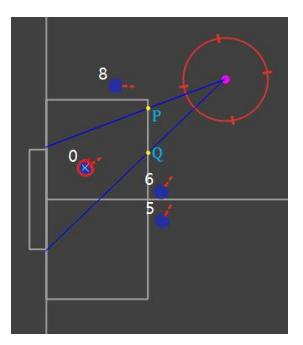
- Opponent's guard time. Guard plays an important role in the SSL game that preventing opponents from scoring around the penalty area, and each team have at least one guard on the field. Connect the point to be evaluated to the sides of the opponent's goal, and hand defense area to P and Q (according to Figure 17). Then we predict the total time opponent's guard(s) spend arriving P and Q. The point score is proportional to this time.
- Avoid the opponent's defense. When our robot is further away from the ball than the opponent's robot, we can conclude that the opponent's robot will approach the ball before ours, and therefore we should prevent our robots being involved in this situation.
6.3 Drag skill
There is a common case that when our robot arrives at its destination and stops, it is easy to be marked by the opponent's robot in the following time. We can call this opponent's robot "defender". To solve this problem, we developed a new "Drag" skill. First of all, the robot will judge if being marked, with the reversed strategy in [4]. Assume that the coordinates of our robot, defender and the ball are (xme, yme),(xdef ender, ydef ender) and (xball, yball). According to the coordinate information and Equation(9) we can solve out the geometric relationship among our robot, defender and the ball, while they are clockwise with Judge > 0 and counterclockwise with Judge < 0. Then our robot will accelerate in the direction that is perpendicular to its connection to the ball. At this time, the defender will speed up together with our robot. Once the defender's speed is greater than a certain value vmin, our robot will accelerate in the opposite direction. Thus there will be a huge speed difference between our robot and defender, which helps our robot distance defender and receive the ball safely.
The application of this skill allows our robots to move off the opponent's defense without losing its purpose, thus greatly improves our ball possession rate.
$$Judge = (x_{ball} - x_{me})(y_{defender} - y_{me}) - (x_{defender} - x_{me})(y_{ball} - y_{me}) \quad (9)$$
7 Result
Our newly developed algorithms give us a huge advantage in the game. We won the championship with a record of six wins and one draw. Table 1 shows the offensive statistics during each game extracted from the official log.
Table 1: Statistics for each ZJUNlict game in RoboCup 2019. The possession rate of Game UR1 is not included in the calculation due to the radio communication interference.
| Game | Possession Rate(%) | Goals by Regular Gameplay | Goals by Free Kick | Goals by Penalty Kick | Total Goals |
|---|---|---|---|---|---|
| RR1 | 66.4 | 2 | 2 | 0 | 4 |
| RR2 | 71.6 | 3 | 2 | 1 | 6 |
| RR3 | 65.9 | 0 | 0 | 0 | 0 |
| UR1 | – | 2 | 1 | 1 | 4 |
| UR2 | 68.2 | 1 | 0 | 1 | 2 |
| UF | 69.2 | 1 | 1 | 0 | 2 |
| GF | 71.4 | 1 | 0 | 0 | 1 |
| Total | – | 10 | 6 | 3 | 19 |
| Average | 68.8 | 1.4 | 0.9 | 0.4 | 2.7 |
7.1 Passing and Shooting Strategy Performance
Our passing and shooting strategy has greatly improved our offensive efficiency resulting in 1.4 goals of regular gameplay per game. 52.6% of the goals were scored from the regular gameplay. Furthermore, Our algorithms helped us achieve a 68.8% possession rate per game.
7.2 Free-kick Performance
According to the game statistics, we scored an average of 0.9 goals of free-kick per game in seven games, while 0.4 goals for other teams in nineteen games. And goals we scored by free kick occupied 32% of total goals (6 in 19), while 10% for other teams (8 in 78). These statistics show we have the ability to adapt to new rules faster than other teams, and we have various approaches to score.
8 Conclusion
In this paper, we have introduced our main improvements on both hardware and software which played a key role in winning the championship last year. Our future work is to predict our opponent's actions on the field and adjust our strategy automatically. Improving our motion control to make our robots move faster, more stably and more accurately is also the main target next year.
References
- Chen Zexi, et al.:Champion Team Paper: Dynamic Passing-Shooting Algorithm of the RoboCup Soccer SSL 2019 Champion. Robot World Cup. Springer, Cham, 2019.
- Nicolai Ommer, Andre Ryll, Mark Geiger.:TIGERs Mannheim Extended Team Description for RoboCup 2019. RoboCup Wiki as extended team description of TIGERs Mannheim team, Leipzig, Germany, accessed April 5(2019): 2019.
- Zheyuan Huang, et al.:ZJUNlict:RoboCup SSL 2018 Champion Team Paper. RoboCup 2018 small size league champion. Robot Soccer World Cup. Springer, Berlin, Heidelberg, 2018.
- Zheyuan Huang, et al.:ZJUNlict Extended Team Description Paper for RoboCup 2019. RoboCup Wiki as extended team description of ZJUNlict, Sydney, Australia, accessed March 6 (2019): 2019.
- Technical and Organizing Committee:Rules of the RoboCup Small Size League 2019. RoboCup Soccer SSL Official Web. https://robocup-ssl.github.io/sslrules/sslrules.html (2019). Accessed 26 June 2019
- Sanders J, Kandrot E.: CUDA by Example: An Introduction to General-Purpose GPU Programming[M]. Addison-Wesley Professional, pp.41-114 (2010)
- Harris M.: Optimizing Parallel Reduction in CUDA[J]. Nvidia Developer Technology. 2(4), 70 (2007)
- Garland, M., Le Grand, S., Nickolls, J., Anderson, J., Hardwick, J., Morton, S., Phillips, E., Zhang, Y., Volkov, V.:Parallel Computing Experiences with CUDA. IEEE Micro. 28(4), 13-27 (2008)
- Gyarmati L, Anguera X.:Automatic extraction of the passing strategies of soccer teams[J]. arXiv preprint arXiv:1508.02171 (2015)
- Guarnizo Marin, Jose Guillermo, Martin Mellado Arteche.: Robot Soccer Strategy Based on Hierarchical Finite State Machine to Centralized Architectures. IEEE Latin America Transactions. 14(8), 3586-3596 (2016)
- Michael Phillips, Manuela Veloso.:Robust Supporting Role in Coordinated Two-Robot Soccer Attack. In:Proceedings of the RoboCup Symposium, pp.235-246 (2008)
- Juan Pablo Mendoza, Joydeep Biswas, Danny Zhu, Philip Cooksey, Richard Wang, Steven Klee, Manuela Veloso.: Selectively Reactive Coordination for a Team of Robot Soccer Champions. In:Proceedings of AAAI'16, the Thirtieth AAAI Conference on Artificial Intelligence, Phoenix, pp.3354-3360 (2016)