RoboIME: Pioneering the Next Frontier in Robocup 2025
Andr´e Favalessa, Eduardo Galv˜ao, Alisson Santana, Mois´es Guedes, Henrique ´ Barreto, Lucio E. Horie, Enzo G. Frese, Renato da P. Alves, Isabel C. de Freitas, Marcos C. Antunes, Eduardo Baldi, Ebert H. V. Melo, Raquel Belchior F. N., Antˆonio Pl´acido C. C. F., Jo˜ao Pedro Gomes C., J. V. Neves Duarte, A. H. Rocha e Silva, V. Henequim C., P. H. Cantergiani C., Gustavo L. Alves, Vinicius de F. L. Moraes, Gabriel M. Lima, Carla S. Cosenza, Hebert Azevedo S´a, Luiz R. L. Rodrigues, Paulo F. F. Rosa
Instituto Militar de Engenharia, Rio de Janeiro, Brasil
Abstract This paper describes the electronic, mechanical, and software designs developed by the RoboIME Team to join the RoboCup 2025. The overall concepts are in agreement with the rules of Small Size League 2025. This is the tenth time RoboIME participates in the RoboCup tournament.
1 Introduction
RoboIME is a Small Size Soccer League team from IME (Instituto Militar de Engenharia), and this is the 18th time the team participates in competitions. The team has already gotten good results on previous occasions: (i) first place in the Latin American Robotics Competition 2017 (LARC 2017); (ii) second place in seven different competitions, RoboCup Brazil Open 2011, LARC 2012, RoboCup 2018 (division B), LARC 2018, RoboCup 2019 (division B), LARC 2019 and RoboCup 2022 (division B); (iii) third place in LARC 2022, (iv) fifth place in LARC 2023, (v) fifth place in LARC 2024.
We regret to inform that RoboIME did not participate in RoboCup 2024. However, our continued efforts in refining and advancing our project are geared toward a strong comeback, as we are fully committed to participating in RoboCup 2025.
Our past achievements and ongoing technological advancements underscore our dedication to excellence. We look forward to leveraging these improvements for a competitive performance at RoboCup 2025, reaffirming our legacy in the robotics arena.
All students who work on the SSL project are members of the Laboratory of Artificial Intelligence, Robotics, and Cybernetics (LIARC) at IME. The team's previous works were used as reference [2], as well as the help from former members of the team as consultants and tutors.
This article describes the team's general information and improvement in the last semester since our TDP for RoboCup 2024 has detailed explanations on our previous system. The article is organized as follows: software in section 2, embedded electronics in section 3, and mechanical design in section 4. Conclusions are discussed in section 5.
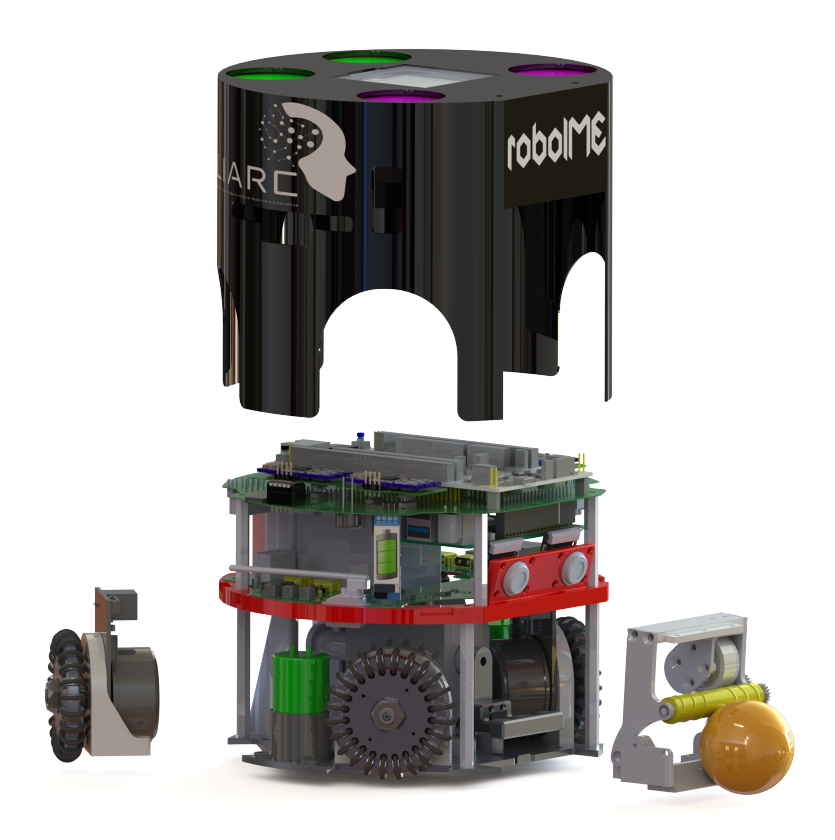
Table 1: Robot Specifications
| Robot version | v2025 |
|---|---|
| Dimension | Ø177 x 147mm |
| Total weight | 2,5 Kg |
| Max. ball coverage | 8.5 % (Vol) |
| Locomotion | Nanotec DF45L024048-E 65W, Direct Drive |
| Wheel diameter | 60 mm |
| Encoder | Nanotec incremental embedded DF45L024048-E |
| Dribbling motor | ECU22048H18-S101, 55W - Slotless BLDC motor with encoder |
| Controller | A3930 MOSFET Driver |
| Kicker charge | 3600 µF @ 244 V |
| Straight kick speed | 9.57 m/s |
| Microcontroller | NUCLEO-H723ZG |
| Sensors | Encoders, Gyroscope, Accelerometer, Compass, Camera, NFC |
| Communication link 2 Semtech SX1280 @1.3 MBit/s, 2.300 - 2.555 GHz | |
| Compute module | Raspberry Pi 5 + with two forward oriented camera |
| Power Supply | Li-Po battery, 22.2 V nominal (6S1P), 1300 mAh |
2 Software Project
The past year, RoboIME made significant changes to its software, particularly in the strategy domain. The primary focus was on refining the positioning of attacking robots in order to create more scoring opportunities. Additionally, significant adjustments were made in the defense team, introducing new logic for both the goalkeeper and barrier.
In line with these improvements, the utilization of two cameras was introduced to enhance the team's vision capabilities. These cameras will provide accurate data for decision-making during gameplay.
Moreover, there were a few adjustments on the robot control, especially into turning maneuvers, aimed at improving our turn-and-shoot skill. Lastly, in the vision processing, updates were made to our Kalman filter as well.
2.1 New Attack Logic
One of the main problems with our old attack strategy was that our robots were always fixed on the same specific position no matter how many robots we were playing with and they would not place themselves in a good spots to receive a pass either.
Furthermore, the way we evaluated the positioning of allied robots was not accurate. This evaluation is the decision factor for the robot that possesses the ball to either shoot in the goal or decide to make a pass.
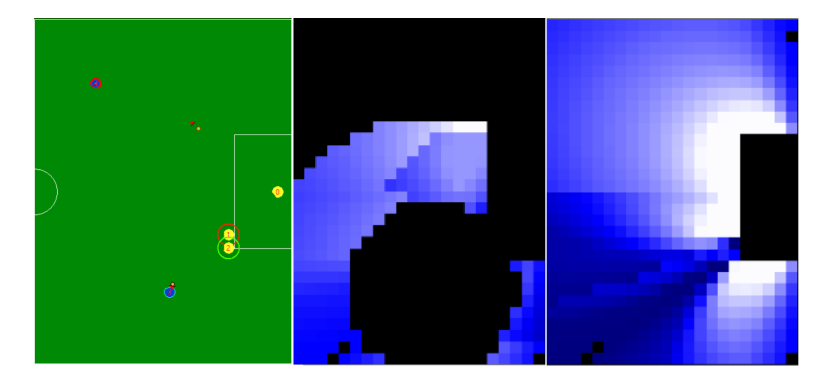
For this reason, inspired by the old CMDragons strategy [5], we created 2 heat maps. Both are built using a function that evaluates some position P = (x,y) into a 0 to 1 number.
The first function is called EvaluatePass(x,y) and it calculates the given position by multiplying the result of 3 criteria:
- The probability of the ball not being intercepted by an adversary robot after the pass (this one was already implemented and it was our only criterion for evaluating the pass )[2])
- There is an open angle to shoot into goal;
- The Ball-Point-Goal angle is narrow enough so that a one-touch shoot to goal is possible (1 if it's possible, 0.8 otherwise);
- The distance of the pass is within a certain range (1, if it is and 0 otherwise).
The second function is called EvaluateShoot(x,y) and have only 2 criteria:
- There is an open angle to shoot into goal just like in EvaluatePass;
- The Probability of the ball being intercepted by some adversary robot, except the goalkeeper, after a shot to goal (the point being analised is the ball and not the target).
The result of the heat map is shown in Fig. 2.
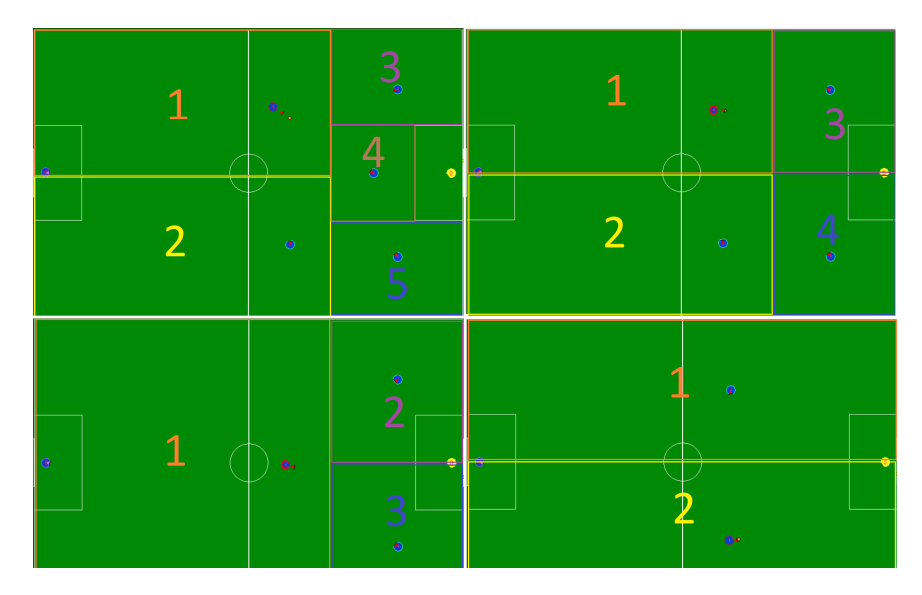
In addition to the heat maps, another functionality that was implemented into the attack strategy was the attacking zones. They are disjunctive areas that covers the entire field and are fixed for each number of attacking robots. Furthermore, each region has an associated point called Guard Position (indicated by the red triangles on Fig. 3)).
Based on these functionalities the attack strategy still follows our Skill Tactics Play (STP) architecture [2], but now there are 3 main plays: Normal Game, Prepare Pass and Pass Game.
The Normal Game play is performed by admitting two main roles: The Shooter and the Attacker. The shooter is chosen based on the region where the ball is currently located. Then it reaches the ball, or go for interception if it's moving, while the remaining Attackers stay in the Guard Position.
Then, the Prepare Pass play holds for just a small amount of time in which the attacking robots perform a search for the best evaluated position in their zones. It's important to point out that the heat map is just a concept because calculating the evaluation for every position in the field is too costly. So the search is actually fulfilled by sampling a fixed amount of points in each zone and choosing the better evaluated.
Finally, either the Normal Game or the Pass Game is started. The first one if The Shooter evaluation is higher than any other Attacker and the second one otherwise. If the Normal Game is started, the Prepare Pass will not be started until the a shot is made or the ball zone changes.
2.2 New Defense Logic
For the new defense, many efforts were made in two different roles: the goalkeeper and the defensive barrier. A lot of geometry was employed to find the ideal way to defend the goal, and some basic rules were applied as well. Firstly, the robots cannot collide with other ally robots. Secondly, while in the barrier defending the goal, the robot cannot stray far from the keeper's area unless it needs to shoot the ball.
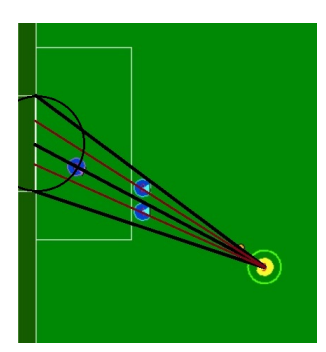
The barrier is always on the bisector line formed by the straight line of the goalkeeper's bisector and the straight line of the respective corner of the goal, as depicted in Fig. 4. If there is only one robot in the defense, the goalkeeper shifts away from the bisector line to compensate for the absence of the second robot in the defensive barrier, while the remaining robot in the wall makes a similar adjustment to cover the angle.
In summary, the goalkeeper, when in danger, is always at the intersection between the bisector of the triangle formed by the most dangerous adversary and the two corners of the goal, as shown in Fig. 4.
2.3 New Keeper's play
In our system, we have made slight adjustments to the goalkeeper's intelligence, and some of it was focused on countering first-touch kicks by the opposing team. Specifically, when the ball is kicked to an angle outside the goal, our code triggers a designated play. This play involves identifying the next opponent in the ball's path and promptly adjusting its positioning to narrow the angle of this attacker, using the new defense logic.
A potential concern arises when an opposing attacker positions themselves behind the ball for the kick. To address this, if no robot is detected along the expected path of the ball, it once again employs the new defense logic, but this time, to swiftly close the angle of the ball, preventing the attacker from exploiting the open space.
2.4 Robot Control
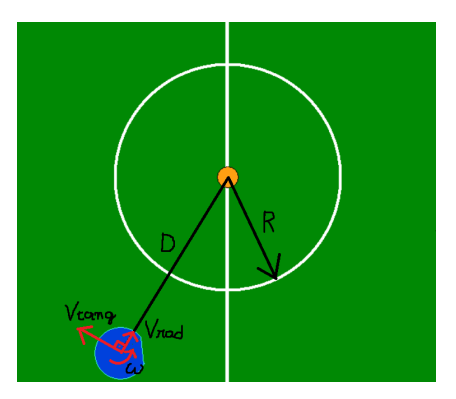
As described in RoboIME's previous work [2], our control system works fine when the robot is following a straight line. However it was not quite good when making lateral movements like describing a circumference, which is required for our turn-and-shoot skill
As a result, a new state was created only for the control of turning movements. In this state, the target goal is interpreted not as the end point of the trajectory but as the center of the translation. This movement is then executed with a fixed radius R and a fixed angular velocity Ω.
To achieve this, a perpendicular velocity Vtang = Ω · D is sent and then it is summed up with two feedback velocities: a radial velocity Vrad an angular velocity ω. Vrad corrects the distance to the center D, so that it comes closer to R, and ω corrects the robot orientation to face the center point while moving. Both of the feedback velocities are calculated with a PID controller, which makes the robot correct its trajectory very quickly.
2.5 Kalman Filter
There were some issues with the estimated values obtained from the SSL-Vision software, particularly regarding the velocity estimation for field objects, robots, and the ball. Consequently, the Kalman filter was reimplemented in the code with corrections to the previous version.
First, based on [3], the discrete model state-space representation can be described as:
$$\mathbf{x}(k+1) = \mathbf{\Phi}\mathbf{x}(k) + \mathbf{\Gamma}\mathbf{u}(k) + \mathbf{\Gamma}_{\mathbf{1}}\mathbf{w}(k) \tag{1}$$
with measurements:
$$\mathbf{y}(k) = \mathbf{H}\mathbf{x}(k) + \mathbf{v}(k) \tag{2}$$
- x is the state vector;
- y is the output vector;
- u is the control vector;
- w is the normally distributed process noise with covariance Q;
- v is the normally distributed measurement noise with covariance R.
With this model, the following algorithm can be used:
- a) Time update (prediction):
- Project the state ahead: ¯x(k) = Φˆx(k − 1) + Γu(k − 1);
- Project the covariance ahead: M(k + 1) = ΦP(k)Φ T + Q;
- b) Measurement update (correction):
- Compute the Kalman gain: K(k) = P(k − 1)HT (HP(k − 1)HT + R) −1 ;
- Update state estimate: ˆx(k) = ˆx(k − 1) + K(k)(y(k) − Hˆx(k − 1));
- Update the covariance: P(k) = (I − K(k)H)P(k − 1);
- Q is the process noise covariance;
- R is the measurement noise covariance.
It is worth noting that to filter and estimate the data, it is necessary to determine the model, the Q and R matrices, in addition to the initial values, the P and x matrices. The latter two provide a better estimate when starting to filter. More detailed descriptions can be found in [3].
3 Electronics
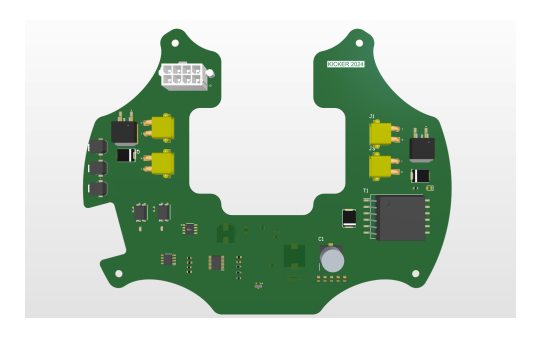
In our continuous pursuit of excellence and innovation, our team has undertaken several key hardware upgrades for RoboCup 2025. These changes are aimed at addressing previous limitations while enhancing overall system performance, reliability, and adaptability during high-intensity competitions. Our primary modifications include the transition from our former ESC design to the A3930 MOSFET Driver, the upgrade of the dribble motor from the T-Motor F60 Pro IV 1750KV to the ECU22048H18-S101 slotless BLDC motor with an integrated encoder, and a comprehensive redesign of the main board to accommodate these new components. The kicker board remains unchanged, preserving its proven reliability.
3.1 Transition to the A3930 MOSFET Driver
In previous competitions, our original ESC solution presented several challenges, primarily due to inadequate support and difficulties in achieving consistent and responsive motor control. After an extensive evaluation of available alternatives, we selected the A3930 MOSFET Driver as our new motor control interface. The decision was based on the following technical and operational advantages:
- Enhanced Precision and Control: The A3930 MOSFET Driver offers superior switching performance with lower on-resistance and faster response times. This results in more accurate control over the motor's actuation, allowing for smoother acceleration profiles and finer modulation of speed, which is critical for both offensive maneuvers and rapid directional changes on the field.
- Improved Reliability under Dynamic Conditions: The robust design of the A3930 significantly mitigates issues such as thermal stress and transient voltage spikes. Its improved current-handling capabilities ensure that our robots maintain stable performance even during sudden load changes or high-speed operations. This reliability is essential in a competitive environment where split-second decisions can determine the outcome of a match.
- Better Support and Community Integration: The A3930 is not only technically advanced but also widely adopted within the robotics community. Teams like ITAAndroids [1] have begun integrating this driver into their systems, creating an ecosystem of shared knowledge, troubleshooting resources, and firmware optimizations. This collaborative environment fosters continuous improvement and standardization across multiple platforms.
- Reduced Electromagnetic Interference (EMI): With optimized switching characteristics and integrated filtering, the A3930 helps minimize EMI, thereby reducing potential disruptions to nearby sensors and communication modules. This is crucial for maintaining the integrity of our data streams and ensuring that sensor feedback remains accurate during gameplay.
3.2 Dribble Motor Upgrade
To further enhance our robot's ball-handling and dribbling capabilities, we have upgraded our dribble motor from the T-Motor F60 Pro IV 1750KV to the ECU22048H18-S101, a 55W slotless BLDC motor equipped with an integrated encoder. This change was driven by several key factors:
Superior Control via Integrated Encoder Feedback: The new motor's integrated encoder enables high-resolution real-time feedback, which facilitates precise closed-loop control. This enhancement allows our control algorithms to adjust motor performance instantaneously, ensuring consistent dribbling and rapid adaptation to changing field conditions.
Slotless Design Benefits: The slotless architecture of the ECU22048H18- S101 significantly reduces cogging torque—a common issue in traditional BLDC motors that can lead to jerky or uneven movement. The smoother
torque profile directly translates to more refined dribbling control, allowing our robots to manipulate the ball with greater accuracy and finesse.
Enhanced Efficiency and Thermal Performance: Operating at 55W, the new motor offers improved power efficiency, minimizing heat generation during prolonged use. This ensures that the motor operates within optimal temperature ranges, reducing the risk of thermal degradation and enhancing the overall lifespan of the component.
Improved Dynamic Response: The ECU22048H18-S101 is designed for applications requiring rapid speed changes and high dynamic response. This is particularly beneficial in a RoboCup scenario where quick acceleration and deceleration are necessary to navigate tight spaces and respond to opponent maneuvers.
3.3 Main Board Redesign
The integration of the A3930 MOSFET Driver and the ECU22048H18-S101 motor necessitated a comprehensive redesign of our main board. The updated board layout is engineered to optimize performance and reliability, incorporating several critical improvements:
- Optimized Signal Routing and Power Distribution: The new design ensures that high-frequency switching signals from the A3930 MOSFET Driver are isolated from sensitive control circuitry. Enhanced power distribution pathways reduce voltage drops and electrical noise, ensuring stable operation even under high load conditions.
- Enhanced Compatibility and Future-Proofing: The board now features updated connectors and interfaces that not only support the new components but also allow for potential future upgrades. This modular approach ensures that our system remains adaptable to evolving technological standards and can incorporate additional features without extensive redesign.
- Improved Thermal Management: Recognizing the increased power demands and the heat generated by the new components, we have implemented enhanced thermal management strategies. These include optimized PCB layout for heat dissipation, additional thermal vias, and strategically placed heat sinks to ensure that all components operate within safe temperature ranges.
- Robust Mechanical Integration: The mechanical layout of the board has been revisited to accommodate the new drivers and motors without compromising the overall structural integrity. This redesign minimizes vibrationinduced issues and mechanical stress during high-speed maneuvers, which is critical for maintaining consistent performance over the duration of a match.
3.4 Kicker Board Continuity
While significant updates were made to the motor control and dribble systems, the kicker board remains unchanged. Our previous iterations of the kicker board have proven to be both reliable and effective in delivering consistent kicking performance. By maintaining the established design for the kicker board [4], we ensure that the energy and focus of our redesign efforts are directed toward areas where previous shortcomings were most evident, namely motor control and dribble handling.
3.5 Conclusion
These targeted hardware improvements collectively enhance our robot's agility, responsiveness, and overall performance on the field. The transition to the A3930 MOSFET Driver and the upgrade to the ECU22048H18-S101 motor provide a more robust and precise control platform, addressing the key challenges encountered in past competitions. The redesigned main board not only supports these new components but also sets the foundation for future advancements, ensuring that our team remains at the forefront of innovation in the RoboCup arena.
Through these comprehensive updates, we are confident that our robotic platform is now better equipped to meet the demands of RoboCup 2025, delivering improved reliability, precision, and competitive performance.
4 Mechanical Project
The mechanical design has undergone several modifications compared to the previous version. Currently, the team is focused on enhancing not only the robot's efficiency and structural robustness but also improving its ease of maintenance. Furthermore, RoboIME continuously explores new solutions, and through extensive research and collaboration with other teams, certain adjustments have been applied to the mechanical system. The advancements and strategic planning for RoboCup 2025 are detailed below.
4.1 Dribbler
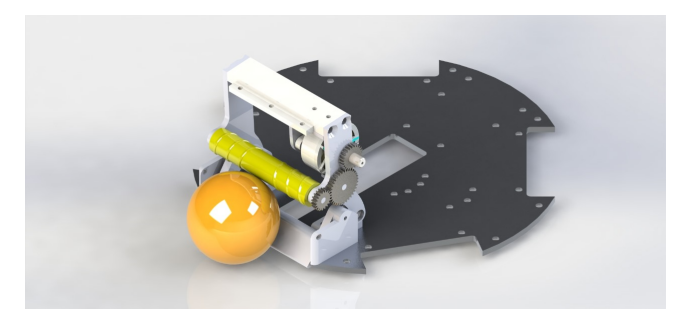
In response to the limitations identified in the dribbling mechanism during RoboCup 2023 and LARC, significant improvements have been implemented. By incorporating a mobile and damped motion system, the mechanism now slows the ball down upon contact, reducing unexpected rebounds. Additionally, inspired by techniques used by other teams, the new design incorporates three contact points, increasing stability during gameplay. Initial tests indicate that these adjustments have resulted in a notable improvement in overall performance.
4.2 Omni Wheels
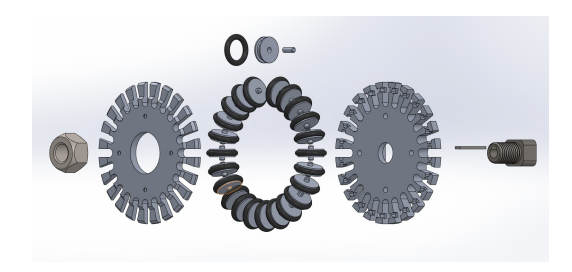
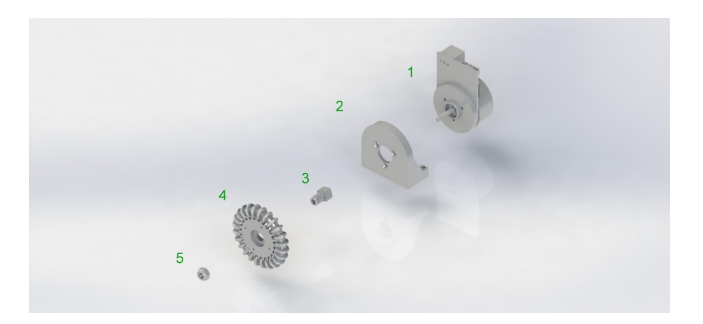
The increased power output of the new motors allowed for modifications to the omni wheels, improving the robot's overall maneuverability. The wheel diameter was increased from 45mm to 60mm, while the number of smaller rollers was raised from 15 to 24 (see Fig. 8)), resulting in smoother and more precise movement. Additionally, the previous gearbox was replaced by a direct-drive system, eliminating the backlash that was present in the previous design. This upgrade ensures greater accuracy and responsiveness in controlling the robot's movement (see Fig. 8)).
4.3 New Solenoid Supports
In the previous season, the kicking system experienced failures due to the fracture of the 3D-printed solenoid supports during RoboCup 2023 and LARC 2023. To solve this issue, the 2024 design introduces modifications in both structure and manufacturing processes. Although 3D printing remains the chosen production method, a newly implemented mutually supported configuration significantly enhances the durability and stability of the system. These improvements not only reduce the likelihood of breakage but also optimize overall performance, ensuring greater reliability for the competition.
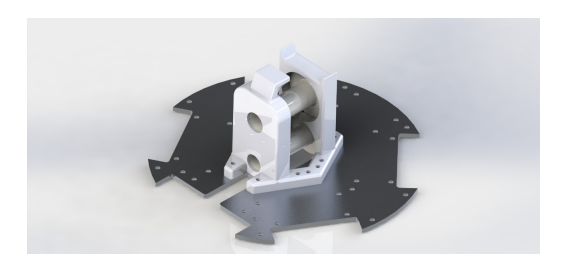
4.4 Motor mount
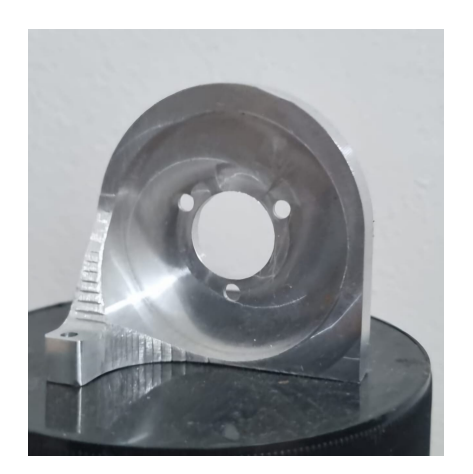
After a thorough analysis of previous editions of RoboCup and LARC, we have finally been able to implement a series of improvements to our robot's motor system, changes that had been in our plans since last year but only now became feasible.
The main upgrade was the integration of larger high-torque motors, which provided a significant boost in speed and responsiveness. In addition, we successfully introduced an innovative direct drive torque transmission system, eliminating the need for traditional gears. This approach optimizes power delivery and enhances reliability, making the robot even more prepared for the challenges of competitive environments.
Another important structural modification was the redesign of the motor support, which is now attached exclusively to the robot's floor. To ensure stability and minimize unwanted vibrations, an additional mounting point was added. This change resulted in asymmetry between the supports, as the need to accommodate the larger motors required internal space adjustments.
With these upgrades, we have made significant advancements in the robot's performance and robustness, aligning our engineering with the increasingly demanding requirements of competitions.
4.5 Initial modifications during manufacturing
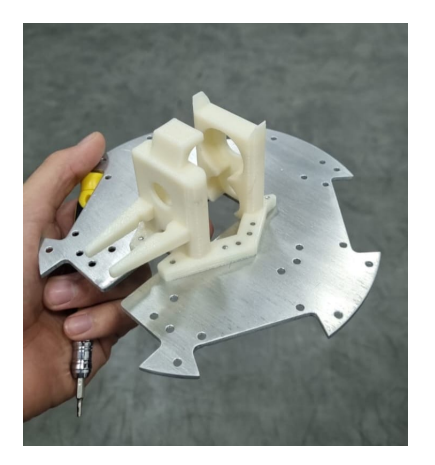
During the manufacturing phase of the first prototypes, modifications were made to the solenoid support structure. Two horizontal rods were added to enhance the stability of the dribbling system. This improvement was essential since the high rotational speed of the motor can induce vibrations in the structure, potentially affecting the precision and efficiency of the mechanism. Additionally, a more robust support system reduces mechanical wear on the components and improves force distribution, ensuring more consistent performance during the system's operation.
4.6 Planning for RoboCup 2026
For RoboCup 2026 in the SSL, we're revamping our robot's mechanical design by introducing flat coils to streamline internal space. This layout enables improved cable routing, frees room for sturdier supports, and reduces overall weight. We're also employing a modular chassis for quicker maintenance and potential midtournament swaps. By carefully calibrating bearings and adding dampers, we minimize vibration for smoother, more powerful kicks. Ultimately, these mechanical upgrades enhance both the robot's stability and its agility on the field.
5 Conclusions
For this competition, our goal is to consolidate the progress made in previous years by experimenting with changes in the software project, allied with new electrical and mechanical projects. Our software went through significant improvements through the development of a new navigation algorithm, kick logic, and attack strategy. In electronics, aside from changing motors and motor controllers, we embarked on a comprehensive redesign of the main board. Moreover, the new mechanical project incorporates omni wheels, enhancements to the kick system, a new dribbler, and optimized positioning for batteries and motors. With these enhancements, we anticipate delivering superior performances and achieving excellent results at the RoboCup 2025 tournament.
5.1 Acknowledgement
This research was partially supported by the Brazilian Army's Department of Science and Technology (DCT), F´abrica de Material de Comunica¸c˜oes e Eletrˆonica (FMCE/IMBEL), and the IME Alumni Association. We extend special thanks to all former members of RoboIME. Without their invaluable support, this team would not be possible.
References
- Andryus Martins Antˆonio Penna Bismarck Moreira Bruno Yamamoto Eduardo Simpl´ıcio Emanoel Morais Gustavo Pironi Gustavo da Hora Leticia Mendes Lucas Neves Lucca Zoppi Marcos Maximo Mariana Martins Mateus Egger Murilo Pedroso Nando Farias Valerio Barros Victor Wakugawa Andr´e Gon¸calves, Andrei Freiberger and Yves Queiroz. Itandroids small size league team description paper for robocup 2023.
- Felipe W. V. da Silva, Antˆonio S. G. Pereira, Vinicius de F. L. Moraes, Mayara R. Mendon¸ca, Gabriel M. Lima, Henrique Barreto, Iasmin C. Mathias, Lucio E. Horie, Enzo G. Frese, Pedro V. Rocha, Renato da P. Alves, Marcos C. Antunes, L´eo V. C. Vasconcelos, Isabel C. de Freitas, Arthur B. S. de Souza, Marcos C. Antunes, Eduardo Baldi, Ebert H. V. Melo, Raquel Belchior F. N., Antˆonio Pl´acido C. C. F., Jo ao Pedro Gomes C., Alberto F. de Lima. L. S., Franciele Sembay, Roboime: On the road to robocup 2022.
- Gene F. Franklin, J. David Powell, and Michael L. Workman. Digital Control of Dynamic Systems. Ellis-Kagle Press, Estados Unidos da Am´erica, 3 edition, 1998.
- P.H.Cantergiani, Felipe W. V. da Silva, Antˆonio S. G. Pereira, Vinicius de F. L. Moraes, Mayara R. Mendon¸ca, Gabriel M. Lima, Henrique Barreto, Iasmin C. Mathias, Lucio E. Horie, Enzo G. Frese, Pedro V. Rocha, Renato da P. Alves, Marcos C. Antunes, L´eo V. C. Vasconcelos, Isabel C. de Freitas, Arthur B. S. de Souza, Marcos C. Antunes, Eduardo Baldi, Ebert H. V. Melo, Raquel Belchior F. N., Antˆonio Pl´acido C. C. F., Jo ao Pedro Gomes C., Alberto F. de Lima. L. S., Franciele Sembay, Roboime: Igniting innovation, shaping the future in robocup 2024.
- Stefan Zickler, James Bruce, Joydeep Biswas, Michael Licitra, and Manuela Veloso. Cmdragons 2009 extended team description.