Berlin United - Nao Team Humboldt 2023
Heinrich Mellmann, Stella A. Schlotter
Adaptive Systeme, Institut für Informatik, Humboldt-Universität zu Berlin, Berlin, Germany
https://berlin-united.org/ · https://github.com/BerlinUnited/NaoTH · https://github.com/BerlinUnited/NaoTH/wiki · https://docs.berlinunited.org · https://naoth.de/de/publications/ · https://robocup.tools/ · https://doi.org/10.1146/annurev-control-100719-064806
Abstract Berlin United - Nao Team Humboldt (NaoTH) is the Standard Platform League team from Humboldt-Universität zu Berlin. This team description paper details our code base, technical contributions including video data collection systems, neural network compilers, dynamic role assignment and team coordination, behavior simulation, implicit communication through audio signals, and decision making based on anticipation. We highlight our team's history, achievements in various RoboCup competitions, and our impact on the RoboCup community through research, public engagement, and workshop organization.
Team Information
team name: Berlin United
team leader(s): Heinrich Mellmann, Stella A. Schlotter
team contact email: [email protected]
team website URL: https://berlin-united.org/
country of origin: Germany
university affiliation: Humboldt-Universität zu Berlin, Department of Computer Science, Adaptive Systems Group
Code Usage
Berlin United maintains an originally developed code base, which does not incorporate any major or unchanged code parts developed by other teams. Ideas and inspiration based on other teams code and publications are acknowledged accordingly in the team report and code where they are used.
Currently we are using a custom Ubuntu-based image on the robot. The script for building it was originally developed by NaoDevils and was restructured and extended to our needs.
On the Robot we use compiled neural networks. Our custom compiler uses parts of code shared by NaoDevils in 2018. Currently, we are experimenting among others with the library CompiledDNN by B-Human which then might be used as part of our code at the RoboCup 2023.
During the past years some smaller code parts were adapted into our code base from other teams, which are not used anymore. One example was the CNN ball classifier trained and provided by NaoDevils, which was used by our team during the RoboCup 2018 alongside other selectable classifiers developed by out team. It is not used anymore.
We are not planing to use any other code of other teams at the RoboCup 2023.
Own Contribution
Throughout its history our team made numerous technical and scientific contributions. Our published contributions can be found on our team-website. Our code base and related projects are regularly made public (we publish every commit to our main branch) together with our code documentation.
Code: https://github.com/BerlinUnited/NaoTH Setup: https://github.com/BerlinUnited/NaoTH/wiki Online Documentation (in progress): https://docs.berlinunited.org Scientific Publications https://naoth.de/de/publications/
In the following we highlight a few noteworthy contributions from the past three years as per section A.1. in the rule book.
Video data collection
As described in [3] we developed a recording system for the RoboCup games that is synchronized with the game controller logs and can therefore be easily synchronized to the teams individual robot logs. We deployed this system in the past events to collect and organize videos and data from SPL Games on a large scale, and helped with the setup at events, which we were not part of. The collected data is publicly available and was used as a basis for the Open Research Challenge — Video analysis / statistics at the RoboCup 2022. The challenge lead to a number of posters presented at RoboCup 2022. This project is currently supported through a RoboCup Federation research grant and will be presented at the symposium at the RoboCup 2023. We are planing to upgrade the hardware and are also working on an integration of streaming and recording of RoboCup games in collaboration with the team NaoDevils.
Neural Network Compilers
As part of a master thesis we compared a number of compilers for neural networks. The results of that research will go into future development of our robot software.
Dynamic Role Assignment and Team Coordination
In his thesis [4], Philipp Strobel, developed a behavior system for highly dynamic team strategy strategy including role negotiations between players and assignment of locations on the field. The role assignments depend on the importance of the roles and the situation in the field. For instance, more important roles (goalie, striker) are prioritized and overall walking-load of the team is optimized. An initial version was already employed at the GO19 and RC19, which can be seen in the accompanying video.
Behavior: from Simulation to Reality
SimSpark-Simulator used by the S3D-League was extended and adapted to the SPL rules and physics requirements. Our team has been continuously working and improving this adapted version since 2010. SimSpark allows to execute lightweight simulations of entire games making it ideal for behavior experiments. In [4], SimSpark was used as part of a system running large numbers of SPL games with different parameters for the team strategy described above. Based on the results, most promising parametrizations were determined, which were used in real games.
Implicit Communication Through non-intrusive Audio Signals
In a recent Master-Thesis-Project, Jacob Dübel investigated a method for coordination between robots using short chirp-sounds optimized for robots, similar to R2D2. The sounds themselves do not carry digital information, but rather serve as short call-outs marking certain situations (e.g., "I'm free to receive a pass") and can be localized in space by receiving robots. The sounds were designed in a way to be non-intrusive to a human audience and to be easily detected and localized by teammates. This way we hope to further reduce the dependency on Wi-Fi communication. An example sound can be heard at the beginning of the video.
Decision Making based on Anticipation
Our robots simulate the behavior of the ball for different possible actions (kicks) and choose the action promising the best outcome. This approach was first introduced in [2] and is continuously extended to incorporate more environmental factors and to more challenging decisions, like positioning to intercept the ball.
Past History
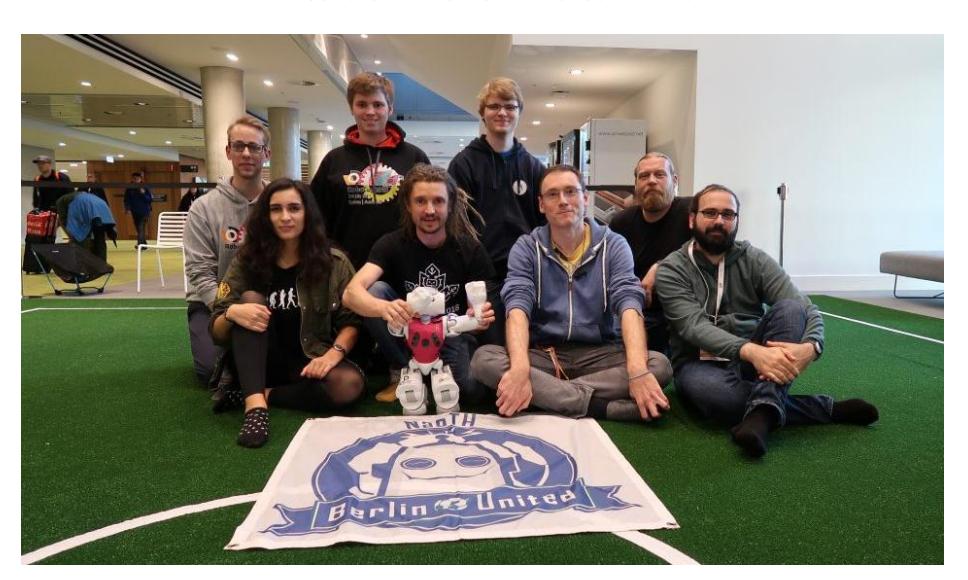
The research group Berlin United - Nao Team Humboldt (NaoTH ) is part of the research lab for Adaptive Systems at Humboldt-Universität zu Berlin (HU) headed by Prof. Verena Hafner. The team mainly consists of students and researchers from the Humboldt-Universität of different levels - Bachelor, Master/Diploma, and PhD levels. We also have team members who finished their studies at the HU and still continue to contribute. Besides the direct participation at the RoboCup competitions NaoTH is involved in teaching at the university, public engagement and building of the RoboCup community.
NaoTH was founded at the end of 2007 at the AI research lab headed by Prof. Hans-Dieter Burkhard and is a member of the SPL since the first SPL competition in 2008 in Suzhou. NaoTH is a direct successor of the Aibo Team Humboldt, which was active in the Four Legged League of the RoboCup as a part of the GermanTeam until 2008. GermanTeam won the world championship three times during its existence. In 2011 we formed a conjoint team Berlin United with the team FUmanoids from Berlin, which participated in the KidSize League. The collaboration included extensive exchange of experience, sharing of code and organization of joint workshops. In 2017 the team FUmanoids ceased to exist. Since then NaoTH remains the only member of Berlin United and continues to compete under this name.
Our joint test games with FUmanoids developed into a growing series of workshops known as RoboCup Berlin Open Workshop (RoBOW). After its first installment in 2011 RoBOW grew into a regular series of RoboCup workshops organized by different universities, most notably RoHOW organized by the team HULKs in Hamburg/Germany and Rodeo organized by the Team Nao Devils in Dortmund/Germany.
In 2010 and 2011 we also competed in the 3D Simulation league with the same code as used for the SPL. In the 3D Simulation, we won the German Open and the AutCup competitions and achieved the 2nd place at the RoboCup World Championship 2010 in Singapore.
In 2017 and 2018 NaoTH competed together with the team NaoDevils as joint team DoBerMan at the RoboCup SPL Mixed Team Competition and achieved 2nd place in both years. In 2017 NaoTH won the 2nd place in the challenger shield and in 2018 reached the quarterfinals in the champions cup of the main competition. We won 1st place in each of the technical challenges in 2019: the Directional Whistle Challenge, and the Open Research Challenge with our "joint relaxation mechanism to prevent overheating". We also won the 1st place in the Mixed Team competition (6 vs 6) as part of the mixed team B&B together with B-Human.
In 2021 our team achieved the 3rd place in the Obstacle Avoidance Challenge. Our team was unable to participate at the RoboCup competitions in 2022 as a result of the COVID pandemic.
Impact
Most of the impact can be derived from the previous sections. Here we would like to highlight a few aspects.
on SPL: We believe that collecting well structured data from the RoboCup games on a large scale as described in section 3 (Video data collection) will significantly advance the league and RoboCup as a whole. The support and the positive feedback that we received from the community strengthen this belief. This project was also cited in the landmark publication [1] by Asada and von Stryk.
We organize and actively contribute to various public and non public RoboCup events, like RoHOW, Rodeo, Lange Nacht der Wissenschaften in Berlin, and many more. We regularly publish at the RoboCup Symposium.
The impact of our technical and scientific contributions is difficult to assess: our original code base and scientific publications is public and can be used as inspiration for other teams.
on the team's university/community: RoboCup is a great opportunity for our students to connect with other students and researchers on international level. RoboCup provides strong motivation to work on robotic problems and attracts significant number of students. Our team is actively participation in teaching activities at our university. Our team is well known in the University and local campus and is often invited to local public events.
Other
Our team was pre-qualified for the RoboCup championships beginning from 2015 until 2022, where we unfortunately were not able to participate due to impact of the COVID pandemic on our team. Now we are ready to return and to join the group of the top SPL teams again :)
References
- Asada, M., von Stryk, O.: Scientific and technological challenges in robocup. Annual Review of Control, Robotics, and Autonomous Systems 3(1) (2020). https://doi.org/10.1146/annurev-control-100719-064806
- Mellmann, H., Schlotter, S.A., Blum, C.: Simulation based selection of actions for a humanoid soccer-robot. In: RoboCup 2016: Robot Soccer World Cup XX (2016), http://www.ais.uni-bonn.de/robocup.de/2016/papers/RoboCup_Symposium_2016_Mellmann.pdf
- Mellmann, H., Schlotter, S.A., Strobel, P.: Toward Data Driven Development in RoboCup. In: RoboCup 2019: Robot Soccer World Cup XXIII (2019)
- Strobel, P.: Teamstrategie und -koordination im Kontext des Roboterfußballs. Diplomarbeit, Humboldt-Universität zu Berlin (2020)