RedbackBots Qualification Document RoboCup Soccer SPL, 2024
Dr. Timothy Wiley, Prof. John Thangarajah, Jasper Avice Demay, Son Hai Cao, Hin Yeung Samuel Chan, Tom Ellis, Mark Field, Samuel Griffiths, Ben Hodder, Lewis Matthews, Luke Mullan, Murray Owens, Jed Pauckner, Justin Perrie
School of Computing Technologies, STEM College, RMIT University, Melbourne, Victoria, Australia
http://www.rmit.edu.au/ailab · https://youtu.be/BZjOs0efZMs · https://github.com/rmit-computing-technologies/redbackbots-coderelease
Abstract RedbackBots is applying to qualify for the RoboCup Soccer Standard Platform League in 2024. The team competed for the first time in the Challenger Shield in 2023, placing 5th, and previously participated in remote technical challenges in 2022. As a new team at RMIT University, RedbackBots is developing competitive behaviors for 5v5 soccer while also contributing novel innovations including an Augmented Reality visualizer (GameSight), improved whistle detection using machine learning, and vision algorithms for robot detection. The team leverages code from rUNSWift 2020 and B-Human, while building unique contributions to expand the diversity of available codebases in the SPL.
RedbackBots Team Information
RedbackBots is applying to qualify for the RoboCup Soccer SPL in 2024. We competed for the first time in the Challenger Shield in 2023, placing 5th. We also remotely competed in RoboCup Soccer SPL in 2022 for the technical challenges. The RedbackBots academic team leads have both previously participated in multiple RoboCup events and Dr. Timothy Wiley been active members in the RoboCup communities, including the SPL Technical Committee. Additionally, Tom Ellis is currently on the Organising Committee.
Team Name: RedbackBots
Team Leader: Dr. Timothy Wiley
Academic Supervisors: Dr. Timothy Wiley, Prof. John Thangarajah
Team Members: Jasper Avice Demay, Son Hai Cao, Hin Yeung Samuel Chan, Tom Ellis, Mark Field, Samuel Griffiths, Ben Hodder, Lewis Matthews, Luke Mullan, Murray Owens, Jed Pauckner and Justin Perrie Affiliation: School of Computing Technologies, STEM College, RMIT University, Melbourne, Australia
Contact Email: [email protected], [email protected],
Website: http://www.rmit.edu.au/ailab
Qualification Video: https://youtu.be/BZjOs0efZMs
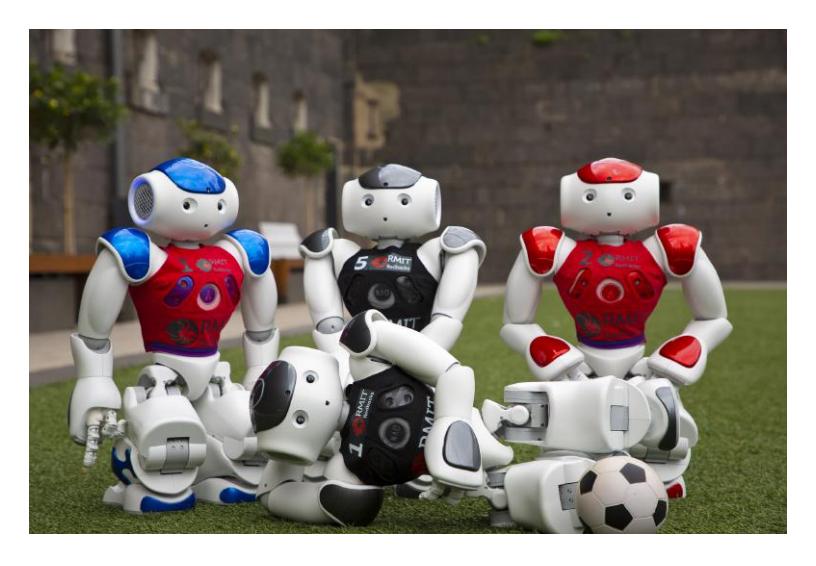
Robots: We acquired 10 new V6 Nao robots in late 2023 in preparation for participation in the Soccer SPL in 2024. These new robots, along with our 2019 collection are also currently used for undergrad student projects, and in our Master's of AI program. The robot Jersey's have been designed and created by our colleagues at the School of Design, using materials the School has been developing for human sporting activities.
Code Use
We acknowledge the following code-use as part of our current development of our RedbackBots software:
- Primarily the rUNSWift 2020 code release, for the software architecture, locomotion, vision, communication, etc.
- B-Human (and Nao Devils) 2022 code release, for the structure and creation of a bootable Nao V6 Ubuntu 20.04 image, along with general build configuration scripts, and general robot configuration management scripts..
We continue to fully support the need for each team providing contributions to the league. At the time of this application, we intend to use the following additional code as part of our 2023 developments:
• B-Human 2023 code release for revising our vision system. Our current vision is reaching it's limitations, so we intend to adopt the vision system of another team. Extensive modification to the B-Human will be required for compatibility with our code base.
We will notify the TC or RoboCup mailing lists of further code-use if this arises.
Own Contribution(s)
In the past 3 years we have made the following contributions to the league:
- We have published our work on the visual referee challenge (Lohani & Wiley [2023]). We used this in the 2022 technical challenge, and attempted to use it in 2023 game play, though we had integration issues due to our first participation in the Challenger Shield.
- Multiple Master's Minor Thesis works have been completed (Owens [2023;] Lohani [2022]).
- We have ported our existing codebase a buildable Nao V6 Ubuntu 20.04 image, enabling another independent codebase to be deployed as an independent image following the same structure as other teams. This therefore increases the diversity of different codebases available in the SPL.
- Compatibility of our codebase with Python 3, from Python 2.7 which has limited support.
- Attempted implementation of Whistle Detection.
We declare to make the following novel contributions:
- We are currently developing an Augmented Reality (AR) visualiser, GameSight, compatible with TCM and GC, along with custom RedbackBots data types. This enables visualisation of localised game information through AR platforms including the HoloLens2 and MetaQuest. We intend to demonstrate this during the 2024 competition, and publish this work as part of our 2024 code release.
- A new implementation of Whistle Detection with alternative approaches with machine learning models, to replace our 2023 attempt which faced major challenges during game play. In 2023 we failed to hear the kick-off and goals whistles on numerous occasions.
- If possible, implementation of vision algorithms, especially robot detection. This contribution is subject to the time commitments our the team members who are primarily undergraduate students.
We will also notify the Technical Committee of any intention in changes to these contributions.
We have the capacity for these contributions as our academic supervisors have research and experience in the fields of machine learning and computer vision. These contributions would be in conjunction with the team having to develop our own robot behaviours. We think, given the size of our team, that this would be a significant amount of work for our team to get through in time for the competition.
Code Release
Our 2023 code release can be found here: https://github.com/rmit-computing-technologies/redbackbots-coderelease. Our 2023 team paper is included in this repository, and via this direct link https://github.com/rmit-computing-technologies/redbackbots-coderelease/blob/master/RedbackBots_Teampaper_2023.pdf.
Current Development Progress
We are currently working on the following features of our codebase:
- Continued development of robot behaviours for playing 5v5 soccer based on our leanings from the 2023 competition. We have significant ground to cover still given our more rudimentary behaviours in 2023, and are in development towards quality 5v5 game play.
- Overhaul of our vision system which is reaching it's limitations. We intend to adopt the vision system of another team. Extensive modification to the B-Human implementation will be required for compatibility with our code base.
- Development of vision methods which could be leveraged as part of the 2023 Technical Challenges on collaborative play with human participants.
We observe that as a new team, we are in progress of creating our initial soccer behaviours. While we endeavour to also make a novel contribution to the league, as per the requirements of the qualification. However, we also note that the initial development of competitive behaviours is intensive for new teams.
Qualification Video of our current Progress
Our video demonstrates:
- Game play footage from the 2023 challenger shield.
- Footage from our 2022 technical challenge participation.
- Thesis work of Lohani [2022].
- Individual robot scoring from kick-off play controlled via Game Controller.
- Current development of 1 vs 1 soccer behaviours.
- Current development of Goal Keeper behaviours.
Team History
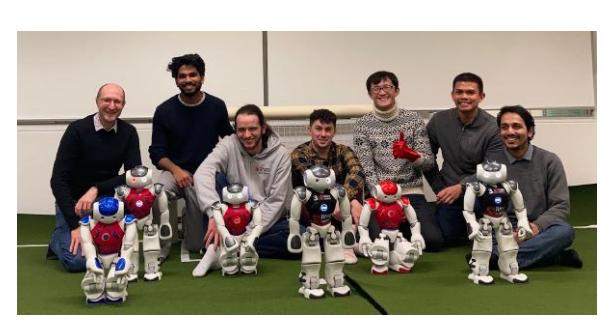
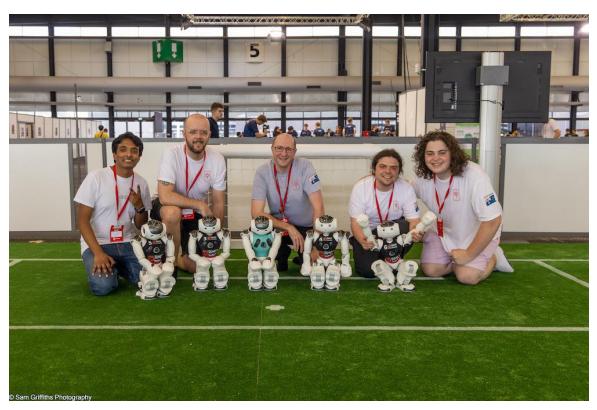
RMIT University established our RedbackBots team in 2019. The RedbackBots team is a small but keen team of combined undergraduate and postgraduate students who are studying at RMIT University.
The below table summarises RedbackBots participation in RoboCup Soccer SPL.
RedbackBots participation in RoboCup Soccer SPL
| Year | Participation | Results |
|---|---|---|
| 2023 | Challenger Shield | 5th place. |
| 2022 | Technical Challenges | 8th place Technical Challenges overall. 3rd Place Visual Referee Challenge. |
| 2021 | Qualified | Withdrew due to COVID-19 travel restrictions. |
| 2020 | Qualified | RoboCup 2020 cancelled due to COVID-19 pandemic. |

Impact
In 2023 we competed in the Challenger Shield and in 2022 we completed remotely in the Technical Challenges for the RoboCup Soccer SPL as part of the Visual Referee Challenge. Despite our limited participation, we have published research work within RoboCup, including publishable novel contributions as part of a student's Master's work (Lohani & Wiley [2023]), and we intend to submit this work for publication in the RoboCup Symposium. In 2023 we have made conitrbutions to expand the available codebases of RoboCup, by creating a alternative buildable Nao V6 Ubuntu 20.04. In 2024 we are working towards our first major completely independent contributions of an AR visualisation system.
RMIT University
RMIT University has made a significant investment in Artificial Intelligence and Robotics. The Artificial Innovation Intelligence Lab was launched in late 2019, and the RoboCup team is a key element of the lab strategic direction. RMIT University also launched the Centre for Industrial Artificial Intelligence and Research Innovation (CIAIRI) in late 2021 with a focus on AI applications for industry.
RMIT University also had an education partnership with Amazon Web Services (AWS), in particular as one of 25 universities world-wide to partner with AWS in launching the RoboMaker platform.
The RedbackBots team is a major part of this strategic drive of RMIT, and the School of Computing Technologies. Students in the Master's of AI along with senior undergraduate students, will be required to completing our established course in Autonomous Robotics. The Robot Soccer project is a fundamental part of this coursework, and one of the core projects.
Publication History
While our RedbackBots team may be relatively new to the Soccer SPL, we are building a track record of publications and thesis work. Additionally, our academic team leaders have an established track record of novel publications in both the RoboCup domain, and the fields of autonomous robotics, multi-agent systems, planning, machine learning and artificial intelligence. This history provides strong evidence of our independent work, and provides the basis of our intention to continue our research interests within the Soccer SPL.
References
- Lohani, P. & Wiley, T. (2023). Hybrid Methods for Real-time Video Sequence Identification of Human Soccer Referee Signals. Proceedings of the RoboCup Symposium, pp. 1–12.
- Wiley, T., Bratko, I., & Sammut, C. (Aug. 2017). A Machine Learning System for Controlling a Rescue Robot. RoboCup Symposium. Nagoya, Japan, pp. 1–12.
- Wiley, T., McGill, M., Milstein, A., Salleh, R., & Sammut, C. (July 2012). Spatial Correlation of Multisensor Features for Autonomous Victim Identification. RoboCup 2011: Robot Soccer World Cup XV. ed. by Röfer, T., Mayer, N. M., Savage, J., & Saranli, U. Springer-Verlag Berlin Heidelberg, pp. 538–549.
- Milstein, A., McGill, M., Wiley, T., Salleh, R., & Sammut, C. (Nov. 2011a). A Method for Fast Encoder-Free Mapping in Unstructured Environments. Journal of Fields Robotics, Special Issue on Safety, Security, and Rescue Robotics. 28 (6), pp. 817–831.
- Owens, M. (2023). Visual Referee Signals for RoboCup Standard Platform League. Master's Minor Thesis. Melbourne, Australia: School of Computing Technologies, RMIT University.
- Lohani, P. (2022). Visual Referee Challenge For RoboCup Soccer. Master's Minor Thesis. Melbourne, Australia: School of Computing Technologies, RMIT University.
- Wiley, T. (2010). Autonomous Victim Identification. School of Computer Science and Engineering, The University of New South Wales Australia.
- Tennakoon, R. B., Hoseinnezhad, R., Tran, H., & Bab-Hadiashar, A. (2018). Visual Inspection of Storm-Water Pipe Systems using Deep Convolutional Neural Networks. ICINCO (1), pp. 145–150
- Wiley, T. (June 2017). A Planning and Learning Hierarchy for the Online Acquisition of Robot Behaviours. PhD Thesis. School of Computer Science and Engineering, The University of New South Wales.
- Wiley, T., Sammut, C., Hengst, B., & Bratko, I. (2016). A Planning and Learning Hierarchy using Qualitative Reasoning for the On-Line Acquisition of Robotic Behaviors. Advances in Cognitive Systems. 4, pp. 93–112.