SABANA Herons
A. Santafe-Silva, B. Diaz-Garcia, C. Garzón Castro, E. Florez-Marino, H. Guzmán-Montaño, J. Castellanos-Rivillas, J. Gómez-Rueda, J. Mora-Zarate, J. Ulloa-Mejia
Universidad de La Sabana
Abstract The SABANA Herons SPL(Standard Platform League) team is the result of the collaboration between the mechanical engineering and informatics engineering departments of the Universidad de La Sabana. The team was born out of the student's desire to carry out projects that bring together different fields of engineering to solve complex problems that can be compared with real-world systems, as well as their desire to form multidisciplinary groups that require teamwork. The team currently has 5 NAO Robots V6 and 3 V5. Our team was founded in 2017 and has been gaining experience in different robotics competitions, some in the national context and others internationally.
Team Information
The SABANA Herons SPL(Standard Platform League) team is the result of the collaboration between the mechanical engineering and informatics engineering departments of the Universidad de La Sabana. The team was born out of the student's desire to carry out projects that bring together different fields of engineering to solve complex problems that can be compared with real-world systems, as well as their desire to form multidisciplinary groups that require teamwork. The team currently has 5 NAO Robots V6 and 3 V5. Our team was founded in 2017 and has been gaining experience in different robotics competitions, some in the national context and others internationally. In recent years, the university has been able to participate in various global competition events, such as Shell Eco Marathon Americas (Detroit 2017 and Sonoma 2018), All Japan Sumo Robot Tournament in Japan (December 2017), RobotChallenge in Mexico (May 2018), RoboCup in Australia (July 2019) where we were Sub champions in the Challenge Shield category, and RoboCup in Thailand (July 2022). ). Now we are hoping to be part of the 5v5 RoboCup Challenge in Eindhoven, Netherlands (July 2024).
Code Usage
In this participation, Herons team use the 2021 version of the B-human code release, where several of the modules and representations proposed by this team are used directly and others were modified. Based on the CABSL platform of B-Human, SABANA Herons team develop all the behaviors for the Striker, the Defenders, and the Goalkeeper. It is important to add that the kicking movements and goalkeeper's special movements were programmed in their entirety, in addition to the heatmap-like module, a zone representation and provider, and implementation of the heuristic algorithm for optimizing the position of the team on the playing field that was released in 2019 and updated for the 2022 version. We have also used as a foundation the advancements utilized by SABANA Herons team in the 2022 competition, adding new modules and implementing improvements in referee recognition.
Own Contribution
SABANA Herons team has improve his abilities on Computer Vision for referee signal recognition. This helps the robot identify different game states based on the output that the implemented Neural Network retrieves. In order to achieve a significant performance, we used a key-point detector for the feature extraction of the image frames. The key-point coordinates will feed a Long-Short Term Memory (LSTM) layer, that will predict the referee sign (Bharathi et al., 2024; Shayestegan et al., 2023). On the other hand, to reduce the need of high computational power for the key-point extractor, the input image was reduced to a 120x120 resolution. Also, video is capture with a step of 6 between frame and frame, and the LSTM layer receives data from 10 frames.
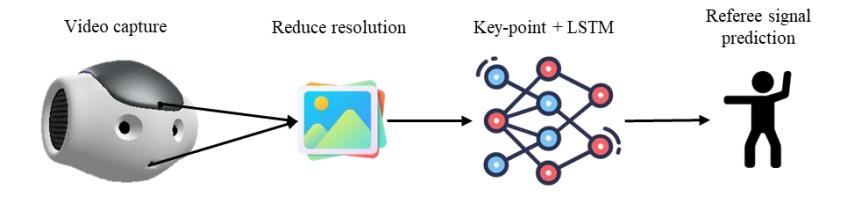
For training the used Neural Network, a dataset was built with the 8 team members as referees. Taking into account that the goalkeeper is the one in charge of the detection process, the robot position was kept the same on all the image captures. But there were five different head orientations by rotating the NAO´s neck. Resulting on 160 images that will go through a data augmentation process for having a wider dataset.
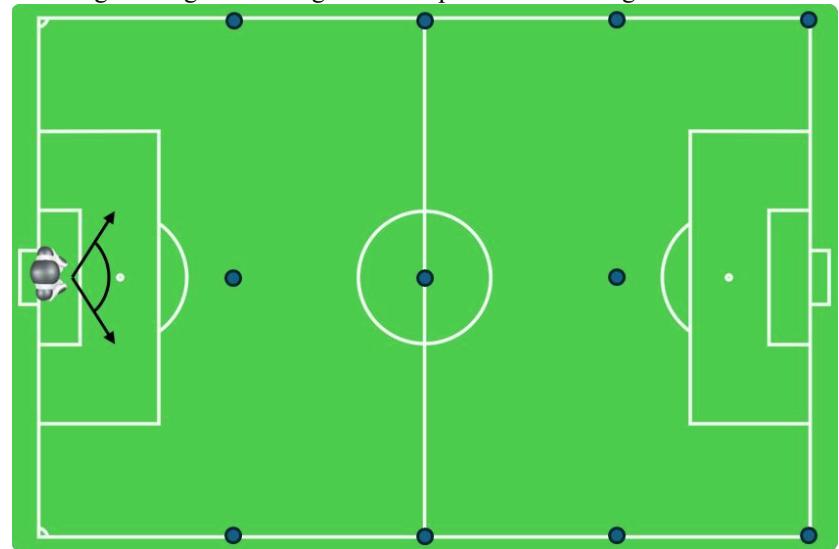
For this purpose, the NAO robot acting as the goalkeeper will maintain focus on the referee whenever the ball is on the opponent's side of the field during the initial, set, and playing stages of the game. It will detect any instructions given and transmit the corresponding game instructions to the rest of the NAO robots on the team. During other game stages such as penalties or corners, the goalkeeper NAO will focus on the ball. For achieving this, any Nao robot of the team will send a UDP message acknowledging an opponent's field - own field transition and vice versa or any game state change, where the NAO robot acting as the goalkeeper will change the focus according to the situation.
History
The Sabana Herons team participation in Robocup SPL started when the team took part in the Australia 2019 competition, in which the Sabana Herons team ended up as sub champions in the Challenge Shield category, showing great knowledge and perseverance as it was the team's first participation in the RoboCup competition. Additionally, the team has had other experiences in international competitions and challenges such as the Shell Eco Marathons Americas 2017 and 2018 where the team constructed and programmed a highly-energy-efficient vehicle as well as participating in several RoboSumo events, two of them being the Japan Sumo Robot Tournament in 2017 and the Robot Challenge Mexico in 2018.
Regarding the team's participation in the RoboCup 2019 competition, Tables 1 to 4 show the game scores and opponents we faced throughout the event.
Table 1: Group Phase
| Match Score | Opponent |
|---|---|
| SABANA Herons 0 - 3 Bembelbots | Goethe Universita Frankfurt am Main |
| SPQR 4 - 0 SABANA Herons | La Sapienza University of Rome |
| SABANA Herons 4 - 0 MiPal | Universitat Pompeu Fabra, Griffith University |
Table 2: Challenge Shield Group Phase
| Match Score | Opponent |
|---|---|
| SABANA Herons 5 - 0 RoboEireann | Maynooth University |
| Naova 1 - 1 SABANA Herons | Ecole de Technologie Supérieure |
| SABANA Herons 0 - 0 Camelia Dragons | Aich Prefectural University |
Table 3: Semifinal
| Match Score | Opponent |
|---|---|
| SABANA Herons 2 - 0 NTU RobotPal | National Taiwan University |
Table 4: Final
| Match Score | Opponent |
|---|---|
| SABANA Herons 3 - 4 Starkit | Moscow Institute of Physics and Technology |
And finally, in the Table 5 you will find the matches played in RoboCup 2022 with their respective scores.
Table 5: 2022 Robocup matches
| Round | Match Score | Opponent |
|---|---|---|
| 1 | SABANA Herons 0 - 4 HULKs | Hamburg University of Technology |
| 2 | SABANA Herons 3 - 0 Naova | Ecole de Technologie Supérieure |
| 3 | NomadZ 0 - 1 SABANA Herons | Automatic Control Laboratory (IfA), Computer Vision Laboratory (CVL) |
| 4 | HTWK Robots 7 - 0 SABANA Herons | Faculty of Computer Science and Media, Leipzig University of Applied Sciences |
| 5 | SABANA Herons 1 - 3 UT Austin Villa | Department of Computer Science, The University of Texas at Austin |
Impact
In Colombia, NAO robot technology has influenced a wide range of areas, such as in the education of children as well as adults, including seniors (Céspedes et al., 2021; Lozano-Mosos et al., 2023). This sets the stage for the team's participation in RoboCup, which represents a significant impact on the country in terms of robotics competitions and inspires other students to delve into the world of robotics, programming, and the development of new technologies.
While Universidad de La Sabana is a relatively young institution (almost 45 years old), it has a strong record in both national and international competitions. An example is Shell Eco Marathon, where the team was able to build a highly efficient vehicle improving by around 93 % when compared to traditional vehicles. Similarly, in the previous installment of RoboCup 2019 the team was able to achieve a podium finish, closing the competition in second place.
Regarding SABANA Herons' participation in 2022, it did not yield the expected results; however, we consider this experience invaluable as it allowed us to identify and understand our areas for improvement. We learned significantly from our mistakes, acquired knowledge, and shared with other teams. We are committed to applying these lessons to strengthen our performance in future competitions and also to disseminate them to the community around us, not only in the competitive realm of RoboCup. In RoboCup 2024, we hope to have a better performance to demonstrate the effort among computer engineering, mechanical engineering students, and professors who work tirelessly as a team.
Additionally, it is necessary to highlight and remark on the importance of soccer as a sport nationwide in Colombia. The sport brings together a huge following that keeps up with all events of the soccer scene. With the participation of SABANA Herons team in 5v5 RoboCup Challenge hopefully the team can bring recognition and popularity of engineering and robotics as astonishing disciplines to be sought and learned, among the population all around the country. To be able to participate in the championship again would allow the university to promote the development of Robotics among students and researchers locally, boosting knowledge nationwide.
Video Presentation
In the next link you can check our inscription video: EnlaceVIDEO
References
- Bharathi, A., Sanku, R., Sridevi, M., Manusubramanian, S., & Chandar, S. K. (2024). Real-time human action prediction using pose estimation with attention-based LSTM network. Signal, Image and Video Processing, 1–10. https://doi.org/10.1007/S11760-023-02987-0/TABLES/6
- Céspedes, N., Raigoso, D., Munera, M., & Cifuentes, C. A. (2021). Long-Term Social Human-Robot Interaction for Neurorehabilitation: Robots as a Tool to Support Gait Therapy in the Pandemic. Frontiers in Neurorobotics, 15, 612034. https://doi.org/10.3389/FNBOT.2021.612034/BIBTEX
- Lozano-Mosos, J. S., Hernández Leal, J., Colina-Matiz, S., & Muñoz-Vargas, P. T. (2023). Education by a social robot on nutrition and catheter care in pediatric oncology patients. Supportive Care in Cancer, 31(12), 1– 6. https://doi.org/10.1007/S00520-023-08168-6/TABLES/2
- Shayestegan, M., Kohout, J., Trnkova, K., Chovanec, M., & Marěs, J. (2023). Motion Tracking in Diagnosis: Gait Disorders Classification with a Dual-Head Attentional Transformer-LSTM. International Journal of Computational Intelligence Systems, 16(1), 1–18. https://doi.org/10.1007/S44196-023-00280-Z/FIGURES/17