ATIS-bots RoboCup@Work 2019 Team Description Paper
Vahid Rostami, Pouya Mansournia, Anmar Ghazi Akar, MohammadAli Kamkar, Faraz Jalili, Mehran Mehralian
Department of Computer Engineering, Qazvin Islamic Azad University, Qazvin, IRAN; Department of Mechanical Engineering, Qazvin Islamic Azad University, Qazvin, IRAN
http://mrl-atwork.ir/ · www.ros.org · http://www.trossenrobotics.com/dynamixel-pro-m54-60-s250-r-robot-actuator
Abstract This paper addresses a description of MRL@Work team and a robot which is designed in the MRL laboratory. We describe the current state of the team with respect to mechanical parts, hardware and software architecture. The mechanic of the robot is designed and manufactured in this laboratory. A high-performance hardware has been employed to run all software parts and designed algorithms on this robot without any exterior computers.
1 INTRODUCTION
MRL Mechatronic Research Laboratory is located in Qazvin Islamic Azad University research and innovation Center – Syntech, in which several teams have focused on robotic and AI research and challenges to contribute new technology and to participate in RoboCup competitions annually.
"MRL-@Work" is a team consist of undergraduate and graduate students and an assistance professor as team supervisor. The vision of this team is to design and build a robust intelligent autonomous industrial robot.
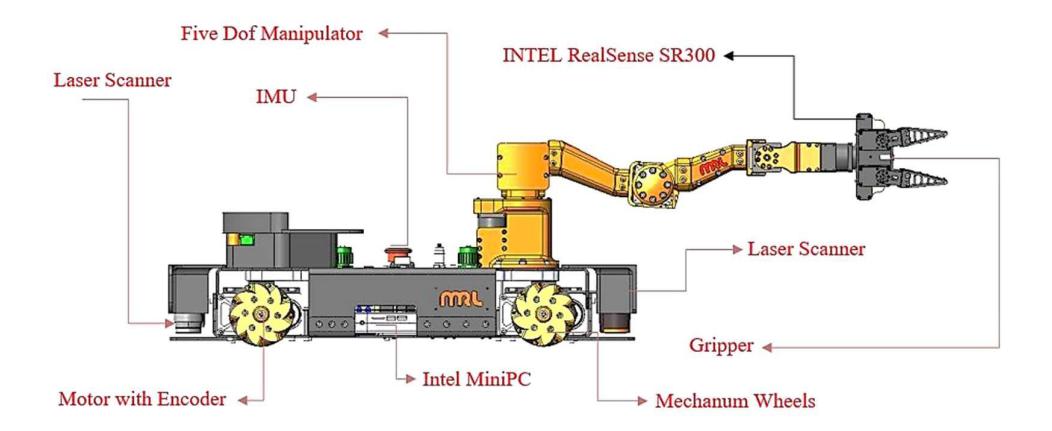
We have designed a UGV – unmanned ground vehicle – robot, called "AtisBot" composed of two distinguished parts; an Omni-directional base[Fig.1] and a 5DOF robotic arm. The arm's manipulation and the base's navigation have professionally performed in two year passed We are going to work on grasping system, decision making and task scheduling as well as fault toleration of our system in this year.
2 SYSTEM DESCRIPTION
A. Mechanics
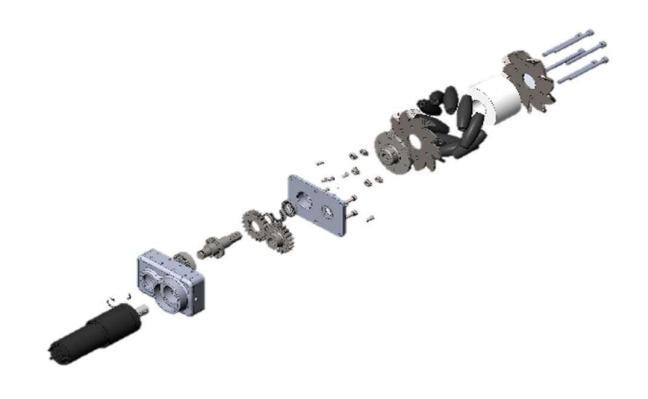
A.1 Robot Locomotion is based on 4 Mecanum wheels tracked system because it is common capable to transport in industrial flat ground [Fig. 1].
B. Hardware
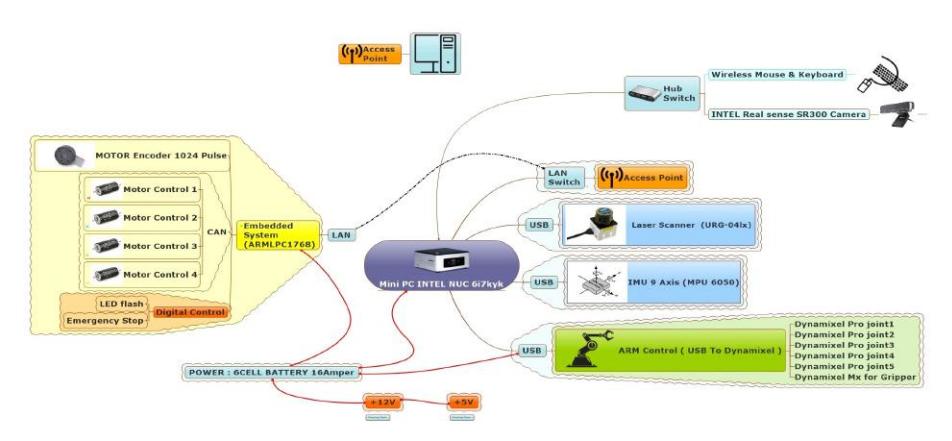
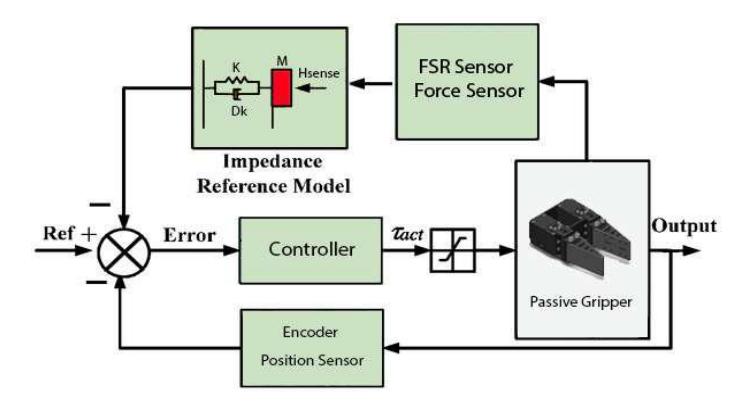
B.1. MINI-PC: Regarding to problems on communication for sending sensory rapidly such as laser, images and etc., an Intel Core i7 mini pc is considered to handle all software algorithms on the robot. This system can handle the proposed localization system which is based on three sensory laser scanner, IMU and a vision system. Fig 4 shows the hardware and their connection as completely. An embedded arm control system interfaces the motors of locomotion to the mini pc. This system communicates via cabled LAN to high level controller such as planner or navigation parts.
C. Software
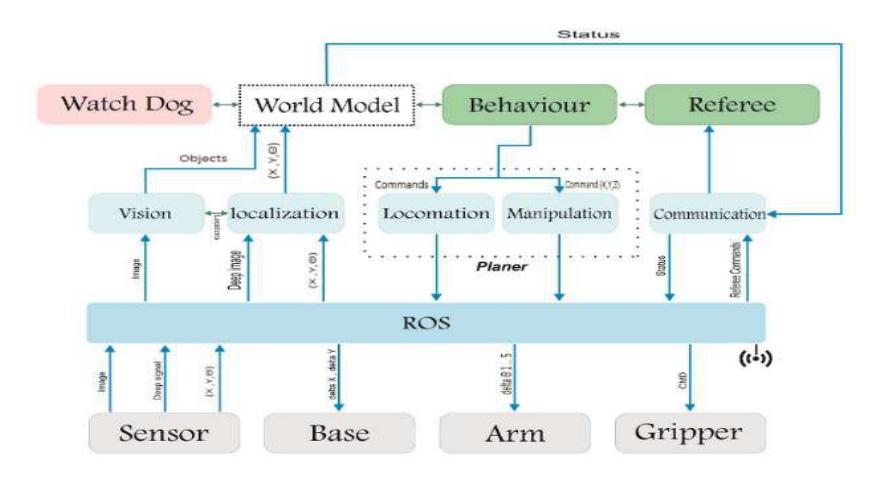
The software architecture is shown in [Fig. 5.], most of the developed software tools are stand-alone, middleware agnostic, in which some packages are integrated within Robot Operating System (ROS) [4] by suitable wrappers. Since ROS is a flexible framework for writing robot software MRL[At]Work software infrastructure has been established based on the ROS Indigo middle-ware running on Ubuntu 14.04.
3 ACKNOWLEDGEMENTS
Our team is supported by the Mechatronics Research Laboratory (MRL) in Qazvin Islamic Azad University (QIAU). We would like to thank all of persons for supporting of our work, specially head of university Prof. M. Mosakhani and vice chancellor of MRL Dr. M. Norozi.
APPENDIX A TEAM MEMBERS AND THEIR CONTRIBUTIONS
Vahid Rostami Pouya Mansournia Anmar Ghazi Akar MohammadAli Kamkar Faraz Jalili Meran Mehralian
Team Supervisor Mechanical/Electrical Design Robot SLAM, Software Software/ Arm Control Navigation, State Machine Software/ Vision
Qazvin Islamic Azad University
Sponsor
APPENDIX B LISTS
A. System List: Table I list several features of this robot with manipulator system.
TABLE I
| Attribute | Value |
|---|---|
| System Weight | 25Kg |
| Overall Length | 550mm |
| Overall Width | 380mm |
| Overall Height | 140mm |
| Minimum velocity | 0.1m/s |
| Maximum velocity | 1.2m/s |
| Height | 750mm |
| Payload | 0.5kg |
| Structure Material | Aluminum cast |
| Position repeatability | 5mm |
| Communication | Ethernet-CAN |
| Voltage connection | 24V-DC |
| Arm Link Speed | 120 degree/s |
References
[1] Robot Analysis and Control, H. ASADA, J.-J. E. SLOTINE, MIT 2001 [2] Robotics Dynamics Control, Mark W. Sponge, M. Vidyanagar [3] http://www.trossenrobotics.com/dynamixel-pro-m54-60-s250-r-robot-actuator [4] www.ros.org [5] P. van Turennout, G. Honderd, and L. J. van Schelven, "Wall-following control of a mobile robot," in Robotics and Automation. IEEE, 1992. [6] S. Kohlbrecher, J. Meyer, T. Graber, K. Petersen, U. Klingauf, and O. von Stryk, "Hector open source modules for autonomous mapping and navigation with rescue robots." RoboCup Symposium 2013, 2013. [7] M. Quigley, K. Conley, B. Gerkey, J. Faust, T. B. Foote, J. Leibs, R. Wheeler, and A. Y. Ng, "Ros: An opensource robot operating system," in International Conference on Robotics and Automation. Open-Source Software workshop, 2009 [8] Razzing, Dario Lodi, et al. "Unsupervised range image segmentation and object recognition using feature proximity and Markov random field." Intelligent Autonomous Systems 13. Springer International Publishing, 2016. 807-820. [9] Branch, Olivier, and Marc Van Droogenbroeck. "Vibe: A universal background subtraction algorithm for video sequences." IEEE Transactions on Image processing 20.6 (2011): 1709-1724. [10] MacLeod, Charles N., et al. "Quantifying and improving laser range data when scanning industrial materials." IEEE Sensors Journal 16.22 (2016): 7999-8009. [11] Zaman, Safdar, et al. "ROS-based mapping, localization and autonomous navigation using a Pioneer 3-DX robot and their relevant issues." Electronics, Communications and Photonics Conference (SIECPC), 2011 Saudi International. IEEE, 2011. [12] https://en.wikipedia.org/wiki/Finite-state_machine [13] Force Sensing Resistor (FSR): a brief overview and the low-cost sensor for active compliance control Article10.1117/12.2242950 [14] Dokeroglu, Tansel, Ender Sevinc, and Ahmet Cosar. "Artificial bee colony optimization for the quadratic assignment problem." Applied Soft Computing (2019). [15] Chmiel, Wojciech. "Evolutionary algorithm using conditional expectation value for quadratic assignment problem." Swarm and Evolutionary Computation (2019).