RoboCupRescue 2011 - Robot League Team SHINOBI (JAPAN)
Yuichi Ambe, Hisashi Mizumoto, Hayato Shin, Ryo Ariizumi, Tehyon Kim, Souhei Hanamoto, Satoshi Toyoshima, Hiroki Igarashi, Fumitoshi Matsuno
Kyoto University, Yoshida honnmachi, Sakyou-ku Kyoto-shi, Kyoto 606-8501, Japan; The University of Electro-Communications, Chofugaoka 1-5-1, Chofu, Tokyo 182-8585, Japan
Abstract We will participate this competition with two robots. First robot is KOHGA3. KOHGA3 is 2nd place of Best-in-class in mobility in 2007 and 3rd place of Best -in-class mobility in 2009. Third one is HIEI. HIEI is autonomous searching robot has 2-flippers at its rear. This one will be used in both red arena (tel-operation) and yellow arena (autonomy).
Introduction
We have participated RoboCupRescue competitions since 2002. Our results are;
- 2002 International (Fukuoka): 2nd place,
- 2003 Japan Open (Niigata): 2nd place,
- 2003 International (Padova): Semi Final,
- 2004 Japan Open (Osaka): 1st place,
- 2004 International (Lisbon): 5th place,
- 2005 International (Osaka): Semi Final, Best Design Award 1st place,
- 2006 Japan Open (Kitakyusyu): 4th place,
- 2006 International (Bremen): Locomotion Challenge 1st place.
- 2007 Japan Open (Osaka): 2th place
- 2007 International (Atlanta): 6th place, Best-in-class in mobility 2st place.
- 2009 Japan Open (Osaka):1st Place,
- 2009 International (Graz):4th Place, Best-in-class in mobility 3rd place.
- 2010 Japan Open (Osaka):3rd Place,
- 2010 Thailand Rescue Robot Championship (Bangkok): Best Autonomous Award
We have put our experience at these competitions to accout for our research. For example, we proposed "synthsezed seen recollection [1] (Fig. 1)", "pole fish-eye camera [2]" and "better ratio of the number of operators to the number of robots [3]."
Since JapanOpen2007 competition, we have challenged to develop both mobility robots and full-autonomous robots.
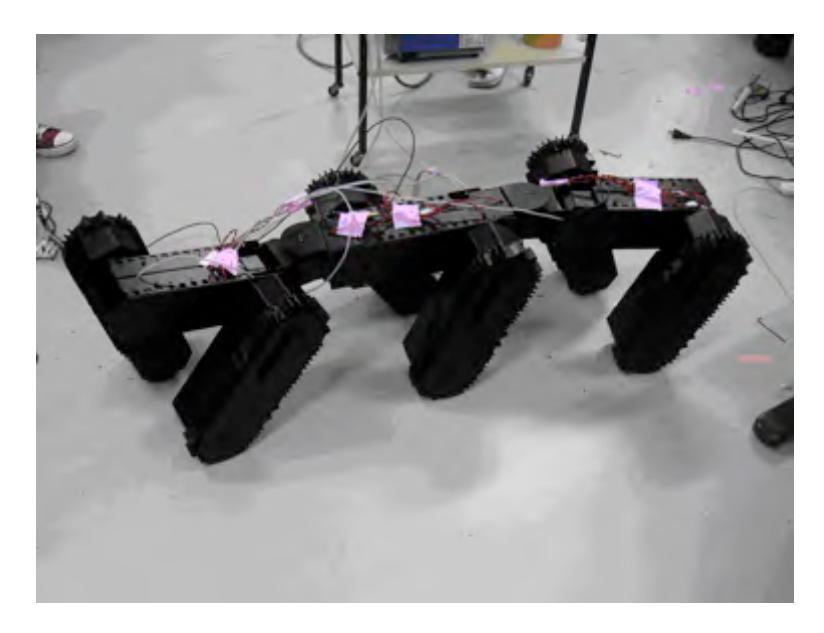
We developed KOHGA2, our first robot, which is the winner of Locomotion Challenge in 2006. KOHGA2 is a reconfigurable robot. We can freely change its configuration in advance suitable for environments. In fig.2, KOHGA2 have 3 bodies, two 2- DOF joints and 6 crawler arms. This configuration is useful to overcome stack situations. In Fig3, KOHGA2 has 1 body and 4 crawler arms. This configuration is useful for running on rubbles. With this configuration, we won the Locomotion Challenge in 2006.
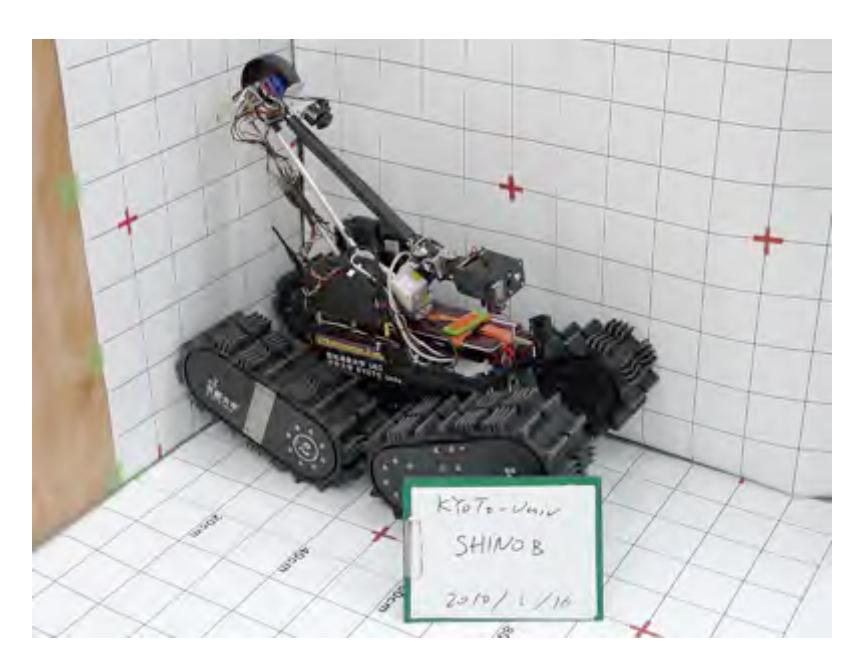
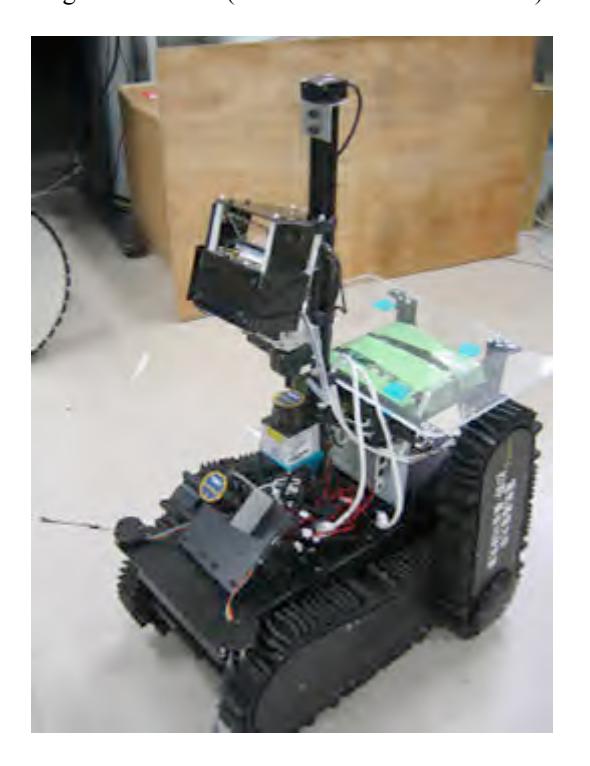
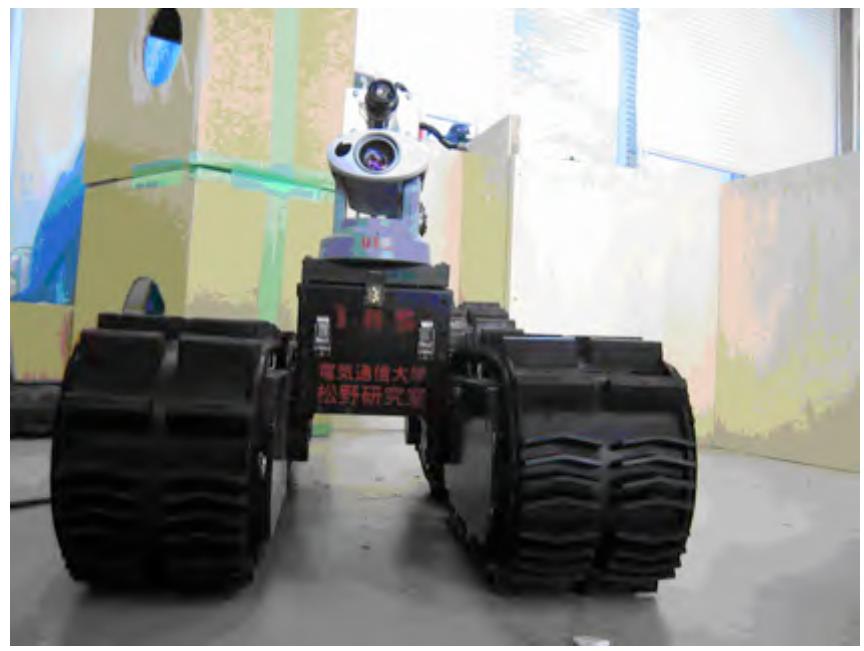
However KOHGA2 is broken down easily but can not be maintained easily because the mechanism of KOHGA2 is complex. We developed KOHGA3 (Fig.4), our second robot, which was simplified on the mechanism. KOHGA3 was more reliability than KOHGA2.
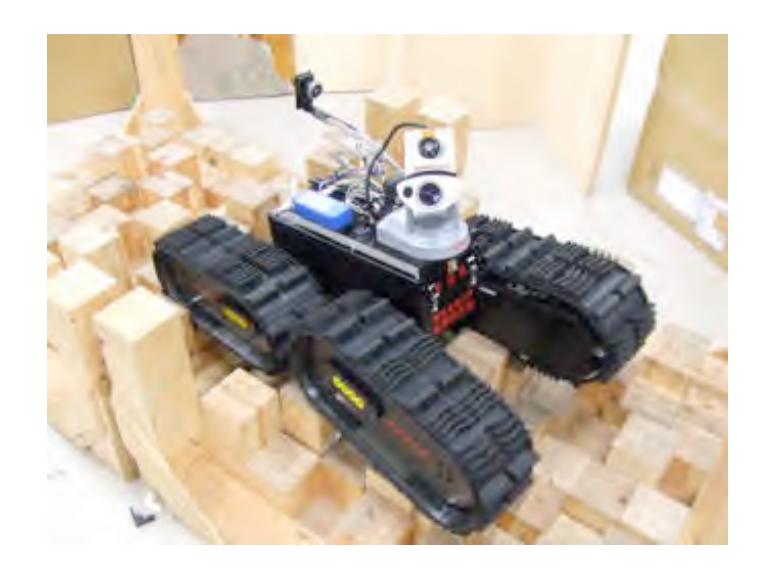
HIEI(Fig. 5), our third robot, has 2-flipper at its rear and full autonomous robot. This robot can build 2D map real-time by SLAM (ICP) algorism(Chapter 4, 5) and find victims using thermal camera automatically (Chapter 7).
1. Team Members and Their Contributions
• Yuichi Ambe Team leader, KOHGA3 system development • Hisashi Mizumoto KOHGA3, HIEI system development • Hayato Shin KOHGA3 system development • Ryo Ariizumi KOHGA3 system development • Tehyon Kim HIEI system development • Souhei Hanamoto HIEI system development • Satoshi Toyoshima KOHGA3 system development • Hiroki Igarashi Mechanical design advisor
• Fumitoshi Matsuno General advisor
2. Operator Station Set-up and Break-Down (10 minutes)
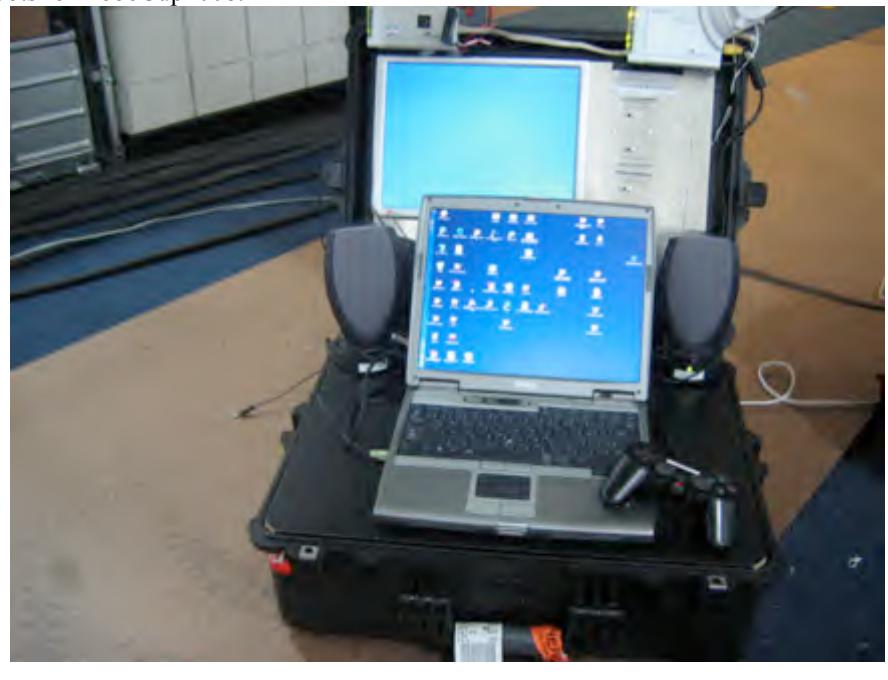
We have participated in several rescue robot competitions and have many experiences of operator station set-up and break-down. In 2007, we packaged everything which we need for the robot operation in one suitcase(Fig.6), and could achieve quick set-up and break-down. We will use this system again at this competition.
However, we prepared one control box per one robot, then it took much time on setup and break-down for all robots. We will develop only one control box for three robots for RoboCup2008.
3. Communications
We will use the wireless LAN. The frequency and the channel are shown in following table.
Communications Frequencies for Rescue Robot League SHINOBI (JAPAN)
| Frequency | Channel/Band | Power (mW) |
|---|---|---|
| 5.0 GHz - 802.11a | 36, 40, 44, 48 (selectable) | |
| 5.0 GHz - 802.11a | 36, 40, 44, 48 (selectable) | |
| 5.0 GHz - 802.11a | 36, 40, 44, 48 (selectable) |
4. Control Method and Human-Robot Interface
Our robots control methods are as follows.
KOHGA3: teleoperation.
HIEI: teleoperation / full autonomy (selectable).
5. Map generation/printing
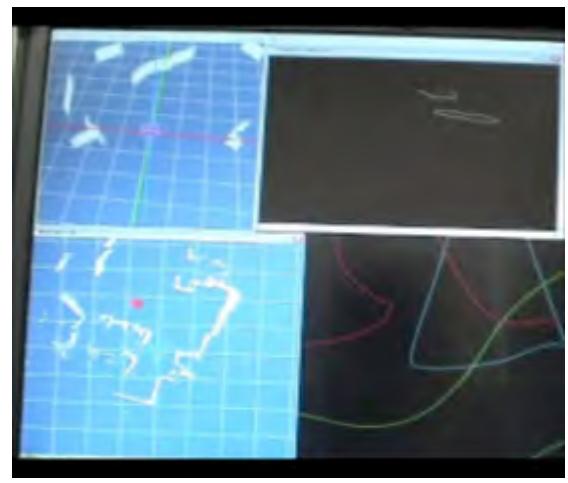
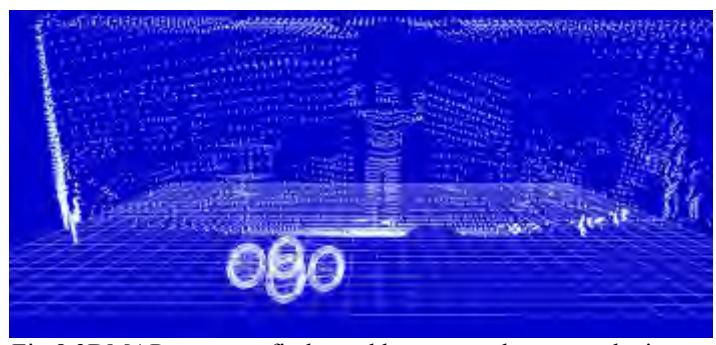
An automatic 2-D map building method by laser range finder (LRF) have implemented on the HIEI (Fig.7;left side). We will extend this 2-D map building method to 3-D one by rotating the LRF for 3-D point scanning. With this method we can also obtain good robot position information. The 3D map by this method (Fig.8) have implemented on the FUMA, which is developed for robocup 2004 and 2005.
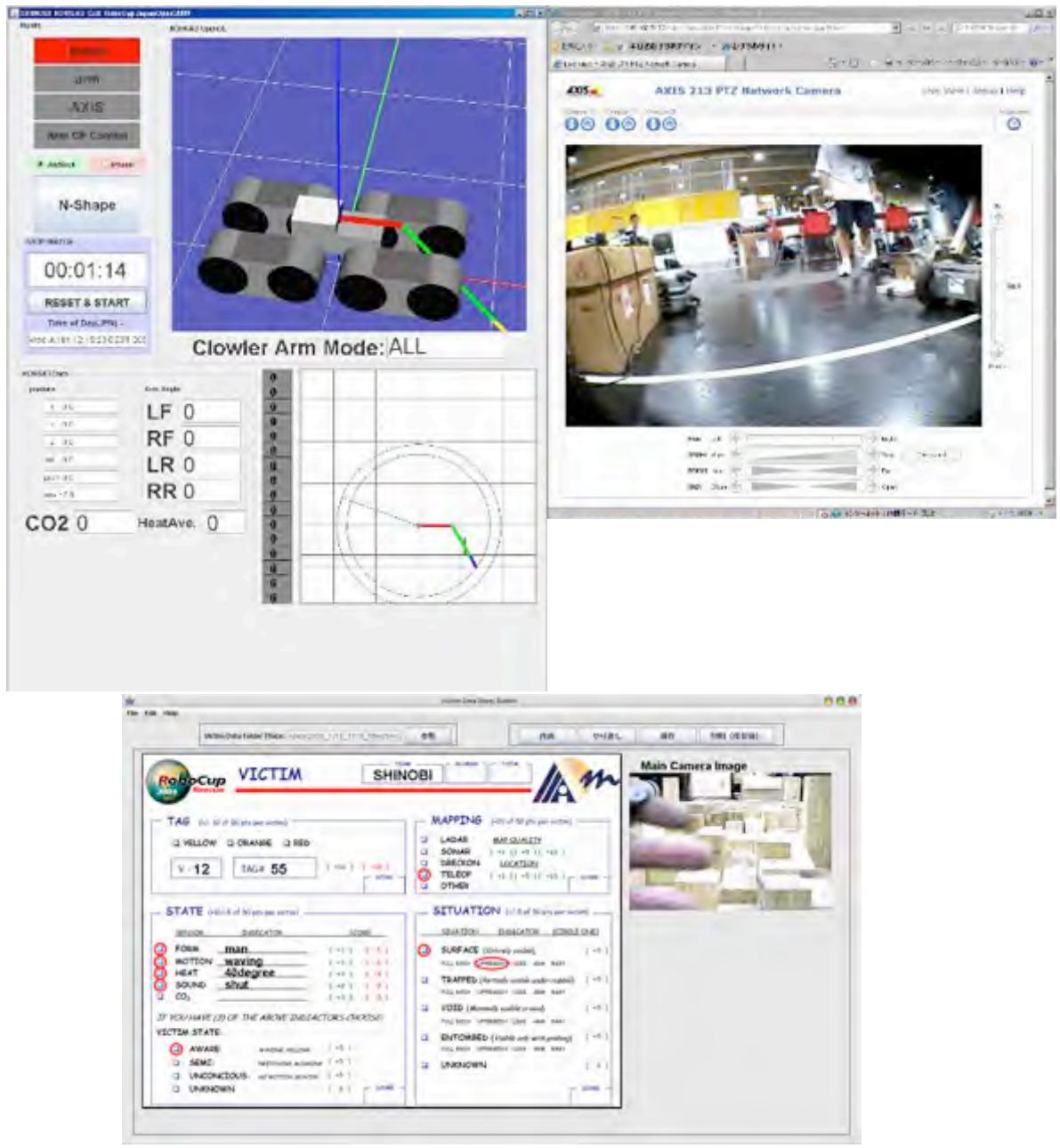
We develop the automatic victim sheet print software for KOHGA2 and KOHGA3(Fig. 9). During the mission, the operator selects the some buttons and fills the text field on the interface software about the information of victims. After the mission, if the operator does only one click on "print" button, all victim data sheets are printed automatically.
6. Sensors for Navigation and Localization
We use following sensors for navigation and localization.
Fish-Eye Camera: for understanding the surroundings of the robot
LRF(URG, HOKUYO): for SLAM (Simultaneous Localization and Mapping)
Encoder: for getting the robot velocity. Inertial Cube3: for getting the robot angle.
7. Sensors for Victim Identification
We use following sensors for victim identification.
CCD camera or web camera: form and move
Thermal camera: heat CO2 gas sensor: breath
Speaker and microphone: sound and consciousness
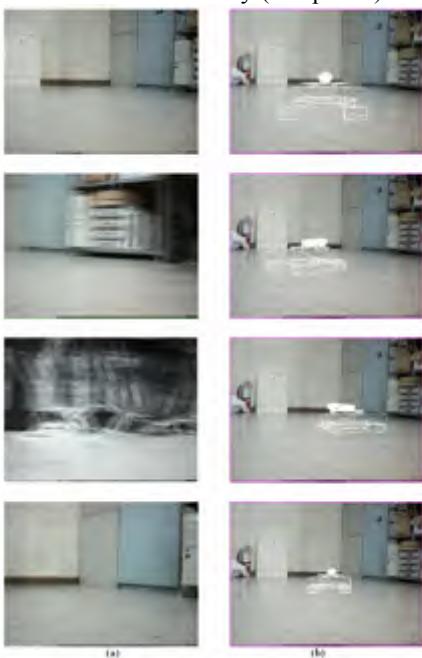
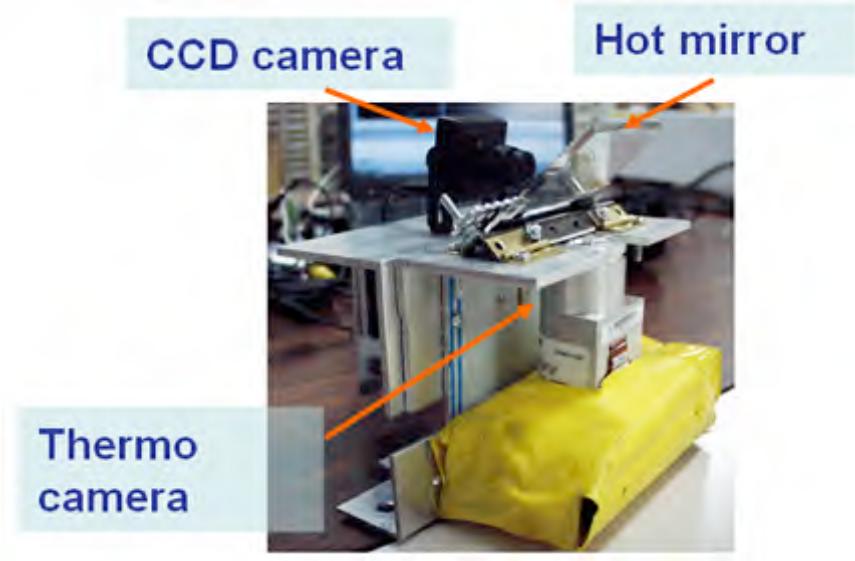
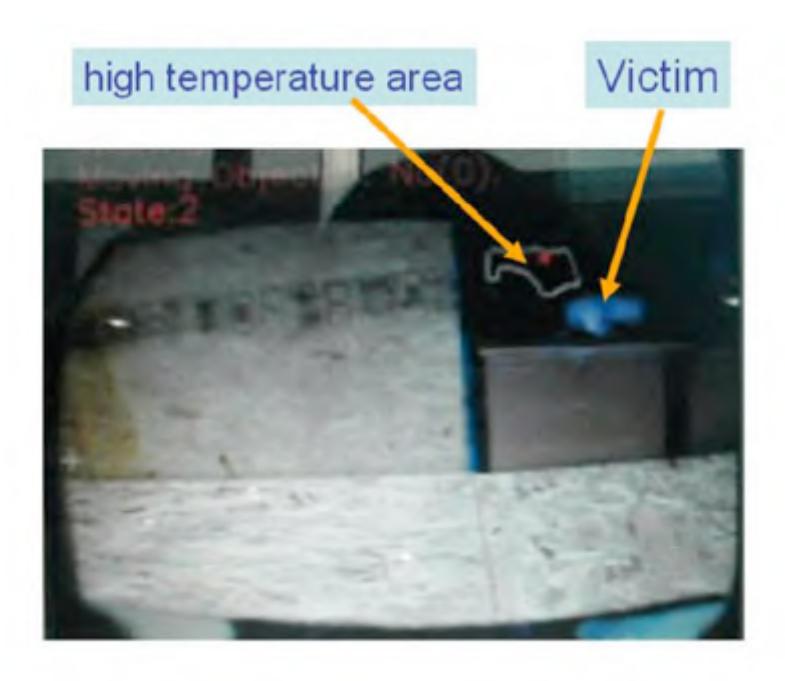
We overlay the thermal camera image to the normal CCD camera image in order to ease to recognize victims for the operator (Fig. 11). The high temperature area displayed as the area enclosed with white line (Fig.12).
8. Robot Locomotion
KOHGA3: tracked with four crawler arm (Fig. 4)
HIEI: tracked with two flipper (Fig. 5)
9. Other Mechanisms
In robocup2006, the body of KOHGA2 was low and the bottom of KOHGA2 hit obstacles. So we changed the connection between body and arms for bottom-up. This improvement made the robot more mobility.
In addition, we will develop camera arm for finding victim who is in a high place in order to get the high score at this convention by this arm.
10. Team Training for Operation (Human Factors)
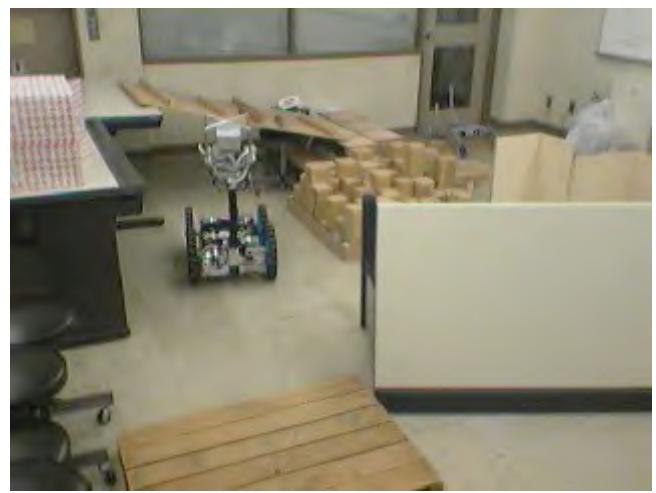
We have employed a commonly game pad as our control interface device, since most people are familiar with such devise. We configure the input commands for the robots as simple as possible so that the operator only needs to input few commands to control the robots. One of the difficulties of remote operation is that it is hard to control a robot in remote site only from the information provided by the cameras, as it does not provide enough details for us and make it difficult to recognize the surroundings of the robot. Our remote control method which uses a wide angle fac-ing-down fish-eye camera and virtually generate bird's eye view images will overcome this problem and also allows the operator to control the robots with ease even without long training time. In addition, we simulate the field of Robocup Rescue competition in our experimental laboratory and train ourselves for the competition (Fig.14).
11. Possibility for Practical Application to Real Disaster Site
For the practical use of our robots we need to improve the ability to control them within tough environments like water, dust, vibration, shock resistance and so on. Our wireless communication system has some weakness in not structured areas. Ad-hoc network system in wireless communication will overcome this problem.
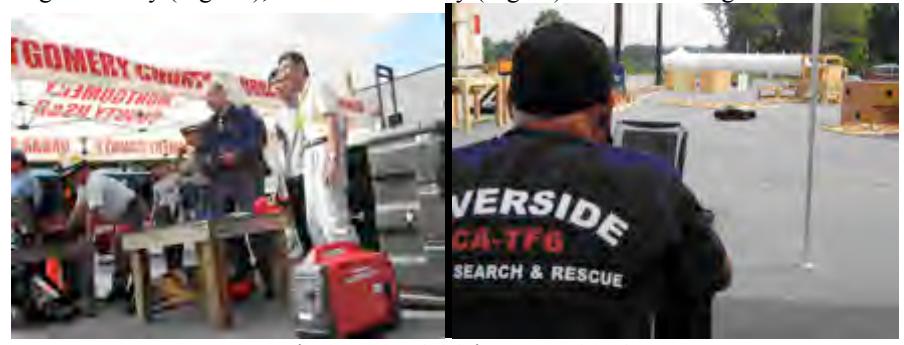
However our systems is very useful for real disaster site without improvements men above. In 2006, we went RREE (Fig. 15). In this exercise, our system presented good mobility and controllability.
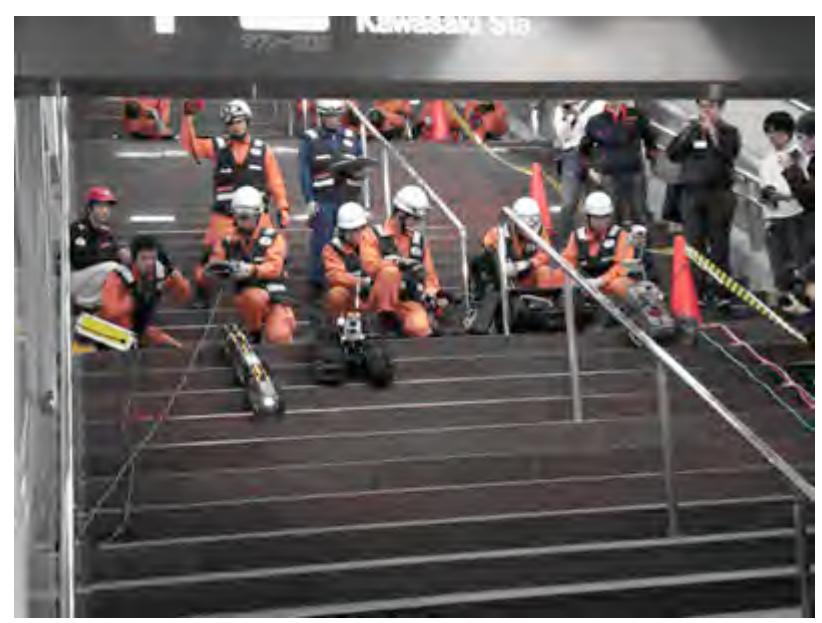
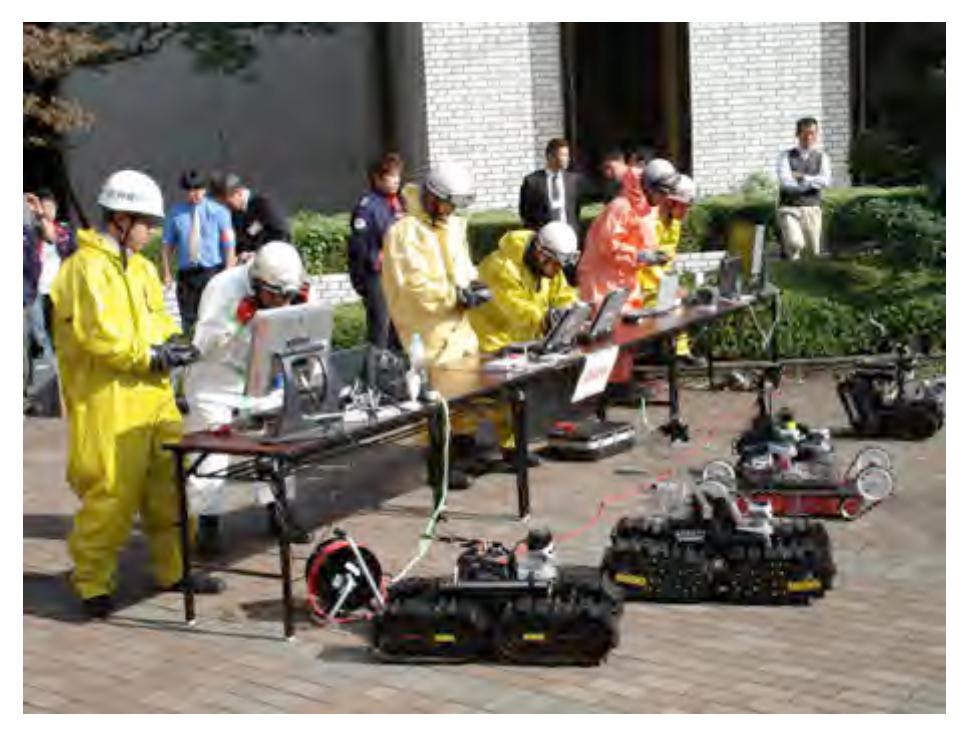
Also in Japan, our system was used by Japanese fire fighters in their training at the underground city (Fig. 16), and our university (Fig.17) in their training.
12. System Cost - (1) KOHGA3
Cost breakdown for KOHGA3 robot.
KOHGA3 System Cost
| Name | Part | Price in JPY | Number | Total price in JPY |
|---|---|---|---|---|
| Robot Base | 6,000,000 | 1 | 6,000,000 | |
| Laser Range Finder | URG-04LX | 150,000 | 1 | 150,000 |
| 3D-motion sensor | Inertial Cube3 | 300,000 | 1 | 300,000 |
| Web camera | Axis 213 | 160,000 | 1 | 160,000 |
| CCD Camera | KPC-S700CB | 33,400 | 2 | 66,800 |
| Fisheye lens | Minilens-fisheye | 6,890 | 2 | 13,780 |
| Micro Controller | TitechSH2 | 15,000 | 6 | 90,000 |
| Motor driver | DC Servo amplifier | 7,500 | 8 | 60,000 |
| Thermal sensor | RAYMID-10-LT | 60,000 | 1 | 60,000 |
| CO2 sensor | TGS4161-A03 | 6,000 | 1 | 6,000 |
| Sum Total | 6,906,580 |
12. System Cost - (2) HIEI
Cost breakdown for HIEI robot.
HIEI System Cost
| Name | Part | Price in JPY | Number | Total price in JPY |
|---|---|---|---|---|
| Robot Base | 3,000,000 | 1 | 3,000,000 | |
| Laser Range Finder | URG-04LX | 150,000 | 2 | 300,000 |
| 3D-motion sensor | Inertial Cube3 | 300,000 | 1 | 300,000 |
| Motor driver | DC Servo amplifier | 1,500 | 6 | 9,000 |
| Micro Controller | TitechSH2 | 15,000 | 3 | 45,000 |
| Web camera | Axis 213 | 160,000 | 1 | 160,000 |
| CMOS camera | NM30 | 130,000 | 1 | 130,000 |
| CCD Camera | KPC-S700CB | 33,400 | 1 | 33,400 |
| Thermal camera | THERMAL EYETM 3600AS | 1,000,000 | 1 | 1,000,000 |
| Note PC | ThinkPad X32 | 180,000 | 1 | 180,000 |
| Sum Total | 5,157,400 |
References
[1] Naoji SHIROMA, Georges KAGOTANI, Maki SUGIMOTO, Masahiko INAMI and Fumitoshi MATSUNO,"A Novel Teleoperation Method for a Mobile Robot Using Real Image Data Records",Proc. 2004 IEEE International. Conference on Robotics and Biomimetics (ROBIO2004), Shenyang, China, August, 2004. [2] Naoji Shiroma, Noritaka Sato, Yu-huan Chiu and Fumitoshi Matsuno, "Study on Effective Camera Images for Mobile Robot Teleoperation", Proc. 13th IEEE International Workshop on Robot and Human Interactive Communication, 1C4, Kurashiki, Sep/2004 [3] Naoji Shiroma, Yu-huan Chiu, Noritaka Sato and Fumitoshi Matsuno, "Cooperative task excecution of search and rescue mission by a multi-robot team", Advanced Robotics, Vol.19, No.13, pp.311-329, 2005