RoboCupRescue 2013 - Robot League Team BART LAB Rescue (THAILAND)
Jackrit Suthakorn, Ph.D., Woratit Onprasert, Sakol Nakdhamabhorn, Rachot Phuengsuk, Yuttana Itsarachaiyot, Choladawan Moonjaita, Syed Saqib Hussain Shah, Peerapat Owatchaipong, Chawaphol Direkwattana, Watcharawit Saensupho, Maria Chatrasingh, Preedipat Sattayasoonthorn, Jitendra Yadav, Nantida Nillahoo, Karat Thanaboonkong, Pitchaya Rayothee, Nonthachai Soratriyanont, ShenTreratanakulchai
Center for Biomedical and Robotics Technology (BART LAB) Faculty of Engineering, Mahidol University 25/25 Phuttamonthon 4 Road, Salaya, Nakhon Pathom 73170 THAILAND
Abstract "BART LAB Rescue Team", the robotics team from Thailand, has been continuously researching and developing rescue robots, and has been joining the Rescue Robot Competitions in Regional Levels since 2006. Currently, BART LAB Rescue consists of eighteen members, and three robots. Among the three robots, two robots are tele-operative robots (TeleOpIV and TeleOpV), and one autonomous robot (AutoBot II). They are highly mobility robots with tracked locomotion system, and are attached with four independently controlled flippers to enhance their mobility. Moreover, inversekinematically controlled manipulators, attached with victim-sensing unit at the end-effecter, are equipped on both TeleOpIV and TeleOpV. The victim sensing unit includes all possible life-signal detections, such as, heat sensors, real-time motion image detector, Carbon Dioxide sensor, and two-way voice communication system. The third robot, AutoBotII, is an autonomous robot equipped with victim identification system based on image processing and heat imaging technology. The AutoBotII is navigating itself based on laserscanner system and its efficient algorithm. For QR code detection, autonomous robot is moving during the mission, therefore the QR code detection must input the data in video type for image processing. The robots mainly uses the ROS operation. The software package for generating map has used G-Mapping package from open slam community. For all, tele-operative and autonomous robots are equipped with SLAM system to generate reasonable 2-D maps to guide the responders after Rescue Robots raid the disaster area. The ultimate goal of BART LAB Rescue Research and Development team is to produce trustable rescue robots to be employed and ready for real disaster situations around the world.
Introduction
'BART LAB Rescue Team' is, the robotics team from Thailand, currently consisting of eighteen members, and three robots. Among the three robots, two robots are tele-operative robots (TeleOpIV and TeleOpV), and one autonomous robot (AutoBot II). BART LAB Rescue has been continuously researching and developing rescue robots, and has been joining the Rescue Robot Competitions in Regional Levels since 2006. In 2008, BART LAB Rescue was one of the 8-finalist among 80 plus teams in the 2008 Thailand Rescue Robot Championship (TRR2008), and was received the Best-In-Class Award for Autonomy. In early of 2009, BART LAB Rescue attended the RoboCup Japan Open 2009 in Rescue League, and received the 2 nd Place from the rest 10 Japanese teams. Moreover, BART LAB Rescue was awarded the 'SICE Award' for Data Collection and Management in Autonomous Robot.
In the end of 2009, BART LAB Rescue was awarded the Winner and Best-In-Class Award for Autonomy in the 2009 Thailand Rescue Robot Championship (TRR2009). TRR2009 is one of the toughest Rescue Robot League in the World since there are more than 100 high-standard local teams to join the competition with 6 international teams from 4 countries (CAsualty: Australia, NuTech-R: Japan, NIIT-Blue: Japan, Jacobs University: Germany, Pasargard: Iran, and Resquake: Iran). In early of 2010, the team attended the RoboCup Japan Open 2010 and was awarded the 1st Place Rescue Robot Award. Then, BART LAB Rescue joined the World RoboCup Rescue 2010 which to be held in Singapore as the official representative team of Thailand, and received the 1st Runner-up Rescue Robot Award.
During 2011-2012, the team was awarded the 1st Place Rescue Robot Award and the 1st Runner-up Rescue Robot Award from RoboCup Japan Open 2011 and 2012 respectively. Moreover, BART LAB Rescue was awarded the Best Autonomy in Rescue Robot League from Thailand Robot Championship 2012.
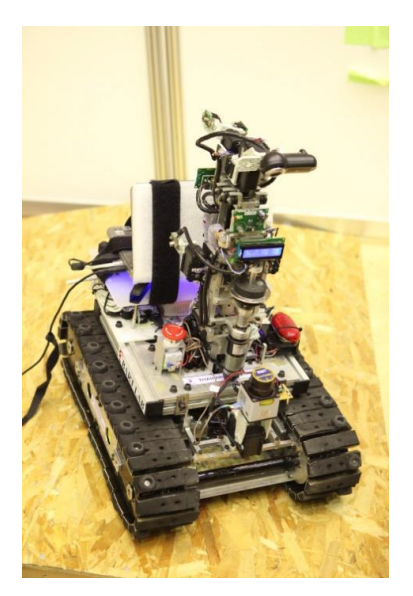
BART LAB Rescue's two tele-operation robots (TeleOpIII and IV) are almost identical in design but they are different in performances with improved driving components in TeleOpIV. Fig. 1. illustrates TeleOpIII. They both are highly mobility robots with tracked locomotion system which makes both robot can mealy be anywhere in orange and red arenas. The robots employ four independently controlled flippers to enhance their mobility (two flippers are in the front end, and the rest two flippers are in the rear end). The tele-operative robots are also equipped with inversekinematically controlled manipulators, and attached the victim-sensing unit at the end-effecter to improve their victim's searching and information retrieving. The victim sensing unit includes all possible life-signal detections, such as, heat sensors, real-time motion image detector, Carbon Dioxide sensor, and two-way voice communication system. The manipulator is multi-degree of freedom system with both rotational and prismatic joints for their compact folding size and high efficient workspace. The third robot is an autonomous robot equipped with victim identification system based on image processing and heat imaging technology. The autonomous robot (AutoBotII) is navigating itself based on laser-scanner system and its efficient algorithm, so the robot could navigate along the yellow arena without hitting the wall. Fig. 2. shows AutoBotII. Both tele-operative and autonomous robots are equipped with SLAM system to generate reasonable 2-D maps to guide the responders after Rescue Robots raid the disaster area.
In conclusion, BART LAB Rescue has a highly mobility set of rescue robots as regularly built by most Thai teams to complete in the previous World RoboCup Rescues. However, BART LAB Rescue has improved a better ability in autonomous robot and a higher quality of real-time generated map from the past. The ultimate goal of BART LAB Rescue Research and Development team is to produce trustable rescue robots to be employed and ready for real disaster situations around the world.
![The TeleOpIII, one of our two tele-operative robots in BART LAB Rescue team. The TeleOpIII employs tracked locomotion system with 4 independent flippers, and equips with an inverse-kinematically controlled manipulator to enhance more ability to search and retrieve better victim information, similar to other robots in [1,2]](/tdps/rescue_robot__2013__BART_LAB/_page_1_Picture_3.jpeg)
Team Members and Their Contributions
Jackrit Suthakorn Team Advisor
Woratit Onprasert Mechanical designer
Sakol Nakdhamabhorn Operator, Programming and communications Rachot Phuengsuk Controller and navigation system development
Yuttana Itsarachaiyot Team manager
Choladawan Moonjaita Inverse kinematic algorithm development
Syed Saqib Hussain Shah Power management Peerapat Owatchaipong Mechanical designer
Chawaphol Direkwattana Mechanical designer for camera manipulator
Watcharawit Saensupho Test field design
Maria Chatrasingh Communication monitoring for autonomous robot
Preedipat Sattayasoonthorn Accessories management JitendraYadav Power management
Nantida Nillahoot Spare parts and accessories management Karat Thanaboonkong Spare parts and accessories management
Pitchaya Rayothee Team stuff management
Nonthachai Soratriyanont Programming and communications
ShenTreratanakulchai Sensing development for autonomous robot
Operator Station Set-up and Break-Down (5 minutes)
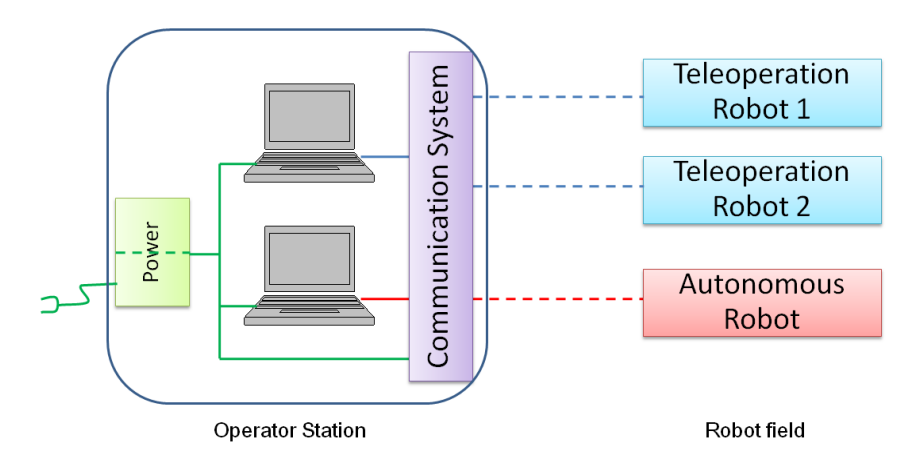
BART LAB Rescue's operator station is a suitcase-size mobile unit. The station system consists of 2 laptop computers, robot controllers (joysticks), backup battery, power connection system, wireless access point system and a large-size monitor system. The system is contained in a wheeled/roughed waterproof suitcase. The operator station is then easy to transport and set-up. The system is to control and communicate to BART LAB Rescue's three robots (TeleOpIII, IV and AutoBotII). A laptop computer is dedicated to two tele-operative robots, and another laptop computer is connected to the autonomous robot. Fig. 3. Illustrates the system of operator station. Therefore, the set-up for the BART LAB Rescue's operator station is almost immediate, and ready to use well maintenance.
Communications
BART LAB Rescue employs five access points connecting via Wireless LAN 802.11A to communicate among the three robots. Each robot (TeleOpIII, IV and AutoBotII) is installed with an access point to communicate to two access points at the operator station with bridging technique. Fig. 4 illustrates a diagram to describe BART LAB Rescue's communication system. Channel 36 is used as the default setting; however, the channel can be modified to any requested channel in the available range. There is no RF or Analog wireless communication used by BART LAB Rescue team.
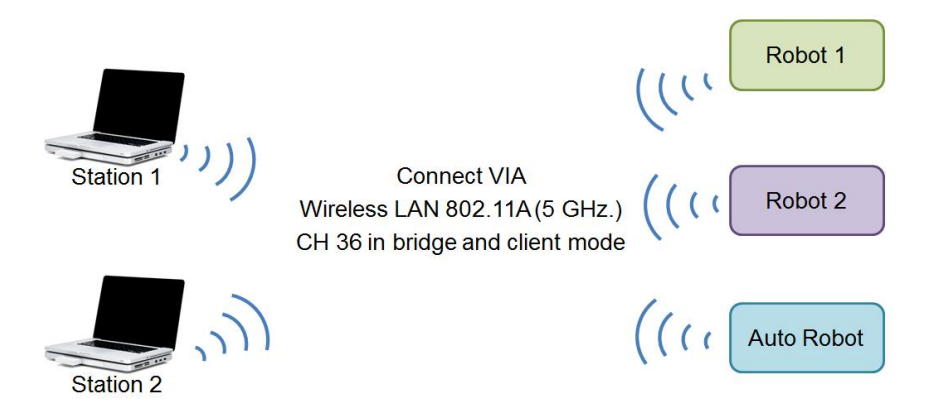
Frequency, Channel/Band and Power Table to describe the communcation system of BART LAB Rescue team.
| Rescue Robot League | ||||
|---|---|---|---|---|
| BART LAB Rescue (Thailand) | ||||
| Frequency | Channel/Band | Power (mW) | ||
| 5.0 GHz - 802.11A | 36 | To Be Determined |
Control Method and Human-Robot Interface
Control method and human-robot interface of BART LAB Rescue can be separated into two parts; 1) control and interface on tele-operative robot, and 2) control and interface on autonomous robot. Details are described below.
Control Method and HRI on Tele-Operative Robot
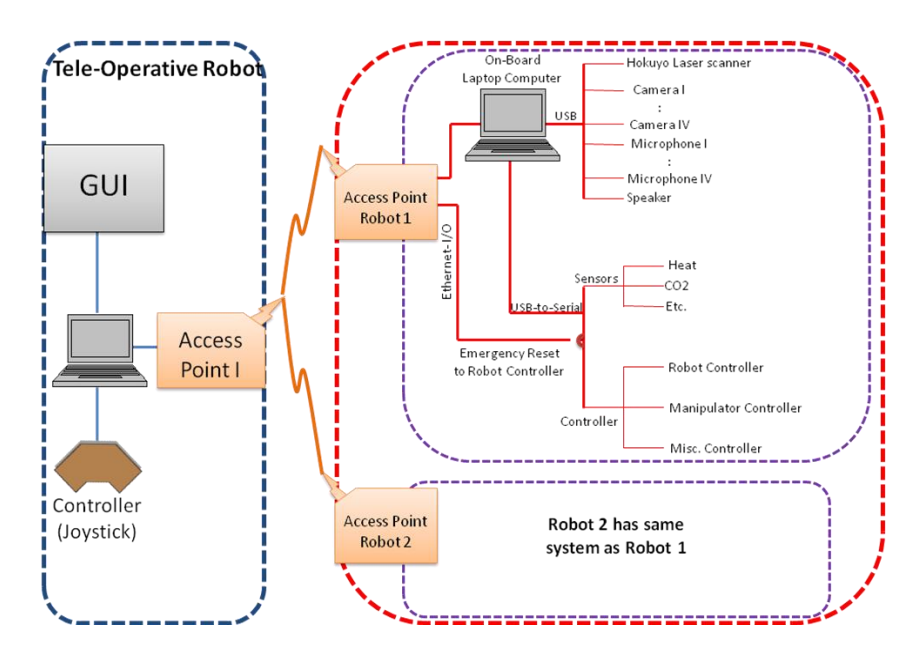
The control system for tele-operative robots is described in Fig. 5. The onboard controlling system communicates to the operator station via Wireless LAN 802.11A access points. On the robot, on-board access point is connected to an onboard laptop computer. Several USB apparatuses, such as, cameras, microphones, speakers and Hokuyo ranging laser-scanner are connected to the laptop. Another USB port is used for USB-to-Serial to communicate with Robot-CPU. The Robot-CPU distributes the controlling command to the platform, manipulator and other controlling subsystems. Under the platform and manipulator subsystems, each individual joint and drive (motor) controller module employs our developed speed/position PID control system. Therefore, feedback control theory is widely used in our robots. An emergency resetting system is prepared to assure and recover the robot controllability when it performs in the remote area, far from the operator station.
The other tele-operative robot has an identical control scheme which allows the flexibility to add more number of robots in the future.
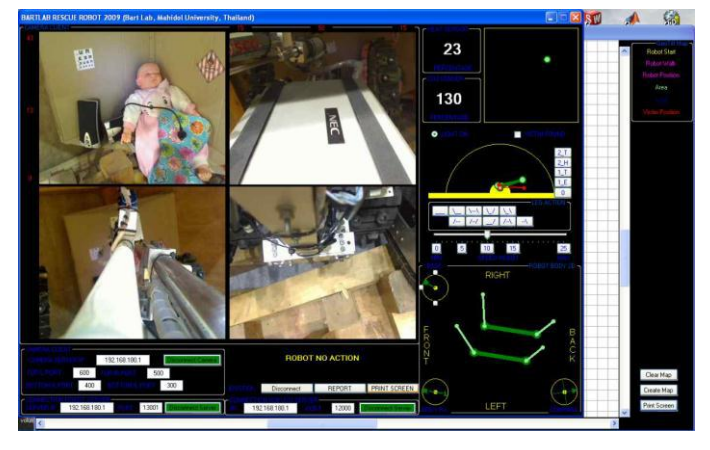
On the operator station, the station's access point is connected to a laptop computer which is connected to a robot's remote controller (joystick), and a display monitor with GUI for HRI. The GUI is illustrated in Fig. 6. The GUI display consists of 4 viewing areas from 4 on-board cameras, sensing data display (heat, CO2, and others), robot heading, communication controller, robot platform's configuration display, pre-set robot configuration controller, and a controller for our inversekinematically controlled manipulator.
Control Method and HRI on Autonomous Robot
The control scheme for Autonomous robot is similar to the tele-operative robot. However, the autonomous robot is required to navigate itself autonomously and also to detect the victim automatically. The map generation, robot navigation and localization will be discussed in section 5 and 6. Also, the victim automatic identification will be discussed in section 7. The autonomous robot is manually launched at the start position, however, the robot is reporting directly to the laptop computer at the operator station which is dedicated to the autonomous robot (see section 5 for the GUI).
Map generation/printing
BART LAB robot mainly uses the ROS operation. The software package for generating map has used G-Mapping package from open slam community. Firstly, the map is defined into occupancy grid, which have the high resolution, about 0.05 m per pixel. The input is divided into two parts: 1) the laser range finder is used to measure the distance around the robot in 180 degrees and 2) the odometry of the robot is used the wheel encoder for approximation the distance of the robot moving in the axial direction. Inertia measurement unit (IMU) is used to measure the robot orientation.
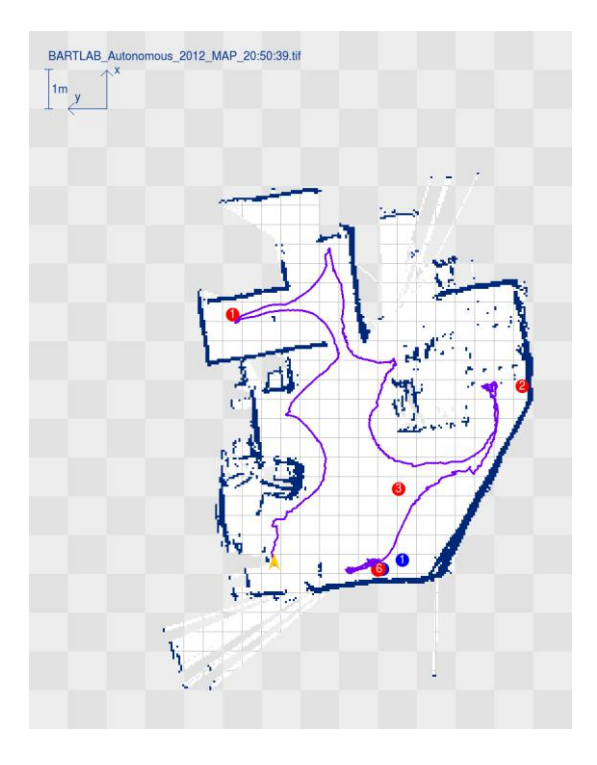
The figure 7 has shown the map generated by the G-Mapping algorithm. Maps has the resolution about 0.05 m per pixel and the red mask has shown the victim form the heat detection and the blue mask has shown the victim from QR code detection.
Autonomous running with obstacle avoidance technique using Fuzzy logic algorithm
Bart Lab autonomous robot uses the fuzzy logic algorithm for running the robot and avoiding the obstacle. Fuzzy logic system used input range information from the laser range finder. The laser range scanner divided the range into ten directions following the pan scan direction. The reasons for choosing ten directions from all direction are reduce amount of information and calculation time in the Fuzzy logic system. The input is filtered for reducing the errors before turn into the membership function into Fuzzy sets. The membership value is defined by range of the distance from the laser range finder device. The membership function value is in the range zero to one and uses as the fuzzy input in the Fuzzy rule based. For the fuzzy rule based designing, the obstacle avoidance using fuzzy logic uses basic principle that if robot detects the distance of obstacle and the distance is decrease during robot moving, then robot reduce the speed in each side of driving system. The fuzzy set is divided into three set low, medium and far. These fuzzy sets are responded for obstacle and choose the minimum distance for obstacle avoidance. The Fuzzy outputs from the If-Then Rule based are the orientation of robot and velocity of each driving motor. These output is computed all the time depend on the environment and is sent to driving unit of robot for responding the environment immediately.
Sensors for Victim Identification
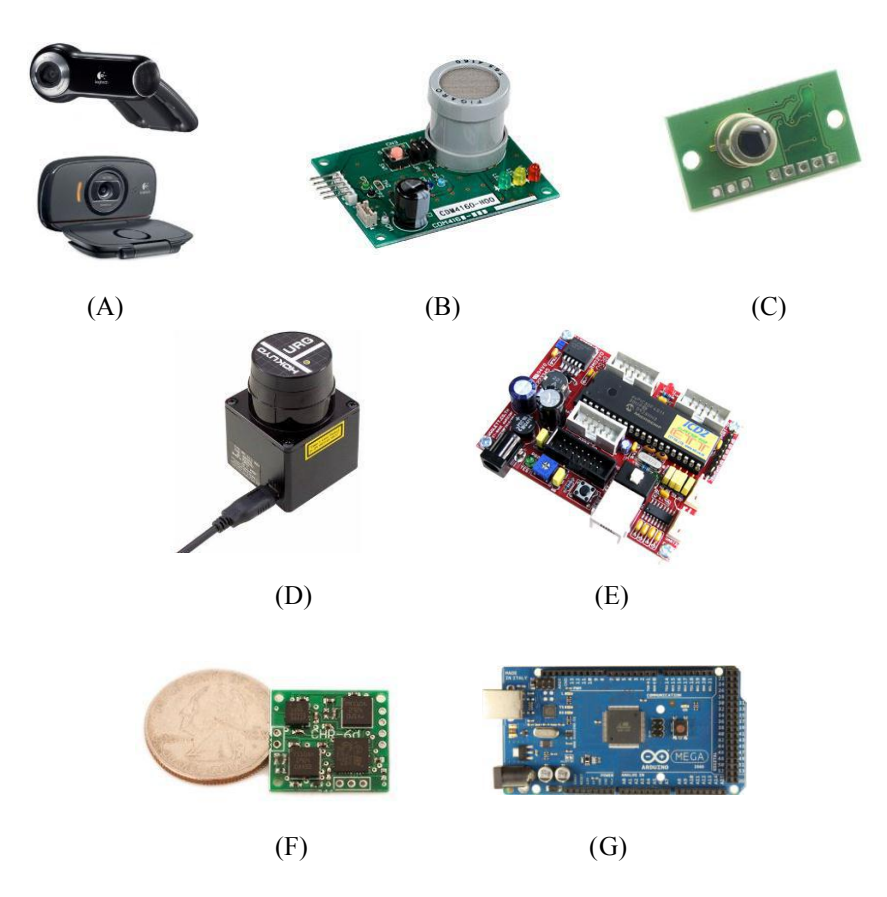
BART LAB Rescue robots are equipped with victim sensing unit which contains all necessary sensors to detect the victim life-signals. The sensors are listed below:
- Cameras (for Victim Form and Motion Detection)
- Heat sensors (for Victim Temperature)
- Microphone/Speaker (for 2-way voice communication)
- CO₂ sensors
- QR code
- Motion
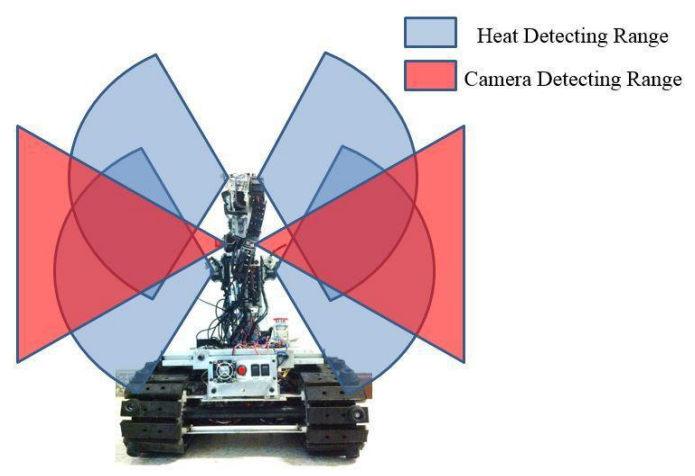
The autonomous robot approaching victim are divided into 2 types: 1) the image from camera is used to monitor and analyze the data from victim such as motion detection, QR code detection, and reading the text in image, and 2) the heat sensor detect the heat of victim inside the arena. The heat sensor is mounted on the servo motor in order to sweep for searching the heat victim. The figure 9 has shown the searching area of the autonomous robot by the red zone is imaging detection area and the blue zone is heat detection area.
The autonomous robot is mainly divided into 2 pasts. The first part is the plat form of the robot involving in the driving system. The second part is the robot manipulator and sensors. The manipulator is used to attach the sensors such as camera, heat sensor, carbon dioxide sensor and the laser range finder. The special characteristics are the rotation and extension of the manipulator. The manipulator has co-operated with sensors as shown in the figure 10.
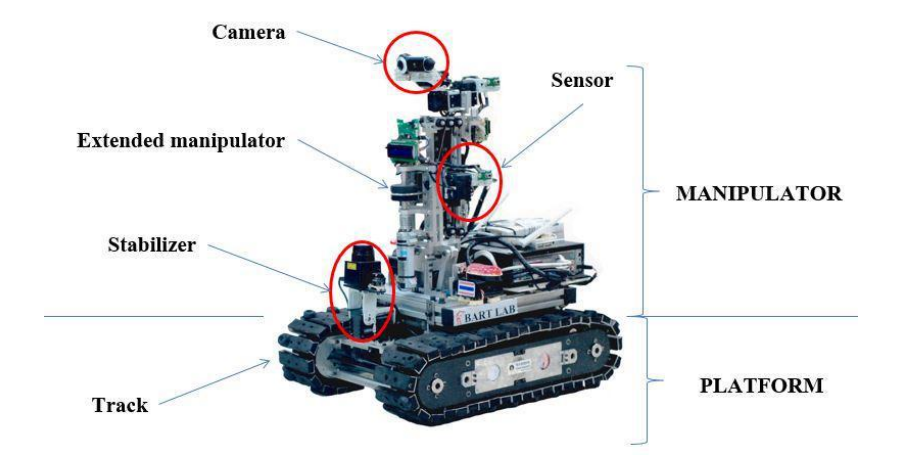
For QR code detection, autonomous robot is moving during the mission, therefore the QR code detection must input the data in video type for image processing. The QR code detection flow chart as shown in figure 11.

The image processing has processed for QR code detection in the different zone of arena which is divided into many steps. First is to import the video and sampling into the image for processing. Second, the image is applied the pre-image processing such as noise reduction and exposure calibration. The next step is searching for QR Code detection, searching for mainly three points in the QR code for reading alignment. Final step, the QR code is interpreted into Data information following QR code format.
Robot Locomotion
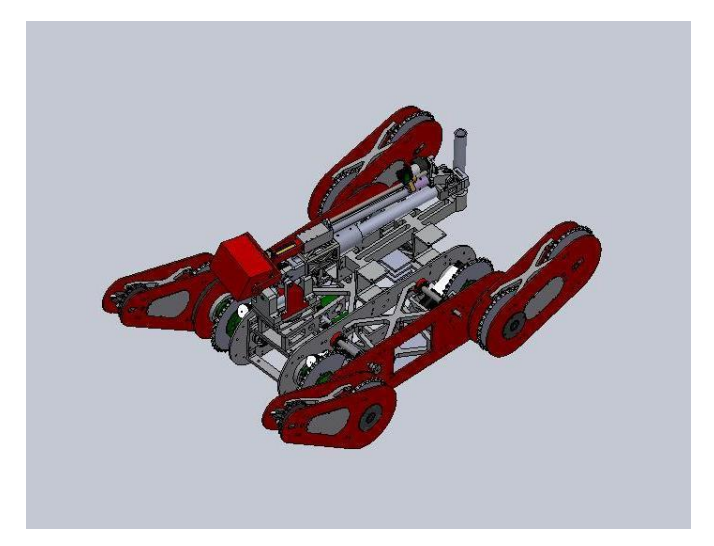
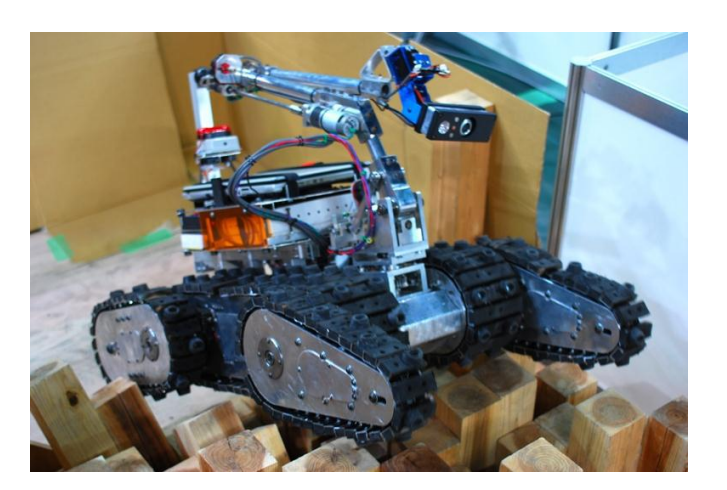
BART LAB Rescue robots have the tracked locomotion systems. The Tele-OpIII and IV are similar in the design and locomotion. Moreover, the tele-operative robots are equipped with 4 independently controlled flippers to enhance their mobility. The locomotion is the tank-liked system. Once the left and right tracks are moving in the same direction at the same speed, the robot will move forward or backward. Once the left and right tracks are moving at the different speeds, the robot will make a turn. The maximum speed of the tele-operative robot is almost 0.5 m/sec. The robot can robot about itself at the maximum angular velocity, 1.8 rad/sec. To maintain the stability during moving up/down the ramp and stairway, the robot has to move at a proper speed. Fig. 12 and 13 compare the CAD and Real Image of the robot.
Other Mechanisms
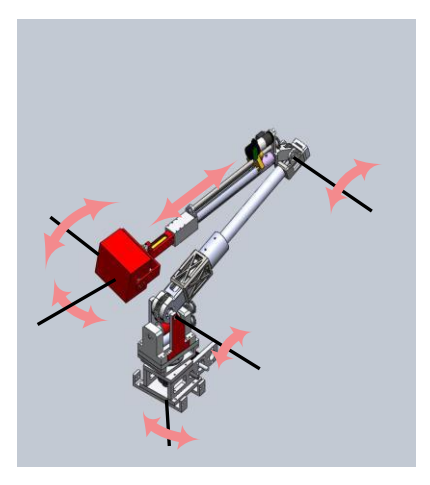
The tele-operative robots are installed with the 6 degree-of-freedom manipulator. The manipulator is designed to used on a highly vibrated with strong shock action during the movement of such rough-terrain robot. The manipulator is relatively light-weight and strong by its structure. The folding size is very compact while the workspace is optimized by using both rotational and prismatic joints. The victim sensing unit is attached at the end-effecter which improve the ability to search and identify the victim conditions. Fig. 14 shows the manipulation's degree of freedom.
Team Training for Operation (Human Factors)
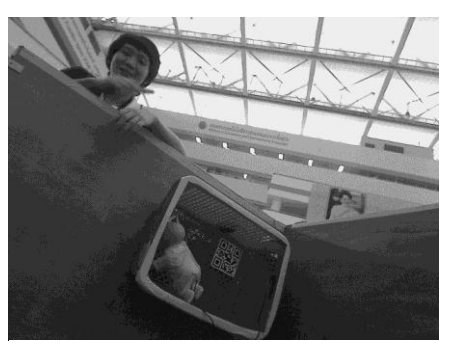
A year-round set up of rescue robot arena is arranged for practicing and training at the Mahidol Unversity, Salaya, Thailand. The arena is built and set up follow the NIST suggestions. The arena consists of all zone; red, orange, yellow and blue arena. Therefore, BART LAB Rescue is able to practice and conduct experiments frequently. QR code is setting in the arena as shown in the figure 15.
Possibility for Practical Application to Real Disaster Site
Our ultimate goal is to research and development the trustable rescue robot to be used in the real disaster site around the world. We strongly believe that we are ready to join any rescue task in the real world.
System Cost
The following table shows the approximate cost of one robot.
Cost Per One Tele-Operation Robot
| Item | Qty | Unit price (USD) | Price (USD) |
|---|---|---|---|
| Laser-Scanner | 1 | 1,500 | 1,500 |
| Laptop | 2 | 800 | 1,600 |
| Camera | 4 | 100 | 400 |
| Sensor (system) | 1 | - | 500 |
| DC Motors (Locomotion system) | 6 | 1,200 | 7,200 |
| DC Motors (Manipulator system) | 7 | 800 | 5,600 |
| Electrical Components | - | - | 1,000 |
| Mechanical Parts | - | - | 1,000 |
| Part Machining/ Misc | - | - | 2,500 |
| Total | 21,300 |
Lessons Learned
Team works and Real World Applications.
References
[1] S. Schwertfeger, J. Poppinga, K. Pathak, H. Bülow, N. Vaskevicius, and A. Birk, "Jacobs University," RoboCup Rescue 2009, TDP, Graz, Austria, June 2009. [2] T. Nakaya, "NuTech-R," RoboCup Rescue 2009, TDP, Graz, Austria, June 2009 [3] R. Sheh, A. Milstein, C. Sammut, B. Hengst, G. Dissanayake, and J.V. Miro, "Team Casualty," RoboCup Rescue 2009, TDP, Graz, Austria, June 2009. [4] Copyright 2007-2010 (c) Jeff Brown All Rights Reserved