RoboCupRescue 2015 - Robot League Team MRL (Iran)
F. Najafi, M. Dadvar, A. Hosseini, S. Habibian, H. Haeri, M. Arvan, M. H. Salehzadeh, A. Haji Mohammad Hosseini
Mechatronics Research Laboratory (MRL) Azad University of Qazvin Qazvin, IRAN
Abstract This paper introduces a new package of robotic systems for rescue operations. Particularly, we have designed and implemented a new advanced autonomous robot and a tele-operated robotic system with dexterous manipulator for different rescue missions. These robots will operate as a practical system to assist rescue personnel in real disaster situations such as earthquakes and explosions. The main capabilities of the system software are simultaneous localization and mapping, navigation strategies, collision avoidance algorithms, sensor fusions, victim detection and exploration algorithms. Moreover, the robotic systems enjoy a set of sophisticated mechanical and electronic systems.
Introduction
Many earthquakes take place every year around the world. One of the most important factor in rescue operations is to find and save victims in time. Besides, a rescue scenario is usually unstructured and unstable environments, requiring the use of a combination of complex mechanical designs and control strategies both in software and hardware levels. So implementing high technologies such as robotics could be helpful for search and rescue missions.
In this paper, the MRL rescue robot team and its robots are explained. The MRL Rescue Robot team is planning not only to take part in Robocup competitions, but also to design and present a practical robotic solution for real disasters such as earthquakes which are very common in our home country, Iran.
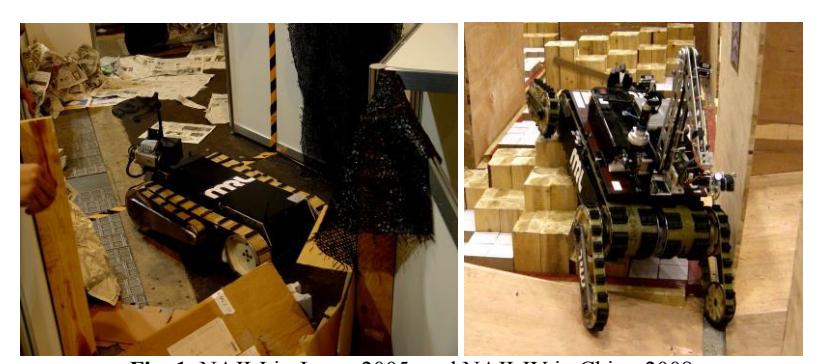
Obviously, based on the environmental situation, special robots with proper abilities are required. In other words, there could be no unique robotic solution for a rescue mission in every disaster situation. Accordingly, we have designed different robots with different maneuverability. For example NAJI-I and NAJI-IV are two types of robots designed by MRL Rescue robot team, with a high power and flexible mechanism, in order to overcome hard obstacles, are also capable of supporting a powerful manipulator for carrying objects. Fig.1 illustrates NAJI-I in Japan-2005 and NAJI-IV in China-2008.
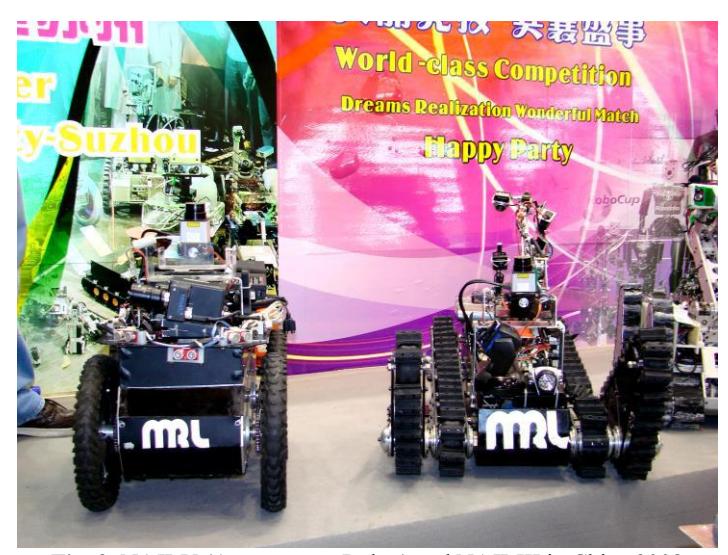
NAJI-III is a modified version of NAJI-I which is more powerful and flexible while it is lighter and smaller. In 2008, we designed a new Autonomous robot NAJI-V for the competitions. Fig.2 illustrates the NAJI-V and NAJI-III in China2008. We achieved 2 nd place in China 2008 using this two robots.
There are so many rough and hard terrains in a disaster situation, therefore, the rescue robot should be fast enough and low weigh to pass and explore environment quickly while remain stable. So we developed a new design with 4 arms named NAJI-VI which is equipped to roller cylinders in its bottom.
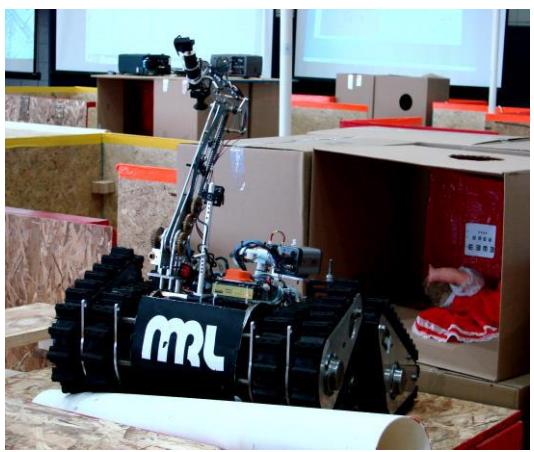
NAJI-VI with the new stylish is now more stable and efficient than previous ones, plus, using a new Mechanical design in NAJI-VI makes this robot more powerful and effective in Step-Fieled zones. In other word, NAJI-VI is a combination of NAJI-I and NAJI-III. By this new design, the capability of NAJI-I in Climbing and the excellences of NAJI-III in Step-Field passing are combined. Figs 3 illustrate NAJI-VI in US 2007.
NAJI-I, II and NAJI-III are good examples of such robots while NAJI-VI with a novel mechanical design is faster, flexible and more stable.
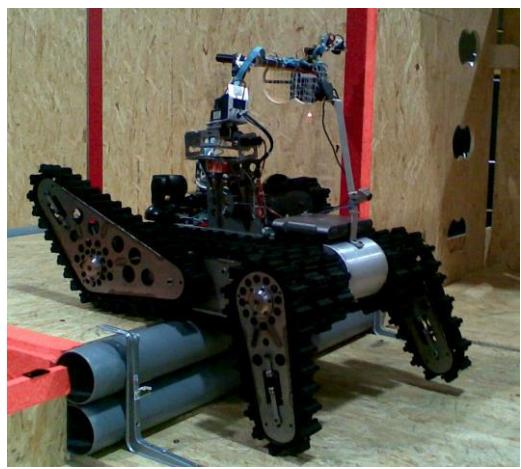
One of the factors which help the NAJI-VI to have a better performance is that NAJI-VI's caterpillar covers whole body and makes it capable of crossing obstacles such as step fields easily. Fig, 4 illustrates NAJI-VI in Austria 2009.
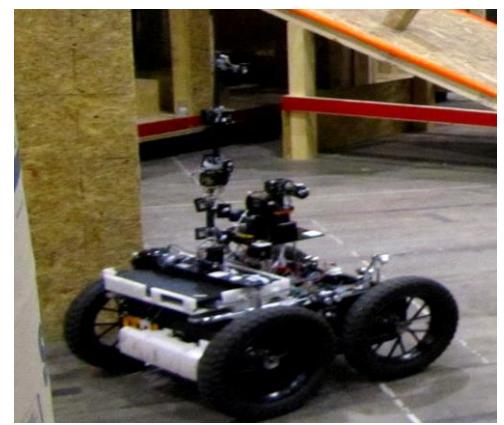
For Robocup 2010 competitions two new robots have been designed; NAJI-VII a teleoperated robot and Viana an autonomous robot. Viana, facilitated by most required sensors, is an autonomous mobile robot to carry out different research programs and is also suitable for the radio off zone arena. Due to improvements in autonomous field the mechanical platform of autonomous robot is improved as well. Therefore, Viana uses a four wheeled differential moving system so that it can cross easily the sloped floor arenas.
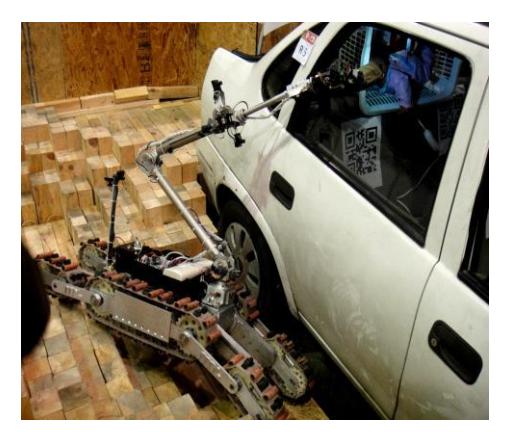
Scorpion consists of 4 flippers attached to the main body. Each of these flippers has two links as shown in Fig-6(Scorpion in Mexico 2012). Second part of each flipper has a self-relative rotation to the first part of the flipper with a series of gears. This causes the robot to have a capability of driving both parts of the flipper with one motor and gearbox. This property helps robot to have more flexibility in rough terrain surfaces. Another marked property of this robot is using light-weighted materials. For example, fiber carbon material, titanium and aluminum are used for the main body and the other parts. Power train system contains two Maxon dc motors coupled with worm gearboxes which speed up the robot up to 0.5m/s. Team MRL has managed to achieve 1 st place in Mexico 2012 Robocup competition.
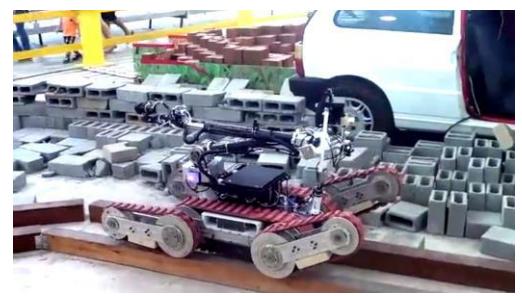
Ario-I is an unmanned ground vehicle (UGV) designed for a wide range of rescue missions. It easily climbs stairs, rolls over rubble and navigates narrow passages. Its timing pulleys equipped with an integrated suspension system isolates vehicle from road noises and vibrations. Power train system consists of two bevel gearboxes that are directly coupled to driver shafts. Ario moves by tract belt system designed and fabricated specially to deliver a high driving force to the UGV.
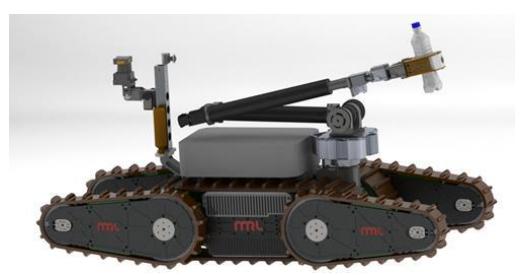
A new version of tele-operative robot, Ario-II, has been designed and fabricated. The main purpose of this improved design, is to achieve reliable mechanical platform, efficient power transmission and sophisticated control system.
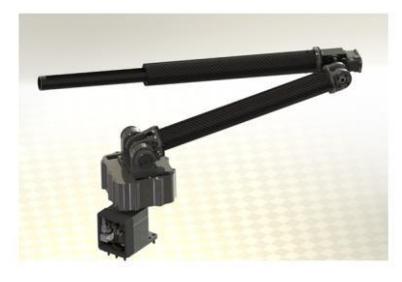
Most of the rescue robots are required to perform tasks in real disaster sites, which demand accurate, light weight and soft-controlled manipulators. Manipulating objects and finding the victim's location are the most critical tasks in rescue missions. In addition, the manipulator should enjoy light weight and rigid structure with sufficient degrees of freedom (DOF).
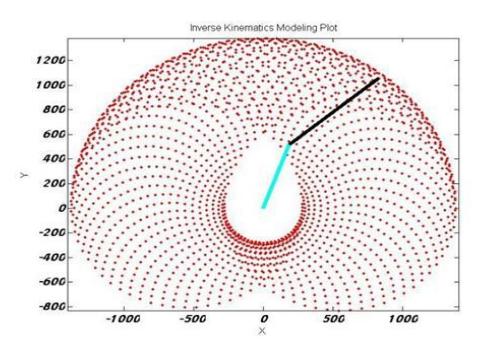
This manipulator has 6 DOFs which is able to reach 140 cm height. In this manipulator, three out of the six motors are placed before the first link. Power transmissions utilize timing belts, ball screws and sophisticated ball bearing arrangements. These power trains provide an accurate and precise motion for the manipulator end-effecter. Main links rotate with 15 rpm without considering destructions. End effecter of this serial manipulator is attached to a 3 DOFs wrist which provides the manipulator with dexterity to search in tight places. To increase the reachable workspace of the manipulator, the wrist is mounted on a prismatic joint with 24cm of stroke.
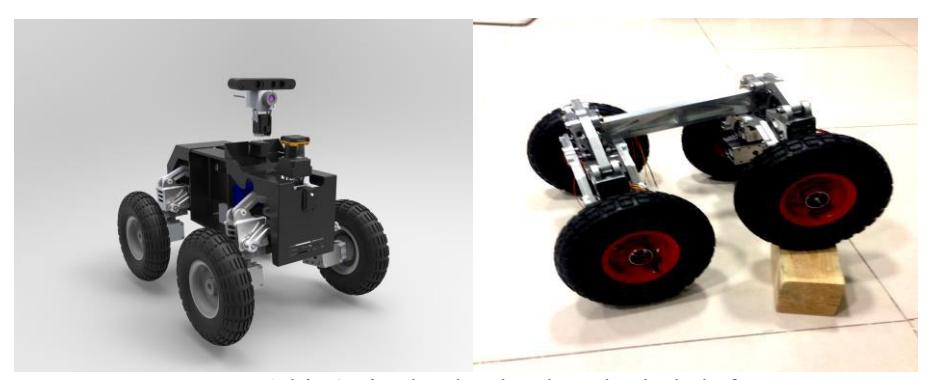
Adrina is designed and implemented in order to move in rugged trains. In comparison with Viana, Adrina uses double wishbone suspension and steering for each wheel independently. Suspension system increases the robot's stability as it enters in an uneven train and prevents the robot from being overturned. Independent steering for each wheel in Adrina's design reduces sliding on inclined surfaces.
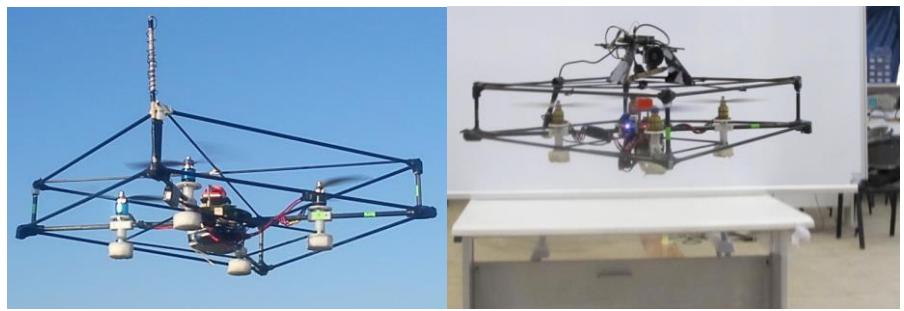
Also, In order to improve the performance of USAR system, Unmanned Aerial Vehicles are integrated with UGVs. The QUADVIN-Flyer-I is shown in Fig. 11. This robot is suitable for flying over impassable arenas and gathering information about environment. This robot is equipped via IMU, laser scanner, un-board real-time PC, camera and sonar sensors, being capable of flying autonomously or manually. Collision avoidance, transmitting live video stream and SLAM information to UGVs in case of autonomous mission or to a remote station (in case of tele-operated missions) are other abilities of the implemented robot.
1. Team Members and Their Contributions
F. Najafi Team Leader J. Chegini Advisor M. Dadvar Team Organizer, Electronics Design M. H. Salehzadeh Embedded Systems Programming A. Abedini Electronics A. Hosseini Autonomous Mobile Robot Software Development M. Arvan Navigation & Motion Planning E. Najafi Image Processing A. Haji Mohamad Hosseini Mechanical Components Fabrication
S. Habibian Manipulator Mechanical Design H. Haeri Autonomous Robot Mechanical Design B. Peykari Tele-Operated Robot Mechanical Design P. Mansournia Unmanned Aerial Vehicle (UAV) M. R. Hashemian Unmanned Aerial Vehicle (UAV)
Azad University of Qazvin Sponsor
2. Operator Station Set-up and Break-Down (10 minutes)
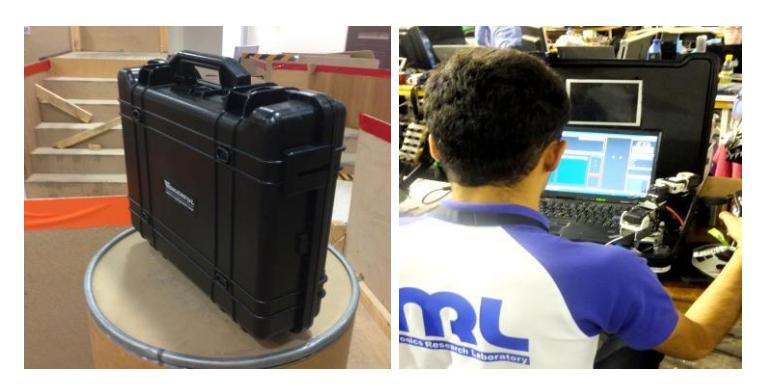
In the rescue operation, it is desirable to set-up and break down the robot operation system in less than 10 minutes. A Mobile Control Pack (MCP) including notebook, joystick, access point, antenna, I/O extension board and a case with appropriate connectors is designed, so that the operator can setup and drive in a user friendly environment. Fig.12 illustrates the Control Pack and GUI of the robot.
3. Communications
The robots have been equipped with Engenius© 802.11a/b/g DUAL BAND Access Point/Bridge. Choosing IEEE 802.11a 5 GHz standard has allowed achieving the maximum efficiency without having the difficulties of 802.11b and 802.11g. 500MW power ensures robust signal to overcome long distances. Controlling tele-operated Robot, video and sound streaming, system diagnostics, sensors feedback, visualizing procedures like localization and mapping in a remote station are the most common usages of this type of communication.
Communications
| Rescue Robot League | ||
|---|---|---|
| MRL (Iran) | ||
| Frequency | Channel/Band | Power (mW) |
| 5.8 GHz – 802.11a/b/g | Multiple Channel | 500 |
| 5.8 GHz – 802.11a/b/g | Options | 500 |
| 5.8 GHz – 802.11a/b/g | 600 |
4. Control Method and Human-Robot Interface
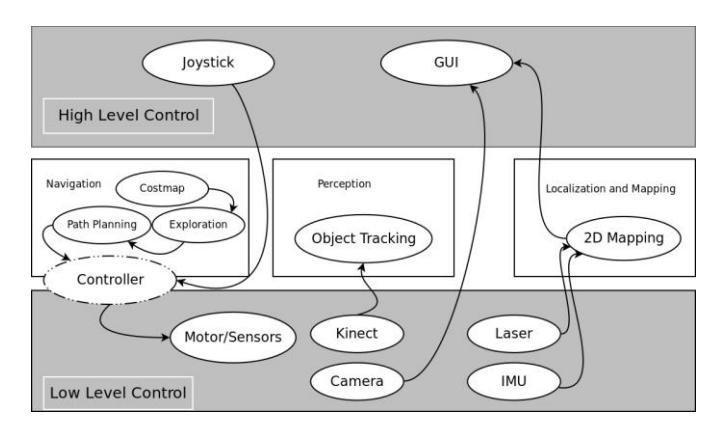
Remote Station, have been equipped with two laptops, running human supervision and tele-operation software, which are integrated with ROS [1] as the middle ware. Also in order to provide a dynamic and easy to use graphical user interface, Qt GUI libraries and RVIZ plug-ins are employed.
Human supervision software has been designed for full autonomy mode and mostly used for chores like, diagnostics, notifying operator from possible victims and sending positive victim confirmation to the robot.
Tele-operation GUI, displays information such as real time video streaming, sensors measurements (such as CO2, Temperature and Robot's Joint States), 2D map visualization and diagnostics. Tele-operated robot could be controlled using keyboard and various joysticks, using an abstract tele-operation ROS node, which can be easily modified according to the type of joystick.
5. Map generation/printing
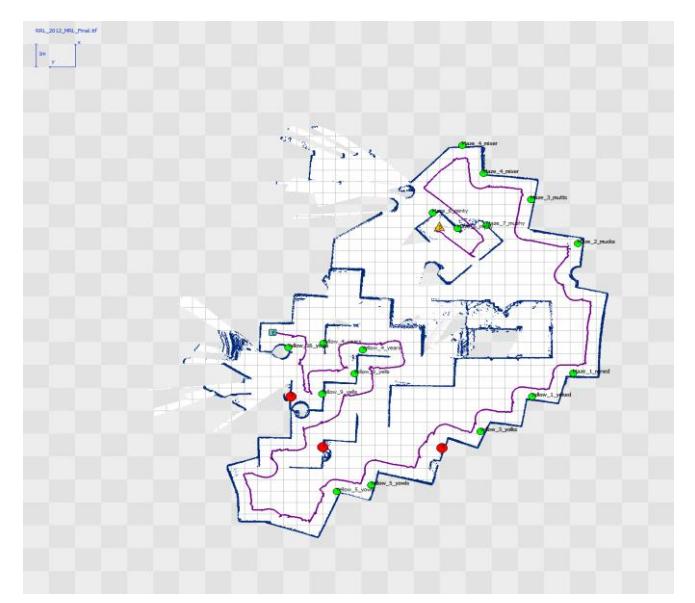
Generating an accurate map depends on precise localization and smooth navigation. In order to achieve this purpose, Occupancy Grid based 2D mapping is used [2], which makes a map with smaller piece of environment measurement. For updating the map, a robust scan matching approach has been used [3]. Also the changes in the attitude of the laser scanner and robot, caused by the slope gradient, took in to account, using an Inertial Measurement Unit. As the matter of the fact, that in a cluttered environment, there are lots of impassable terrains, which could not be perceived by a horizontally placed 2D laser scanner, a RGB-D camera is mounted on a Pan Tilt unit to provide a 3D representation of the terrains.
6. Sensors for Navigation and Localization
Shaft Encoder: The robot's base platform is equipped with two Incremental Optical Rotary Shaft Encoders, which makes wheels odometry calculation, possible. According to slope gradient and mostly hash terrains, localization according to odometry measurement could not be a satisfying solution and using additional sensors measurement is unavoidable.
RGB-D Camera: Autonomous Robot is equipped with an "Asus Xtion Pro Live" RGB-D Camera, mounted on a Pan Tilt unit, which is provides depth images in addition of RGB images. One of the major usages of this sensor is to detect and avoid impassable terrains and obstacles, by using Point Clouds acquired from camera. Detected obstacles will be added to cost-map, and will be used in further processing of robot's planner [4].
Laser Scanner: 2D map of the environment will be generated using a Hokuyo UTM30-LX LIDAR mounted on a stabilizer. Accordingly, on an inclined surface, it always will be stay parallel to the ground.
Inertial Measurement Unit: The changes in the attitude of the base platform, will be measured using a 6DoF inertial sensor, "Xsens MTI-100".
7. Sensors for Victim Identification
Infrared temperature sensor: One of the most important vital signs, for analyzing whether the victim is still alive or not, is temperature of the victim's body. Accordingly "TPA 81" has mounted on the end effector of manipulator of the tele-operation robot.
CO2 sensor: In order to find out, whether the victim is breathing or not, CO2 of founded victim will be measured.
Thermal Camera: Problem of autonomously detecting and position estimating of the victims have been solved by equipping autonomous robot with a Thermal Image Optris PI230, which is capable of synchronous capturing of visual and thermal images.
Analog Cameras: Two analog camera attached on the manipulator of the teleoperated robot, will be assist operator to detect victims.
8. Robot Locomotion
All Tele-Operated robots are equipped to caterpillar locomotion system and autonomous robots have wheeled based locomotion system.
9. Other Mechanisms
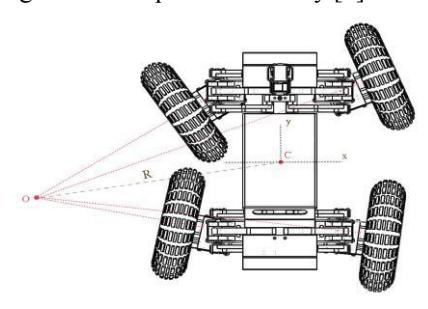
Adrina's movement is based on 4-wheel drive and steering. This mechanism helps robot to move along non-linear paths accurately [5].
10. Team Training for Operation (Human Factors)
The whole system in terms of mechanical, electronics, software and user interface is designed in a way that a rescue operator can work and interact with the system intuitively.
11. Possibility for Practical Application to Real Disaster Site
MRL's tele-operated and autonomous robots are designed and implemented for practical application and they have been tested repetitively at real disaster sites. According to the results of the tests the performance of the tele-operated robots are more reliable in comparison with autonomous robots. They need more develops especially in mechanical platform, autonomous victim detection, mapping and exploration algorithms and are under progress.
12. Lessons Learned
The urban search and rescue (USAR) robot requires capabilities in mobility, sensory perception, planning, mapping, and practical operator interfaces, therefore, the robots should have high power and flexible mechanism to move over fairly large obstacles, and it should be intelligent enough in control, map generation, exploration, localization and victim detection. In the case of autonomous search and rescue tasks, In addition of mentioned abilities, the victim detection, obstacle avoidance and exploration in unknown environments are the major issues.
References
- M. Quigley, K. Conley, B. Gerkey, J. Faust, T. B. Foote, J. Leibs, R. Wheeler, and A. Y. Ng. ROS: an open-source Robot Operating System, in International Conference on Robotics and Automation, ser. Open-Source Software workshop, (2009).
- Eitan Marder-Eppstein, Eric Berger, Tully Foote, Brian Gerkey, Kurt Konolige. The Office Marathon: Robust Navigation in an Indoor Office Environment. In International Conference on Robotics and Automation (2010).
- Kohlbrecher, J.Meyer, O. von Stryk, and U.Klingauf. A flexible and Scalable slam system with full 3d motion estimation. In International Symposium on safety, Security, and Rescue Robotics, IEEE, November (2011).
- D. Fox, W. Burgard, and S. Thrun, The dynamic window approach to collision avoidance, IEEE Robotics and Automation Magazine, vol. 4, no. 1, pp. 23–33, (1997).
- Reza N. Jazar. Vehicle dynamics: theory and application. Springer Science+Business Media, LLC New York (2008).