Technical issues of MRL Virtual Robots Team RoboCup 2017, Nagoya – Japan
Mohammad H. Shayesteh, Mahdi Salamati, Adib Dehghan
Islamic Azad University of Qazvin, Electrical, IT & Computer Sciences Department, Mechatronics Research Laboratory, Qazvin, Iran
http://gazebosim.org/ · https://staff.fnwi.uva.nl/a.visser/activities/FutureOfRescue/ · http://sakura.meijo-u.ac.jp/ttakaHP/Rescue_index.html
Abstract In this paper we describe MRL Virtual team preparation to take part in Robocup 2017. Regarding new Robocup 2017 challenges, there are massive changes in rules. Therefore we are trying design a new system to manage our four wheels robots based on ROS framework [1]. We plan to explore simulated unknown urban environments and navigate our robots manual and autonomously to detect set of victims in less time.
1 Introduction
In the virtual robot competition a disaster environment is simulated which could be explored with a team of rescue robots. It is based on Gazebo, a high fidelity Robot simulator [2]. Within this simulated environment users can simulate multiple agents whose capabilities closely mirror those of real robots. This environment currently features wheeled as well as some sensors and actuators. Moreover, users can easily develop models of new robotic platforms, sensors and test environments. Validation experiments have shown close correlation between results obtained within the simulation and the corresponding real robots.
The Virtual Robot Competition of this year comes after The Future of Robot Rescue Simulation Workshop and Robocup 2016 that has set a new milestone and designed an environment and scenario which are planned to be used inside the competition for some years.
MRL Virtual Robot has participated since 2006 in various RoboCup competitions such as: IranOpen, Kharazmi and WorldCup. Our major focus is on developing four Wheels and Aerial robots. We have been champion on 2013 and 2014 WorldCup competitions and our base research area is on: Autonomous systems, SLAM and Multi Agents systems. MRL team consist of M.Sc. and BC.s students in different fields such as Artificial Intelligence, Software Engineering and Information Technology Engineering. Most of mentioned researches area are defined as thesis's topics. Mechatronic Research Laboratory is depend on Islamic Azad University of Qazvin.
2 Team Members
The team members and their contributions are as follows:
Mohammad H. Shayesteh : Base Code, Navigation
Mahdi Salamati : SLAM
Adib Dehghan : Graphical User Interface, Victim Detection
3 Base Code
With the latest changes in Virtual Robot league, all teams can use "ROS" to create better modulesfor SLAM, navigation, etc. to develop a suitable program to manage multi robots. So due to these changes we prepared to re-design our system to use ROS capabilities such as Navigation, SLAM, Robot Control and etc. directly according to the rules.
This new system is based on Ubuntu OS and C++ language and tried to use QT for GUI. Our primary goals of this new systems is to be design a reliable application to navigate robots in unknown environments to find victims automatically. On the other hand MRL team can research and develop their new studies. In this TDP we show the most important of software abilities and options of base code.
Application Sections
Robot Base: This application is as controller and provides fundamental tasks, autonomous system and navigation modules for each robot based on ROS Framework. Each robots uses a separate ROS core and it may run in different computers because of processing issues.
Com-Station: A software with suitable GUI for control the robots by driver and merging all gathered information from all robots.
System Architecture
The Virtual Robot league consists of two main services, one for simulating the disaster environment based on Gazebo engine that presented by Masaru Shimizu et al. from Meijo University and Chukyo University, Japan. The other one is ROS Framework which with that robots are able to use its modules and services to do their missions.
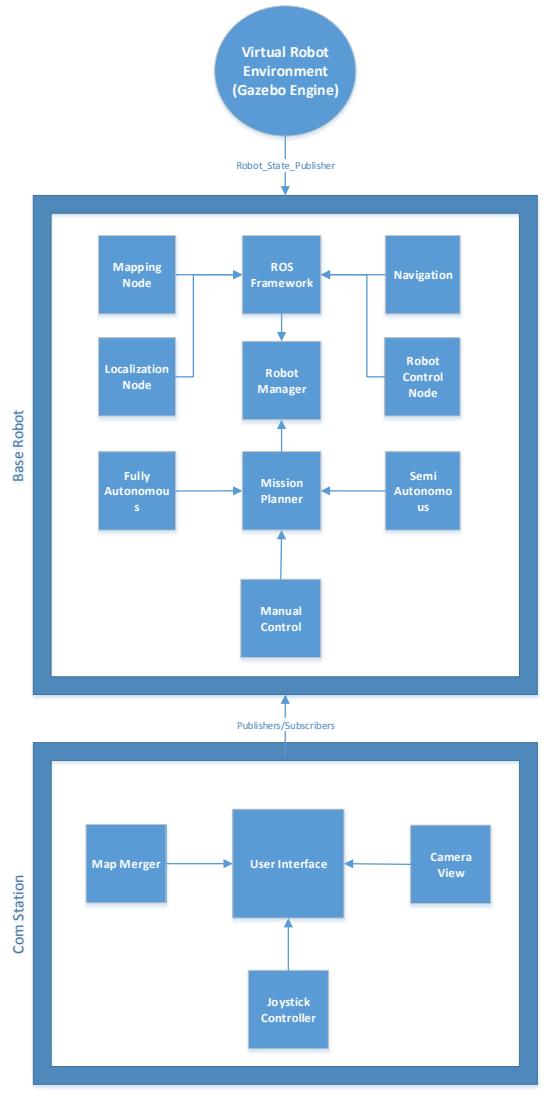
With these two services we present our structure to control many robots in virtual robot environment:
As shown in Fig 1, robots communicate to simulation environment robot_state_publisher without user interface and gather the information from sensors to control the robots. In this architecture each robot uses the ROS framework to have a stable navigation, mapping and etc. directly to Gazebo from its ROS instance. In addition, there is Mission Planner module that says to robots what rule they should act in different situations. These strategies will be chosen by operator. On the other hand, we tried to develop a program to control all robots with reliable autonomous behavior to give a complete control for driver. Also we tried to prepare some required modules like map merging using for multi robot exploration and decision making issues. Last, we are use from Camera View and Joystick Controller to drive robots easily by operator from their spawned positions.
4 Localization and Mapping (SLAM)
Scan matching as a basic part of SLAM has a key role in localization and even Mapping of mobile robots. In our previous researches, we implemented ICEG [3] as Scan matching method and Grid Mapping in previous competitions. This year we use ROS slam_gmapping that contains a wrapper around gmapping which provides SLAM capabilities and also robot_localization package that prepares nonlinear state estimation through sensor fusion of an arbitrary number of sensors.
There is a map merging module that integrates all generated maps from robots to major decisions such multi robot exploration. We use map_merger package from ROS to merge several maps on the fly to one global map.
5 Robot Navigation
For any mobile robot, the ability to navigate in its environment is important. Avoiding dangerous situations such as collisions and unsafe conditions comes first, but if the robot has a purpose that relates to specific places in the robot environment, it must find those places. For this purpose, we use ROS navigation packages which all required package to reach goals in unknown environments.
6 Victim Detection
The detection of victims in the disaster area and building map is an important task for fully autonomous application. Therefore, it should be possible to give rescue virtual robots the capability to detect victims and landmarks autonomously, alerting the human operator as required. For detecting victims, the sensors provide information of the environment. Camera images can be used to automatically detect victims, independent from the Victim sensor provided by virtual robot environment, as indicated in [4]. For the victim detection test, the robots must find, identify, and report the location of as many victims in the allotted time. The environment used for this test will not present mobility challenges but will present perception challenges. We will check be based on a HOG algorithm based Body Detection approach [5, 6]. To examine such autonomous recognition, we have implemented an existing object recognition approach that uses a HOG algorithm to find known objects in a given image [7, 8, 9].
7 Conclusion
In this paper we have re-designed our software which are needed for autonomous systems. On the other hand, we tried to use ROS framework directly from our software to virtual robot environment on wheeled robots to search in the disaster environments. Our future task is to design a Multi-Robot Exploration system based on machine learning topics to search in unknown environments more efficient and accurate.
References
- Quigley M., Gerkey B., Conley K., Faust J., Foote T., Leibs J., Berger E., Wheeler R., Andrew N. : "ROS: an open-source Robot Operating System", "ICRA Workshop on Open Source Software"
- Koenig N., Howard A.: "Design and Use Paradigms for Gazebo, An Open-Source Multi-Robot Simulator", Proceeding of 2004 IEEE/RSJ International Conference on Intelligent Robots and Systems, September 28-October 2, 2004, Sendai, Japan"
- Taleghani, S., Sharbafi, M. A., Esmaeili, E., Haghighat, A. T., 2010, ICE matching, a robust mobile robot localization with application to SLAM. IEEE 22nd International Conference on Tools with Artificial Intelligence (ICTAI), Arras, France, Oct 27–29.
- Visser, A., et al.: Design decisions of the UvA Rescue 2007 Team on the Challenges of the Virtual Robot competition. In: Proc. 4th International Workshop on Synthetic Simulation and Robotics to Mitigate Earthquake Disaster, pages 20–26. (2007)
- Dalal, N., Triggs, B., Schmid, C., :Human detection using oriented histograms of flow and appearance. European Conference on Computer Vision, pages 7–13. (2006)
- Wei, J., :Advanced Techniques for Semantic Concept Detection in General Videos. PhD Thesis Graduate School of Arts and Sciences, Columbia University. (2010)
- Flynn, H.: Machine learning applied to object recognition in robot search and rescue systems. Master's thesis, University of Oxford. (2009)
- Flynn, H., de Hoog, J., Cameron, S.: Integrating automated object detection into mapping in USARSim. In: Proceedings of the International Conference on Intelligent Robots and Systems (IROS 2009), Workshop on Robots, Games, and Research: Success stories in USARSim, pages 29–34. (2009)
- Dalal, N., Triggs, B.,:Histograms of oriented gradients for human detection. Proc. IEEE International Conference on Computer Vision and Pattern Recognition (CVPR'05), pages 886–893. (2005)